



WTI Straddles Key Trigger Level at $98.98
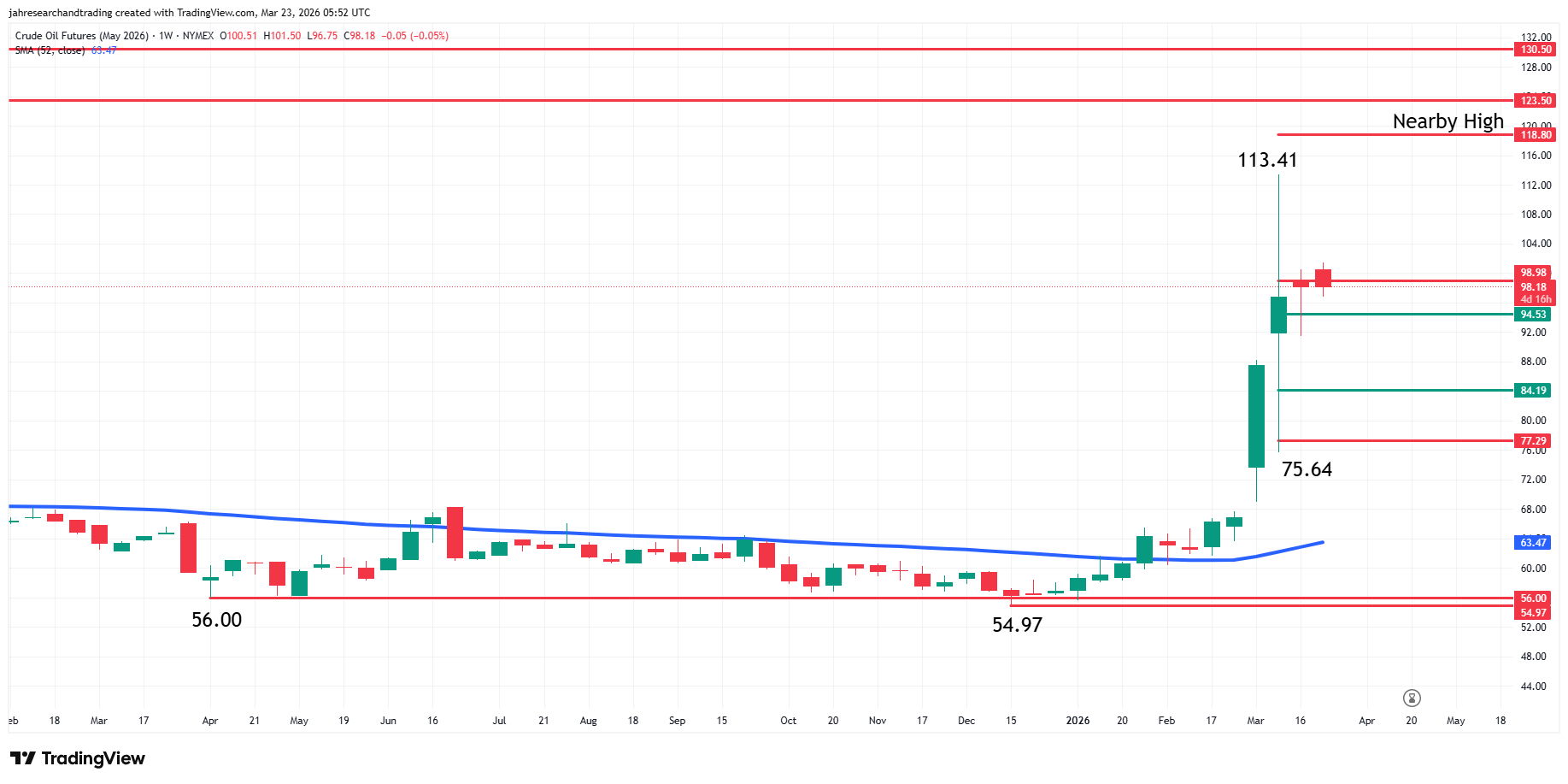
May WTI crude oil futures are nearly flat early Monday with the market straddling a key 61.8% level at $98.98. This price level could be the trigger point for an acceleration to the upside with nothing standing in the way of a retest of the contract high at $113.41. The nearby futures contract high is $118.80 and 4-year highs come in at $123.50 to $130.50.
On the downside, the key support is a 50% level at $94.53. The market straddled this level last week before recovering it. If sellers take it out with conviction, we could see a steep decline into a retracement zone at $84.19 to $77.29. Although the market recently touched $75.64. This retracement zone was probably the target.
The trend is up according to the swing chart, but mostly because we are on the strong side of the 52-week moving average, currently at $63.47. As long as the market holds above this technical indicator, we’re going to be in buy the dip mode on the weekly chart.

The Strait of Hormuz Is Still the Story
Reuters reported last week that shipments through the Strait are down and analysts are already raising their price targets. The real question isn’t what’s happening now. It’s how long it lasts. The longer it drags on the bigger the risk premium traders are going to demand.
Infrastructure Damage Is a Bigger Problem Than Shipping Delays
Iran isn’t just blocking the Strait. It’s hitting export terminals and processing plants. That’s a different problem. Shipping delays end when the route reopens. Damaged infrastructure takes time to fix and that means supply stays tight longer. Traders are starting to price that in and it’s more bullish than a temporary blockage.
Supply Is Getting Squeezed From Multiple Directions
I’m also seeing supply getting squeezed across several key producing countries at the same time. Fewer barrels are reaching the market and buyers are competing harder to secure what’s available. When that happens prices don’t need a headline to keep moving higher. The math does the work.
Governments are releasing strategic reserves to try to cap prices. I see that as a bullish signal, not a bearish one. When governments start opening the taps it means the situation is serious enough to warrant it. The extra barrels slow things down a little but they don’t replace what’s been lost. The market knows that and it’s trading accordingly.
Brent Oil Price Forecast
Every new Brent Oil analysis as it publishes, today's technical signal and key levels, live price — on one page.
See all Brent Oil forecastsThe Physical Market Is Confirming the Bullish Case
The physical market is telling the same story. Buyers are scrambling for cargoes and refiners are shopping around for alternative supply. That kind of competition pushes physical prices up and the futures market follows. When the spot market is this tight it’s hard to make a bearish case for oil no matter what the headlines say.
More Information in our Economic Calendar.


