



Crude Firms on Fed Pivot Talk and Supply Jitters
Light crude settled at $60.08 last week, up $1.53 or about 2.6%, marking a second straight weekly gain. Buyers stepped in on a combination of looser Fed expectations, geopolitical noise out of Russia and Venezuela, and calmer vibes around North American trade. The weekly chart’s starting to look cleaner too — market’s building higher lows and sitting above retracement levels that matter.
Rate Cut Bets Did Most of the Heavy Lifting
The biggest shift was monetary. Traders are now pricing in an 87% chance the Fed cuts 25 basis points at the next meeting. Inflation’s cooling, growth’s softening, and the central bank’s getting ready to ease — or at least that’s the bet.
For crude, rate cuts are more about sentiment than immediate demand. Lower borrowing costs help eventually, sure — cheaper financing for transport, manufacturing, refining. But right now, what matters is that traders don’t think demand’s going to crater. That’s enough. Dip-buying kicked in late in the week because the Fed story looks less hostile.
Data’s still mixed — consumer spending’s soft, labor market’s uncertain — but the Fed narrative is supportive. If the market starts pricing a series of cuts instead of a one-off move, this rally’s got more room.
Supply Risks Are Real Again
The second driver was geopolitics. Ukraine talks stalled, and the G7’s reportedly exploring a full maritime ban on Russian oil — a serious escalation from the existing price cap setup. A ban would make it harder for Russia to reroute barrels using shadow fleets, which means actual supply could tighten. Russian officials tried to calm things down, reassuring India of stable flows and securing discounted January loadings, but traders aren’t buying the reassurance.
Brent Oil Price Forecast
Every new Brent Oil analysis as it publishes, today's technical signal and key levels, live price — on one page.
See all Brent Oil forecastsVenezuela added to the noise. Trump floated potential military action tied to drug trafficking, and Rystad flagged that as much as 1.1 million barrels per day could be at risk if operations get disrupted. Most of that crude goes to China, but losing that volume forces refiners globally to scramble for replacements. It tightens the system.
OPEC held steady, which kept a lid on upside volatility but didn’t add enough supply to offset these risks. The net effect: a geopolitical premium that kept crude grinding higher all week.
Trade Tone Helped at the Margin
Smaller factor, but worth noting: U.S.–Mexico–Canada trade talks showed signs of easing. Trump met with both countries, and while nothing concrete came out of it, the risk of near-term disruptions to North American industrial demand eased a bit. That’s enough to support WTI when it’s already climbing.
Not a primary driver, but it reinforced the bullish tone into the close.
Weekly Chart Says Buyers Are in Control — For Now
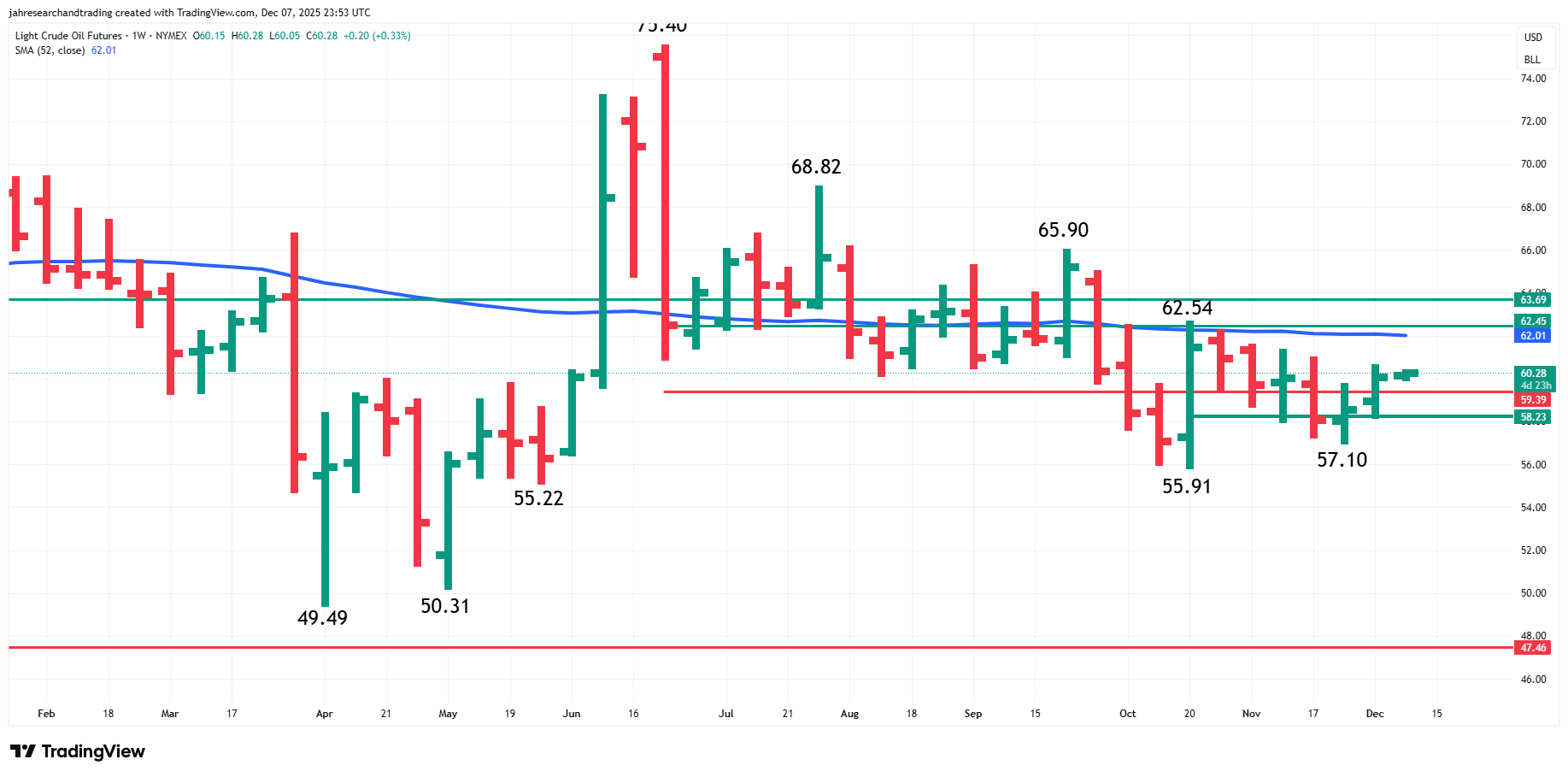
Technically, this is the cleanest crude’s looked in a while. Two straight weekly gains, with $57.10 and $55.91 now confirmed as higher bottoms. The market closed above two weekly retracement levels at $59.39 and $58.23 — those flip from resistance to support, and that matters if we get early-week pullbacks.
Next obstacle is the 52-week moving average at $62.01. That’s been capping rallies since October. A sustained close above it would shift the trend narrative in a real way — trend followers would interpret that as a regime change.
If crude clears $62.01, resistance comes in at $62.45 and $63.69. The latter’s the bigger one. A weekly close above $63.69 opens the door to $65.90, the next major upside target.
Until the market breaks the pattern of higher weekly lows, the bias stays bullish.
This Week: Watching the 52-Week Moving Average
Setup favors the bulls. Fed pivot talk, geopolitical supply risks, cleaner trade tone, and a constructive weekly chart all point higher. The 52-week moving average at $62.01 is the test. A close above that level raises the odds of a push toward $63.69, where a breakout could trigger a run at $65.90.
Caution points: OPEC’s steady output limits explosive upside, and resistance around $62.45–$63.69 could slow things down even if the initial move works. But until proven otherwise, momentum’s with the buyers.
More Information in our Economic Calendar.