
Crude Oil Extends Losses as Supply Concerns Persist
March West Texas Intermediate (WTI) crude oil futures are edging lower on Friday as traders failed to claw back yesterday’s steep loss. Thursday’s dump was caused by renewed concerns over supply, which seemed to offset worries over simmering U.S.-Iran relations.

U.S.-Iran Talks Continue Without Concrete Results
Geopolitical concerns dominated the trade throughout the week, with all eyes on the negotiations between the United States and Iran. However, so far the talks have not yielded concrete results, though comments from Iranian officials suggest the talks are going well enough to have them continue on the diplomatic path.
Nonetheless, the market continues to be well-supported by traders casting doubts over a lasting agreement and betting on an eventual supply disruption. This is probably why prices didn’t collapse on Thursday. The immediate probability of military activity may be dampened by the continuing negotiations; however, without some framework to prove they are on the right path, the current risk premium cannot be eliminated from the market.
Strait of Hormuz Fears Keep Floor Under Prices
Despite Thursday’s sharp selloff, crude oil’s major support at $60.79 remains intact, supported by persistent fears about potential supply disruptions through the Strait of Hormuz. This critical waterway handles approximately 20 million barrels per day of oil transport, representing roughly 20% of global consumption.
EIA Inventory Build and IEA Demand Cut Trigger Selloff
With the risk premium intact and little to report from Iran, traders focused on Wednesday’s Energy Information Administration (EIA) report and Thursday’s International Energy Agency (IEA) 2026 forecast.
Brent Oil Price Forecast
Every new Brent Oil analysis as it publishes, today's technical signal and key levels, live price — on one page.
See all Brent Oil forecastsThe EIA reported a huge miss to the upside, with crude oil inventories coming in at 8.5 million barrels versus analyst expectations of just 793,000. The jump in inventories drove U.S. crude stockpiles to 428.8 million barrels. The news highlighted the persistent oversupply situation facing the global oil market.
Initially, the market barely moved on this news. Then came Thursday’s report from the IEA, which showed a downward revision in the forecast for 2026 global oil demand growth.
The IEA’s decision to lower its demand outlook proved to be the catalyst that finally triggered a sharp selloff.
Technical Picture: Uptrend Line Breaks, Support at $60.79
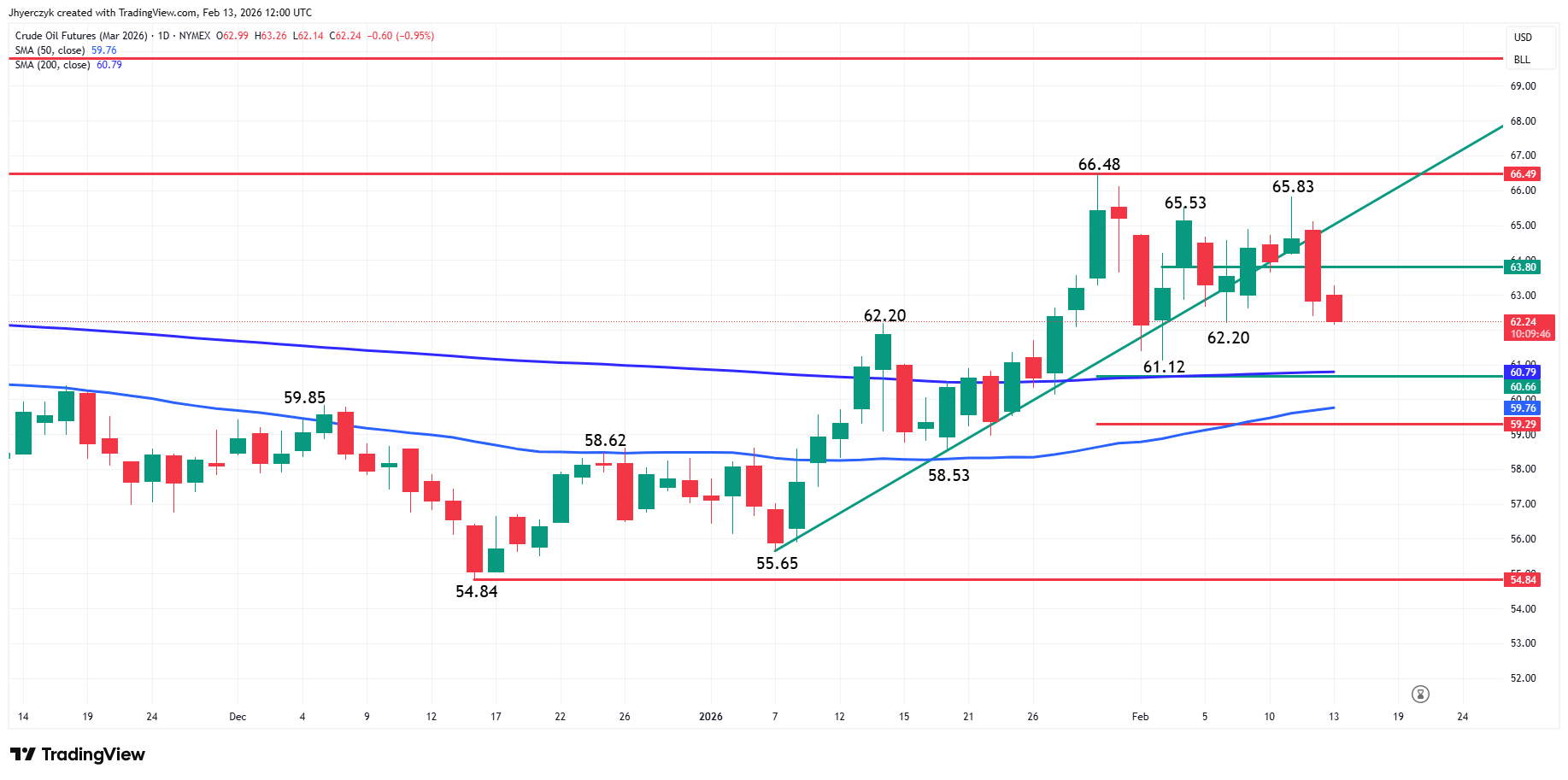
Technically, the selloff occurred when an uptrend line the market had been following since the January 7 bottom at $65.01 failed to hold as support. Minor support targets come in at $62.20 and $61.12. The major support is the 200-day moving average at $60.79.
Additional support is the intermediate retracement zone at $60.66 to $59.29. Inside this zone is the 50-day moving average at $59.77.
Outlook: Risk Premium Keeps “Buy the Dip” Mode Intact
Unless the United States and Iran reach a solid, long-term agreement, I think the risk premium will remain intact and traders will remain in “buy the dip” mode. It’s going to have trouble breaking out to the upside, however, unless military action is taken by the United States.
More Information in our Economic Calendar.