Oil Price Forecast: Can Supply Disruptions and Geopolitics Keep Prices Elevated?
$100.354
Key Points:
- Crude oil remains supported as supply disruptions and Strait of Hormuz risks keep a strong risk premium in the market.
- Ongoing geopolitical tensions and macro uncertainty continue to drive volatility as demand expectations and policy risks remain mixed.
- The technical structure shows consolidation within a wide range, with the next major move depending on the outcome of US–Iran negotiations.
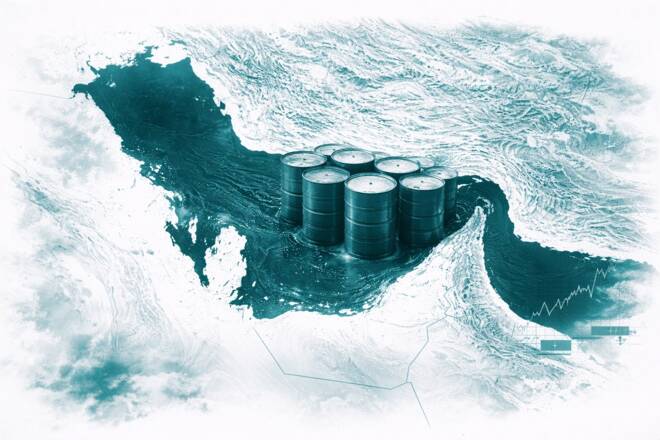
The oil prices consolidate in the $40 range as the market struggles between geopolitical tensions and supply disruptions. Investors are awaiting news of any developments in the talks between the United States and Iran. There is hope that the conflict may soon be over, but the facts on the ground indicate that supply flows are still well below normal. This maintains a risk premium which introduces a strong price range between $80 and $120.
Strait of Hormuz Disruptions and Supply Risks Support Oil Prices
The oil market is affected due to the fears of supply shocks that will impact the global economies. Diplomatic talks have not resolved the issue because a portion of the Strait of Hormuz does not operate. The reduction in traffic through the Strait demonstrates that supply lines have not yet completely reopened.
The U.S. blockade on Iran’s ability to ship goods has severely limited trade. Additionally cumulative supply loss for the entire region in the Middle East has reached substantial levels. All of these shocks will continue to limit supply balances globally and support current price levels as diplomatic moods improve.
The recovery is still slow even though some tankers have begun to transit in the region. Markets are not pricing complete shutdown, but they are reflective of uncertainty. This results in situation in which the prices are still high even as the risk of complete collapse of supply is reduced.
Macro Risks and Demand Outlook Keep Oil Market Volatile
In addition to supply, other macroeconomic variables are also influencing the future of oil market. The U.S. move to refuse to renew waivers on Russian and Iranian oil imports put even greater pressure on world supply. Meanwhile increased political influence on monetary policy might impact both inflation expectations and economic stability.
The rising cost of oil is already contributing towards inflation anxieties and disruptions in the supply chain. In the meantime, the growth policies such as the possibility of interest rate cuts may trigger greater demand for oil in future. This gives a mixed picture in which the supply risks and demand expectations make the market volatile.
In the short term, the oil prices are expected to remain volatile as long as supply disruptions continue. Nevertheless, any established solution to the Middle East conflict can help relieve prices swiftly. Until that time, the market will fluctuate within a wide range which will be influenced by the headlines and changing expectations.
WTI Oil Technical Analysis – Volatility Builds Within Key Range
The short-term price action for WTI oil shows strong consolidation within the range of $80 to $120. The peak on 9 March 2026 at $120 triggered a strong drop back below $80. Then, the rally to mark a high again on 7 April led to another drop in the oil market. The price consolidation shows that the energy market remains highly volatile, and the next move might be uncertain depending on the outcome of negotiations between the U.S. and Iran.
Despite this consolidation in the short term, Brent crude oil shows a bullish structure in the oil market as the price has broken the $90 area, which was the resistance of the descending broadening wedge pattern. This indicates that the immediate support in Brent crude oil is $90, whereby a break below $90 will take prices to the $81 region.
The prices are likely to rebound from the $80 to $85 zone and continue higher. The outcome of the next move in Brent crude oil will likely depend on negotiations between the U.S. and Iran.
Bottom Line
In conclusion, the oil prices are trapped between supply shocks and macroeconomic changes. There is a risk premium in the market since supply flows remain below normal. There are still pending tensions and policy choices that add uncertainty to both supply and demand. Meanwhile technical structure presents some consolidation within bullish trend. The second step will mostly hinge on the result of the negotiations between the United States and Iran. Unless there is a visible improvement, the oil prices will most probably keep fluctuating and oscillating within a broad range.
If you’d like to know more about how commodity markets work, please visit our educational area.
About the Author
Muhammad Umair is a finance MBA and engineering PhD. As a seasoned financial analyst specializing in currencies and precious metals, he combines his multidisciplinary academic background to deliver a data-driven, contrarian perspective. As founder of Gold Predictors, he leads a team providing advanced market analytics, quantitative research, and refined precious metals trading strategies.