Advertisement
Advertisement
Oil Price Forecast: Crude Above $90 as Middle East Conflict Escalates — Is $150 Oil Next?
By:
Live PriceBrent Oil
$106.079
-4.48%
Key Points:
- Brent crude surged above $90 as Middle East conflict disrupted energy infrastructure and threatened shipping through the Strait of Hormuz.
- Production cuts across Gulf producers are tightening global supply while strong economic activity increases the risk of higher inflation.
- Technical analysis suggests WTI oil could target $110 first and potentially move toward $125–$150.
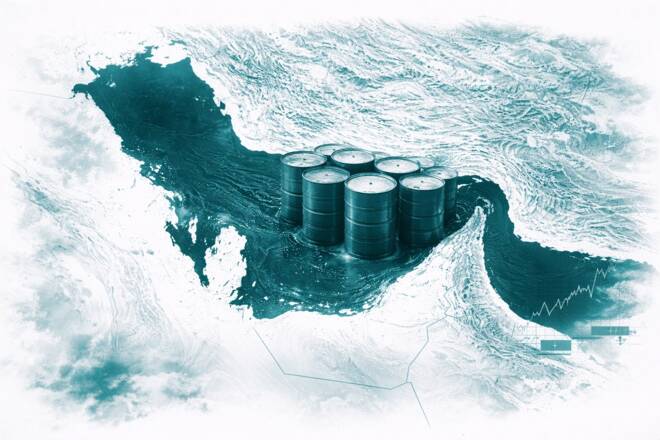
Oil prices surged as the conflict in the Middle East started to disrupt energy supply and shipping routes across the Gulf. Brent oil (BCO) surged above $90 a barrel after threats to energy infrastructure increased fears of supply shortages.
In my opinion, this change in the geopolitical and supply backdrop is the recipe for further crude oil price gains in the coming weeks. This article will discuss the key supply disruptions, production cuts, inflation risks and technical levels that may influence the next move in oil markets.
Middle East Conflict Triggers a Global Supply Shock
Brent crude oil jumped above $90 a barrel as the war in the Middle East shifted from a geopolitical risk to a real supply disruption. Iranian attacks on energy facilities have already forced Qatar to shut down its liquefied natural gas production. They have also forced Saudi Arabia to suspend operations at its largest oil refinery.
These attacks have had people concerned that the conflict could physically damage energy facilities across the Gulf. When supply infrastructure is a target during war, energy markets typically respond very quickly. Because there is a greater risk of shocks in the form of sudden supply shortages.
Shipping risks have also been on the rise throughout the region. Charter rates are increasing dramatically as traders fear attacks on vessels by Iranian drones, missiles and fast attack boats. Higher freight costs raise the cost of transporting crude oil and refined products. They also discourage shipping companies from venturing into perilous waters.
This combination means there is less available shipping capacity. It becomes more difficult for producers to transport oil to global markets. As a result, supply disruptions can have a more immediate impact than production cuts alone.
The situation around the Strait of Hormuz is most important factor in supporting oil prices. The war has nearly blocked this narrow waterway to maritime traffic after Iranian threats against ships. The Strait of Hormuz links the Persian Gulf to open seas and is the primary export route for the largest oil producing region in the world.
Once shipping slows down through this corridor there is an immediate tightening of global supply. This disruption sent crude prices to surge above $90 a barrel. This surge raises the risk of higher global inflation.
Forced Production Cuts Across the Gulf
According to Wall Street Journal, the United Arab Emirates and Kuwait had begun to curb oil production as the closure of the Strait of Hormuz affects the flow of supplies and fills storage facilities. Abu Dhabi National Oil Co. said it is managing offshore production levels to deal with storage requirements. Kuwait Petroleum Corp. also cut output at oil fields and refineries after Iranian threats against safe passage through Hormuz.
Kuwait started to reduce output by some 100,000 barrels per day early Saturday. The reduction is nearly triple on Sunday. This implies that cuts may be up to around 300,000 barrels per day or higher depending on storage levels and the situation around Hormuz.
Kuwait produced about 2.57 million barrels per day in January and relies completely on the Strait of Hormuz for exports. This is a heavy dependence that makes the country vulnerable as there are not many alternative routes from where shipments can come.
The UAE is in a better position but is still facing pressure. The country produced more than 3.5 million barrels per day in January as OPEC’s third largest producer. It is able to bypass Hormuz via a 1.5 million barrel per day pipeline to Fujairah on the western coast and also take advantage of international storage facilities.
Disruptions are spreading in the region. Iraq has begun to withhold production for storage tank saturation. Saudi Arabia shut its largest refinery and Qatar closed the world’s largest liquefied natural gas export plant after drone attacks. Saudi Arabia has diversified some of its crude exports to Yanbu on the Red Sea but this route is not capable of completely replacing exports that usually pass through the Strait of Hormuz.
Inflation Risks Rise as Oil Shock Hits the Global Economy
The current supply shock is already having an impact on consumers all over the world. Asian refiners are beginning to report shortages as shipments from the Gulf slow down. When there are fewer cargoes available to the market, refiners must scale down operations or seek out other supplies. This situation makes energy more expensive not only for businesses but also for households.
Strong Economic Growth Increases Inflation Pressure
At the same time, the global economy is still showing signs of growth. This causes inflationary effect of higher oil prices to be stronger as energy demand is still firm. The ISM Manufacturing PMI is 52.4% which signifies mild expansion of industrial sector.
However, pressures on costs are increasing rapidly. The manufacturing prices paid index has increased to 70.5% which reflects strong increases in production costs.
The services industry is also growing. The ISM Services PMI has increased to 56.1% which is the highest level since July 2022. This implies that economic activity is high despite rising energy prices.
When both manufacturing and services are still growing higher oil prices can be transmitted more easily through the economy.
Businesses are already being hit with higher costs. A survey conducted by the New York Fed finds that average health insurance costs for manufacturers rose 14.2% while service firms experienced a rise of 12.9%. When operating costs increase, companies will be even more sensitive to higher energy prices. This will further increase inflation.
History Shows Oil Wars Trigger Inflation Surges
History shows that wars in key energy areas have frequently resulted in spikes in inflation. In 1973, Yom Kippur War and the Arab oil embargo resulted in a surge in CPI to 12.2% by November 1974.
The Iran-Iraq war in 1980 sent CPI to around 14.59%. During the 1990 Gulf War, CPI increased to more than 6.0%. In all cases, surging oil prices played a major role in spurring inflation.
Oil prices also surged strongly after the COVID-19 pandemic in 2021. When Russia invaded Ukraine in 2022 energy markets once again tightened and annual CPI rose to about 9.0%. These examples show that conflicts in energy regions result in broader inflation due to higher energy costs that impact nearly every sector of the economy.
Technical Structure Points to Oil Rally Toward $110 and Beyond
The long-term picture for the WTI crude oil remains strongly bullish, as seen in the monthly chart below. It is observed that the WTI crude oil has been trading within the descending channel since July 2008 high at $147.27. However, the bottom in April 2020 during the COVID-19 crisis has produced a strong base, and the record high was marked at a strong resistance at $129.42 in March 2022.
The correction from 2022 has produced a bottom during the last quarter of 2025 at the midline of the descending channel pattern and initiated a strong rebound from this level. This strong rebound has taken WTI oil prices to $90, which is seen as resistance from September 2023.
The strong weekly close on Friday indicates that immediate target for oil remains $110, which is the resistance of the descending channel pattern. However, this resistance will likely be broken based on the ongoing supply shortages and production cuts which are unlikely to be resolved soon. The closure of the Strait of Hormuz and physical supply disruptions will be reflected in oil during next few weeks.
A break above $110 will take oil prices towards $125 to $130, which is the resistance of the March 2022 highs. However, a break above the March 2022 highs will take the oil prices towards $150, which is the July 2008 highs.
Brent Oil also shows a strong breakout from the descending trendline at $72 and then the 200 SMA on the weekly chart at $80. This breakout points to an immediate target of $100 in Brent Oil. However, a break above $100 is likely and will take Brent prices towards $125 to $135. This is the minimum target of the supply shortage in the oil market.
In Closing
The recent increase in oil prices is primarily caused by increasing conflict in the Middle East and disruptions to global energy supply. The attacks on energy facilities and production cuts by several Gulf producers are reducing the amount of supply available to global markets.
At the same time, economic activity is very strong and business costs are increasing. This indicates that higher oil prices could easily push inflation higher. These conditions provide conducive environment for oil prices to stay high in the near term.
The technical outlook is also pointing in the same direction. WTI crude oil has rallied strongly from the middle of its long-term descending channel. The price is moving towards the key resistance of $110. A break above this level could open the door to a move towards $125-$130. A break above $130 will take the prices towards $150, which is near the July 2008 highs.
Brent crude has also broken above its descending trendline and the 200 SMA, around $80. This breakout points to the next target around $100. If supply disruptions persist and tensions in the Middle East have not been resolved, oil prices may continue to move higher over the coming weeks. However, if conflict subsides or shipping through the Strait of Hormuz returns to normal, the current risk premium in oil could begin to drop.
Based on the above discussion, oil prices will likely be supported in the short term and will continue to move towards the $150 region in the next few weeks.
If you’d like to know more about how to trade crude oil, please visit our educational area.
About the Author
Muhammad UmairSenior Analyst
Muhammad Umair is a finance MBA and engineering PhD. As a seasoned financial analyst specializing in currencies and precious metals, he combines his multidisciplinary academic background to deliver a data-driven, contrarian perspective. As founder of Gold Predictors, he leads a team providing advanced market analytics, quantitative research, and refined precious metals trading strategies.