It was a morning that began with considerable promise and ended with a familiar sense of dread. Japan’s Nikkei 225 vaulted to yet another record for the second consecutive session, South Korean chipmakers led a surge in technology names on the back of extraordinary earnings from SK Hynix, and the mood across Asian trading desks was, briefly, one of cautious optimism.
Then Iran opened fire on three container ships near the entrance to the Strait of Hormuz, subsequently boarding and seizing the MSC Francesca and the Epaminondas, and the situation turned.
The Nikkei closed the day down 0.9%. MSCI’s broadest Asia-Pacific index fell 0.5%, and S&P 500 futures dropped 0.5%. The speed of the reversal was instructive: a single unverified social media report that the ceasefire had collapsed was enough to push oil prices higher and send equity futures sharply lower – a move that was unwound almost as quickly as it materialised. However, this illustrated with uncomfortable clarity how much of the current rally rests on the assumption that the fighting will not resume.
Strait of Hormuz: Fresh Escalation
The seizure of the two vessels marks a shift in Tehran’s stance. For several weeks, Iran deployed the threat of maritime disruption as a negotiating instrument without fully exercising it. That calculation appears to have changed. Only one vessel – the bulk carrier LB Energy – was observed transiting the strait early on Thursday; the tanker Ocean Jewel aborted its passage after Iranian forces opened fire.
With US warships simultaneously maintaining a naval blockade on ships bound for Iranian ports – a move Tehran’s foreign minister Abbas Araghchi described as a clear violation of the ceasefire – the waterway handling roughly a fifth of global oil supplies has ground to a halt.
Brent crude (spot) has now surged about 32% since hostilities began in late February, recently crossing back above US$100/barrel for a 2nd consecutive session. You will recall that President Trump extended the ceasefire earlier this week but offered no firm deadline for a formal proposal. Iranian officials said they had no immediate plans to resume negotiations. The net result, of course, is a conflict that is neither escalating dramatically nor resolving.
Tesla Beats, but Raises Eyebrows
Away from geopolitics, Tesla delivered a quarterly result that surprised on nearly every metric, and then proceeded to unsettle investors with the bill.
Brent Oil Price Forecast
Every new Brent Oil analysis as it publishes, today's technical signal and key levels, live price — on one page.
See all Brent Oil forecasts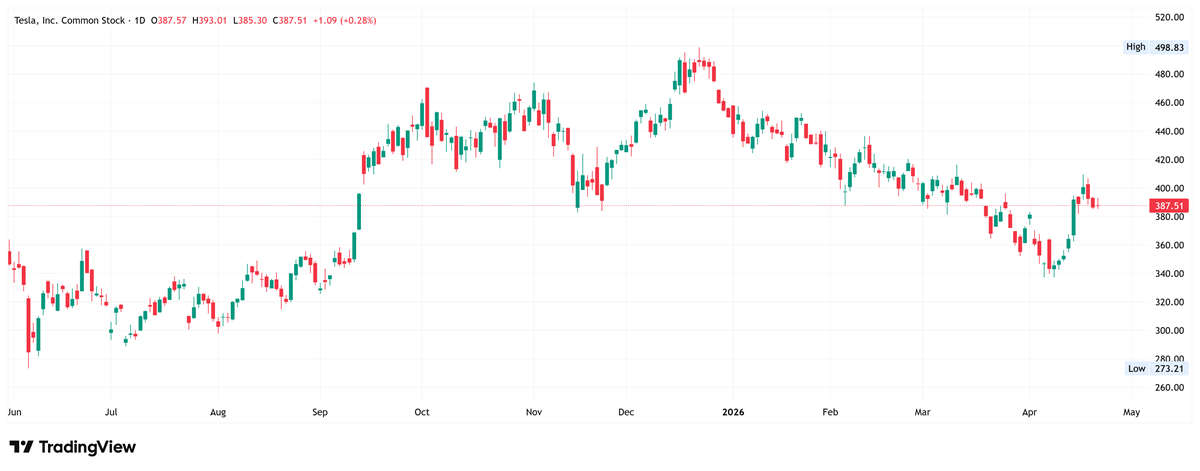
Adjusted EPS came in at US$0.41, which was ahead of the consensus estimate of US$0.37. Free cash flow was also positive – US$1.44 billion versus a forecast of negative US$1.86 billion – as was gross margin, at 21.1%, comfortably exceeding the 17.7% estimate.
The shares initially rallied more than 4.5% in after-hours trading before surrendering gains as investors digested projections for sharply higher spending on AI and robotics. The Cybercab robotaxi is on schedule for production this year; unsupervised services are running in Dallas and Houston; and preparation for an Optimus humanoid robot factory – initially targeting a million units annually from Fremont, California – is said to begin shortly.
Today’s Calendar: Global PMIs
Today’s April global flash PMI readings will shed further light on the economic fallout from the energy price surge and also arrive at a particularly sensitive moment, with 7 major central bank meetings scheduled for next week. Released at 1:45 pm GMT, the US composite reading is expected to recover fractionally to 50.5, though the services component – already below 50 at the prior reading – will attract the most attention. A further retreat into contraction territory would sharpen the debate about whether the Fed is holding rates higher into a slowdown rather than through one.
US weekly jobless claims will also land at 12:30 pm, with the consensus looking for 210,000.
Written by FP Markets Chief Market Analyst Aaron Hill