
Oil prices surged higher after new military headlines from the United States and Iran. WTI Crude oil (CL) rallied to $65 while Brent Crude oil (BCO) reached the critical $71. The news of joint naval drills between Iran and Russia resulted in the increase in oil prices. Earlier exercises near Strait of Hormuz added to the tension. This geopolitical escalation has caused a short term spike in oil.

Why the Risk Premium Remains Contained
The premium remains moderate due to the lack of major anticipated supply disruption in markets. About 20% of the world’s oil flows through Strait of Hormuz. However, conflict in the region in past has hardly led to persistent supply shocks. Market participants assume all parties want oil to continue flowing to avoid damage to economy. This belief puts a limit on aggressive upside movements in oil prices.
Based on current market conditions, there are two possible cases. In first case, a limited deal between Washington and Tehran would decrease tensions and likely push oil lower. Sanctions relief and nuclear oversight could soothe supply fears. In the second case, a military strike with no damage to infrastructure may cause temporary price spikes. In any case, markets are assuming that production will remain largely intact.
The real upside risk is from an extreme scenario in which Iran targets oil infrastructure in region. This action could cut off supply sharply and drive prices much higher. Currently, the oil price remains within the headline-driven trading range, whereby the rallies may develop on tension and pullbacks on diplomacy.
WTI Crude Oil Outlook – Key Support at $55 and Breakout Zone at $66–$71
The weekly chart of WTI Crude oil shows that the price has produced strong rebound from the long-term support of $55. This rebound began in January 2026, and the price is approaching the red dotted trend line around $71. The rebound from this $55 support is constructive, but the resistance around $71 is the key level to define the next move in WTI Crude oil market. A break above $71 will likely take the price toward $77 and $80 zone.
Brent Oil Price Forecast
Every new Brent Oil analysis as it publishes, today's technical signal and key levels, live price — on one page.
See all Brent Oil forecasts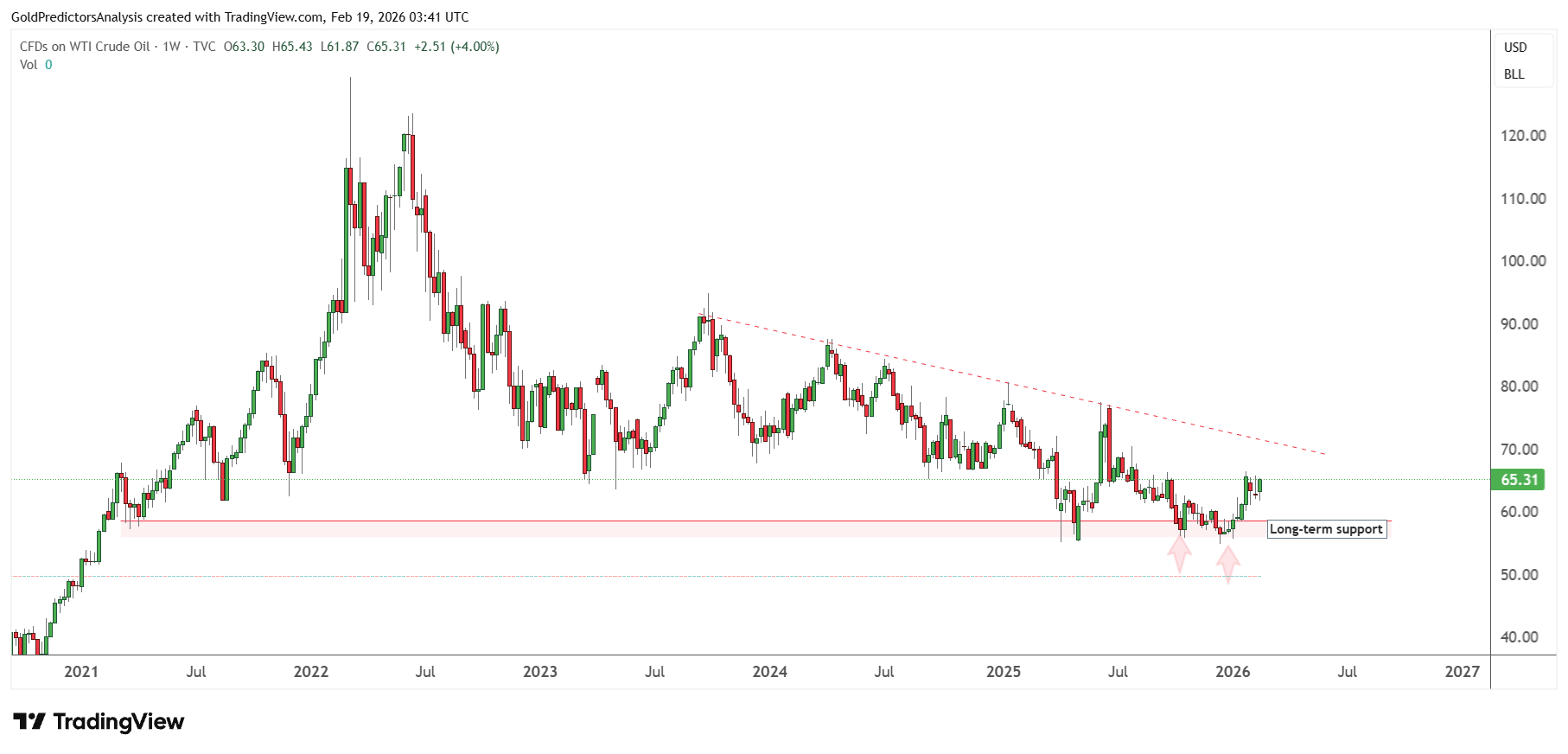
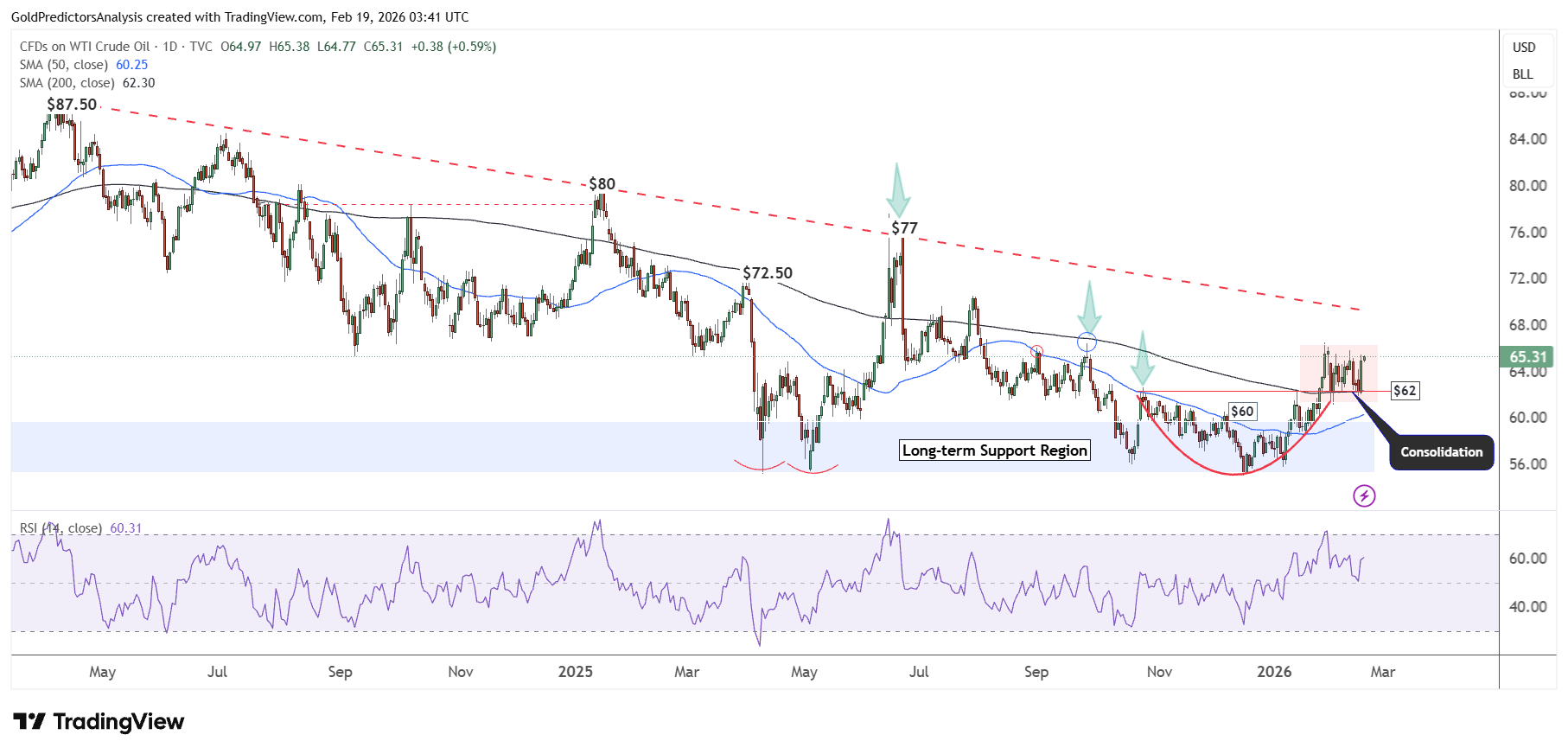
The daily chart for WTI Crude oil shows a strong rebound from the 200-day SMA at $62. This rebound is now attempting to break the consolidation range that was initiated in January 2026. A break above $66 will likely take the price toward $69-$71. However, a break below $62 will indicate further downside towards $55. A strong recovery in the RSI from the mid-level indicates positive momentum in WTI Crude oil.
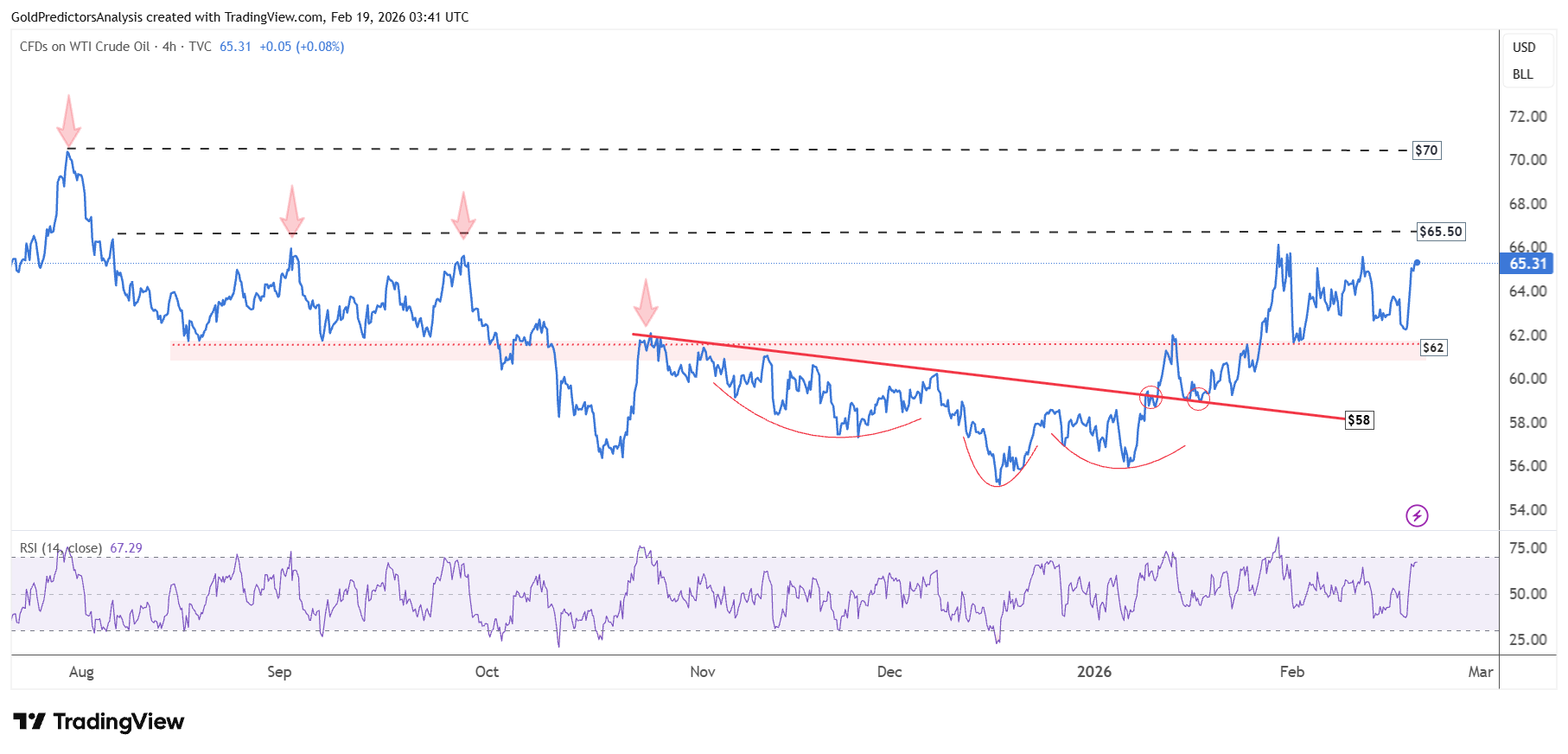
These consolidations are also observed on the 4-hour chart, between $62 and $66. A break of these levels will define the next move in WTI crude oil. A break below $62 will take the price towards $58. However, a break above $66 will take the price toward $70-$71.
Brent Crude Oil Outlook – Testing $70 Resistance with Breakout Potential
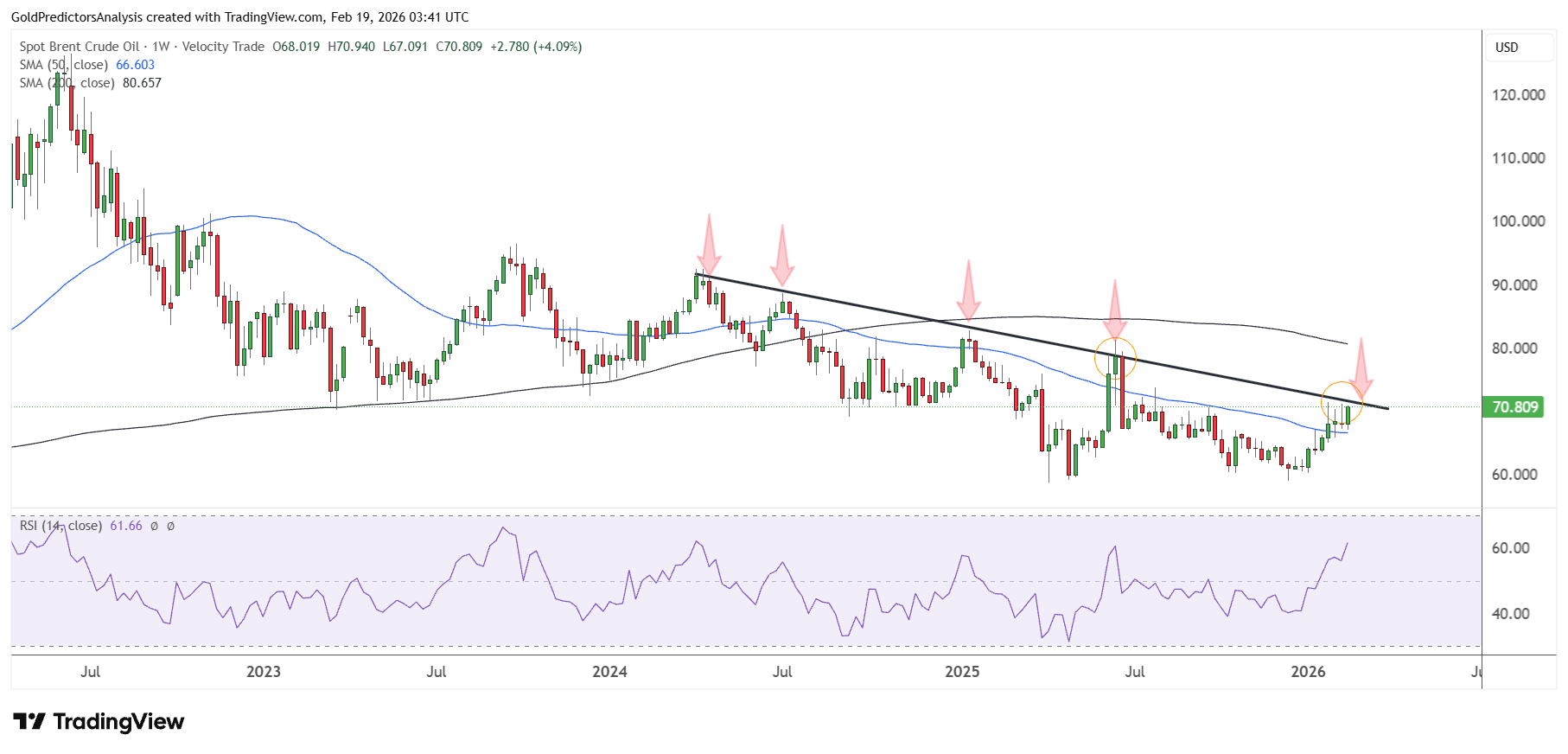
The weekly chart for Brent Crude oil also shows strong key resistance, as seen by the black descending trend line. It is observed that Brent Crude oil has broken 50 SMA on the weekly chart, which is pushing the oil prices higher. A break above $72-$74 will indicate further upside toward $85. The RSI is trending above the mid-level, which indicates further upside in the short term.
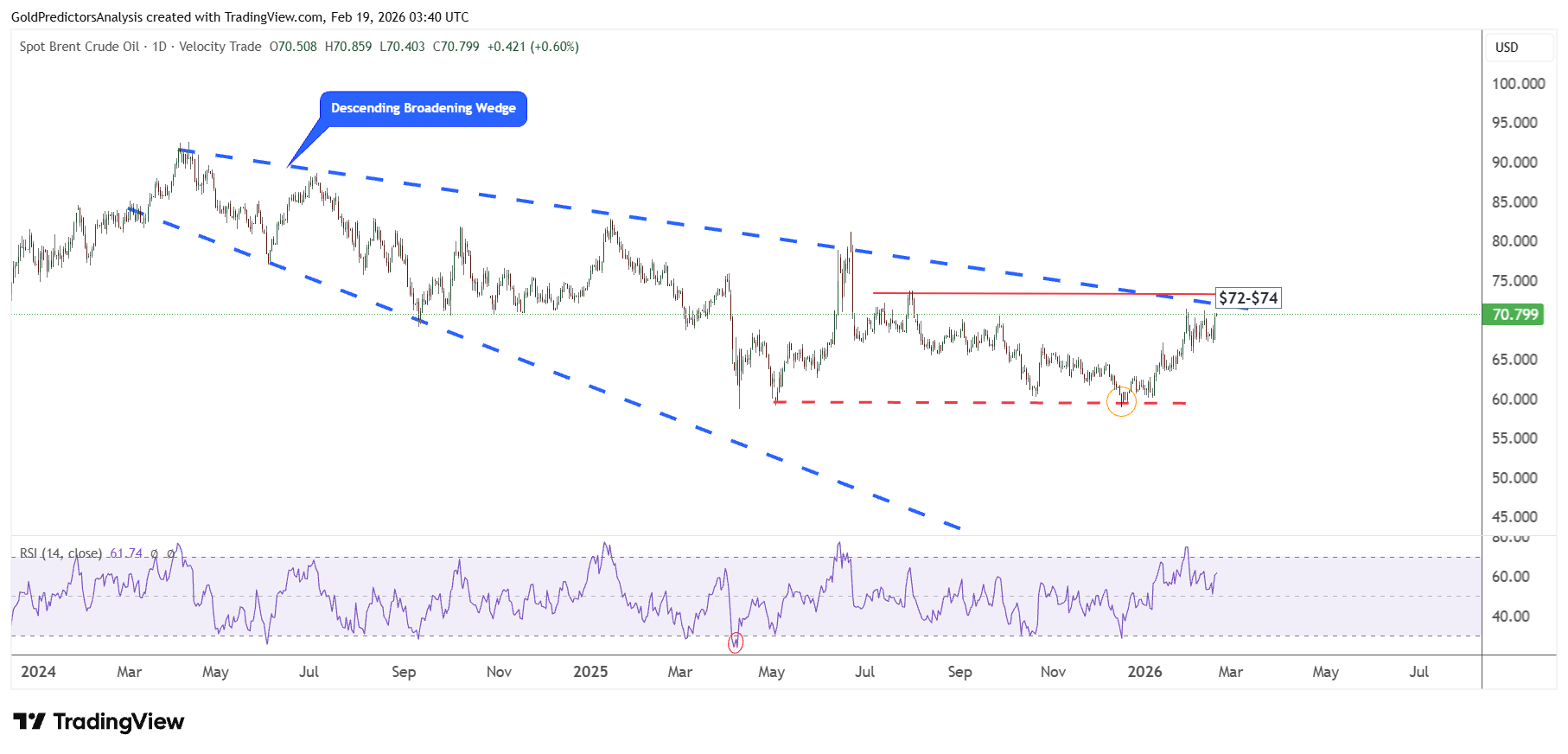
The daily chart of Brent crude oil also shows that the price is approaching the key level of $70, which is defined by the resistance of a descending broadening wedge pattern. This resistance marks key level of $72-$74, and a break above this region will indicate a strong rally in crude oil prices towards $85. The RSI on the daily chart is rebounding from the mid-level, which indicates further upside in the short term.
Conclusion
Oil prices are supported by geopolitical tensions, but gains are limited as supply expectations have stabilised. The market responds to headlines but assumes that production will not be broken. Therefore, there is limited upside movement unless there is severe supply shock.
From technical perspective, both WTI and Brent are testing key resistance zones that are going to determine the next trend. A confirmed break above $71 in WTI and $74 in Brent could open the door to higher targets. However, failure at these levels may keep prices within a volatile range driven by news and diplomacy.
If you’d like to know more about what drives oil prices, please visit our educational area.