Oil prices remain high on Tuesday due to uncertainty in the U.S.-Iran ceasefire. Brent oil remains strong at $108 and WTI oil is around $98. Tehran’s reply to the U.S. offer indicates that there are still wide gaps and that the market is pricing the risk of supply. They include the U.S. naval blockade, Iranian oil sales, compensation for war damage and control of the Strait of Hormuz. Traders will probably continue to maintain a risk premium in oil prices as long as these questions remain unanswered.
The key issue for the global economy is crude oil. The 20% of the world’s oil and LNG traffic flows through the Strait of Hormuz. Therefore, if oil disruption continues in May, they will create serious crisis for global economies starting in June and July. Iran’s emphasis on sovereignty over the strait makes the potential of chaos very real. This is why, as long as talks are prolonged and physical flows remain limited, Brent could stay above $100. Any real progress in the peace process could take some of the war premium off and force a correction. But if the blockade is renewed or any further military escalation is made, it could drag Brent back to $115.
Supply conditions are also very tight. OPEC oil production has already fallen to more than two decade low while export reductions have been imposed due to disruptions near the Strait of Hormuz. Saudi Aramco has called for “instability” to postpone market balance until 2027. This further supports bulls. The U.S. plan to release 53.3 million barrels from the Strategic Petroleum Reserve will help mill prices down in the near term but it does not address the supply issue. Firms involved in Iranian oil shipments are also affected by sanctions, which limit the flexibility of the market.

WTI Technical Analysis: Triangle Compression Signals a Major Move
WTI crude oil remains in a volatile region between $80 and $120 as seen in the weekly chart below. The $40 price swing between $80 and $120 is caused by the oil crisis which was triggered by the closure of the Strait of Hormuz.
The midline of this range remains at $100. As long as the price remains above $100, the risk of surge increases. But as long as the price remains below $100, it suggests that the price is below the key level.
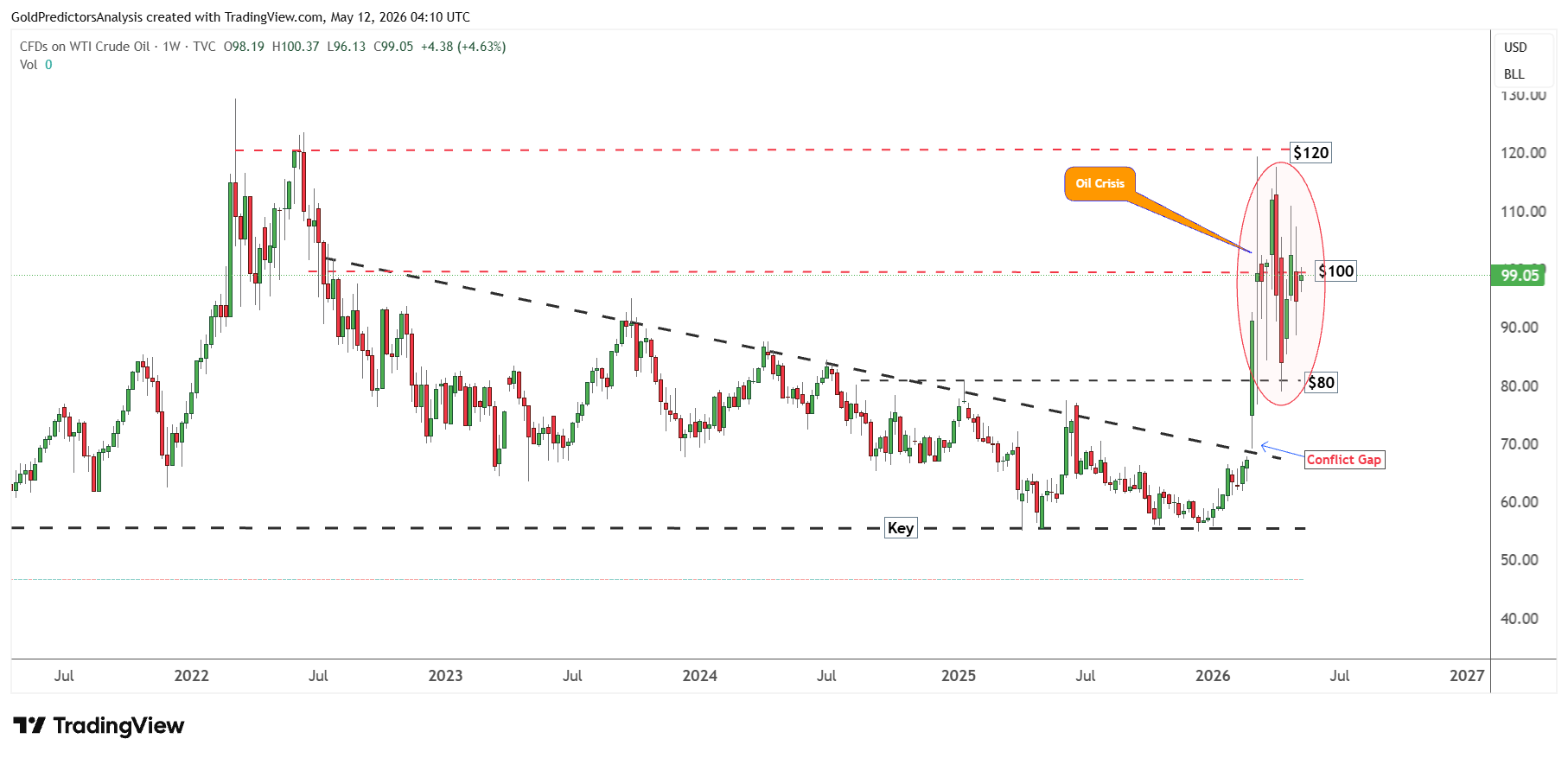
Based on the strong fundamentals, the oil market will likely see a strong surge in coming months if the Strait of Hormuz remains closed and traffic does not return to normal. The breakout from the triangle pattern supports this bullish price action. A break above $120 will likely push prices toward $150.
The 4-hour chart below also shows the consolidation between $80 and $120. It is observed that oil prices are now compressing within the triangle pattern within this range.
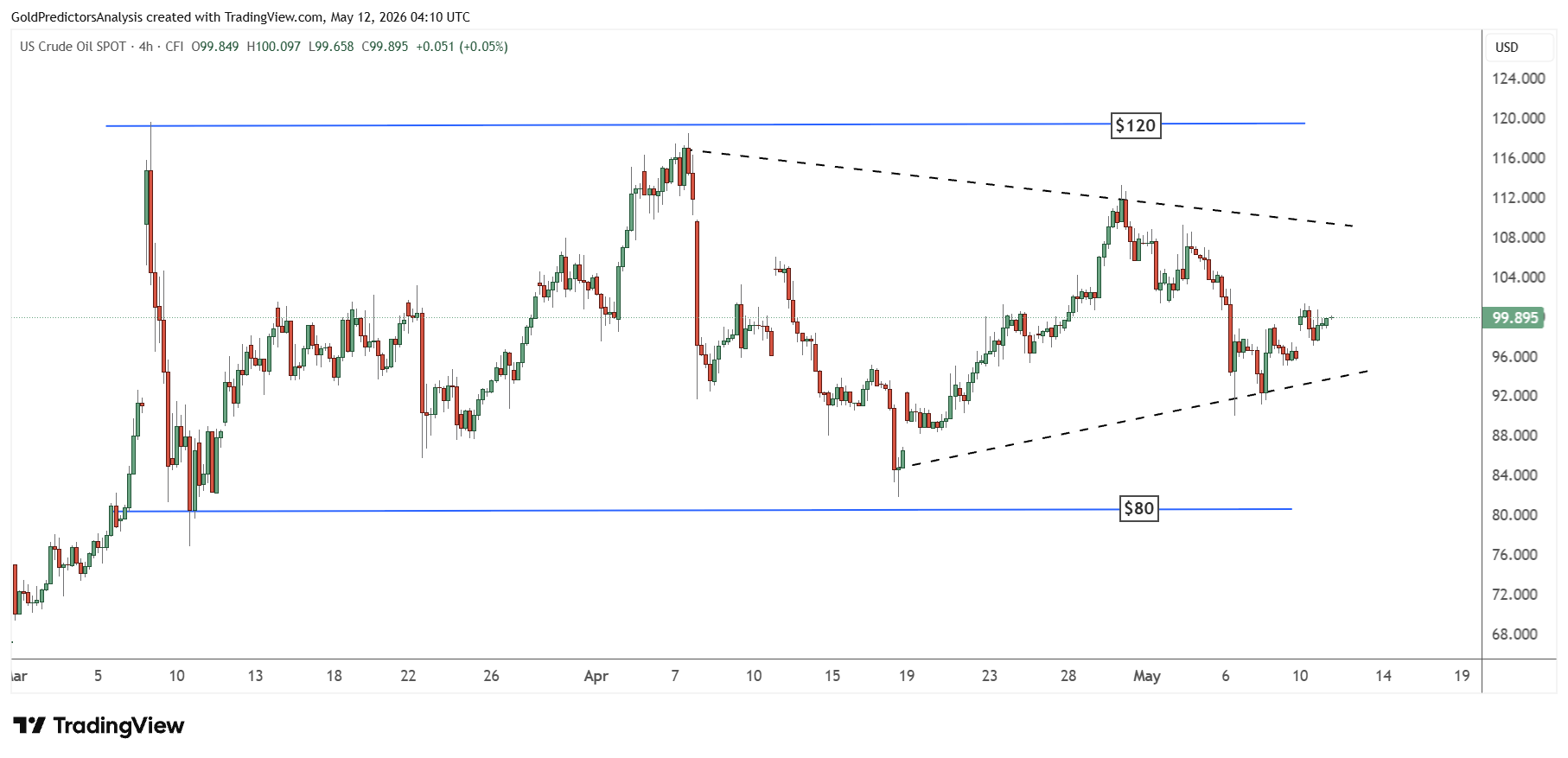
If prices break above this triangle at $110, the possibility of an absolute breakout above $120 will be high. However, if prices break below this triangle at $90, the possibility of prices remaining below the $100 level for the next month will likely remain high. However, due to ongoing geopolitical uncertainty and the global energy crisis, uncertainty in the oil market remains high. Therefore, the market may be driven by the next developments in the Middle East.
Brent Oil Price Forecast
Every new Brent Oil analysis as it publishes, today's technical signal and key levels, live price — on one page.
See all Brent Oil forecastsBrent Technical Analysis: Bullish Structure Builds Above $90 Support
Brent crude oil also presents similar consolidation driven by the oil crisis. Despite this strong volatility above the $90 area, the technical structure for Brent crude oil is even more bullish. This bullish structure is seen by the formation of a descending broadening wedge pattern from May 2024 to January 2026. The breakout from this descending broadening wedge pattern in February 2026 at $72 indicates that the next move will likely be higher.
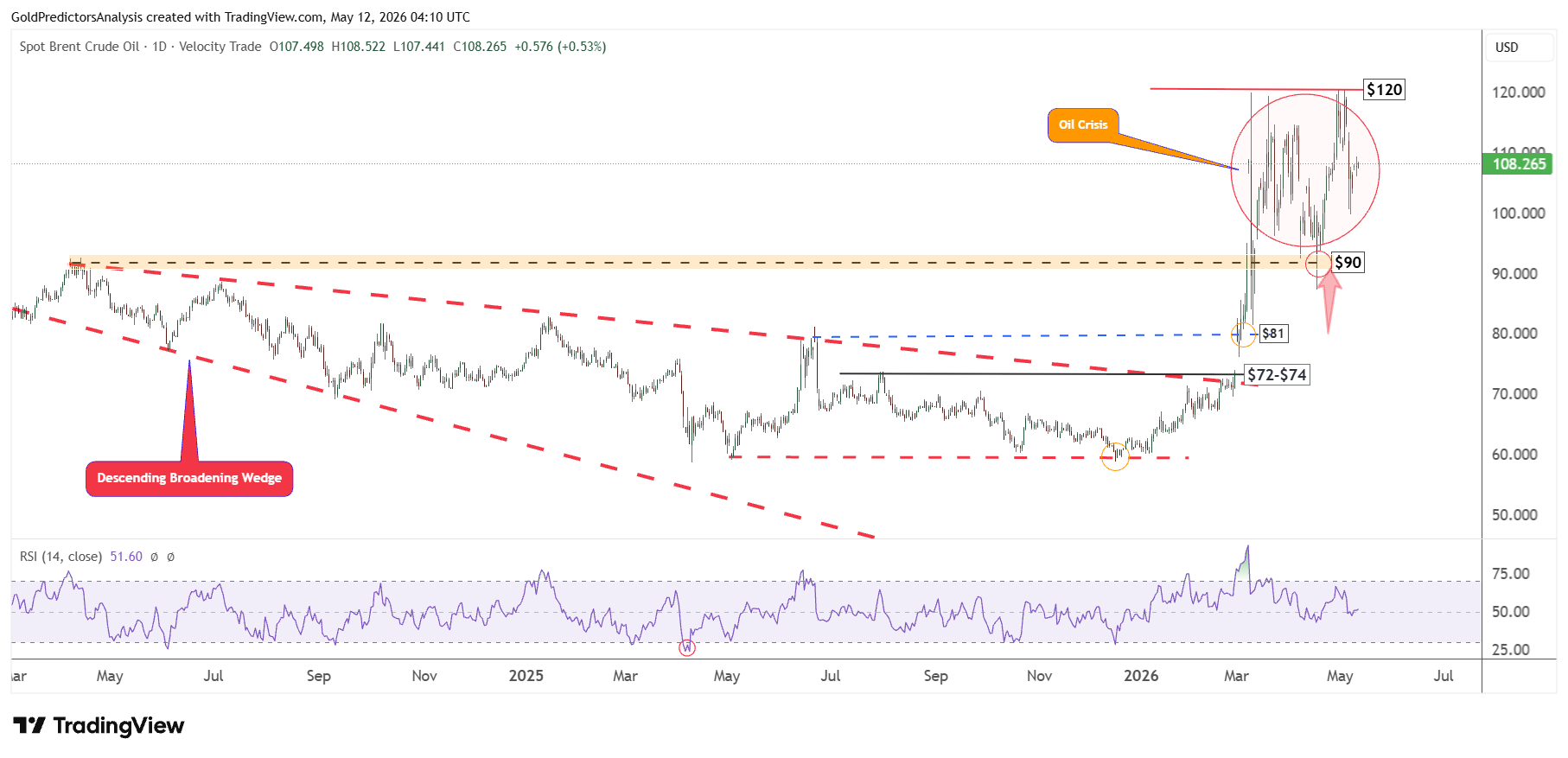
Moreover, the formation of support at the key support of $90, which is stretched from the resistance of the descending broadening wedge pattern further supports the bullish view.
A break below $80 will negate the bullish structure and indicate further consolidation. But a break above $120 will likely trigger a strong surge in Brent crude oil in the next few weeks.
Bottom Line
Tight supply, fragile U.S.-Iran talks and uncertainty around the Strait of Hormuz continue to support oil prices. As long as export flows continue to be limited and traders continue to build a war premium, the market might remain volatile. WTI must break clearly above $110 to signal a move to levels of $120 and $150. Brent is also bullish above the $90 support level and a breakout above $120 may lead to a stronger rally in the coming weeks. Any peace moves or full reopening of the Strait of Hormuz could take some of the risk premium out of the equation and prompt a quick correction.