



Stocks Struggle for Direction After Strong NFP Beat
The major U.S. stock indexes just can’t seem to make up their minds late in the session on Wednesday after the release of better-than-expected jobs data. Stocks soared initially after the Non-Farm Payrolls report showed the economy added 130,000 jobs in January, well above the consensus forecast of 55,000. The unemployment rate also fell to 4.3%.
At 18:49 GMT, the Dow is trading 50067.23, down 120.91 or -0.24%. The S&P 500 Index is at 6946.65, up 4.84% or +0.07% and the Nasdaq Composite is trading 23085.513, down 16.961 or -0.07%.
As upbeat as that report was, benchmark annual revisions combined with monthly moves through the year showed that average monthly job growth in 2025 was just 15,000 after downward adjustments. That’s a weak foundation, but January’s 130K at least shows momentum is building—if it holds.
After the initial rise in the stock indexes, sellers stepped in within an hour of the opening. Prices struggled mid-morning before settling into flat-to-mixed trade after mid-session.
Two Competing Narratives Drive Volatility
The volatility was likely fueled by two different assessments of the report. The bullish case: the economy is stronger than feared. The bearish case: the data was just strong enough to kill March rate cut hopes, keeping expectations locked at June.
Energy Leads as Eight Sectors Post Gains
Despite the mixed performance in the broad indexes, eight out of 11 sectors are positive late in the day. Energy is the big winner with a 2.62% gain, fueled by a surge in crude oil prices. Although the government’s storage report was bearish, it was offset by more traders betting on a supply disruption due to U.S.-Iran tensions. Consumer Staples are up 1.56%, and Materials rose by 0.79%. The biggest loser for a second straight session was Financials. This sector fell on fear that AI will replace certain services. Communication Services were down 1.11%.
S&P 500 Price Forecast
Every new S&P 500 analysis as it publishes, today's technical signal and key levels, live price — on one page.
See all S&P 500 forecastsSoftware Stocks Extend Losses as AI Fear Persists
Software stocks resumed their slide on Tuesday, extending last week’s selloff driven by AI disruption fears. Salesforce fell 4%, ServiceNow dropped 5%, and the iShares Expanded Tech-Software ETF (IGV) declined 3%, now sitting 30% below its 52-week high and firmly in bear market territory.
Meanwhile, stocks benefiting from economic acceleration and AI infrastructure buildout surged. Vertiv jumped 18% on strong earnings and guidance, while Caterpillar, GE Vernova, and Eaton all gained as investors rotated into industrial and infrastructure plays.
S&P 500: 50-Day MA Test Looms After Failed Breakout
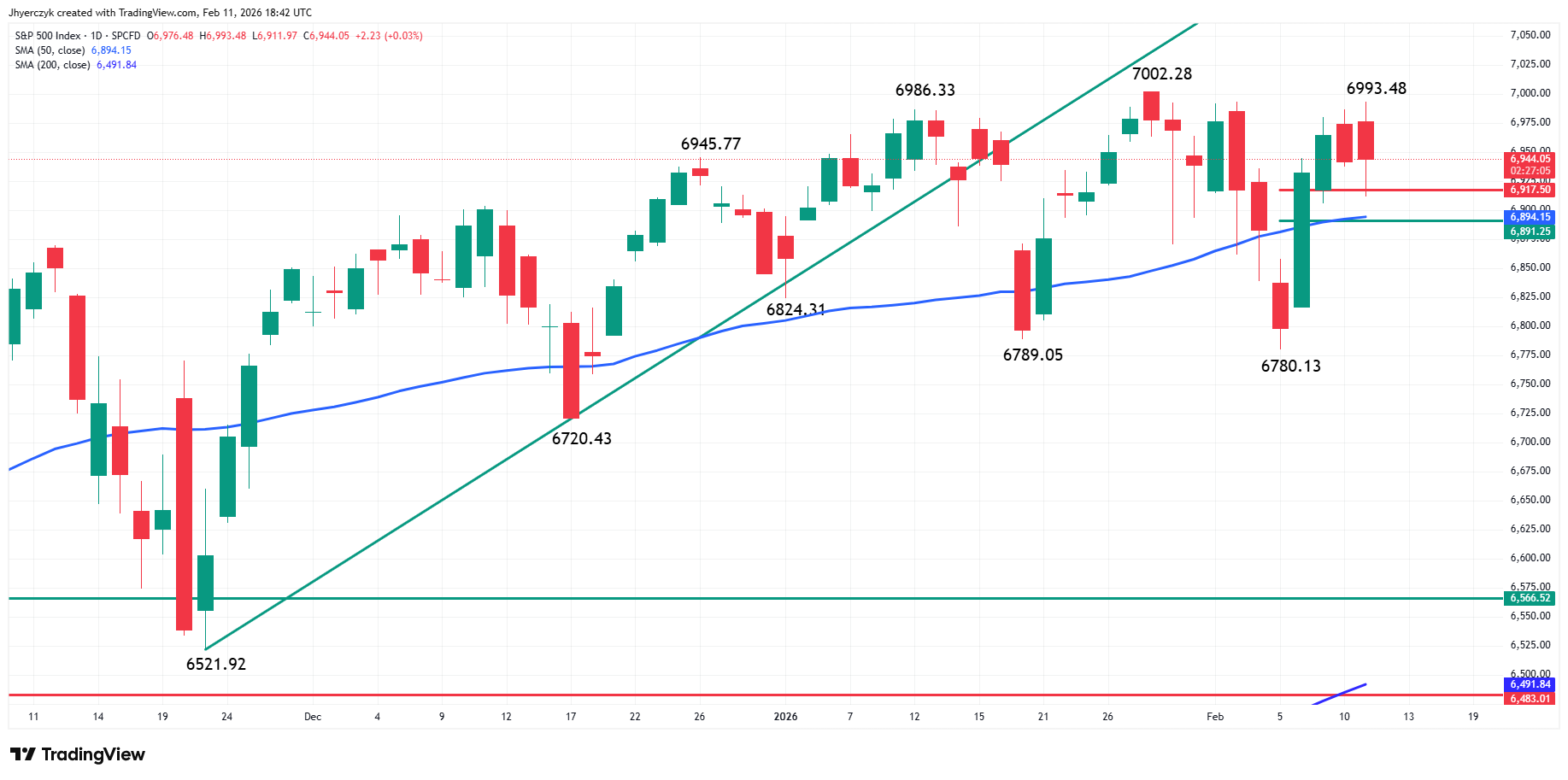
The S&P 500 Index (SPX) is lower after hitting its highest level since January 28 at 6993.48. The subsequent selloff suggests traders are eyeing the 50-day moving average at 6894.13. The failure of this trend indicator led to a steep selloff last week, so traders will be paying close attention to a test of it.
Nasdaq: Rejection at 50-Day MA Signals Weakness
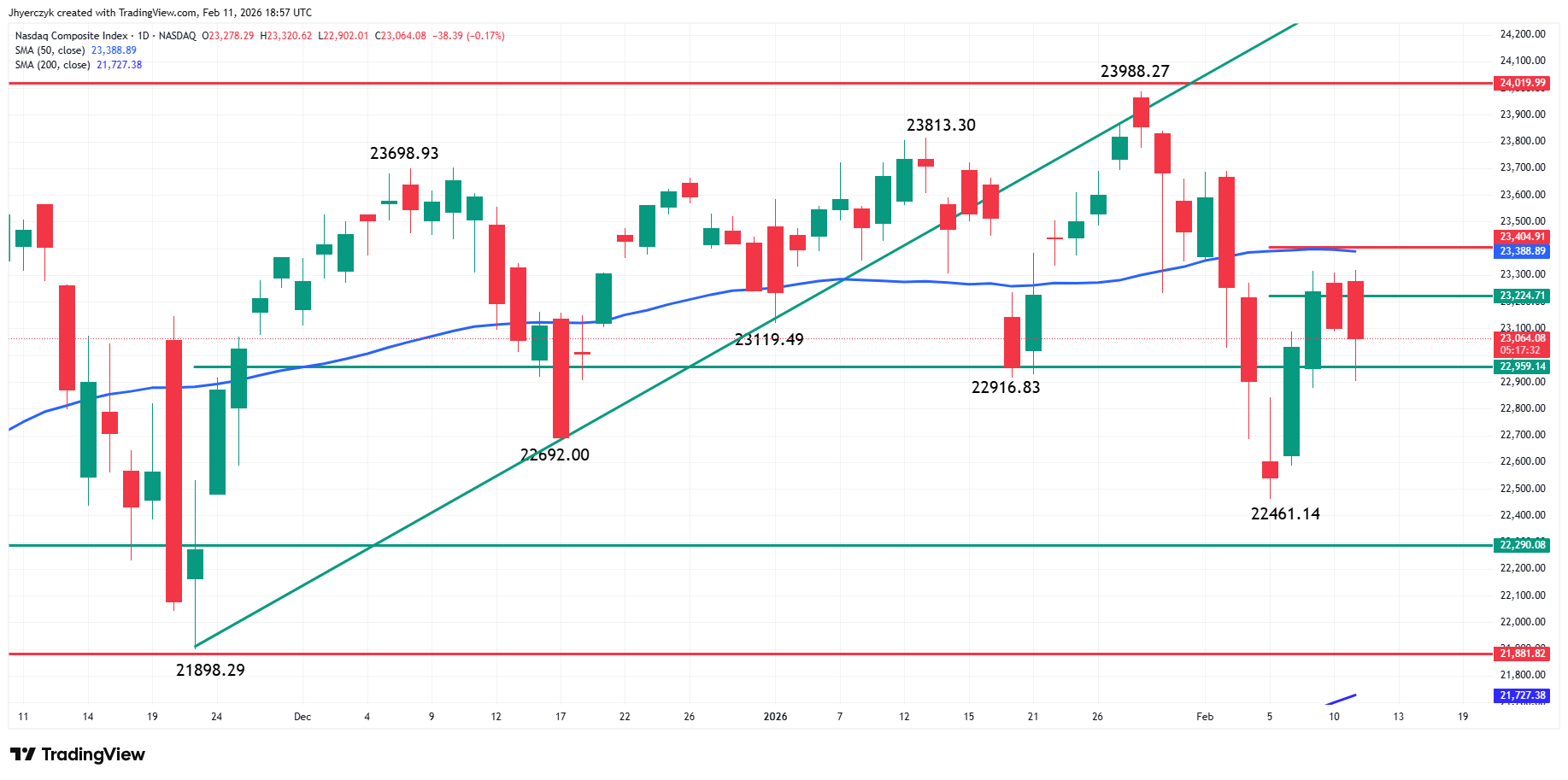
The Nasdaq Composite (IXIC) failed at 23320.62, just under the 50-day moving average at 23389.09. The subsequent selloff suggests that the recent up move on Friday and Monday was just a rally in a weak market. Downside momentum could build into the close if 22959.14 fails to hold. Don’t look for any strong upside momentum unless buyers can overcome the 50-day with conviction and strong volume.
More Information in our Economic Calendar.