


Chips Bounce but Iran Caps the Rally
Semiconductor stocks are leading the market higher Thursday morning after a week of heavy selling. The iShares Semiconductor ETF is up 3%. Micron Technology, Advanced Micro Devices, and Intel are all gaining.
The rebound has limits. President Donald Trump posted on Truth Social that the United States would be attacking Iran “VERY HARD TONIGHT” and said the U.S. would eventually take control of Iran’s Kharg Island and other oil infrastructure assets. West Texas Intermediate crude oil futures are trading near unchanged around $89 a barrel despite the rhetoric, but the threat is keeping a lid on how far equities can run.
The S&P 500 is up 0.53%. The Nasdaq Composite has gained 0.69%. The Dow Jones Industrial Average has added 326.78 points, up 0.65%.
Daily S&P 500 Index (SPX) Technical Analysis
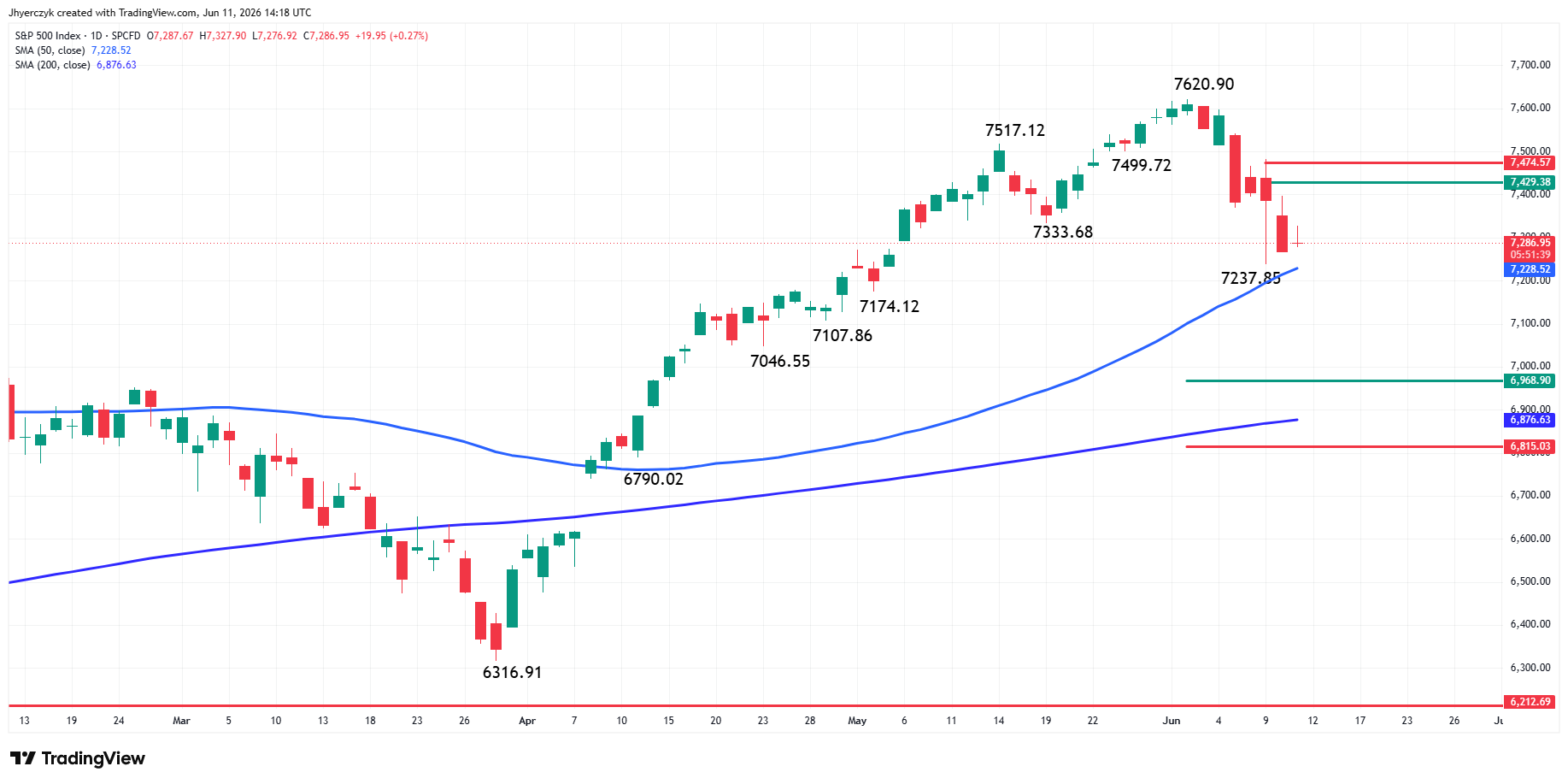
The S&P 500 Index is putting in a mixed performance shortly after the opening on Thursday and for a second straight session, it is trading inside Tuesday’s wide range. This suggests investor indecision and impending volatility.
The trend is down according to the daily swing chart so now the questions are, do we have further to go before investors find value, or will we see a quick retracement to establish a secondary lower top?
Before we get into the swing chart analysis, let’s take a quick look at the 50-day moving average. The 50-day MA is the closest support at 7228.89. The 200-day MA comes in much lower at 6876.72.
The short-term swing chart range is 7620.90 to 7237.85. Its retracement zone at 7429.38 to 7474.57 is the nearest upside target area. This zone is important to the structure because if sellers come in, a secondary lower top will form and shorts will start driving the market lower. A failure at 7237.85 could be the trigger that does the driving.
The long-term range is 6316.91 to 7620.90. Its target zone is 6968.90 to 6815.03. This area is the first major value zone and likely to attract new buyers. The 200-day MA is also inside this zone, doubling its significance.
With the trend down, our bias is short-term bearish but we need sellers to show up on a move to 7429.38 to 7474.57, or the odds of an even bigger sell-off will decline.
If we don’t get the secondary lower top then we may be forced to sell weakness under the 50-day MA at 7448.89 and the minor swing bottom at 7237.85. Both are reasonable trigger points for an acceleration to the downside.
Dow Jones Price Forecast
Every new Dow Jones analysis as it publishes, today's technical signal and key levels, live price — on one page.
See all Dow Jones forecastsOracle Dropped 12% and the Nasdaq Still Rallied
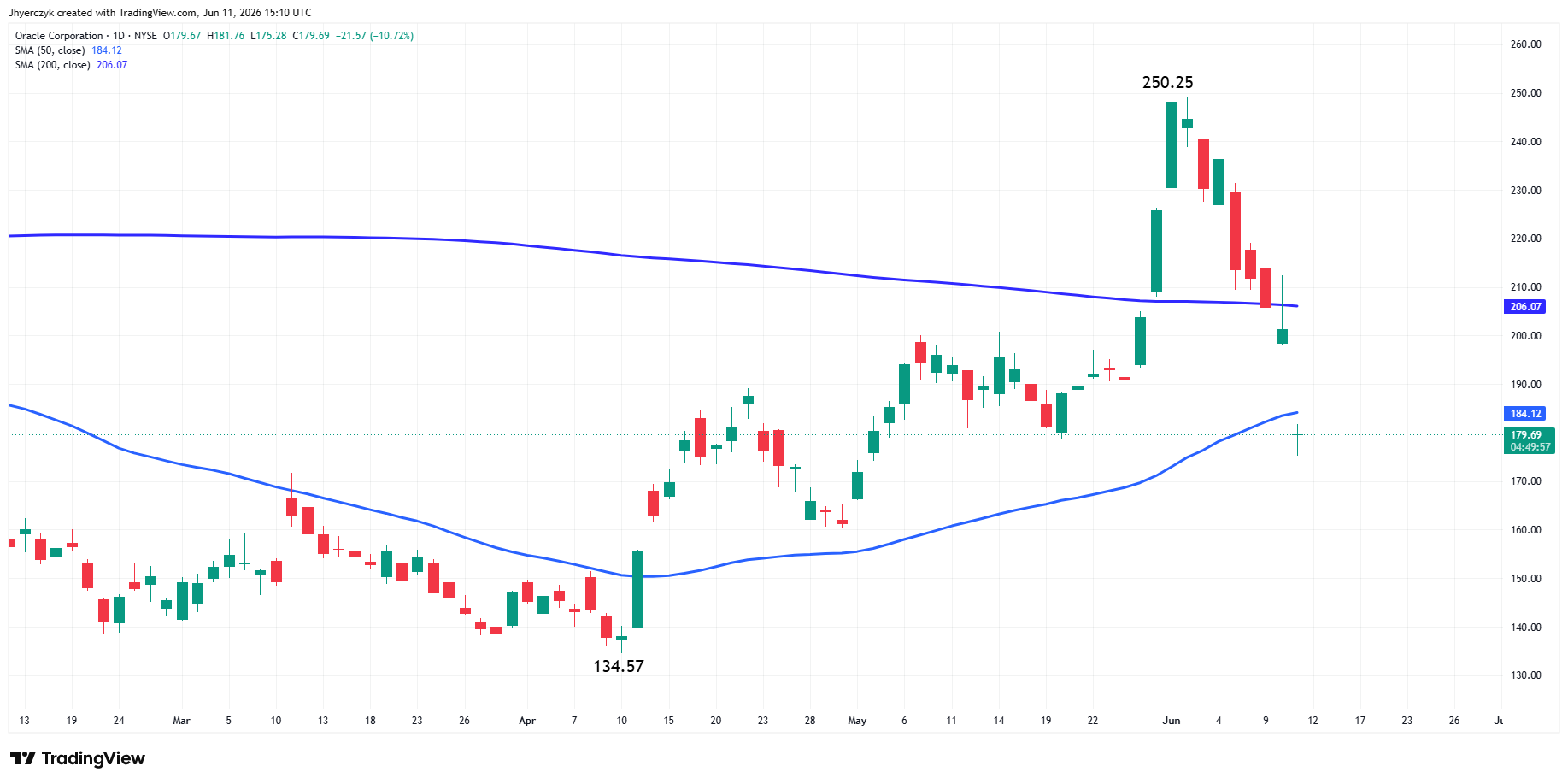
Oracle is down 12% Thursday after announcing plans to raise $20 billion through equity and debt offerings to fund artificial intelligence infrastructure. The market punished the dilution, not the strategy. The artificial intelligence spending commitments across the industry are enormous and investors are starting to ask whether the returns justify the cost.
Oracle dragging on the sector did not stop the Nasdaq from gaining. Semiconductor stocks overwhelmed the Oracle decline. That tells you the chip bid is real Thursday morning. The question is whether it lasts past one session. Every bounce this week has faded. Monday’s 6% SOXX recovery was gone by Tuesday. The pattern holds until it breaks.
PPI Ran Hot on Energy, Core Came in Soft
The Producer Price Index rose 1.1% in May against expectations of 0.7%. Annual wholesale inflation hit 6.5%. The headline looks bad. The details are less concerning.
Core Producer Price Index rose 0.4%, below the 0.5% forecast. Most of the headline damage came from energy. Wholesale gasoline prices surged 23.4%. Overall energy costs climbed 10.7%. The Iran conflict is driving the energy spike the same way it drove Wednesday’s Consumer Price Index above 4%.
The market is reading through the headline to the core. Core inflation below expectations gives the Fed one less reason to hike. That is helping equities hold the bid alongside the chip rebound. A hot headline with a soft core is the best outcome bulls could have asked for given what the numbers looked like going in.
Trump’s Iran Rhetoric Is Getting More Aggressive
President Donald Trump said the United States would attack Iran “VERY HARD TONIGHT.” He went further and said the U.S. would take control of Kharg Island and other Iranian oil infrastructure. U.S. Central Command confirmed additional strikes were carried out late Wednesday at Trump’s direction.
West Texas Intermediate crude oil futures are near unchanged around $89 a barrel. The crude oil market is not reacting the way it should to this kind of rhetoric. That either means traders do not believe the threat, or the market has already priced in a certain level of escalation. Either way, crude oil staying flat while the president threatens to seize oil infrastructure is a disconnect worth watching.
The equity market is treating the Iran situation as background noise Thursday morning. The chip rebound is running the session. If crude oil spikes later on an actual strike, that changes fast.
Money Is Moving Beyond Chips
Victoria Fernandez, chief market strategist at Crossmark Global Investments, said investors are looking for ways to offset heavy exposure to technology. Money is flowing into pharmaceuticals and biotechnology within health care, along with financials and energy companies. Sectors that lagged all year are getting a fresh look.
The rotation does not mean the artificial intelligence trade is dead. It means the market is broadening out after a week that proved how dangerous concentrated positioning can be. The SOXX dropped 10% in one session last Friday. Accounts that were 40% allocated to chips got a reminder of what concentration risk looks like. Diversification is back in the conversation.
What to Watch
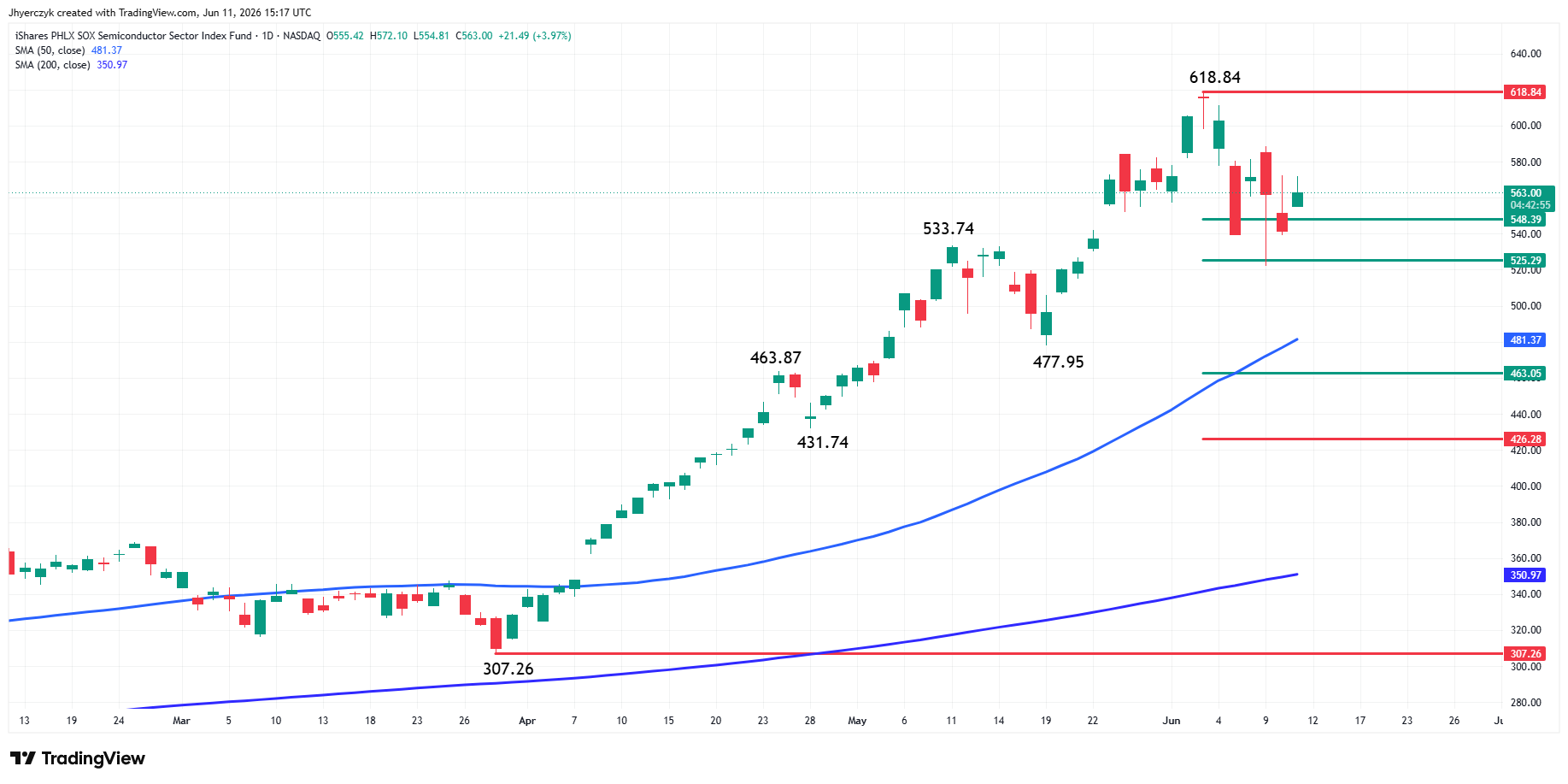
Semiconductor stocks are carrying the session Thursday but the pattern this week has been one-day bounces that fail the next morning. The 3% SOXX gain needs follow-through Friday to mean anything. SpaceX debuts Friday at a $1.8 trillion valuation. That event either releases the capital that has been sitting on the sideline waiting for allocation, or it pulls more money out of existing positions if demand is stronger than expected.
Trump’s Iran rhetoric is the wildcard. Crude oil is flat on threats to seize Kharg Island. If actual strikes hit Iranian oil infrastructure tonight, crude oil moves and equities follow. The PPI core coming in soft is the one bullish data point from this week. The headline inflation numbers are energy-driven, not broad-based. That distinction matters for the Fed debate heading into next week’s FOMC meeting.
The way I see it, the S&P 500 needs sellers to show up at the 7429.38 to 7474.57 retracement zone to confirm the secondary lower top. If they do not show up, the odds of a deeper selloff decline. Below 7237.85 the selling accelerates toward the 50-day moving average at 7228.89 and eventually the value zone at 6968.90 to 6815.03 where the 200-day moving average sits. Thursday’s bounce is constructive. One bounce after a week of selling is not a trend change.
More Information in our Economic Calendar.