Part One: The Metal That Forgot How to Rally
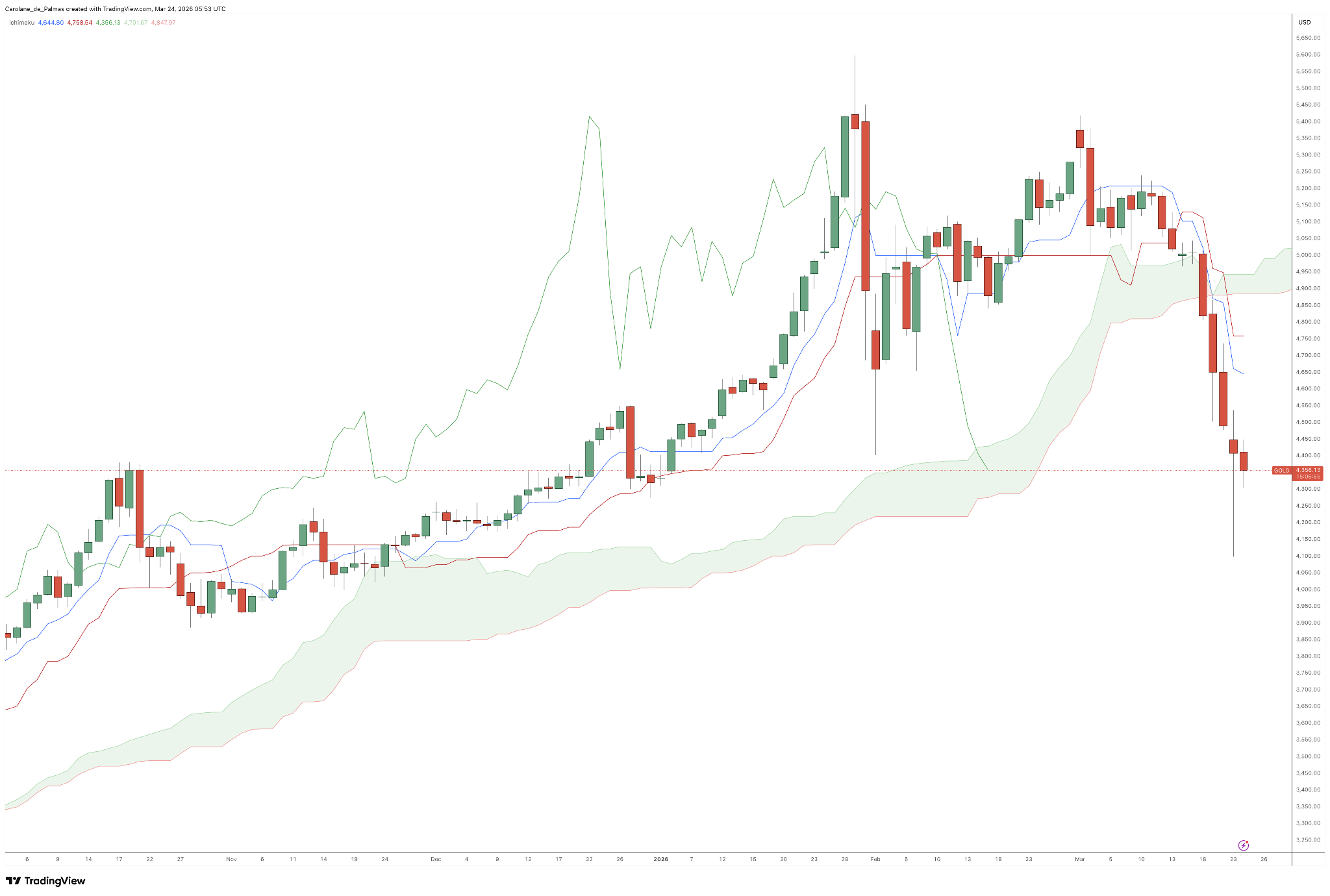
Gold prices opened Monday, March 23, at $4,448 per troy ounce according to ActivTrades’ trading data with a bearish gap from Friday’s close, before sliding further below $4,098 in early trading, its weakest level in 2026. Today, gold prices are still losing ground, hovering around $4,390 before the opening of the European session.
From its all-time high of $5,597, reached on January 29, 2026, gold has now fallen sharply, down roughly 22% from that record peak and approximately 15% since the Iran conflict began on February 28. The metal has posted losses for 10 consecutive sessions and recorded its steepest weekly decline in more than four decades last week (around -10%).
For an asset long celebrated as the ultimate store of value, this is a striking reality check. Gold has historically thrived in exactly the kind of environment markets are now navigating: armed conflict, energy disruption, geopolitical fragmentation. And yet the conditions that should logically be sending investors rushing toward the metal are instead working against it.
When Inflation Becomes Gold’s Enemy
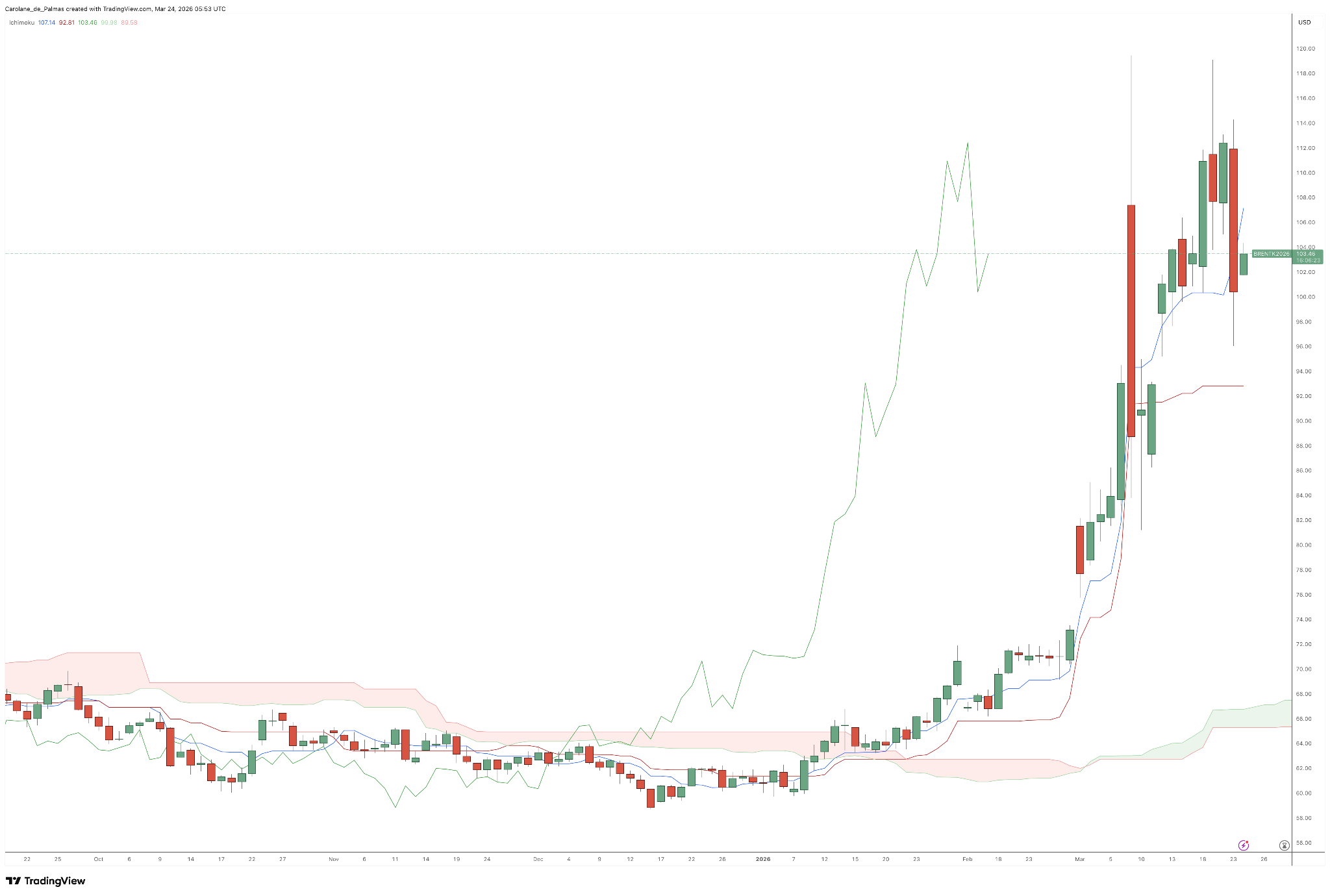
The closure of the Strait of Hormuz, the critical maritime corridor through which a significant share of the world’s oil and gas flows, has driven Brent crude up roughly 70% for the year.
That kind of energy shock does not simply raise fuel prices at the pump: it filters through the entire economy, lifting production costs, transportation expenses, and ultimately consumer prices across the board. For central banks, it means that any plans to cut interest rates must be shelved, and possibly reversed.
The yellow metal pays no dividend, no coupon, no yield of any kind. Its appeal, in normal times, rests on the fact that the opportunity cost of holding it — meaning what an investor gives up by not owning a yielding asset instead — is low when rates are low. But when the prospect of rate cuts evaporates and investors begin pricing in a prolonged period of tighter monetary policy, the calculus shifts.
Fixed-income assets and interest-bearing vehicles have gained significant appeal. Investors, once bracing for a series of rate cuts through 2026, are now overhauling their expectations, a shift that has left gold struggling to maintain its momentum.
Compounding matters further is the behavior of the US dollar.
Gold Price Forecast
Every new Gold analysis as it publishes, today's technical signal and key levels, live price — on one page.
See all Gold forecastsThe Dollar Steals the Spotlight
Oil shocks have a well-established tendency to reinforce the greenback’s status as the world’s reserve currency precisely because global energy transactions are denominated in dollars, and because the United States, as a net energy exporter, benefits relative to oil-importing nations during supply crunches.
A stronger dollar makes gold, which is priced in dollars on international markets, more expensive for buyers using other currencies, effectively suppressing demand. Higher real yields and a firmer greenback form a double headwind for an asset that generates no income.
The selling pressure on gold has also been visible in the market structures that track its performance.
The Paper Gold Exodus
According to World Gold Council data, gold-backed exchange-traded funds have seen outflows of $7.9 billion (equivalent to roughly 54.8 metric tons) since the conflict began, with the bulk of those originating in the United States.
Chinese stock markets, which are closely watched given that China is the world’s largest buyer of gold, also tumbled sharply on Monday, touching their steepest daily decline in a year. Weakening demand from the world’s biggest consumer is never a supportive signal for the price.
Then there is also the question of where gold was standing when this crisis began.
Cashing Out Close to the Top
The metal did not enter this period from a position of undervaluation or neglect. It entered it from a position of extraordinary recent strength.
Gold didn’t just rise in recent years: it staged a historic ascent from $1,829 in early 2022 to a staggering $5,597 peak in January 2026—a total return of around 207%. What began as a strategic foundation of central bank and institutional accumulation eventually ignited into a retail-driven mania, especially across Asia. The vertical move in 2025 (+65%), following a robust 2024 (+27%), served as a vote of no confidence in fiscal responsibility and the endurance of US political stability.
By the time the Iran war erupted, gold had already absorbed much of the safe-haven premium that a fresh crisis might otherwise have generated. There was simply less incremental demand available to drive prices higher. Instead, the volatility created by the conflict gave investors who had ridden the rally all the way up a compelling reason to take profits.
When Fear Triggers Selling (Not Buying)
In the immediate aftermath of a geopolitical shock, fear does not always translate into buying. Sometimes it triggers the opposite: a wave of forced selling as investors scramble to raise cash, cover margin calls, or reduce overall risk exposure.
Just as it did in February 2022 with the Russian invasion of Ukraine, the metal is giving up its initial ‘war premium’ to the reality of rising rate expectations. It’s a classic case of liquidity needs ‘cannibalizing’ safe-haven demand; in the opening act of a crisis, gold often falls not because it’s no longer valued, but because it is often the most liquid asset available to sell.
As John Reade, senior market strategist at the World Gold Council, observed, the trades built throughout 2025 are currently being dismantled, and the market has not yet transitioned into the stagflationary positioning that a prolonged conflict and energy shock might ultimately warrant. Gold tends to perform well in stagflationary environments (periods of high inflation and slow growth), but getting there may require further selling and digestion first.
Sources: Reuters, CNBC, The Wall Street Journal, Fortune, Yahoo Finance, MorningStar
The information provided does not constitute investment research. The material has not been prepared in accordance with the legal requirements designed to promote the independence of investment research and as such is to be considered to be a marketing communication.
All information has been prepared by ActivTrades (“AT”). The information does not contain a record of AT’s prices, or an offer of or solicitation for a transaction in any financial instrument. No representation or warranty is given as to the accuracy or completeness of this information.
Any material provided does not have regard to the specific investment objective and financial situation of any person who may receive it. Past performance is not a reliable indicator of future performance. AT provides an execution-only service. Consequently, any person acting on the information provided does so at their own risk. Forecasts are not guarantees. Rates may change. Political risk is unpredictable. Central bank actions may vary. Platforms’ tools do not guarantee success.