The global economy has absorbed shock after shock – trade wars, institutional clashes, geopolitical escalation – and yet growth has held firm, inflation has cooled and equity markets have climbed to fresh highs.
Traders have grown comfortable with resilience. But history rarely rewards comfort. It rewards anticipation. And right now, two critical Commodities sit at the epicentre of a potential repricing that could define 2026: Oil and Natural Gas.
The Narrow Waterway That Controls the World
Everything hinges on a slender maritime chokepoint – the Strait of Hormuz – through which roughly one fifth of global petroleum liquids flow each day. Any sustained disruption would represent, in the words of Lars Hansen, Head of Research at The Gold & Silver Club, “a monumental supply shock with immediate inflationary consequences.” Oil, he argues, “is the critical transmission channel between geopolitics and the global economy.”
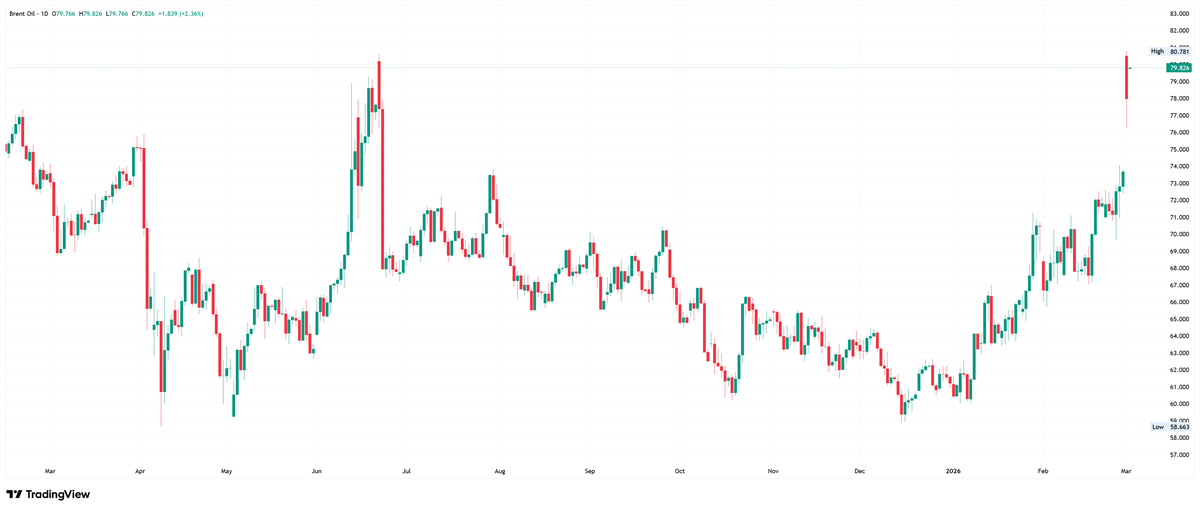
Recent escalation in the Middle East has already forced markets to reprice risk. Brent Crude has surged toward seven-month highs. War-risk insurance premiums on tankers have jumped more than 50%. Analysts at The Gold & Silver Club estimate that a full six-week halt in Hormuz flows could justify a risk premium of $15–20 per barrel, with extreme scenarios pushing crude toward $120 or higher.
“If Hormuz traffic were materially disrupted,” Hansen notes, “you are not talking about incremental volatility – you are talking about a structural repricing of global energy.” One in five barrels is not a marginal figure; it is the backbone of modern commerce.
Two Scenarios – One Asymmetric Opportunity
There are, broadly, two energy market outcomes. The first is severe but low probability: a prolonged shutdown of traffic through Hormuz. In that scenario, Oil could surge above $100 per barrel, reigniting inflation across major economies, delaying central bank rate cuts and unsettling risk assets.
Brent Oil Price Forecast
Every new Brent Oil analysis as it publishes, today's technical signal and key levels, live price — on one page.
See all Brent Oil forecastsJPMorgan estimates such a move could push U.S CPI back toward 5% – levels last seen during the Federal Reserve’s most aggressive tightening cycle in 2023.
The second scenario – arguably more probable – is contained disruption. Iranian exports may face constraints while broader traffic continues. OPEC output increases could temper the spike. Oil in this case gravitates toward $80–90 per barrel. Growth slows modestly but avoids derailment.
“For traders,” Hansen explains, “both scenarios create opportunity. The downside is cushioned by structural underinvestment in energy supply. The upside, however, is explosive if geopolitical risk persists.” In other words, the asymmetry is compelling.
Natural Gas: The Inflation Multiplier
If Oil is the spark, Natural Gas is the accelerant. European benchmark Gas prices recently leapt 25% in a single session, touching eight-month highs. Around 15% of global LNG flows – much of it Qatari – transits the Gulf. Europe, having replaced Russian pipeline gas with seaborne LNG, is acutely exposed.
“Gas markets are structurally tighter than many realize,” says Hansen. “Storage levels are lower year-on-year, speculative shorts are elevated and forced short-covering could amplify any disruption.”
Analysts warn that sustained interference with Gulf LNG could propel European Gas prices toward €80–100 per MWh, doubling current levels and intensifying inflationary pressures across the continent.
Underowned, Underestimated and Underpriced
For much of the past year, capital has crowded into artificial intelligence, mega-cap technology and equity indices. Energies remain modestly valued. Futures positioning reflects complacency. Yet upstream capital expenditure remains below what is required to materially expand supply.
“This is precisely how major Commodity bull cycles begin,” Hansen argues. “Underowned, underestimated and dismissed – until price forces recognition.” Oil and Natural Gas today resemble Gold eighteen months before its historic breakout: quietly building pressure beneath the surface.
The world has endured tariffs, institutional conflict and financial stress without faltering. The decisive variable now is whether Oil stays contained. If it does, growth muddles through. If it does not, inflation resurges and capital rotates decisively into hard assets.
The opportunity for 2026 is not hidden in complexity. It is visible in tanker routes and LNG terminals. It is measured in barrels and cubic metres.
The question is not whether volatility will rise – it already has. The question is whether you are positioned before the repricing accelerates.
As Hansen concludes: “When Energy becomes the macro story, the move is already underway. The biggest gains accrue to those positioned before consensus catches up.”
For traders seeking asymmetric upside in 2026, Oil and Natural Gas are no longer peripheral trades – they are potential centrepieces.
The message is becoming clearer: momentum is building, capital is rotating and 2026 may prove to be the year Energies outperform every other major asset class.