



Uniswap (UNI) has gone up by 23% in the past 24 hours, and trading volumes have exploded by 600% after the project’s development companies proposed a fee switch from ETH to UNI.
If this proposal is passed, it would mean that the largest decentralized exchange (DEX) on the Ethereum ecosystem will start charging its transaction fees in UNI and will use a portion of those fees to burn the token.
In addition, the Foundation proposed a retroactive burn of 100 million UNI tokens, worth over $800 million at the time of writing.
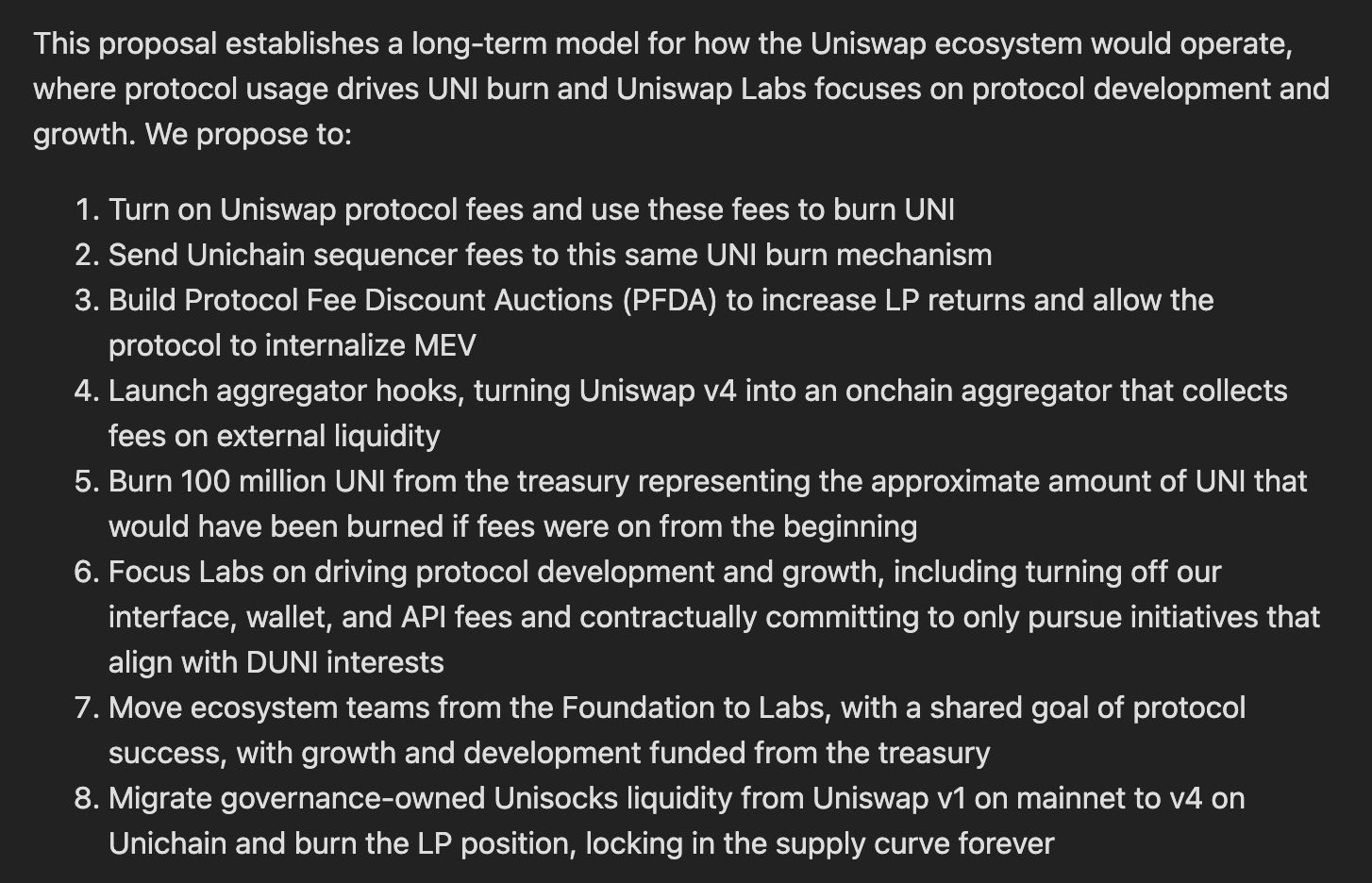
Uniswap Fee Switch Proposal – Source: Uniswap Governance Forum
A favorable regulatory environment is the reason why Uniswap Labs is floating this proposal. A change in leadership at the United States Securities and Exchange Commission (SEC) is giving crypto companies more freedom to make changes to their protocols without fear of being prosecuted by the agency.
“UNI launched in 2020, but for the past 5 years Labs has been unable to meaningfully participate in Uniswap governance, and has been greatly restricted in the ways it can build value for the Uniswap community,” commented to co-founder of Uniswap, Hayden Adams.
The proposal would be first implemented on the v2 and v3 Uniswap networks, which account for the largest percentage of the protocol’s liquidity provider fees.
Trading Volumes Exploded for Uniswap Since April
Between August and October this year, Uniswap collected over $100 million per month in fees, according to data from DeFi Llama.
The protocol’s trading volumes have been progressively increasing in the past few months, as the Pectra upgrade helped the Ethereum network recover its edge.
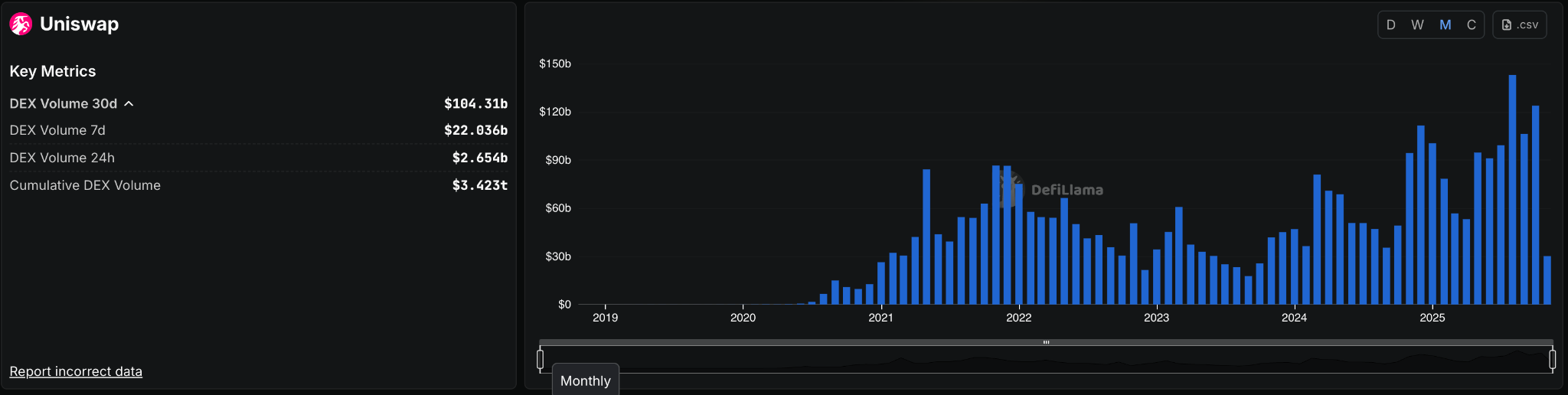
DEX Volumes on Uniswap (Monthly) – Source: DeFi Llama
Back in April, DEX volumes closed the month at $52 billion. Meanwhile, in August, Uniswap processed a record of $143 billion in volumes, and just closed October with $123 billion.
This underscores the solution’s growing appeal among traders and investors, who see it as the go-to decentralized exchange for token swaps on Ethereum, Binance Smart Chain, Arbitrum, Base, and other chains.
UNI Reverses Downtrend – Next Stop $11?
The daily chart shows that UNI managed to reverse its downtrend and broke out of a descending triangle after hitting the $5 support for a fourth time since April.
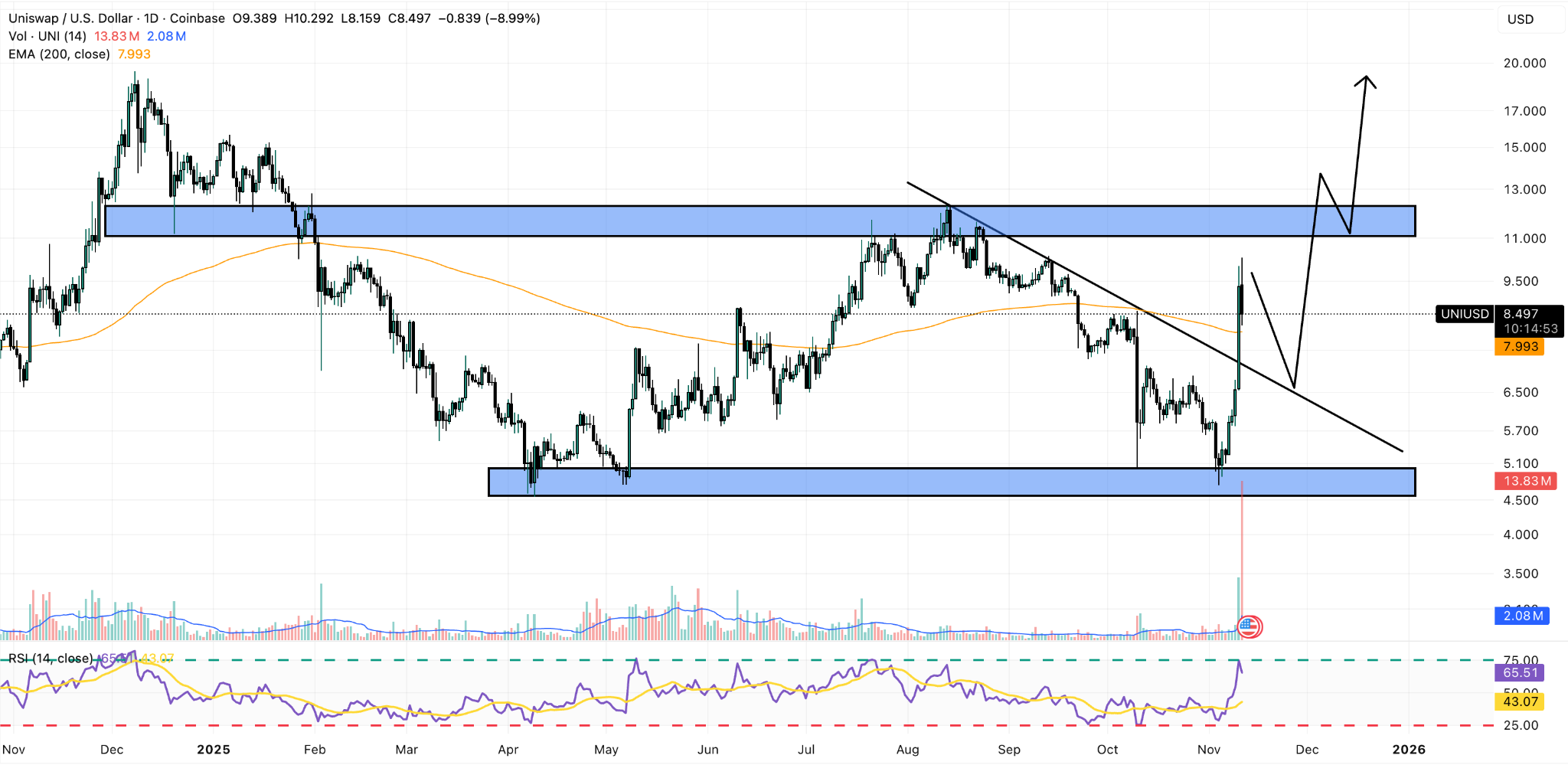
UNI/USD Daily Chart (Coinbase) – Source: TradingView
Buying interest at this level remains quite strong, and this week’s positive news may have sealed the deal for an upcoming push to $12 at least. UNI started to experience strong selling pressure at $10, as early buyers probably cashed out in light of the bearish momentum that cryptos are experiencing.
However, momentum indicators have spiked as a result of today’s move. The Relative Strength Index (RSI) neared overbought territory, meaning that positive momentum is accelerating.
Although this increases the odds of a pullback, it seems too early to call a top for this rally. If UNI starts to burn its circulating supply right after the proposal is passed, the token’s circulating supply will decline, and that will likely cause a supply shock.
Today’s uptick pushed UNI above its 200-day exponential moving average (EMA), meaning that the long-term trend has turned bullish.
If positive momentum gains traction, the two targets for UNI in the next few weeks would be $11 and 19. This translates into a total upside potential of 123% compared to a downside risk of 41% if the token drops to $5 again, which seems highl


