Dollar Gains Ground as Fed Chair Speculation and Rate Cut Timing Fuel Market Volatility
The U.S. Dollar posted modest gains against a basket of major currencies on Friday in a relatively volatile session. The catalyst behind the intraday price swings were comments from U.S. President Trump, which prompted speculation he is less likely to name current economic adviser Kevin Hassett as chair of the Federal Reserve.
On Friday, DXY settled at 99.375, up 0.021 or +0.02%.

Trump’s Comments Signal Hassett to Remain as Economic Adviser
“I see Kevin’s in the audience, and I just want to thank you. You were fantastic on television today. I actually want to keep you where you are. If you want to know the truth,” Trump said.
In my opinion, the dollar edged higher after the remarks because they suggested Hassett would remain in his current role rather than become Fed Chair. Since Hassett is viewed as a ‘dove’ who favors lower interest rates, his removal from consideration reduced the likelihood of a dovish Fed leadership, which would put pressure on the greenback.
Others looked at it from a political perspective. “We have seen some U.S. Dollar buying on this headline, as it underscores that the Fed decision is mostly about political credibility,” Adam Button, chief currency analyst at investingLive, said in a note.
“Of the candidates, Hassett is seen as the least independent, which in turn would be the most dovish due to Trump’s longstanding desire to cut rates,” Button said.
EUR/USD Price Forecast
Every new EUR/USD analysis as it publishes, today's technical signal and key levels, live price — on one page.
See all EUR/USD forecastsDelayed Rate Cut Expectations Provide Additional Support
The index was also supported on Friday by expectations that the first rate cut in 2026 could be pushed into June, after earlier odds pointed toward a March cut. Traders cited steady consumer inflation data and an improving U.S. labor market due to better weekly initial claims numbers as the two reasons that led to the shift in sentiment.
Japan Intervention Concerns and Technical Outlook
Looking ahead, Monday is a U.S. bank holiday so the trade could be muted. However, investors will be watching for activity out of Japan that could impact the Dollar/Yen trade. On Friday, the yen was stronger after Japan’s Finance Minister Satsuki Katayama said Tokyo would not rule out any options to counter weakness in the currency, including coordinated intervention with the U.S., according to Reuters.
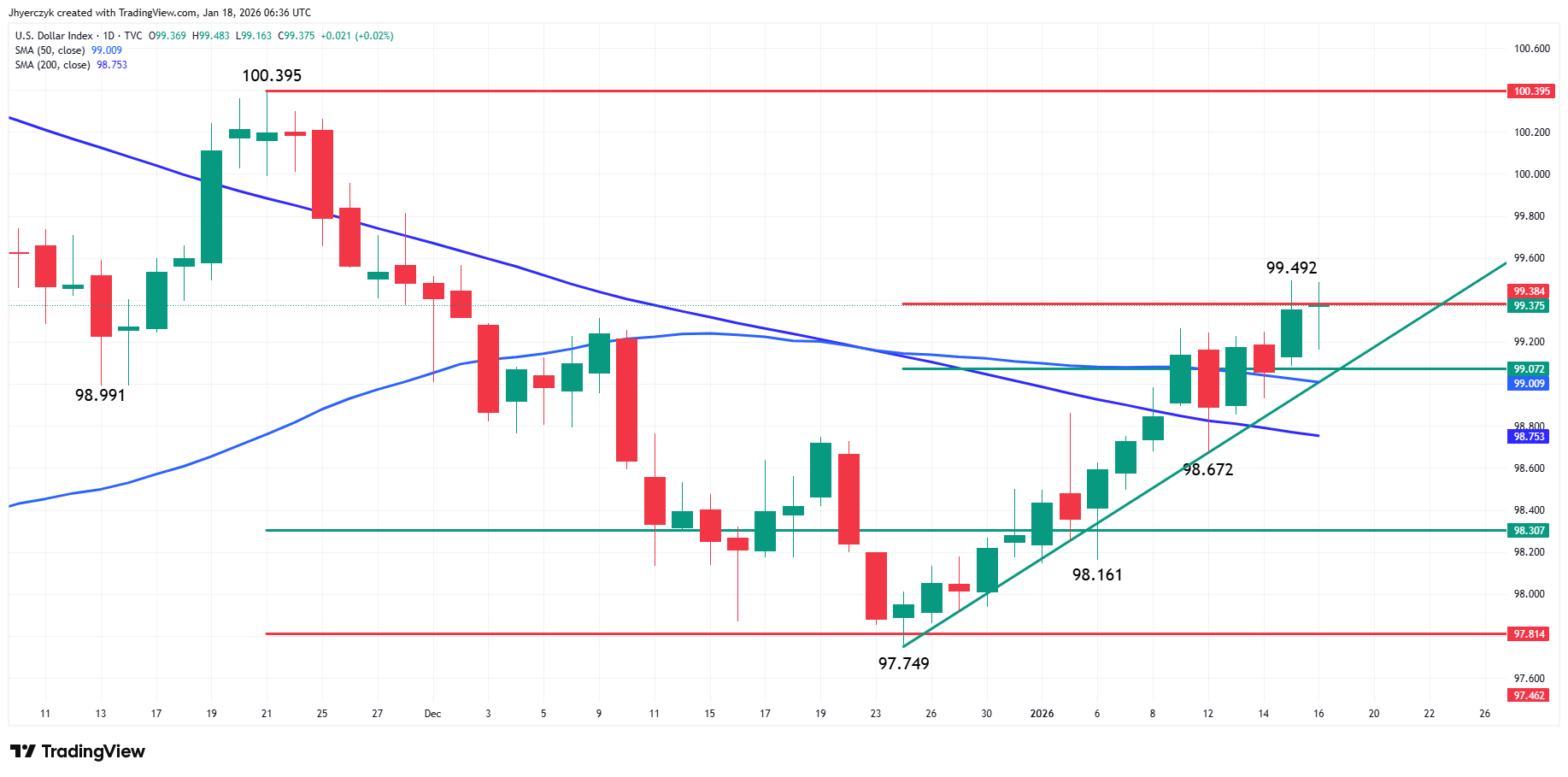
Technically, the U.S. Dollar Index (DXY) closed in a position to overtake a key Fibonacci retracement level at 99.384, which could trigger an acceleration to the upside since the next major resistance level is the November 21 main top at 100.395.
On the downside, the index is supported by a price cluster formed by a trendline at 99.092 and a 50% level. Adding additional support is the 50-day moving average at 99.009 and the 200-day moving average at 98.753, which are also controlling the uptrend.
More Information in our Economic Calendar.