
Dollar Plunges as “Goldilocks” Data Shifts Money Back Into Stocks
The U.S. Dollar plunged against a basket of major currencies on Thursday as traders assessed the latest economic data as well as developments in trade and geopolitics. I’m not convinced that geopolitics had anything to do with the dollar’s decline today, I just think it is the easiest answer for the financial news guys.
In one article, they are saying stocks are going up because of the easing of geopolitical tensions, but then a little while later they are saying the dollar is weakening because of geopolitical uncertainty. So let’s dig deeper into the situation to find something that makes sense from a short-term and long-term perspective.
At 19:52 GMT, DXY is trading 98.366, down 0.424 or -0.43%.
GDP, Claims, and PCE: “Good Enough” But Not Dollar-Bullish
Earlier today, the U.S. released data on GDP, initial claims and PCE inflation. All three reports were “good enough”, but not dollar-bullish. The data didn’t indicate an overheating economy, renewed inflation pressure, or the need for tighter Fed policy. Three factors that would have likely driven the dollar index higher.
The “Goldilocks Interpretation”: Slowing Growth + Cooling Inflation = Risk-On
Instead, the reports reinforced what traders often call a “Goldilocks Interpretation”, which suggests growth is slowing but not collapsing and inflation continues to cool despite being above the Fed target. The combination of all three reports was interpreted to mean the Fed has enough data to stay patient, while having no reason to get defensive. That’s actually a risk-positive assessment, which is why stocks are rallying, but it’s also dollar-negative.
Understanding the Dollar’s Long-Term Trending Behavior
If you’ve analyzed the dollar as long as I have, you’ll know that it trends. Once a direction is chosen by the big entities like foreign countries, central banks and the major international banks, they seldom shift until the task is complete or for short-term reasons, the greenback gets oversold.
Why “Okay” Data Won’t Reverse a Bearish Dollar Trend
Looking at today’s trade, you should be able to pick up that if the long-term trend is bearish, the dollar is not necessarily going to rally on just “okay” data. If there was a surprise in the reports they would’ve repriced Fed rate expectations then we would’ve seen prices rally. Instead, the reports delivered just what the markets expected that is no need to change the outlook for at least two Fed rate cuts later in the year. The price action also indicates that investors don’t seem to care if the rate cut is in March or June.
EUR/USD Price Forecast
Every new EUR/USD analysis as it publishes, today's technical signal and key levels, live price — on one page.
See all EUR/USD forecastsNo Panic Selling, Just Money Rotating From Safe-Haven to Risk Assets
I don’t think we saw panic selling on Thursday, despite the relatively large sell-off. I think we may have seen money moving into stocks as a sign that geopolitics weren’t as scary as they were earlier in the week, which may have encouraged those who bought the dollar for safe-haven reasons, to unwind their positions.
The Real Reason for Today’s Dollar Decline
In conclusion, the greenback sold off because U.S. data confirmed slowing inflation without threatening growth (decent PCE and GDP), reinforcing risk-on flows (money moving back into stocks) and reducing the dollar’s rate premium (bets on a Fed rate cut).
Technical Outlook: DXY Eyes December Bottom at 97.749
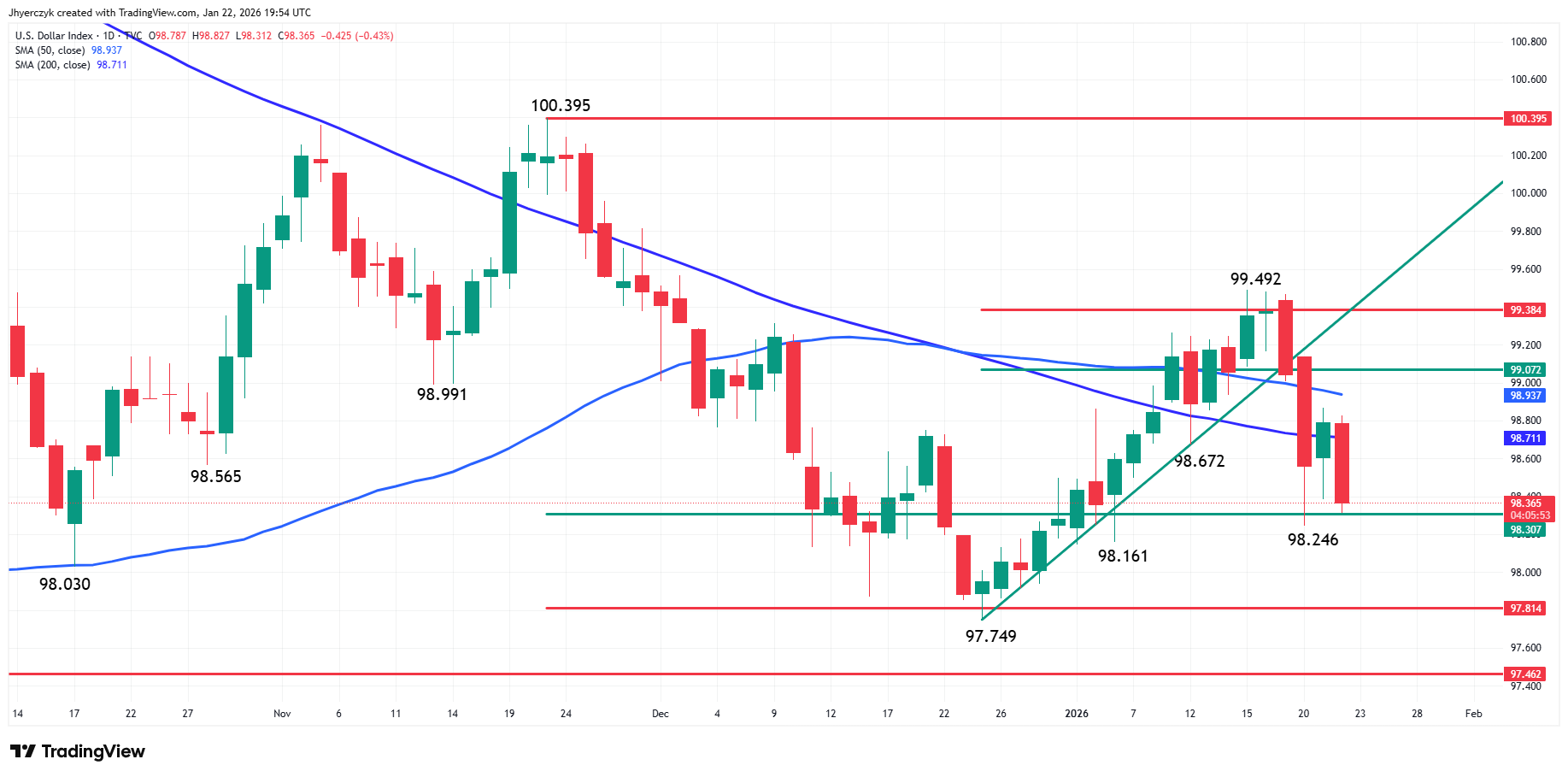
The DXY daily chart shows a dramatic shift this week to the downside, following last week’s failure to overcome a major retracement zone at 99.072 to 99.384. The index is also on the weak side of an uptrend line, adding to the bearish tone. If the downside momentum is strong enough, we expect sellers to challenge the retracement zone at 98.307 to 97.814. This would put the index in a position to break through the December 24 main bottom at 97.749.
More Information in our Economic Calendar.