



Market Overview
On Monday, the US dollar prolonged its bullish trend and remained well bid above the 99.75 level. However, the reason for its upward trend can be attributed to increasing geopolitical tensions, which increased demand for safe-haven assets like the dollar.
Furthermore, the US Federal Reserve adopted a more hawkish stance, signaling possible interest rate hikes, which further supported the dollar.

Middle East Tensions Boost Safe-Haven Demand for the US Dollar
On the geopolitical front, the tension in the Middle East shows no sign of slowing down. US President Donald Trump warned on Sunday that he would target Iranian power plants if the Strait of Hormuz was not reopened within 48 hours. Meanwhile, the Iranian military said it would close the Strait of Hormuz completely if the US goes ahead with its threats.
Hence, these escalating tensions between the US and Iran are increasing uncertainty in the market and pushing investors to buy safe-haven assets like the US dollar.
Increasing Oil Prices and Fed Hawkishness Support the US Dollar
On the other hand, surging oil and energy prices, boosted by the escalating US-Israel-Iran tensions, raised inflation concerns and prompts the Federal Reserve to adopt a hawkish stance, which supports the US Dollar Index (DXY).
Moving ahead, traders are watching the preliminary US S&P Global Manufacturing PMI for March, due Tuesday. If the data comes in weaker than expected, it could weigh on the DXY.
GBP/USD Price Forecast
Every new GBP/USD analysis as it publishes, today's technical signal and key levels, live price — on one page.
See all GBP/USD forecastsU.S. Dollar Index Forecast: DXY Stabilizes Near 99.75 as 100.06 Caps Recovery
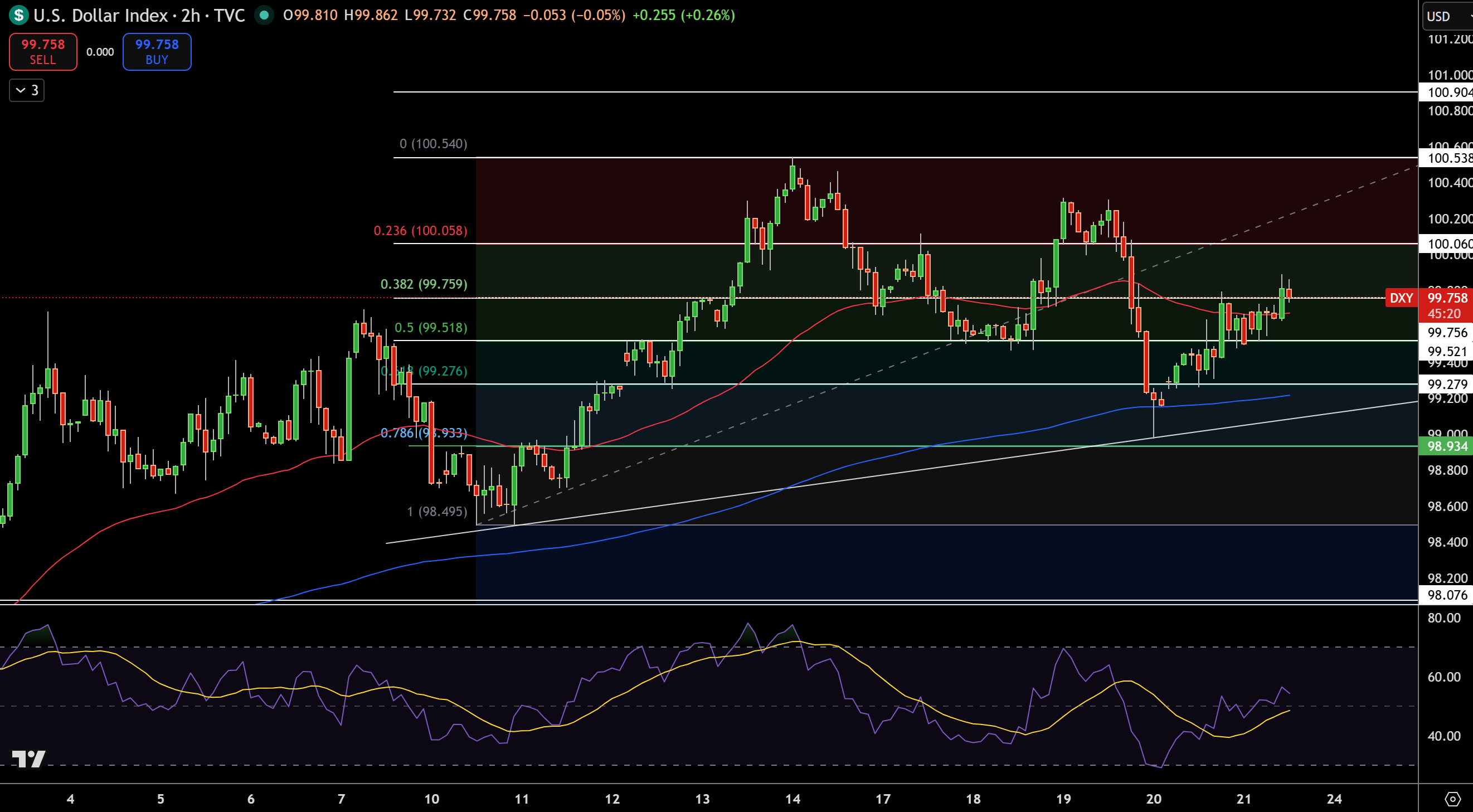
The US Dollar Index (DXY) is just hanging around 99.75 on the 2-hour chart after bouncing back from that low point of 98.49. Price is stuck in a pretty important area – a range between 99.52 and 100.06 that’s a big Fibonacci retracement zone. That’s a pretty key spot for the price to be turning around.
Both the 50-period moving average, which is just hovering at 99.75, and the upward sloping trendline from 98.49 are providing a bit of a cushion for the price.
The momentum is slowly coming back on the RSI, but its still not showing us that clear, decisive move yet. If price does manage to break above 100.06, it could expose some other key levels like 100.54 and 100.90.
But on the flip side, if it slips below 99.27, we may see some real trouble up ahead, and it’s possible price could drop all the way back to 98.49. Right now, the overall bias is cautiously optimistic as long as we’re above that trendline.
GBP/USD Forecast: Pound Holds 1.3300 as Trendline Support Tests Buyers
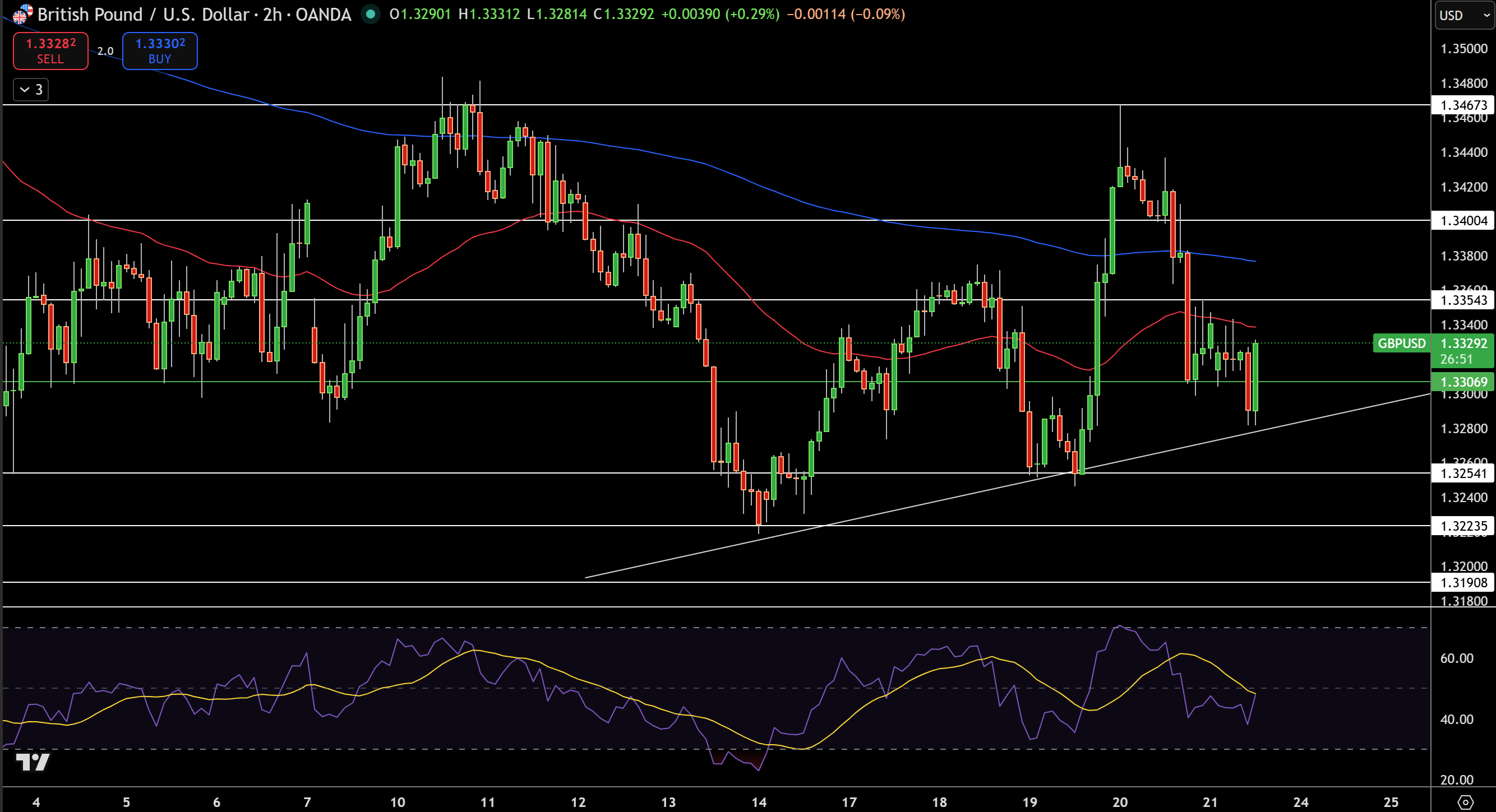
GBP/USD is currently trading at about 1.3329 on the 2-hour chart, it’s settled for the time being above that 1.3300 level that gets traders nervous – it fell pretty sharp from 1.3467 but is now stabilizing.
Prices are kind of stuck in a bit of a squeeze between 1.3354 acting as a horizontal ceiling and that rising trendline that comes from the 1.3223 low . Its making a pretty tight squeeze in the process. The 50-period moving average is sort of leveling out around 1.3340 and its giving us a sign that short term trading might just be a case of going sideways rather than really trying to go somewhere in particular.
The RSI has backed off a bit back to the 45-50 range, that tells us there was a loss of momentum but its not got to the point where we’d be worried about it – still not really getting close to being oversold. If we do break above 1.3354 then the next targets to consider would be 1.3400 and that old high at 1.3467, but if we break below 1.3300 its likely we’re looking at 1.3254 and 1.3223 at least. Trading up against that rising trendline is probably a cautious game of wait and see.
EUR/USD Forecast: Descending Trendline Caps Recovery Near 1.1560
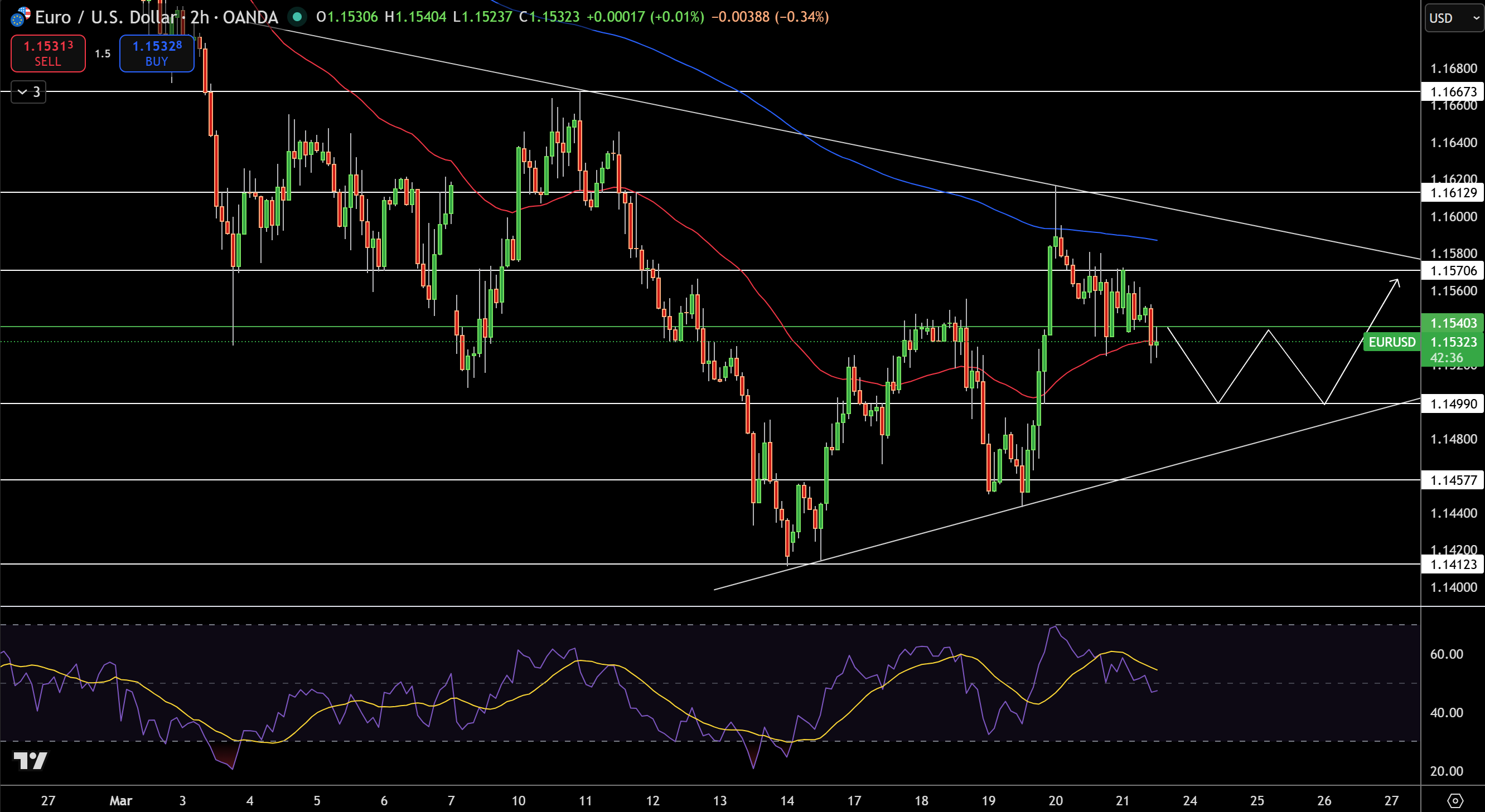
EUR/USD is currently stuck at around 1.1532 on the 2 hour chart, just hanging around a clearly defined downtrend line that comes down from the 1.1673 high. The pair just had a bit of a bounce off the 1.1412 low-line, after jumping back up off support from a small short-term uptrend line, but the momentum to push higher is starting to run out just below 1.1560 to 1.1612 resistance. The 50 period moving average is basically flat at the moment which is a pretty good indication of just how stuck the pair is right now at these current levels.
The RSI has cooled off a bit too & is now hovering around the middle mark of 50, which is a pretty good sign that buyers & sellers are pretty evenly matched at the moment. If we can break above 1.1612 we will probably go on to challenge the broader bearish trend & might even expose 1.1667. On the other hand, if we fail to break above 1.1499 we risk the pair getting pulled back down towards 1.1457 & potentially even all the way back down to 1.1412 again.


