
Market Overview
The US Dollar stays in the doldrums as investors struggle to get their heads around the latest trade policy twists and turns, coupled with some pretty weak economic numbers. As it stands, the US Dollar Index (DXY) has been taking a beating for the second day running, and it’s only just above 97.50 on Monday.

US Dollar Takes a Hit as Trump Unveils New Tariff Plans, Again
It’s hard to tell what’s going on with the US trade policy right now – one minute Trump’s being blocked by the Supreme Court from implementing most of his emergency tariff powers, which basically meant he couldn’t just go ahead and slap big tariffs on countries he didn’t like anymore.
But then, just like that, he announces a brand new 15% global tariff plan using a different trade law – and this back and forth has left investors in a right old pickle. As a result, investors are getting a bit nervous, and the US Dollar’s lost some of its steam.
Dollar Takes a Beating as US Growth Slows and Inflation Refuses to Budge
On the economic front, things aren’t exactly looking bright for the Dollar either. We’ve just had some numbers come in showing the US economy only grew at an annual rate of 1.4% in Q4 2025, which was way short of what people were expecting. That’s sent a bit of a red flag up about slowing growth, I’m afraid.
And to make matters worse, core PCE inflation is still chugging along at 3.0% year on year in December. Inflation’s proving to be a right old sticky situation, which is only making things harder for the Federal Reserve to know what to do next.
GBP/USD Price Forecast
Every new GBP/USD analysis as it publishes, today's technical signal and key levels, live price — on one page.
See all GBP/USD forecastsOn the one hand, slower growth might mean they’re more likely to cut interest rates, but the problem is that the inflation’s still running high, and that’s leaving the central bank with a real headache. So the outlook for the Dollar – or indeed the policy path – remains pretty murky.
Geopolitical Headaches Might Actually Help the Dollar Limit Further Losses
Despite the fact that both the trade worries and the slower US growth are putting a lot of pressure on the Dollar, there’s a possibility that the current global tensions might actually help the Dollar limit its losses.
According to a New York Times report, Trump is mulling over the possibility of limited airstrikes on Iran – and if diplomacy or a targeted strike fails to sort out Iran’s nuclear program, he’s even talked about a bigger attack later on down the line.
So that’s got to have some folks getting a bit nervous, and it could actually push global risk sentiment in a slightly different direction.
Looking ahead, investors will be keeping a very close eye on the economic data, and any new developments in the trade department to see just where the Dollar’s going to go next.
U.S. Dollar Index (DXY) Outlook: Bearish Bias Below 98 Resistance
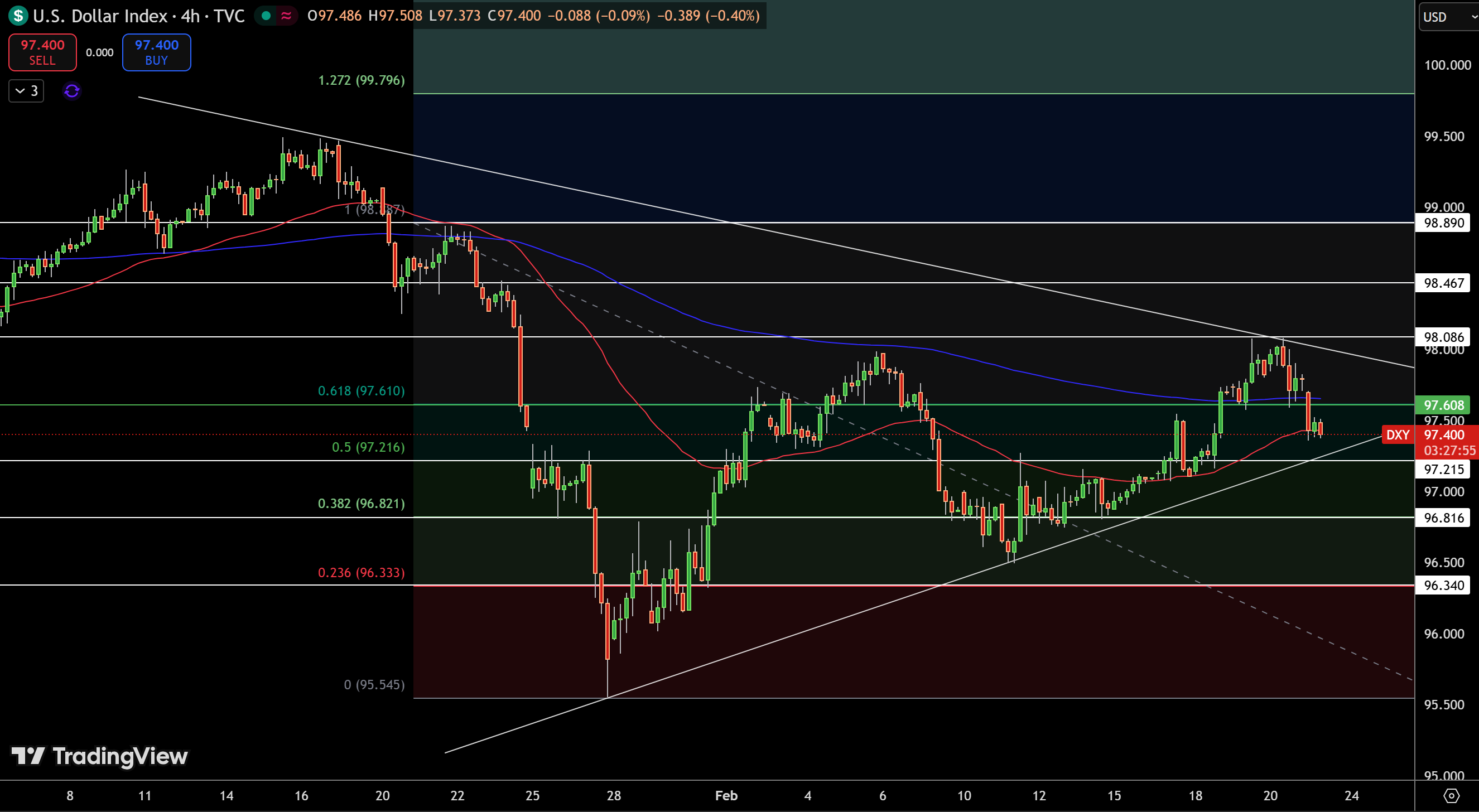
The US Dollar Index (DXY) is currently at around 97.40 on its 4 hour chart just mulling over near a descending trendline from late January highs. The rejection around 98-98.10 resistance area tells us that price sellers are still in charge, those longer upper wicks are a pretty clear indicator that there’s still selling going on. Price is hanging around the 0.5 Fibonacci level at 97.21 and has a couple more support zones at 96.82 and 96.33 to fall back on.
The 50-period moving average is pretty much flatlining while the 200-period MA is still hovering above it – this is not a good sign for the dollar. A break above 98 would probably give it a bit of a boost but if it can’t hold at 97.20 then we might see a pretty fast decline to 96.30.
Trade idea: If you’re feeling bearish on the dollar then you might want to consider shorting it below 97.20 and aiming for 96.35 – just set that stop loss above 98.10.
GBP/USD Outlook: Descending Trendline Caps Recovery Near $1.3580
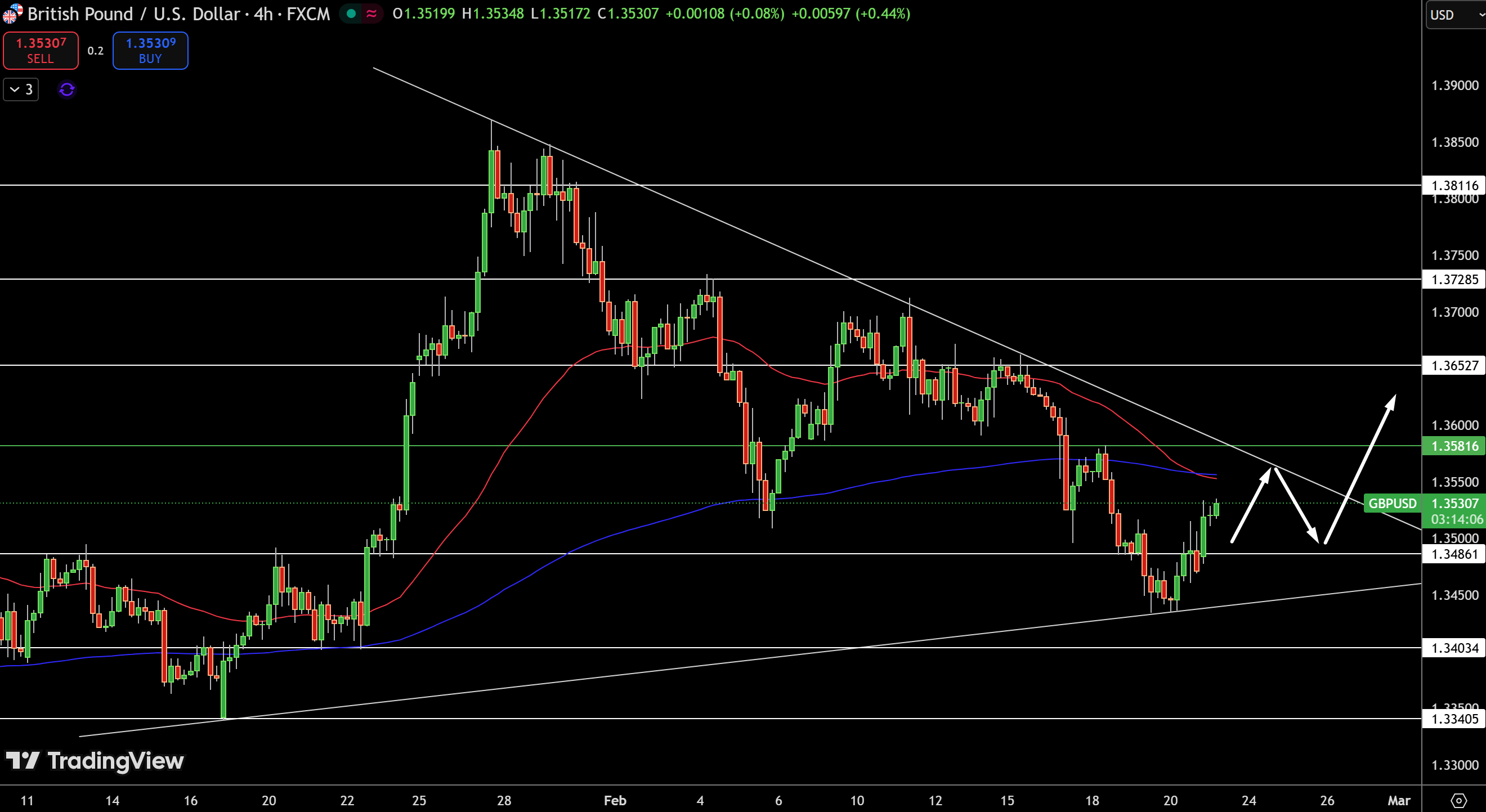
GBP/USD is currently at $1.3530 on its 4 hour chart and its trying to get back up from that recent low around $1.3445. But you can see its still got that descending trendline from late January highs bearing down on it – which means we’ve still got that bearish bias that we’ve been talking about.
Price is just beneath that $1.3580 resistance zone, and its being held back by the 50-period moving average as well as the 200-period MA near $1.3550 above it. Its got some support zones at $1.3485 and $1.3400 to fall back on. If it can break above $1.3580 then maybe we’ll see some real momentum pick up towards $1.3650.
Trade idea: If you think the GBP can break through $1.3580 then you might want to consider buying it – set that stop loss below $1.3485 and aim for $1.3650.
EUR/USD Outlook: Triangle Squeeze Near $1.1860 Resistance
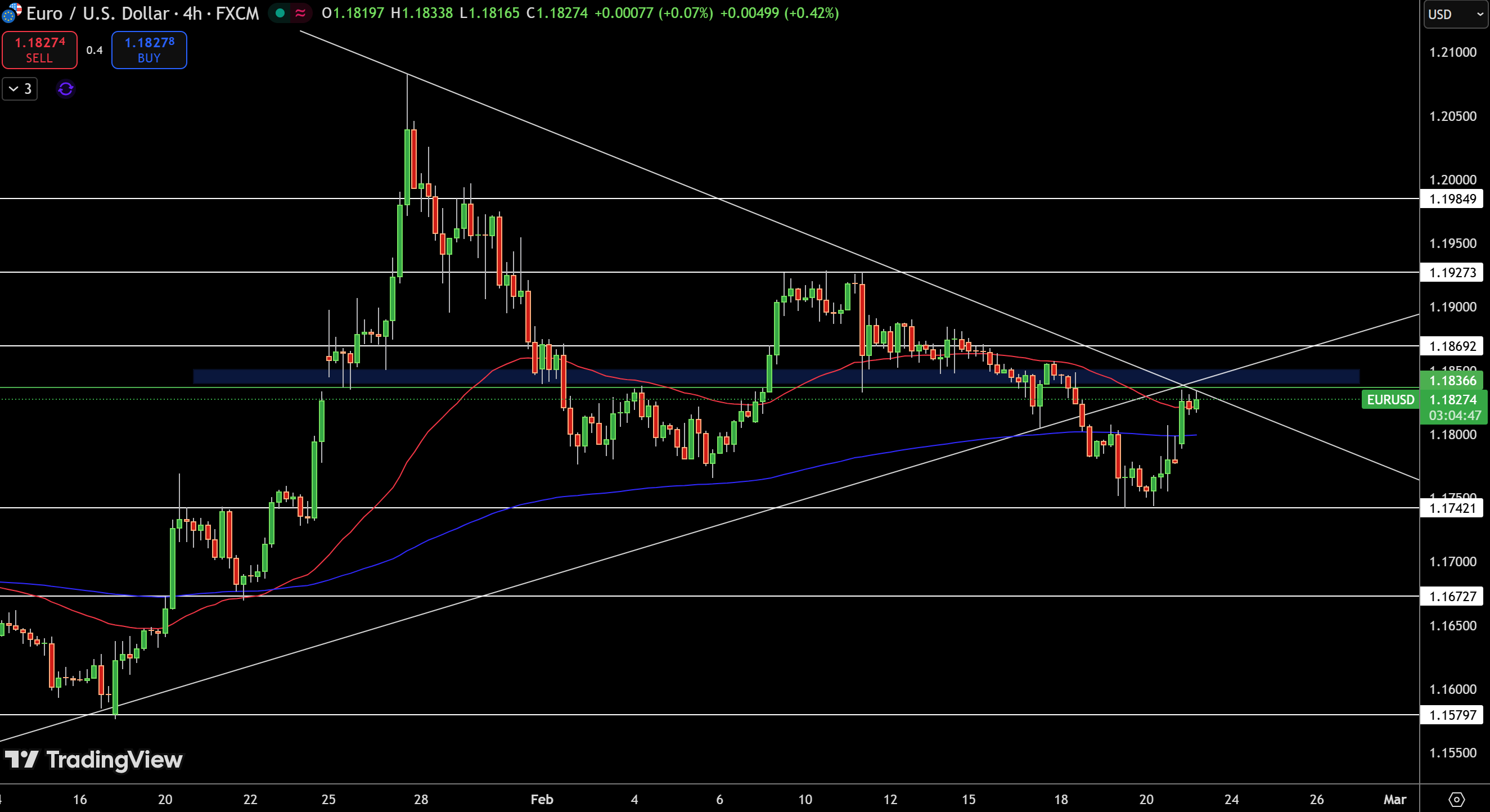
EUR/USD is at around $1.1828 on its 4 hour chart – after bouncing off that $1.1740 support area it’s building up some serious momentum and getting ready to test that confluence of resistance near $1.1860. As it is, price is pretty stuck between that descending trendline from the highs and that rising trendline from the January lows – this is a tightening triangle pattern and it doesn’t look like its going to be broken anytime soon.
The 50-period moving average is just as flat as the dollar’s and the 200-period MA around $1.1800 should give it a bit of a helping hand. If it can break $1.1860 then its probably going to be able to hit $1.1925 and $1.1985 – but if it doesn’t then we might see it head back down to $1.1740.
Trade idea: If you’re feeling the EUR is going to break through $1.1860 then you might want to have a go at buying it – set your stop loss below $1.1800 and aim for $1.1925.