The U.S. Supreme Court delivered major policy shock to markets when it held that President Donald Trump exceeded his authority when he imposed broad-sweeping global tariffs under the International Emergency Economic Powers Act (IEEPA). In a 6-3 decision, the court said that the president cannot use that emergency law to effectively impose broad import taxes. The power to make taxes belongs to Congress.
This decision directly subverts one of the key planks in Trump’s second-term economic policy. It involves using tariffs as rapid policy tool to recast trade balances and promote domestic industries. Markets immediately shifted their attention from legality of tariffs in past to the policy path going forward.

Administration Moves to Preserve Tariff Strategy
Within hours of the ruling, Trump moved swiftly to save his trade agenda. He signed a new proclamation under Section 122 of the 1974 Trade Act that permitted a temporary 10% tariff on imports from almost all countries for up to 150 days. This demonstrates that, despite the court setback, the administration is resolved to maintain tariffs as an important macro policy instrument.
At the same time, there are other tariffs that are still in place. Industry-specific duties on steel, aluminium, autos and other industries remain unaffected. They are imposed under Section 232 of Trade Expansion Act of 1962 based on national security investigations. This means that the overall protectionist bias in US trade policy remains, even if the legal basis has changed.
The larger uncertainty today is the potential $130 billion in tariff revenue collected in unlawful IEEPA framework. The court did not rule on whether companies or consumers should be refunded. That issue will likely drag on for years of litigation. If refunds eventually materialize they might constitute a fiscal transfer back to business and households. This may influence consumption, margins and broader economic expectations.
From a macro point of view, the important message for markets is obvious. The legal framework changed, but the policy direction did not. Trump is continuing to pursue tariffs through other legal avenues such as Section 122 and Section 301 investigations into unfair trade practices. He is also continuing to use Section 232 national security tariffs. In practical terms, this keeps the U.S. on path of protectionism, but with greater constraints and delays legally.
EUR/USD Price Forecast
Every new EUR/USD analysis as it publishes, today's technical signal and key levels, live price — on one page.
See all EUR/USD forecastsPolicy Shock and Trade Strategy Shift
The Supreme Court ruling puts two competing forces in conflict. On one hand, the ruling curbs the unilateral power of the president, which minimizes the risk of large scaled tariff shocks occurring suddenly. Those legal constraints provide stability to markets fearful of unpredictable policy moves. On the other hand quick initiation of a new 10% global tariff demonstrates that the administration will continue to pursue aggressive trade measures.
This push and pull dynamic is likely to be the theme in the market sentiment this week. Investors now have to determine whether the new temporary tariffs are merely a temporary measure or the start of another cycle of increasing trade actions.
Exemptions also matter. Critical minerals, energy products, pharmaceuticals, electronics, and certain types of food can be exempted from the new tariffs. These exemptions reduce the immediate inflation shock but keep pressure on global manufacturing and supply chains. As a result, the policy impact becomes more selective as opposed to broad based.
U.S. Dollar Outlook Under Ongoing Trade Policy Shifts
The above discussed policy combination is complex for the US dollar. A new round of tariffs supports the US dollar in the short term because it indicates tighter trade conditions and possible capital inflows into domestic industries. However, legal uncertainty and potential refund litigation introduce risk element which can curb strong bullish momentum.
If markets interpret the court ruling to mean that there will be a structural constraint on future tariff expansion, there may be periods of dollar consolidation. On the other hand, if investors are concerned about administration’s commitment to keep tariffs in place with other laws, safe haven demand for dollar may remain strong.
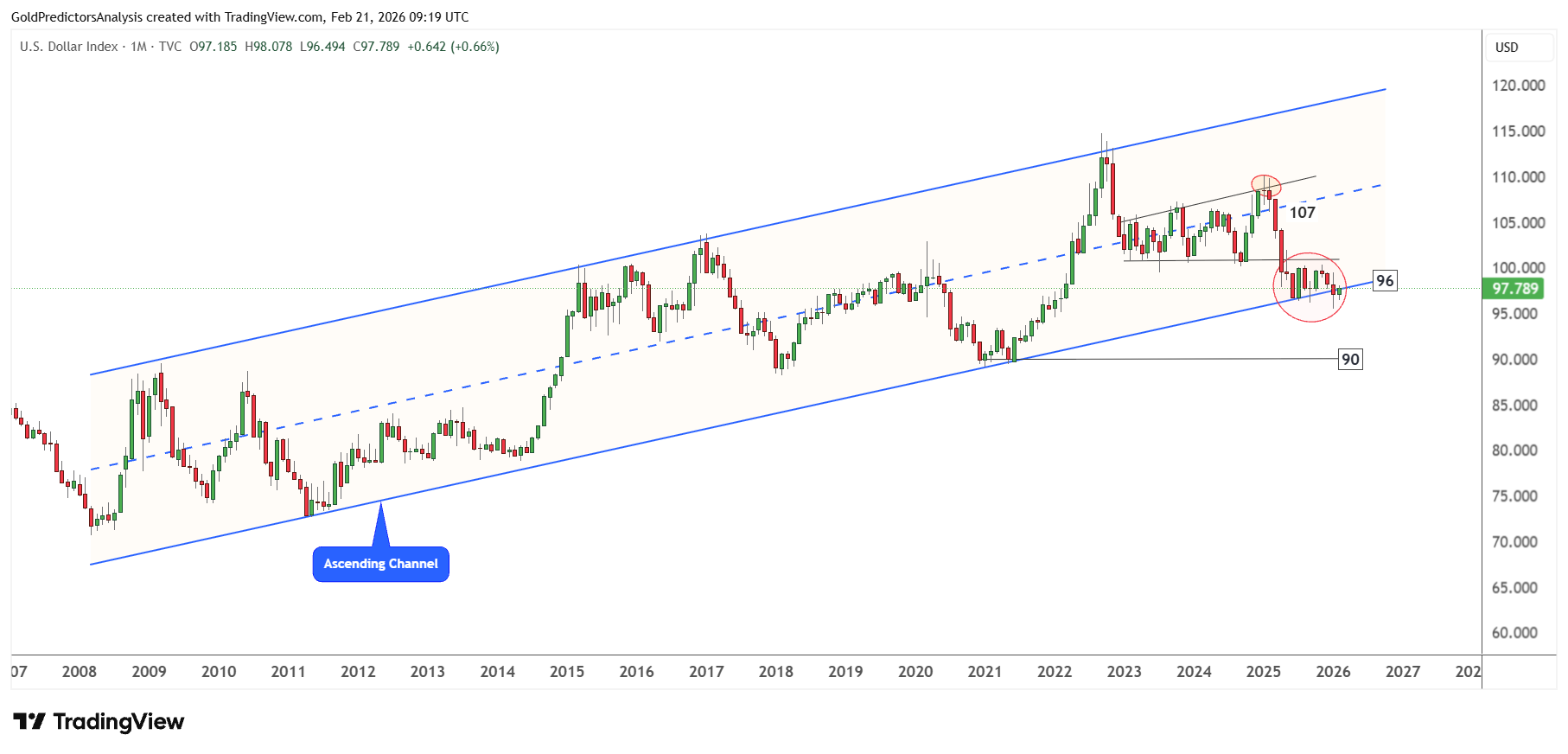
This uncertainty is also observed on the USD index chart, which shows strong price consolidation between 100.50 and 96.50. The USD index attempted to break below 96.50 in January 2026, but the index is still rebounding from this level to find next direction. As long as the index remains below 100.50, the possibility of index breaking below 96.50 is likely. A break below 96.50 will open the door for a strong drop towards 90.
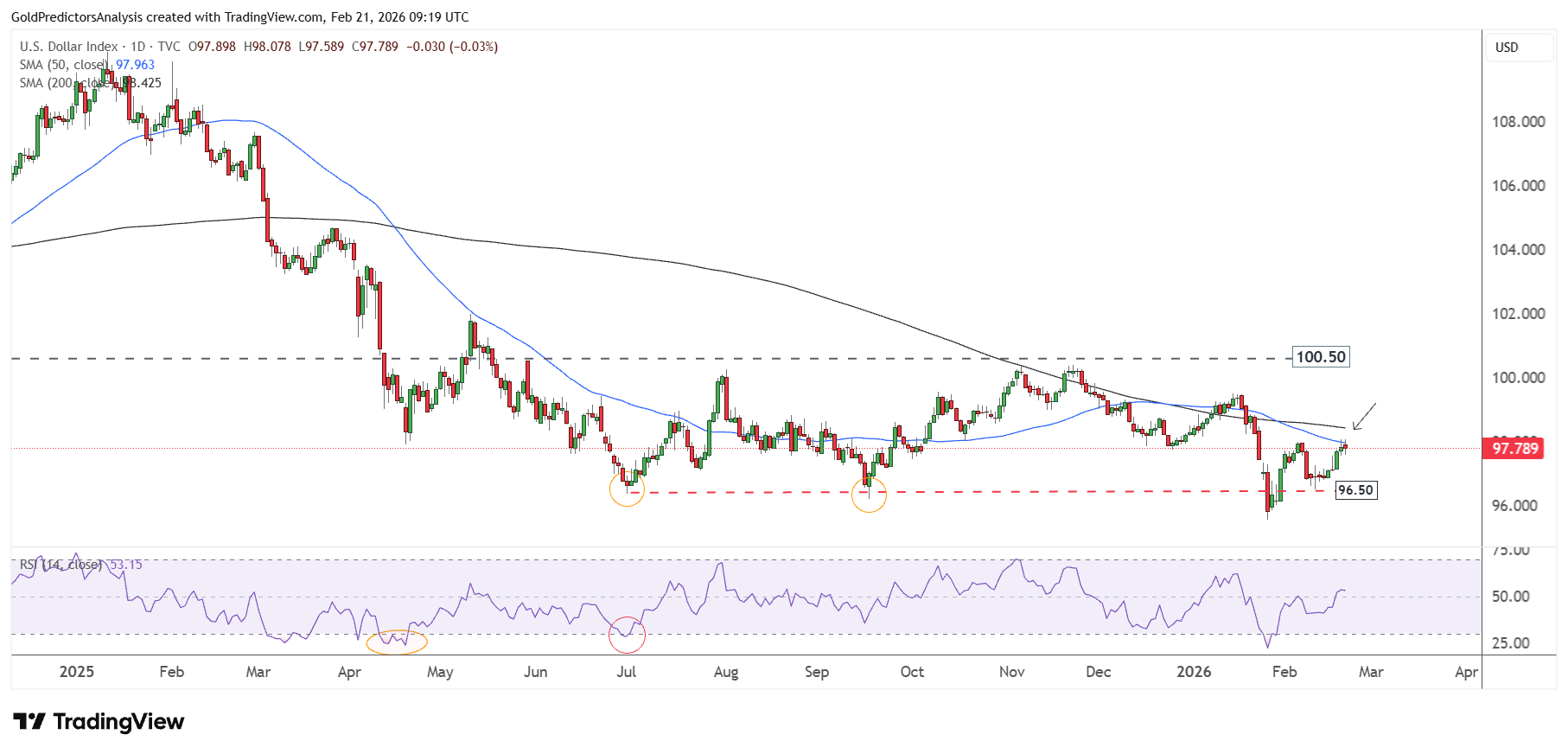
The short-term daily chart for the USD index also shows strong consolidation as 50-day SMA is consolidating around 200-day SMA. Despite the strong economic uncertainty seen last Friday, the USD index is trading below the 50-day SMA. A break above the 200-day SMA at 98.50 is required to take the index towards 100.50.
EUR/USD Outlook as Dollar Consolidates
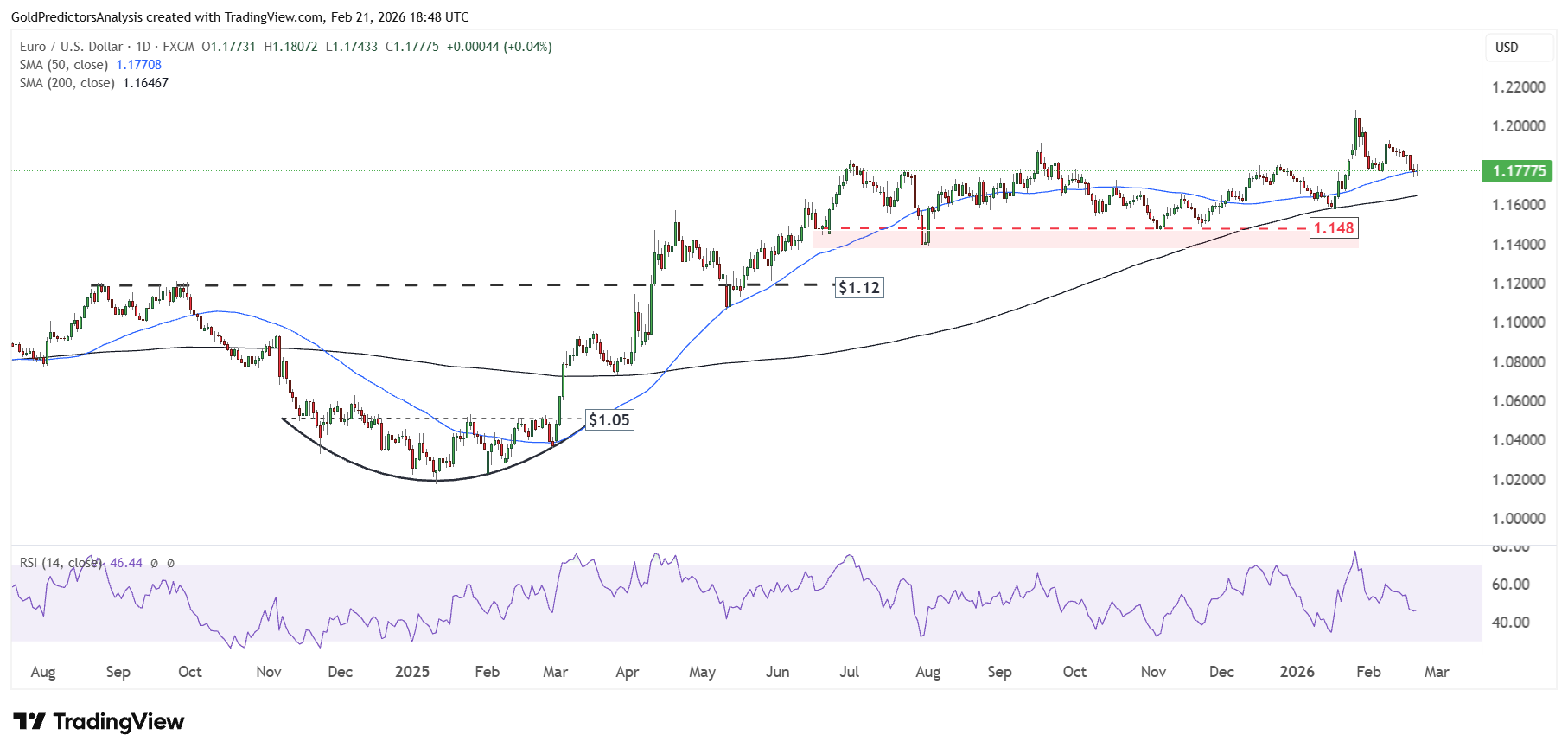
EUR/USD is consolidating above the support level of 1.148. The formation of a rounding bottom in January 2025 and then breakout above 1.12 has opened the door for a strong rally in EUR/USD. This strength in EUR/USD comes from the overall weakness in the US dollar index.
As long as the 1.148 support holds, the EUR/USD may continue to trend higher.
However, the last week’s consolidation bar on Friday increases short-term uncertainty. Despite this uncertainty, traders may continue to buy EUR/USD as long as 1.1650 holds for a rally towards 1.22.
USD/CHF Outlook from Key Support Zone
The rebound in US dollar index from 96 is causing USD/CHF to create a strong support at 0.77. It is observed that since US dollar index is trading at the long-term support region, the USD/CHF is also consolidating around the long-term support of 0.77.
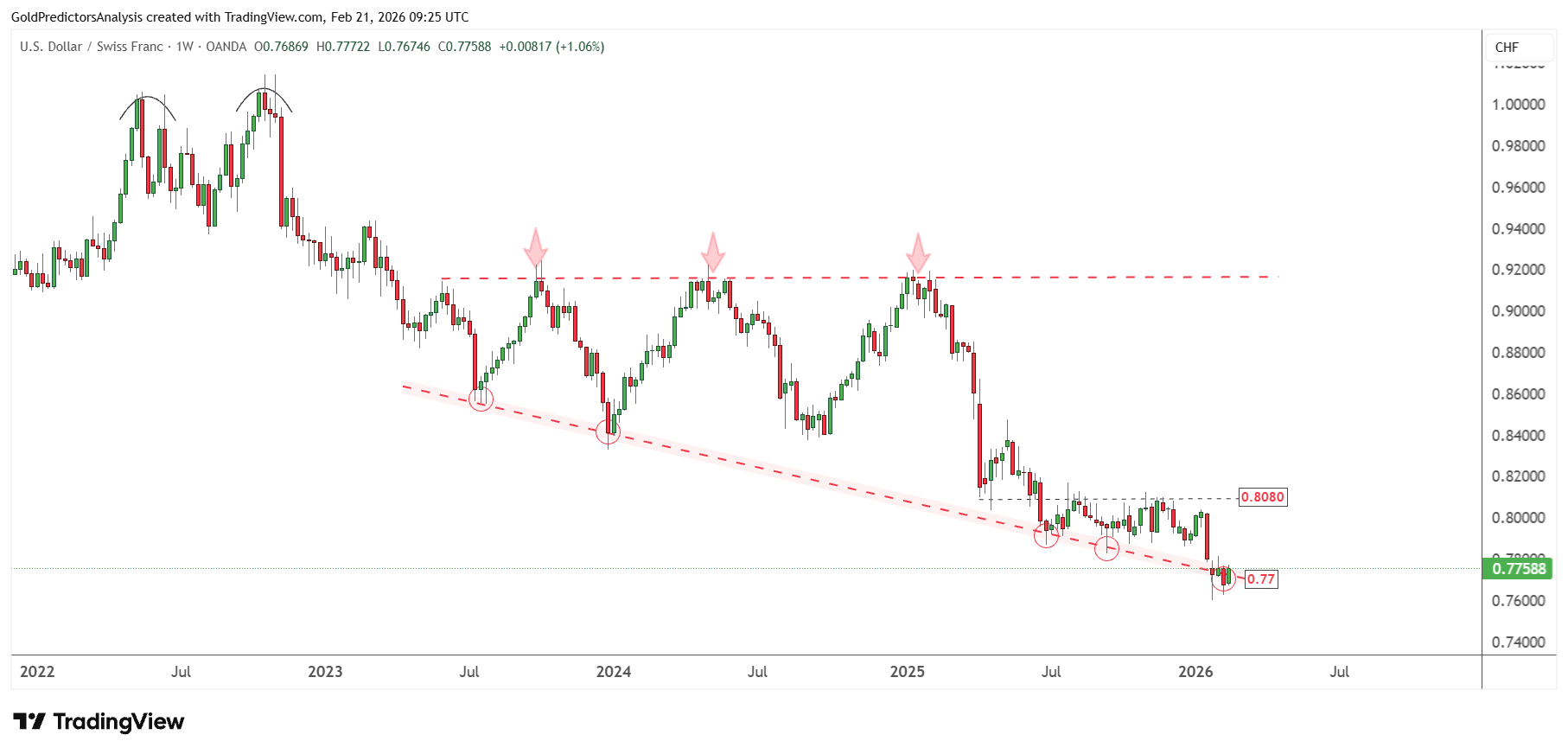
A strong recovery above 0.7850 will open the door to further upside towards 0.8080. This target is seen by the horizontal resistance level in the above chart. Traders may consider buying USD/CHF as long as the support of 0.76 holds and look for a rebound towards 0.80. On the other hand, a break below 0.76 will open the door for further downside towards 0.74.
S&P 500 Outlook Amid Tariff Uncertainty and Growth Rotation
US Equities are subject to a more complex response. The court ruling removes some extreme downside risk associated with unchecked tariff increases, which can support risk sentiment. However, the immediate announcement of a new 10% global tariff increases concern over input costs, global trade volumes and corporate margins.
Large multinational companies that depend on imported parts could remain under pressure. On the other hand, domestically oriented industries could benefit from ongoing protectionist policies. Markets will rotate between these themes instead of trending in one direction.
Another important factor is issue of refunds. If businesses anticipate years of litigation but eventual repayment of tariff revenues, there is a possibility that equity markets will account for future cash flow relief. This would be particularly relevant for companies that paid large import duties. This adds a medium-term bullish undertone even if there is volatility in the short term.
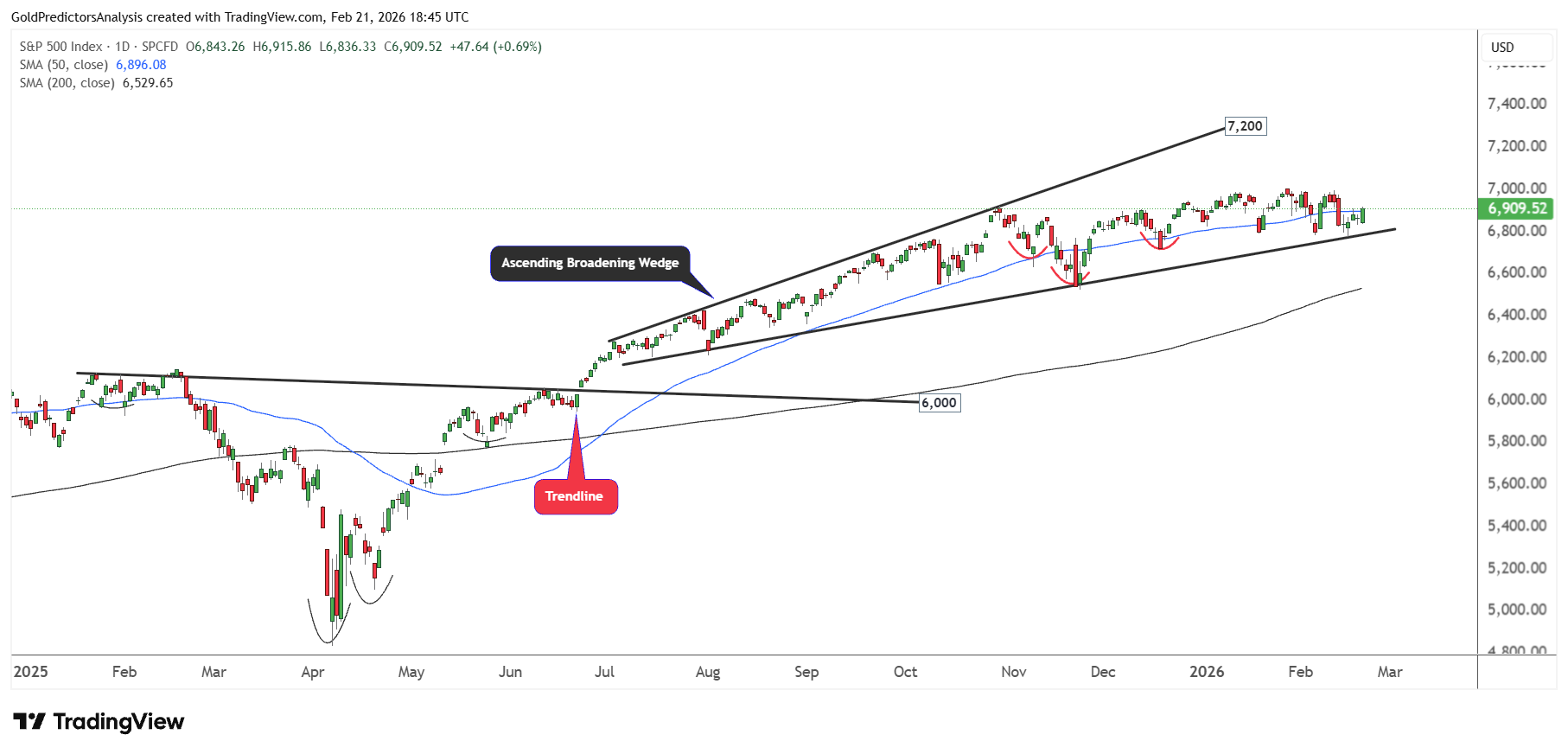
From technical perspective, the S&P 500 remains constructive. The chart below shows that the index is consolidating above 6,800, which is strong short-term support. The formation of an inverted head and shoulders pattern in 2025, and then a breakout above 6,000 indicates strong bullish momentum.
Then the formation of an ascending broadening wedge pattern from July 2025 and emergence of inverted head and shoulders pattern in November 2025 indicate bullish price action. A break above 7,000 will open the door for a rally to 7,500. The uncertainties created by the tariffs have overall had positive impact on the S&P 500.
Gold, Commodities, and Yield Outlook Under Policy Uncertainty
Commodity markets such as industrial metals and energy could respond to the structure of selective exemptions. If there is no taxation on critical raw materials, there is no breakdown in supply chains, which can lead to sharp inflation spikes. However, tariffs on manufactured goods continue to be a sign of slower growth in global trade. This could cap upside in cyclical commodities.
All of these market dynamics will likely keep the gold (XAU) price elevated in 2026. The chart below shows that the gold price has recovered from the record level of $5,600 and found support at $4,400.
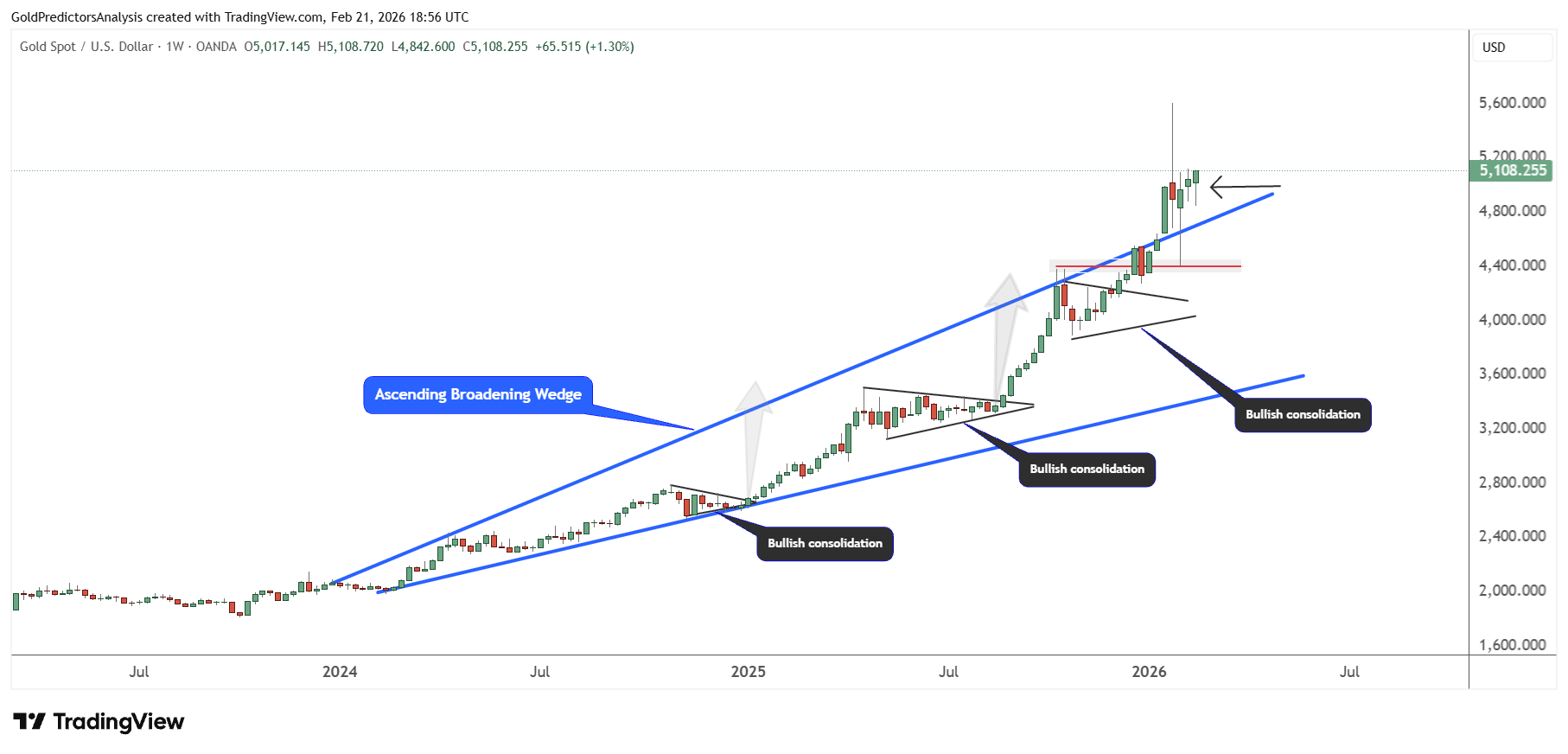
The rebound from the $4,400 is constructive and indicates continued upside during the next few weeks and months. The strong surge in gold price after the court ruling has broken the key level of $5,100. This breakout has opened the door for continued upside towards $5,600.
Macro Backdrop: Yields, Growth, and Inflation Expectations
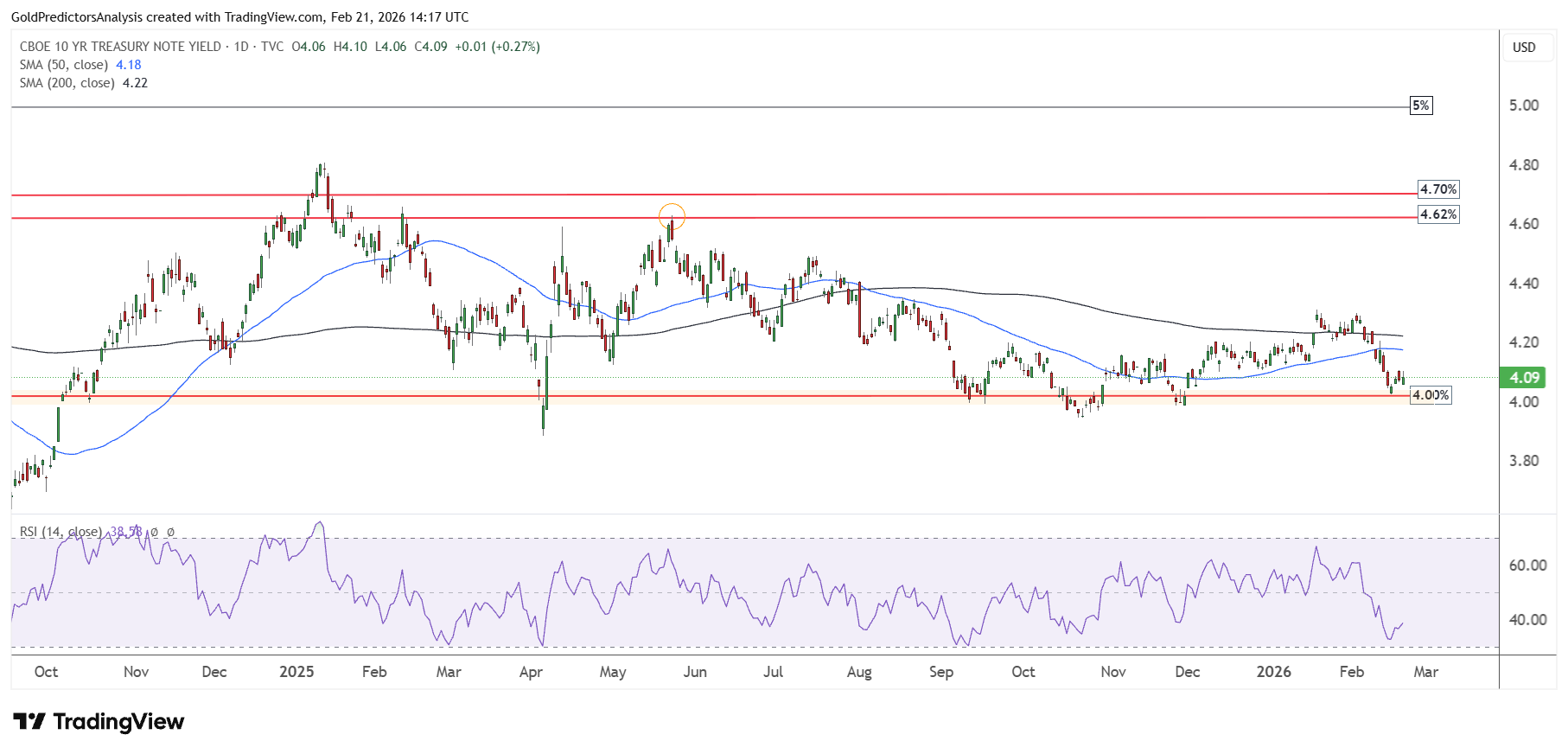
Bond markets will also be heavily monitoring this policy mix. Continued tariffs can keep inflation expectations high. But legal uncertainty and possible refunds are a counterforce that can lead to disinflation. This tension may result in range bound yields and not a clear directional move. The US Treasury yields are consolidating above the 4%, as shown in the chart below.
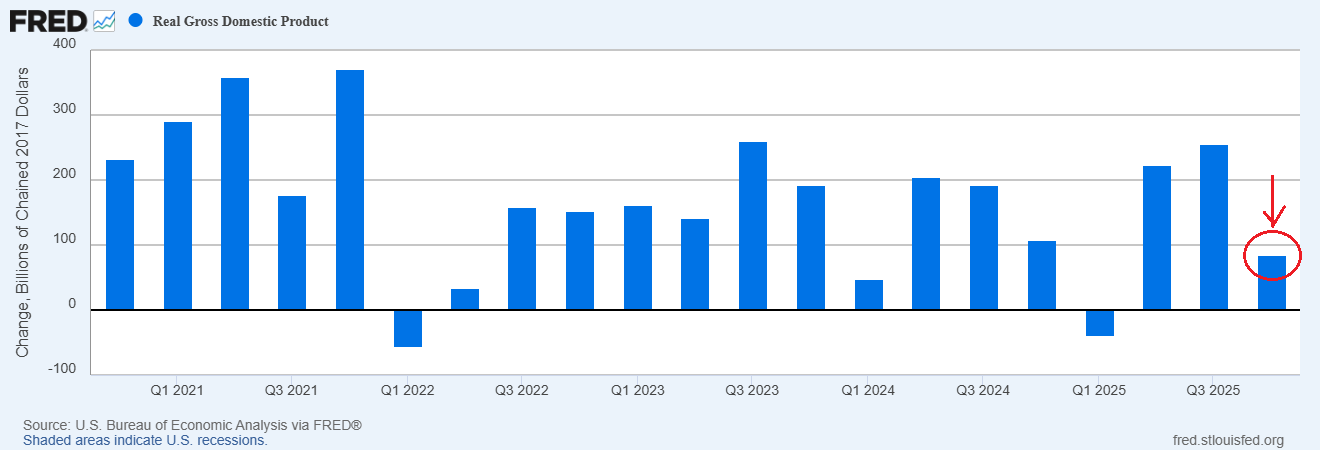
The larger macro picture is also fragile. The chart below shows that the real GDP growth is declining in fourth quarter. This indicates that US economy depends on massive capital investment in AI data centres to prevent recession. Meanwhile rest of the economy is being repeatedly disrupted.
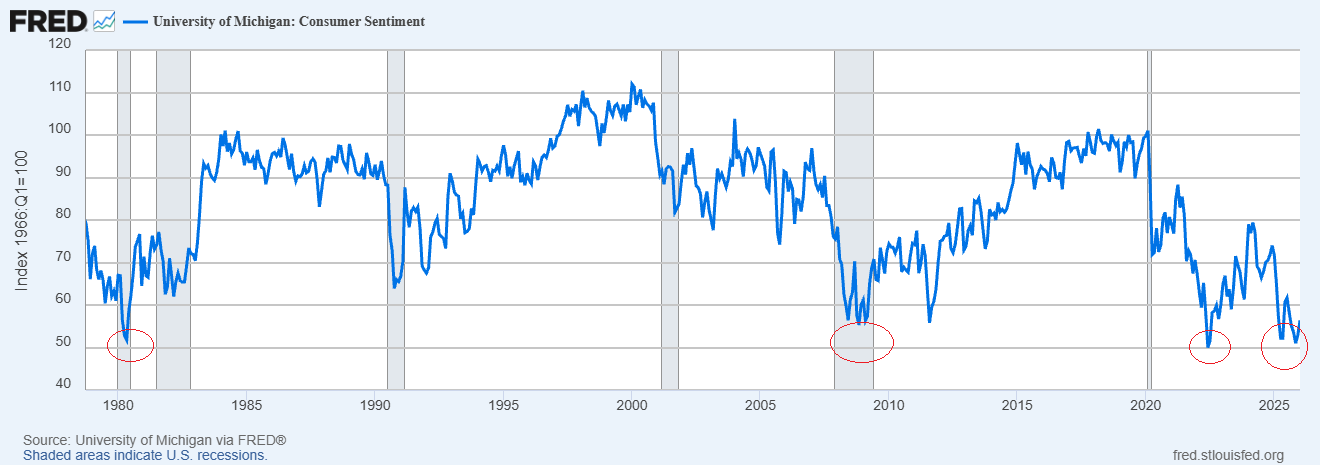
Consumer sentiment and perceptions of current economic conditions are close to sixty-year lows. This emphasizes that the recovery has been narrow and hasn’t benefited the majority of households even though unemployment is low.
As indicated in the chart below, the inflation expectations have slowly been declining during the last year. The expectations are decreasing from 6% in spring to 3% range by early 2026. This falling of expectations implies that despite the tariff policies, the markets have not fully factored in long term inflation shocks.
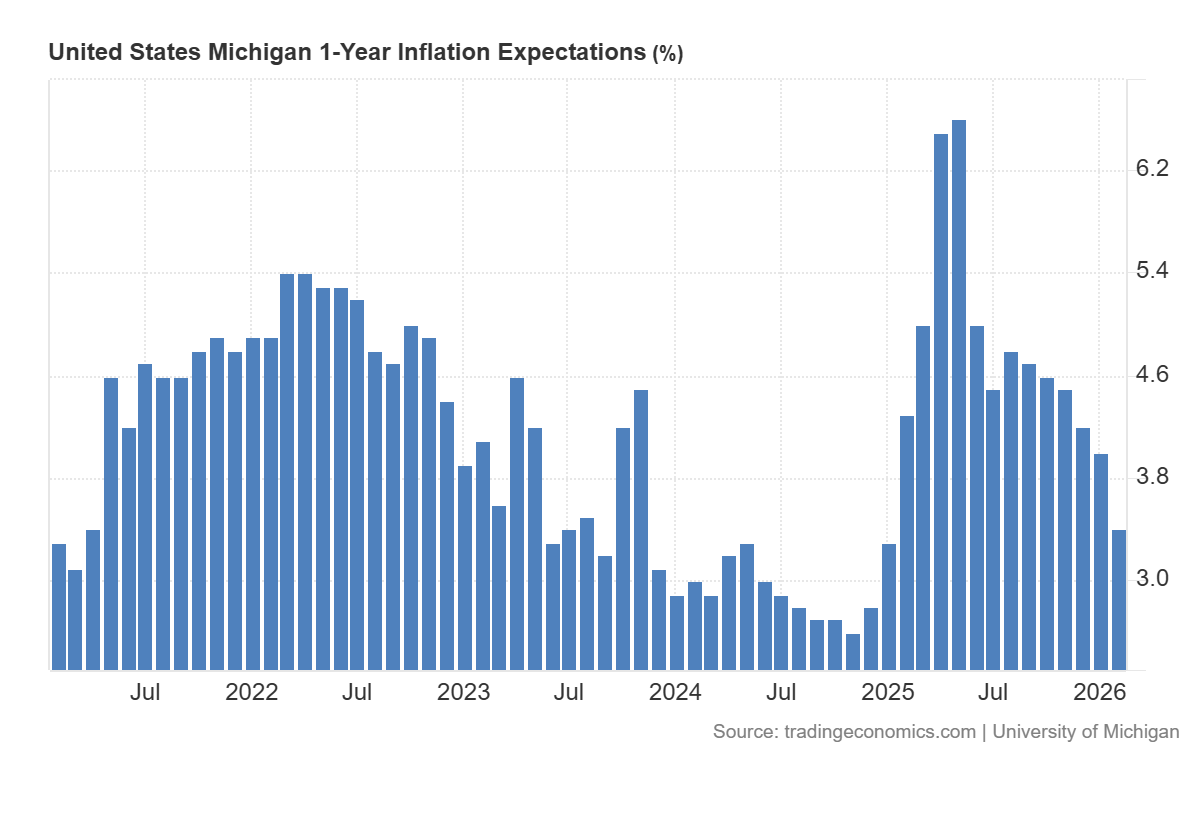
The investors appear to believe that legal problems, selective exemptions and potential tariff refunds will allow them to offset effects of long term inflation. This is one of the factors that has led to expectations being moderated. Thus, Treasury yields have not soared sharply higher but have remained steady above 4%.
Market Positioning Summary
In summary, Supreme Court ruling has not ended Tariff story but has only altered legal path. Protectionist policies are still in place through other tools to keep trade uncertainty elevated across markets. This means choppy moves in US dollar instead of a clear trend. Similarly, EUR/USD and USD/CHF may continue to experience volatility as markets re-evaluate balance between legal limitations and ongoing tariff pressure.
Equities are likely to be in a constructive but rotational tone, with protectionist measures helping domestic focused sectors while global exporters are at margin risk. Gold will likely be supported above $4,400 as policy uncertainty, lower GDP growth and weak consumer sentiment continue to support demand for defensive assets. Treasury yields may continue to be range-bound around current levels as tariffs are source of inflation and legal challenges and potential refunds are a source of disinflation. Overall, traders can anticipate headline-driven volatility this week, with continued strength in defensive assets if trade policy uncertainty is central theme in markets.
If you’d like to know more about how to trade sector and thematic ETFs, please visit our educational area.