XRP hovers below the crucial $1.5 level as improved sentiment toward the progress of the Market Structure Bill bolsters demand for XRP.
The White House stated that the TradFi-DeFi standoff could end, raising hopes that the Senate will pass the Market Structure Bill in the spring.
Meanwhile, robust demand for XRP-spot ETFs continued to signal institutional investor buying interest in XRP, another tailwind.
Increased optimism that the US Senate will pass the Market Structure Bill, US-XRP-spot ETF inflows, and increased XRP utility support a bullish medium-term (4-8 weeks) outlook for XRP, with a price target of $2.5.
Below, I will explore the key drivers behind recent price trends, the medium-term outlook, and the technical levels traders should watch.

US XRP-Spot ETF Market Extends Inflow Streak
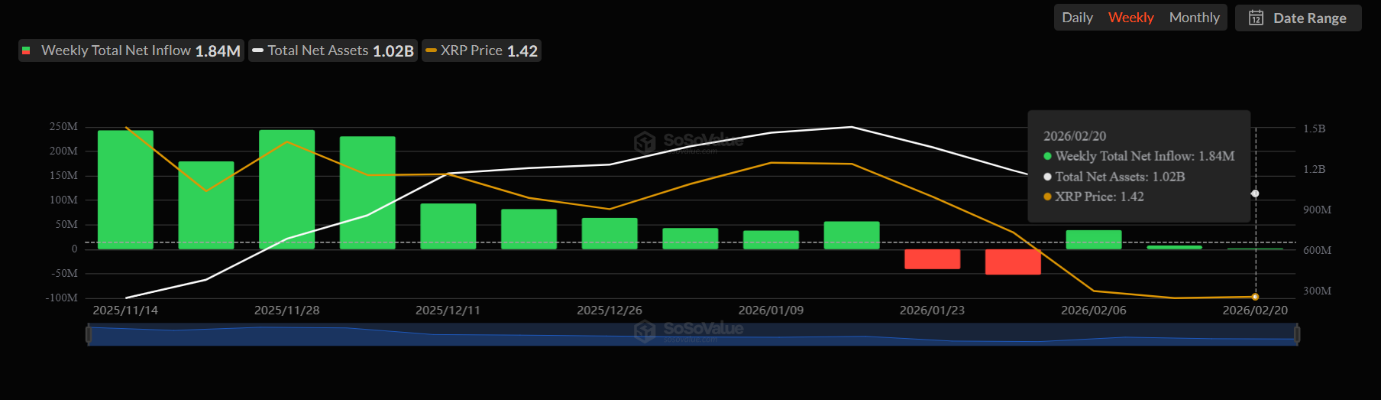
The US-XRP-spot ETF market saw net inflows of $1.84 million in the reporting week ending February 20. Importantly, the spot ETF market extended its inflow streak to three weeks, reflecting resilient institutional demand. Since launching in November, the US XRP-spot ETF market has reported $1.23 billion in total net inflows.
“If you don’t think crypto is the future… Pay attention to how traditional banks are fighting against stablecoins paying yield. It’s really that simple.”
Notably, the US XRP-spot ETF market has outperformed the US BTC-spot ETF market since November. Crypto-friendly legislation and increased XRP utility, combined with spot ETF inflows, suggest a future decoupling from Bitcoin (BTC).
For context, the US BTC-spot ETF market saw $303.5 million in net outflows in the reporting week ending February 20. Since US XRP-spot ETFs began trading in November, the US BTC-spot ETF market has seen $5.33 billion in net outflows, weighing on BTC and the broader crypto market. A decoupling would be a significant outcome for XRP holders seeking the benefits of XRP utility on Main Street.
XRP has dropped 13.27% in February, tracking BTC’s 13.37% loss, underscoring Bitcoin’s heavy influence on broader market sentiment.
Bitcoin Price Forecast
Every new Bitcoin analysis as it publishes, today's technical signal and key levels, live price — on one page.
See all Bitcoin forecastsUS Banks and the Market Structure Bill in the Spotlight
This week, Ripple CEO Brad Garlinghouse lifted sentiment, giving a 90% chance that the US Senate will pass the CLARITY Act before the end of spring. Executive Director of the President’s Council of Advisors for Digital Assets, Patrick Witt, gave a similar prognosis, fueling hopes of an agreement on stablecoin yields next week.
White House economics reporter Eleanor Mueller commented on last week’s session on stablecoin yields, stating:
“In today’s meeting between banks and crypto, the White House presented a proposal that would allow exchanges to pay customers for their stablecoins as long as they base it on activities or transactions (not balances), I’m told. Expectation is banks start meeting tomorrow into the weekend to decide whether to sign off.”
An agreement on how to handle stablecoin yields may not directly impact XRP. However, analysts expect crypto-friendly legislation to strengthen Ripple’s position in the TradFi space, key to XRP utility. XRP remains highly sensitive to legislative developments.
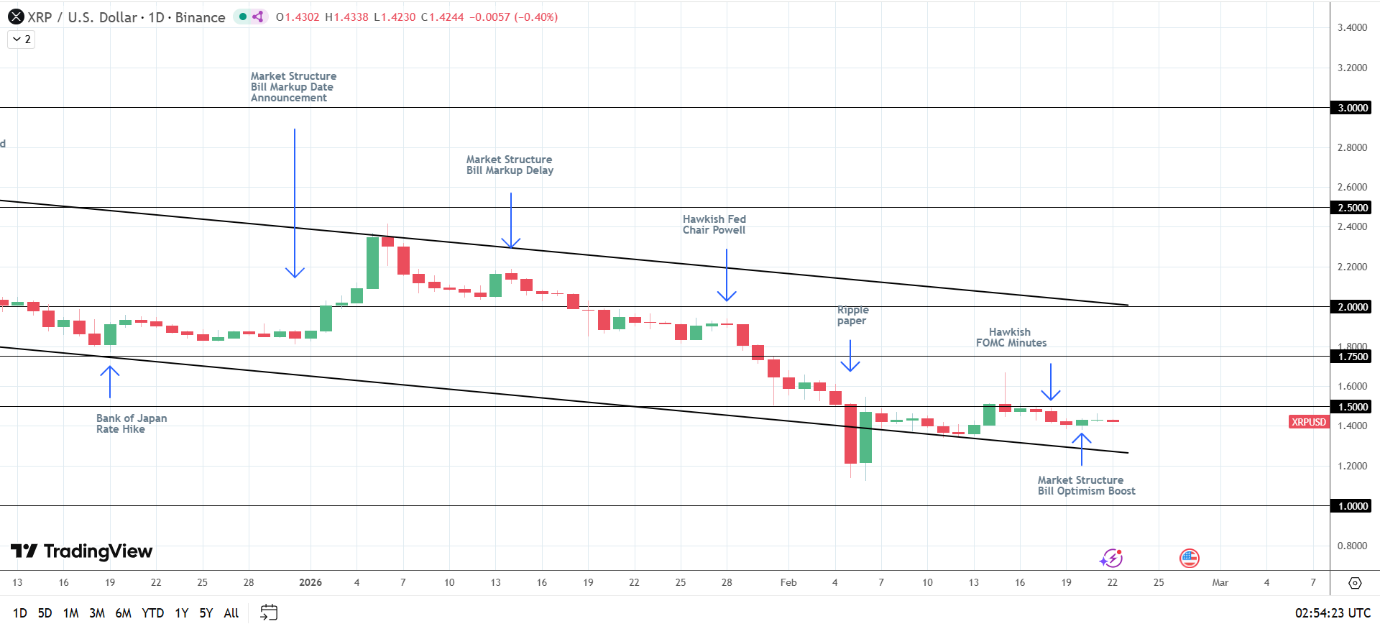
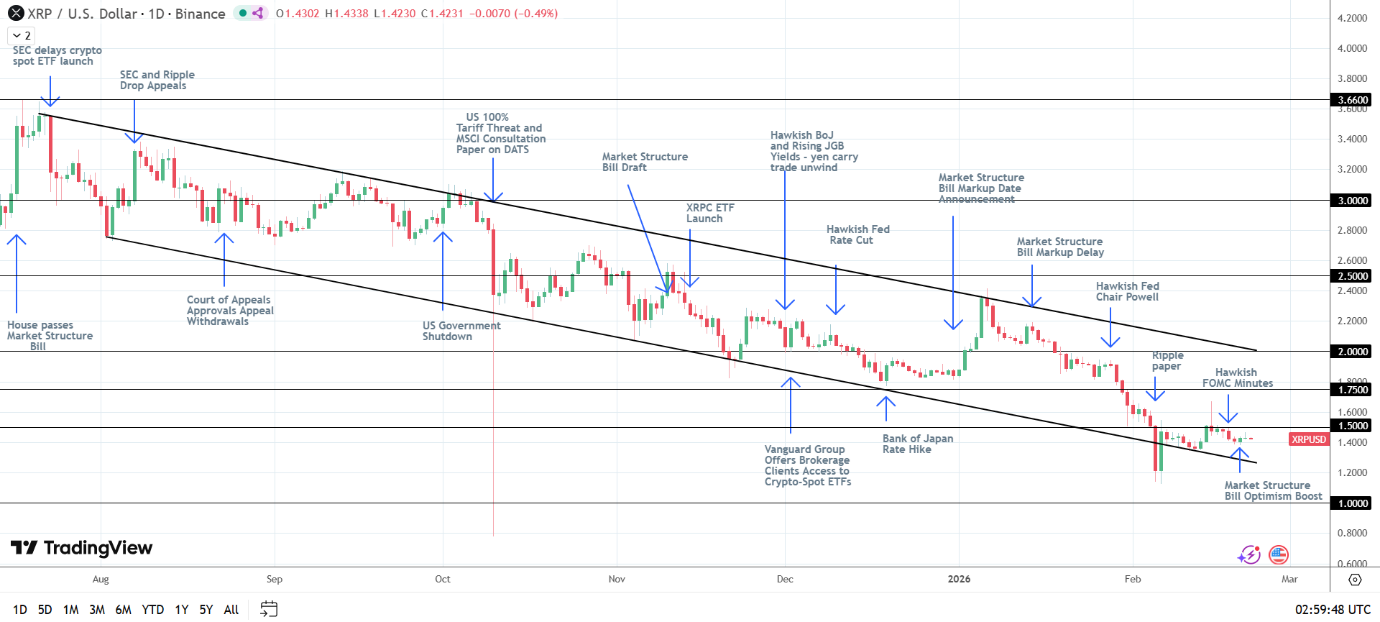
XRP rallied from a December 31 low of $1.8103 to a January 6 high of $2.4151 on the US Senate Banking Committee’s announcement of its markup vote on draft text for the Market Structure Bill. However, XRP tumbled to a February low of $1.1227 in response to the Banking Committee’s postponement of its markup vote. The token has reclaimed $1.43 on the recent legislative developments and the improved optimism.
XRP Price Forecast: Short-, Medium-, and Long-Term Targets
XRP has tumbled 22.63% year-to-date, supporting a cautiously bearish short-term outlook (1-4 weeks), with a target price of $1.0.
However, XRP-spot ETF flow trends, improving optimism over the US Senate passing the Market Structure Bill, and increased XRP utility support the bullish medium- to long-term price projections:
- Medium-term (4-8 weeks): $2.5.
- Longer-term (8-12 weeks): $3.0.
Key Downside Risks to the Bullish Medium-Term Outlook
Several scenarios could derail the constructive medium-term bias. These include:
- A full-blown US-Iran conflict.
- US economic indicators dampen expectations of an H1 2026 Fed rate cut.
- Delays and/or partisan opposition to the Market Structure Bill.
- Extended periods of XRP-spot ETF net outflows.
Additionally, traders should consider Bank of Japan chatter and USD/JPY, given the impact of the mid-2024 yen carry trade unwind on XRP.
A hawkish Bank of Japan, with a higher neutral interest rate (potentially 1.5%-2.5%), would indicate multiple BoJ rate hikes. Multiple hikes would narrow US-Japan rate differentials in favor of the yen. Narrowing rate differentials could trigger a yen carry trade unwind, drying up market liquidity. For context, the BoJ previously announced a wider neutral rate band of 1%-2.5% but stated it would announce a narrower range at a later date.
These factors would weigh on XRP, send the token toward $1.0, and reinforce the cautiously bearish short-term outlook.
Technical Analysis: Levels to Watch
XRP rose 0.08% on February 21, following the previous day’s 1.57% gain, closing at $1.4301. The token outperformed the broader crypto market cap, which ended the session flat.
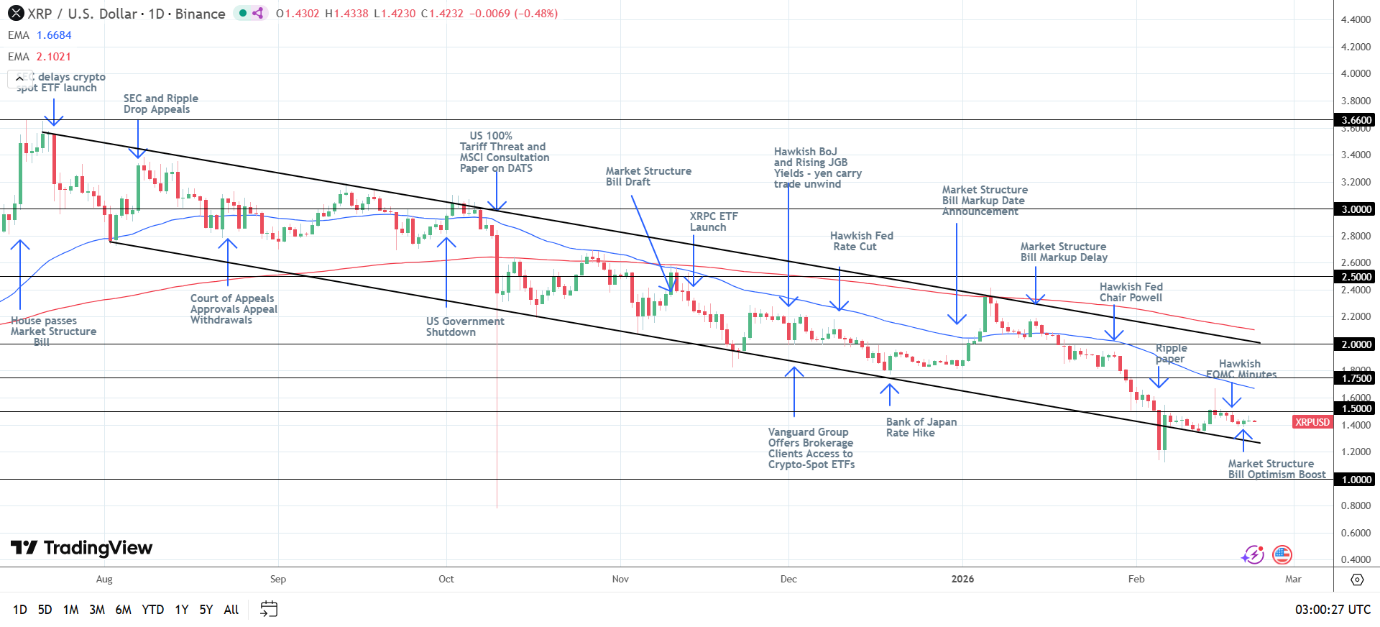
Despite reclaiming $1.43, XRP remained below its 50-day and 200-day EMAs. The EMA positions signaled a bearish bias. However, the 50-day EMA flattened further, suggesting easing near-term selling pressure. Additionally, several positive fundamentals continue to counter bearish technicals, supporting the bullish medium-term outlook. Despite these favorable fundamentals, short-term technicals remain bearish.
Key technical levels to watch include:
- Support levels: $1.0, and then $0.7773.
- 50-day EMA resistance: $1.6684.
- 200-day EMA resistance: $2.1021.
- Resistance levels: $1.5, $2.0, $2.5, and $3.0.
On the daily chart, a break above $1.50 would bring the 50-day EMA into play. A sustained move through the 50-day EMA would signal a near-term bullish trend reversal. A bullish trend reversal would open the door to testing the 200-day EMA.
A sustained breakout above the EMAs would affirm a bullish trend reversal and reinforce the medium- to longer-term price targets.
Fundamental Events Driving Near-Term Price Action
Near-term price drivers include:
- XRP-spot ETF flows.
- US economic data and the Fed’s policy stance.
- Crypto-related legislative developments.
- The Bank of Japan’s neutral rate and rate path.
- Increased geopolitical tensions in the Middle East.
Bearish Structure Intact: $1.0 Remains Crucial Support
Despite Saturday’s gains, XRP has fallen 3.3% this week, affirming the existing bearish trend. A drop below the lower trendline would expose the February 6 low of $1.1227. If breached, $1.0 would be the next key support level. A sustained fall through $1.0 would reaffirm the cautiously bearish short-term outlook and further validate the bearish structure.
However, reclaiming $1.5 would bring $2.0 and the upper trendline into play. A sustained move through the upper trendline would invalidate the bearish structure and signal a bullish trend reversal, reaffirming the constructive medium-term bias.
- Short-term (1-4 weeks): $1.0.
- Medium-term (4-8 weeks): $2.5.
- Longer-term (8-12 weeks): target of $3.0.
XRP Outlook: Geopolitics, Crypto Legislation, and ETF Flows in Focus
Looking ahead, XRP remains exposed to rising geopolitical tensions in the Middle East. An increased risk of a US-Iran conflict would likely overshadow crypto-related regulatory developments.
Nevertheless, the progress of the Market Structure Bill on Capitol Hill would reaffirm the bullish medium- to longer-term outlook for XRP.
Meanwhile, central bank chatter, US economic indicators, and XRP-spot ETF flow trends will also influence XRP’s price projection.
A more dovish Fed and a lower BoJ neutral rate (potentially 1%-1.25%) would lift sentiment. Strong demand for US XRP-spot ETFs and positive crypto-related regulatory developments would fuel buying interest in XRP.
In summary, these events would support a medium-term (4–8 weeks) move to $2.5. The US Senate passing the Market Structure Bill would reinforce the longer-term (8-12 weeks) price target of $3.0.
Beyond 12 weeks, these scenarios may drive XRP to its all-time high of $3.66 (Binance). A breakout above $3.66 would reaffirm a 6- to 12-month price target of $5.