
Bitcoin (BTC) eyes a five-week losing streak as fading bets on a June Fed rate cut and rising geopolitical tensions impact sentiment.
This week, US economic indicators tempered expectations of the Fed lowering borrowing costs, weighing on demand for BTC. Shifting sentiment toward the Fed’s rate path also impacted buying interest in US BTC-spot ETFs, another headwind for BTC.
Nevertheless, improving sentiment toward the US Senate passing crypto-friendly legislation continued to support a cautiously bullish medium-term outlook.
Below, I consider the key drivers behind recent price trends, the short-term outlook, the medium-term trajectory, and the key technical levels traders should watch.

US BTC-Spot ETF Market Extends Outflow Streak
The US BTC-spot ETF market saw net outflows of $315.9 million in the reporting week ending February 20. Significantly, the spot ETF market extended its outflow streak to five weeks, weighing on the supply-demand balance and buying interest in BTC.
According to Farside Investors, key flows for the reporting week ending February 20 included:
- iShares Bitcoin Trust (IBIT) saw net outflows of $303.5 million.
- Fidelity Wise Origin Bitcoin Fund (FBTC) had net outflows of $19.6 million.
- In total, six ETF issuers reported weekly net outflows, compared to one ETF with weekly net inflows.
The five-week outflow streak has weighed heavily on BTC demand. BTC has tumbled 22.44% year-to-date as BTC-spot ETFs have seen YTD outflows of $2.6 billion. Significantly, the spot ETF flow trends continue to support a bearish short-term outlook.
Fading bets on a June Fed rate cut have affected BTC-spot ETF market flow trends. According to the CME FedWatch Tool, the probability of a June Fed rate cut dropped from 68.6% on February 13 to 53.5% on February 20, following the release of US economic data.
Crucially, elevated borrowing rates would affect liquidity, potentially leading traders to unwind leveraged positions in BTC and delay speculative trades.
Bitcoin Price Forecast
Every new Bitcoin analysis as it publishes, today's technical signal and key levels, live price — on one page.
See all Bitcoin forecastsBitcoin and the US Economic Calendar: Labor Market Data and the Fed in Focus
Looking at the week ahead, US labor market and consumer confidence data will influence sentiment following last week’s market reaction to key US data.
On Tuesday, February 24, US consumer confidence figures will provide insights into the domestic demand outlook. Economists expect the CB Consumer Confidence Index to rise from 84.5 in January to 86.0 in February. A sharper upswing would signal a pickup in consumer spending, given the tighter labor market. Increased spending would fuel demand-driven inflation, supporting a more hawkish Fed rate path.
On Thursday, February 26, US initial jobless claims will also influence sentiment after last week’s larger-than-expected fall to 206k. Economists forecast initial jobless claims will rise from 206k (week ending February 14) to 211k (week ending February 21). A higher jobless claims reading, nearer 250k, would revive Fed rate cut bets and boost demand for BTC.
Beyond the data, traders should closely monitor FOMC members’ reactions to the recent US economic reports. Their views on inflation, the labor market, and the timing of rate cuts will be crucial for BTC’s near-term price trajectory.
Bitcoin Fear & Greed Index Signals Bearish Sentiment
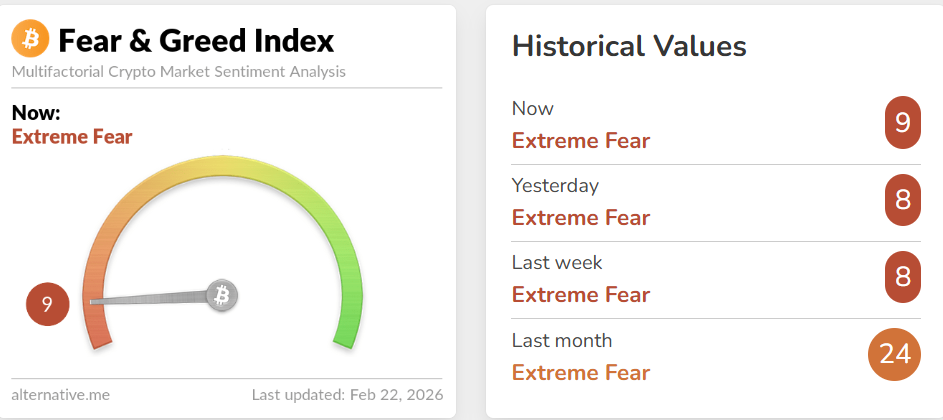
Despite rebounding from February’s low of $60,000, the Bitcoin Fear & Greed Index languishes within the Extreme Fear zone. The Fear & Greed Index rose from 8 to 9 on Sunday, February 22, reflecting extreme bearish sentiment. Typically, these conditions suggest a price recovery, reinforcing the bullish medium-term outlook.
Downside Risks to Medium-Term Outlook: Central Banks, US Data, and ETF Flows
While positive fundamentals support a constructive medium-term bias, downside risks include:
- The BoJ indicates a higher neutral interest rate (potentially 1.5%-2%), signaling multiple rate hikes. BoJ rate hikes and Fed rate cuts would narrow US-Japan rate differentials in favor of the yen. A markedly narrower rate differential could trigger a yen carry trade unwind as seen in mid-2024.
- US economic indicators dampen Fed rate cut bets.
- Lawmakers delay crypto-friendly legislation.
- US-Iran tensions intensify.
- BTC-spot ETFs report extended periods of outflows.
These scenarios would likely push BTC toward $60,000, exposing the August 2024 low of $49,351 (the yen carry trade unwind low).
In summary, the short-term outlook remains bearish as fundamentals align with technicals. However, the medium- to longer-term outlook is cautiously bullish, hinged on favorable fundamentals developing. These fundamentals include the progress of the Market Structure Bill, easing geopolitical tensions, and expectations of Fed rate cuts.
Technical Analysis
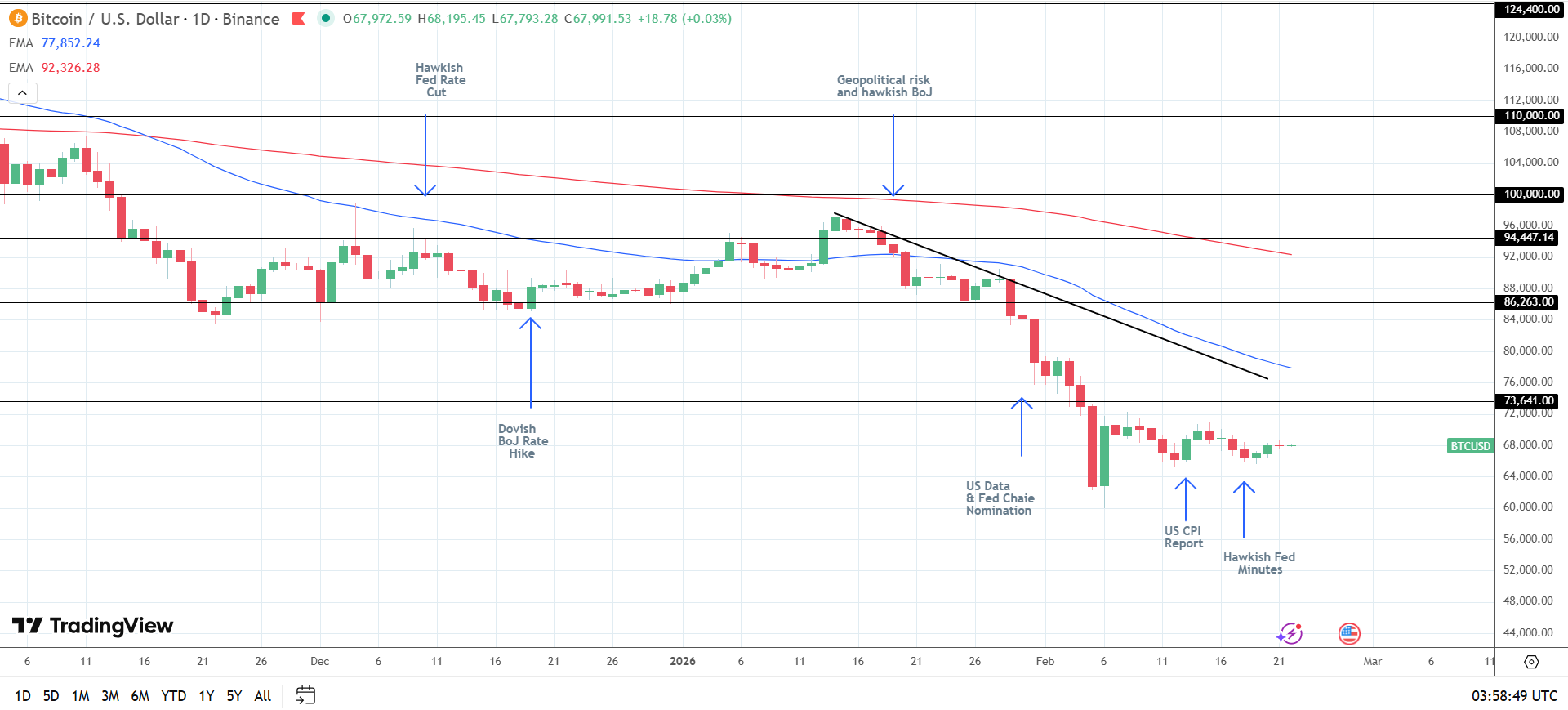
This week’s losses leave BTC trading well below its 50-day and 200-day Exponential Moving Averages (EMAs), signaling a bearish bias. However, oversold conditions and evolving fundamentals suggest a rebound from the current levels, countering the negative technicals.
A breakout above $70,000 would bring the 50-day EMA into play. A sustained move through the 50-day EMA would indicate a near-term bullish trend reversal, paving the way toward the 200-day EMA. A sustained move above the 200-day EMA would affirm a bullish trend reversal, opening the door to testing the $100,000 psychological level.
Bearish Structure in Focus: What Happens if BTC Reclaims $70,000?
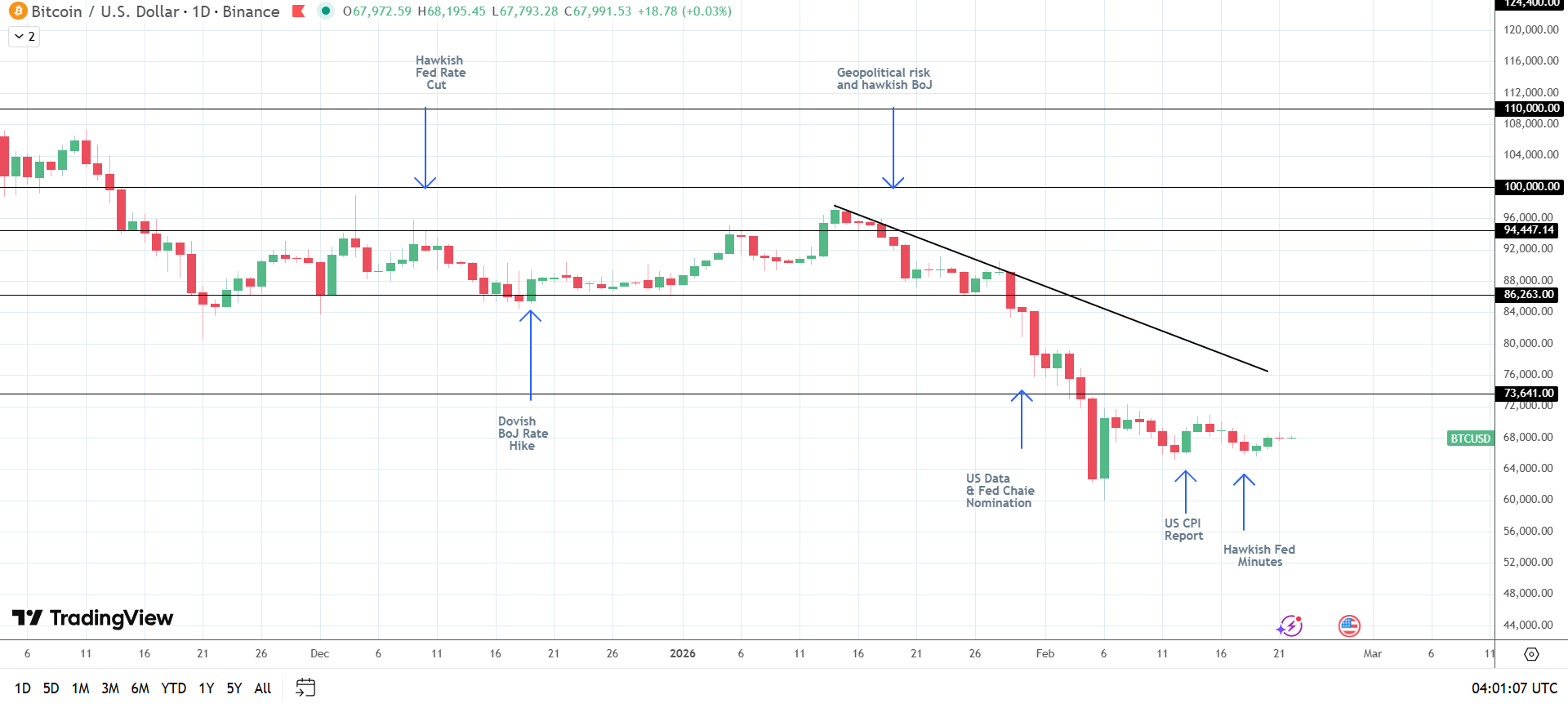
A breakout above $70,000 would bring the upper trendline into play. A sustained move through the upper trend line would invalidate the bearish structure, reaffirming the bullish medium-term (4-8 weeks) price target of $100,000.
However, a sustained drop below the February 6 low of $60,000 would expose the August 24 low of $49,351 and further validate the bearish structure.
Track BTC market trends with our real-time data and insights here.
Outlook: Reclaiming $70,000 Key to Medium-Term Bullish Outlook
US economic indicators, Fed rhetoric, the BoJ rate path, crypto-related legislative developments, geopolitics, and US BTC-spot ETF flows will influence demand for BTC.
Considering the recent price action, the medium- and long-term outlook remains constructive, with a 6-12 month price target of $123,731 (ATH). The US Senate’s passing the Market Structure Bill and rising bets on Fed rate cuts would support the bullish outlook.
Stay informed on BTC trends by monitoring macroeconomic developments, ETF flows, and technical indicators here.