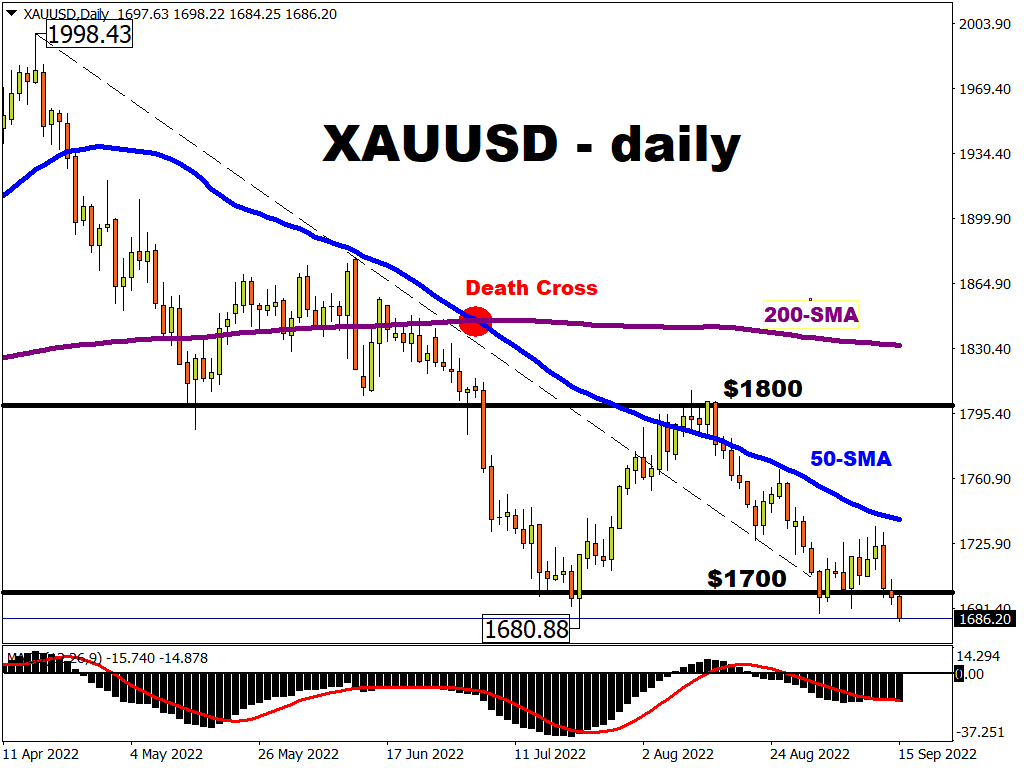
Here are more data points that make for gloomy reading for gold bulls (those hoping that gold prices will climb):
- Gold has fallen by 7.8% so far this year
- Gold has suffered 5 straight months of declines (April – August), its longest monthly losing streak since 2018
- Bullion-backed ETFs have lowered their gold holdings for a 13th consecutive day (i.e. investors are ditching gold)
So Why Has Gold Performed So Poorly So Far in 2022?
It’s all down to the Federal Reserve.
And here’s a quick summary of what you’re about to read:
More Fed rate hikes = stronger US dollar / higher US Treasury yields = lower gold
To better understand the forces that are driving gold prices lower, read on.
US Dollar Index Price Forecast
Every new US Dollar Index analysis as it publishes, today's technical signal and key levels, live price — on one page.
See all US Dollar Index forecastsWhy is the Fed Raising Interest Rates?
The US Federal Reserve has been raising interest rates as the central bank’s main policy weapon against stubbornly persistent inflation.
The August consumer price index (used to measure the headline inflation rate) released earlier this week showed a higher-than-expected 8.3% growth.
While that 8.3% number is lower than June’s 9.1% CPI, it’s still about 4 times higher than the Fed’s 2% inflation target.
In other words, inflation is still stubbornly high despite the Fed having already hiked rates by 225 basis points since March, and counting, to try and bring that inflation down.
The inflation data suggests that the Fed has to hike rates even higher:
- Markets are forecasting a 25% chance of a 100 basis point hike at its FOMC policy meeting next week.
If such a gargantuan move happens, that 100bps move would be 4 times bigger than the usual 25bps adjustments per policy meeting typically employed by major central bankers, at least over the past few decades. - Markets currently expect US interest rates to peak at around 4.4%, from the current 2.5%, excluding next week’s expected hike.
That’s a major shift compared to expectations as of just last week, when markets expect US rates to peak at 4%.
With these updated expectations, that suggests another 190 basis points more that US interest rates could climb.
How Do Fed Rate Hikes Influence Gold Prices?
Here’s a oversimplified narrative for how the above works:
- Fed sends US interest rates higher, investors then ditch US Treasuries, pushing Treasury prices lower.
- As US Treasury prices fall, their yields go up (investors get paid a higher interest from holding on to those US government bonds).
- When US Treasury yields go up, they eventually become more attractive to foreign investors.
- These investors then buy up the US dollar, so they can purchase more US assets.
But when the US dollar/yields climb, gold becomes less appealing because of these two features for the precious metal:
- Gold is a zero-yielding asset.
Investors do not get paid any income for holding on to gold.
Hence, when investors are promised higher yields on US Treasuries, they tend to favor lending their money to the US government in return for those higher interest payments, as opposed to parking their money in gold which does not pay interest. - Also, gold has an inverse relationship with the US dollar.
When the dollar goes up, gold typically goes down, and vice versa.
This is because, when foreign investors need to use more of their currency to buy the more-expensive US dollar in order to purchase gold (the precious metal’s benchmark price is denominated in US dollars), those expensive price tags then make gold less appealing.ECONS 101: Demand falls when prices go up.
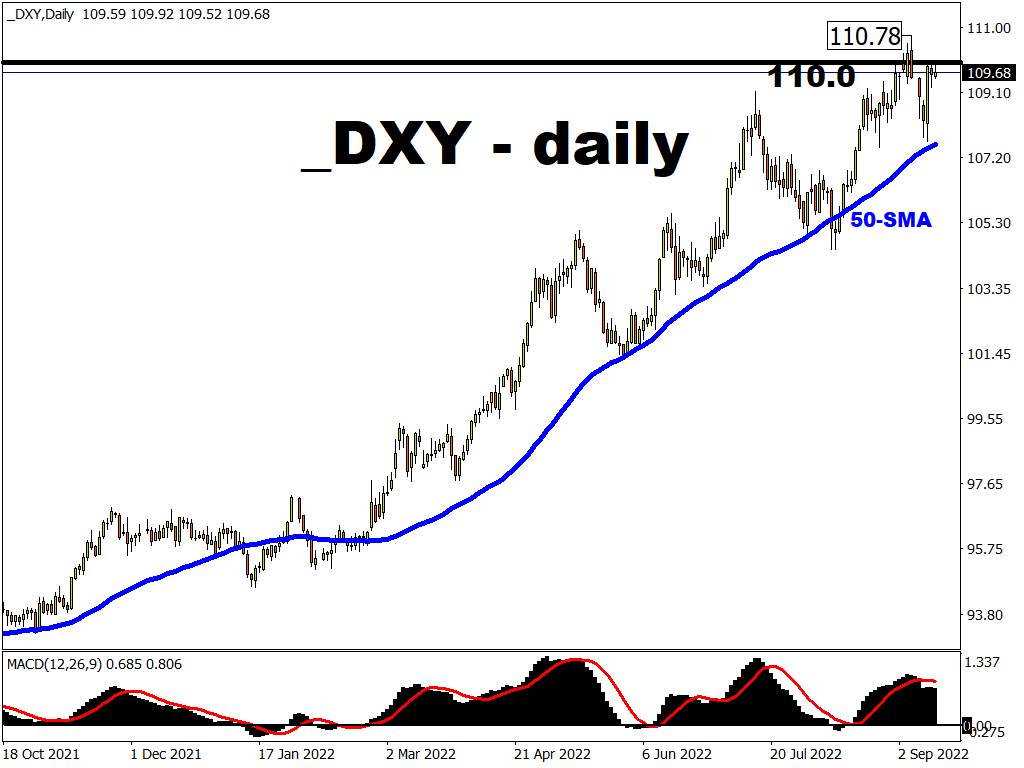
Here’s a chart showing how much the US dollar has risen this year, as measures by the DXY (the benchmark index used to measure the US dollar’s overall performance against its G10 peers) which is now at its highest levels since 2002.
So Where to Next for Gold?
At least gold bulls can take heart from the price action since mid-2020, whereby forays below $1700 have proved short-lived.
As you can see on the weekly chart below, quite a few notable support levels can be seen in a wide range between $1660.03 – $1685.15.
Gold’s 200-week simple moving average (SMA) also hovers in this region ($1676 at the time of writing). This major technical indicator potentially offering support as well.
In other words, gold may not have that much further to fall, provided these support levels close by do hold up.
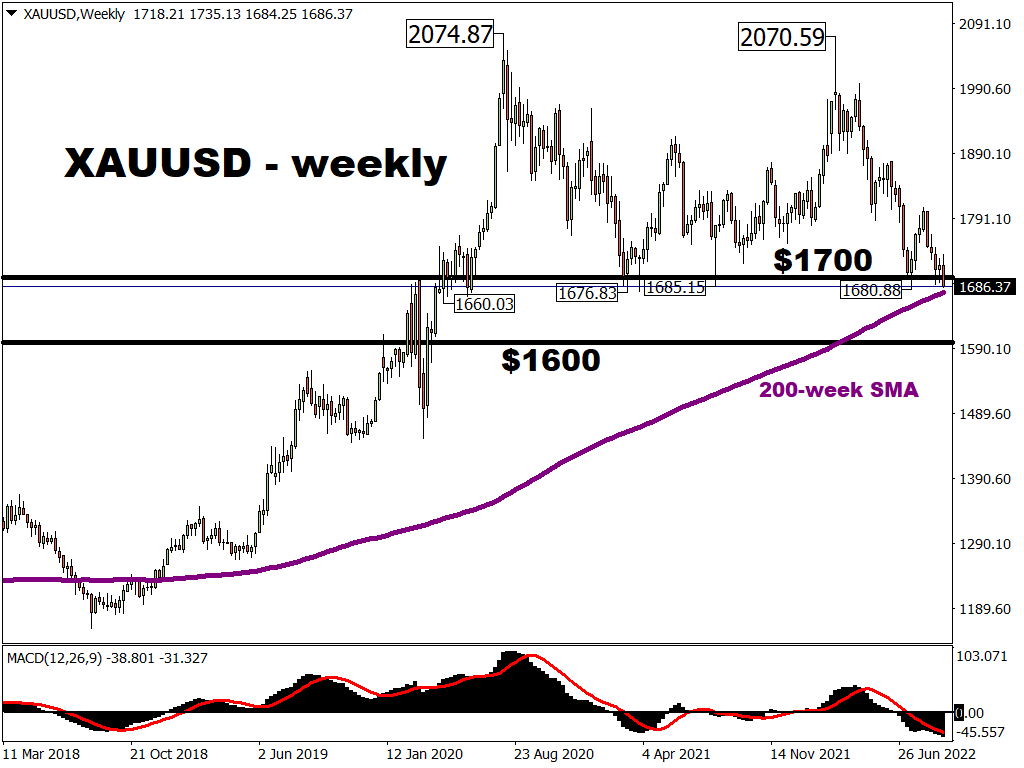
However, once you strip away the wild price swings at the onset of the global pandemic, there appears to be little by way of major support before hurtling down to sub-$1600 levels.
Alternatively, one could employ the price action from back in the 2011-2013 period to draw support levels.
Though bear in mind, support levels from a decade ago are less relevant to today’s markets, given the substantially different market and macroeconomic environment that we currently find ourselves (e.g. US inflation being at its highest in over 40 years).
Overall, Gold’s Safe Haven Status Has Clearly Been Eroded by the Fed’s Ongoing Rate-hiking Cycle
Despite the still-raging war in the Ukraine, along with rising fears of a looming global recession, the precious metal’s traditional role as a way to preserve investors’ wealth has been found lacking, in light of the downward pressures stemming from rising US yields and the dollar.
Ultimately, gold’s immediate fortunes will likely depend on how high markets expect the Fed to send interest rates.
As things stand, markets are forecasting that US interest rates will peak at 4.4% by March, from the 2.5% currently (before next week’s highly-anticipated FOMC rate decision).
If markets believe that the Fed has to send interest rates even higher past 4.4% in order to subdue the inflation beast, that should heap more downward pressure on gold prices.
For more information visit FXTM.