



Natural Gas Surges as Arctic Cold Front Drives Unexpected Demand Spike
Natural gas futures are sharply higher on Monday after gapping on the daily chart early Sunday. Traders are reacting to the cold front cutting across major demand areas in the United States as freezing temperatures extend as far South as lower Florida, leading to an unexpected demand surge.
At 14:26 GMT, February Natural Gas Futures are trading $3.630, up $0.527 or +16.98%.
Winter Storm Warning Amplifies Cold Weather Forecast
Traders knew the cold weather was coming with NatGasWeather forecasting high demand Sunday through Wednesday, but since that forecast was issued on January 15, the National Weather Service has issued a winter storm warning, calling for hazardous wind chills and snow threats stretching from the Midwest to the East Coast.
While not quite a “polar vortex”, the magnitude of the “cold shot” was enough to chase a few of the weaker shorts out of the market and perhaps attract a few speculators.
Arctic Intrusion Expected Late January Could Boost Withdrawals
Professional traders are seldom caught off-guard by a current event like this week’s cold. They tend to react to the 10-15 day forecast. And in doing so, they shifted to the colder forecast for late January with arctic air expected to sweep much of the eastern U.S., lifting heating demand forecasts.
Forecast models for January 26 to February 1 are now calling for an “Arctic Intrusion” that is expected to strengthen heating demand and potentially boost withdrawals.
Natural Gas Price Forecast
Every new Natural Gas analysis as it publishes, today's technical signal and key levels, live price — on one page.
See all Natural Gas forecastsHigh Storage Inventories Limit Upside Despite Demand Surge
Unfortunately for longer-term bulls, storage inventories are significantly above the five-year average, offering a cushion against demand spikes and limiting upside price moves. Therefore, this latest forecast may produce volatile price action, yet limited price gains. Nonetheless, the rally could extend further if the 10-15 day forecasts continue to point toward new cold weather patterns after February 1.
While these quick blasts of cold are more likely to produce limited short-covering rallies, new forecasts calling for lingering cold or even polar vortex predictions will have the power to create rallies of longer duration than a few days.
Technical Outlook Shows Key Resistance at $3.634 Breakout Level
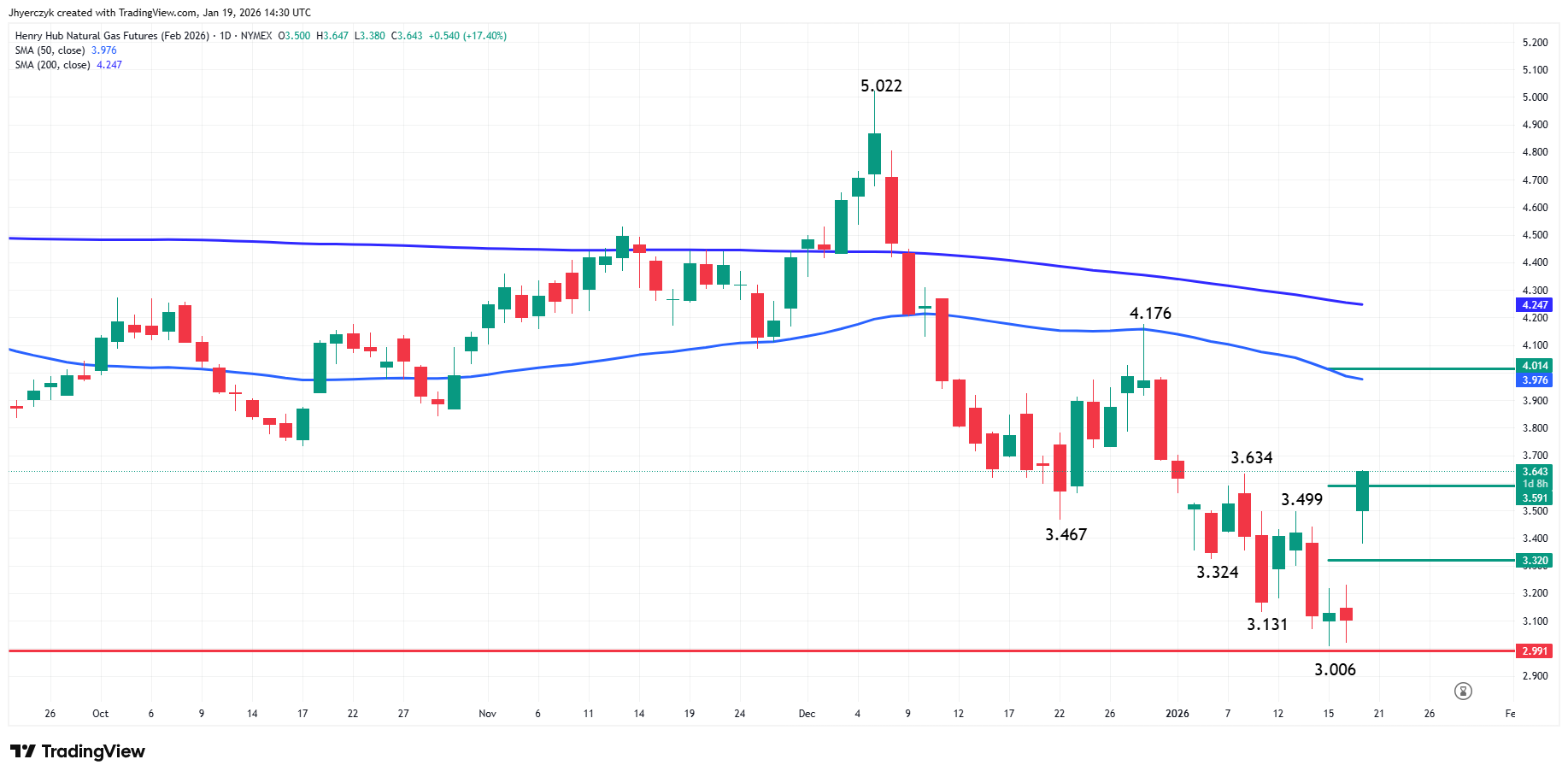
Technically, the support is currently established at last week’s low at $3.006, which is also above the psychological $3.00 level.
After taking out a minor 50% level at $3.320 on the opening, the market is now testing another retracement level at $3.590, just ahead of the swing top at $3.634, which could be the true breakout level for an acceleration into the first major target, the 50-day moving average at $3.976 and the intermediate 50% level at $4.014.
The 200-day moving average at $4.247 is also on the radar, but it’s going to take a stronger cold front to challenge and perhaps overcome this long-term trend indicator.
More Information in our Economic Calendar.