
Yen intervention threats sent XRP lower on Tuesday, December 23, amid lingering fears of a yen carry trade unwind. Government failures to sustainably strengthen the yen through FX markets may pressure the Bank of Japan into more aggressive rate hikes.
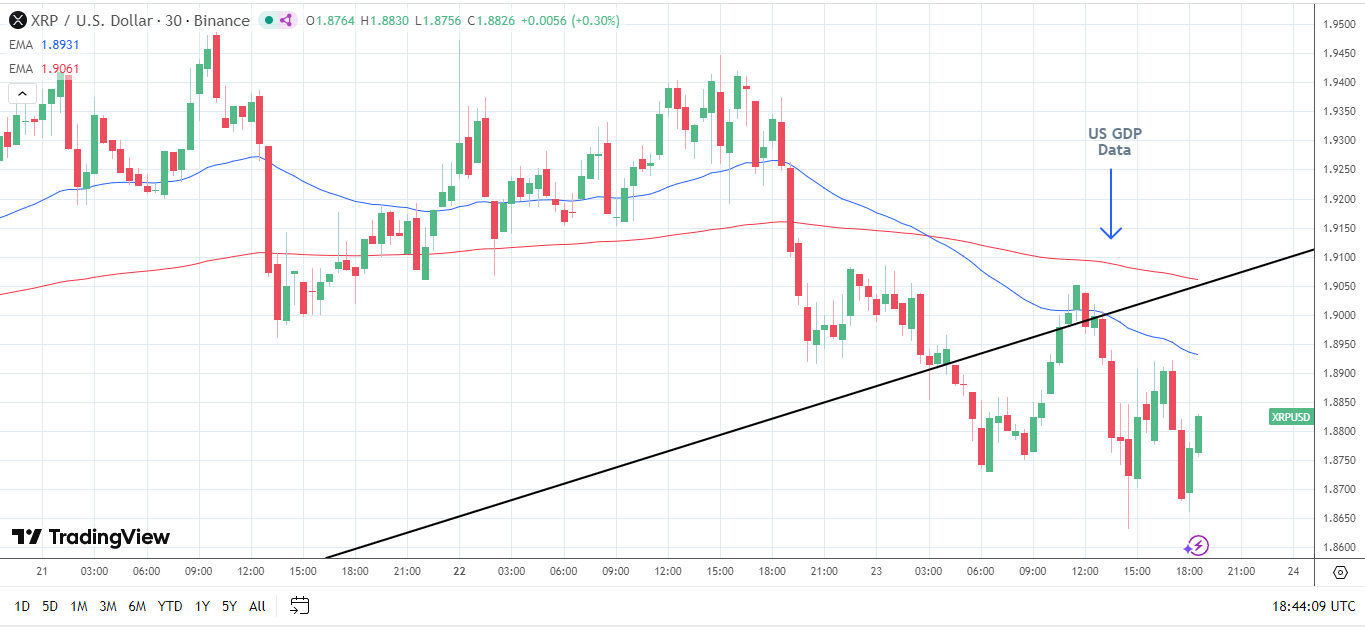
US inflation jitters overshadowed better-than-expected Q3 GDP growth, adding to the selling pressure. Fading bets on a March Fed rate cut sent XRP to a session low of $1.8631.
Robust demand for XRP-spot ETFs failed to cushion the downside, underscoring market sensitivity to Fed and Bank of Japan rate paths. XRP-spot ETFs reported net inflows of $43.89 million on Monday, December 22, as ETF issuers extended the inflow streak to 26 consecutive sessions.
Despite Tuesday’s pullback, the price outlook remains constructive. Legislative developments, a resilient US economy, and strong demand for XRP-spot ETFs remain key tailwinds.
Below, I will explore the key drivers behind recent price trends, the medium-term (4-8 weeks) outlook, and the key technical levels traders should watch.

Yen Intervention Threats Send USD/JPY Lower, as 10-Year JGBs Hold Above 2%
USD/JPY faced a second day of losses on Tuesday, following renewed yen intervention threats. Last week, the cautious BoJ rate hike sent USD/JPY to a high of 157.765.
This week, Japan’s Finance Minister responded to USD/JPY trends, threatening yen intervention in the forex markets. On Tuesday, December 23, Finance Minister Satsuki Katayama reportedly reissued a warning from the previous session, stating:
“They absolutely do not reflect fundamentals. The government will take appropriate action against excessive moves.”
USD/JPY dropped to a session low of 155.649 before steadying. 10-year Japanese Government Bond (JGB) yields fell back from Monday’s multi-decade high of 2.1%, but remained above 2%.
Higher 10-year JGB yields narrow the US-Japan rate differential, making yen carry trades less profitable. The combination of a stronger yen and elevated yields weighed on sentiment. However, the USD/JPY drop from 157 to 155 is unlikely to disrupt the global markets.
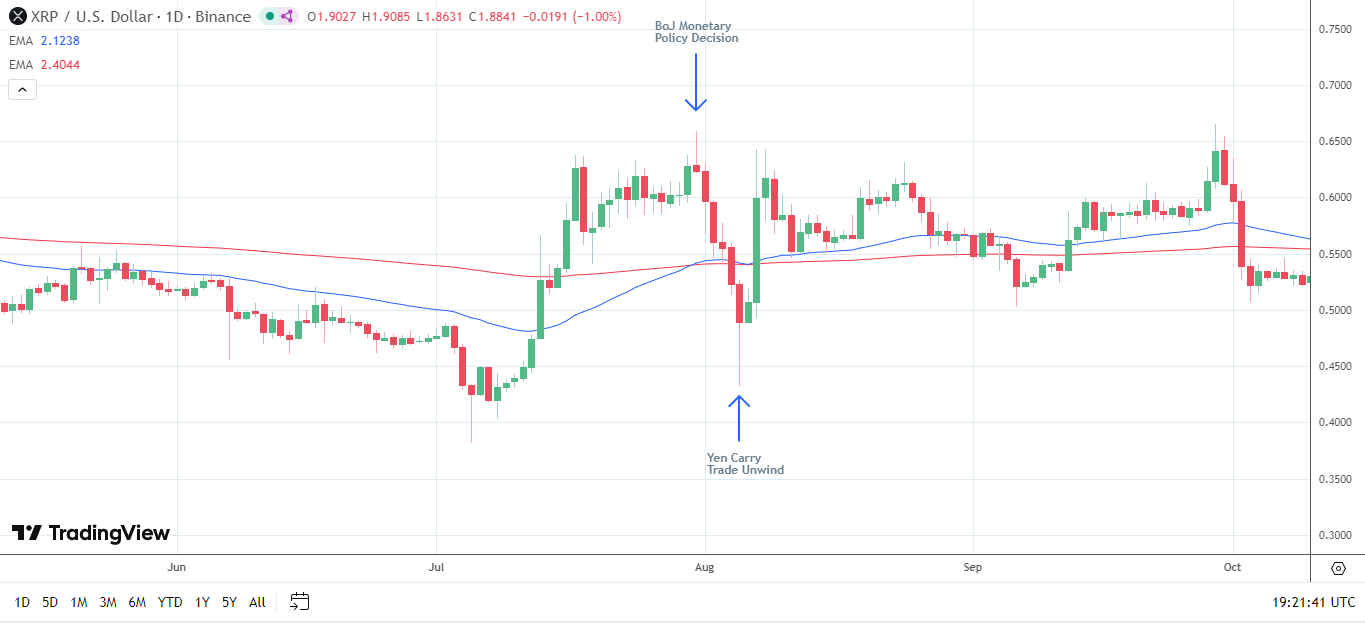
For context, the BoJ raised interest rates and cut JGB purchases on July 31, 2024, triggering a yen carry trade unwind.
USD/JPY plunged from 161 levels in mid-July 2024 to 141.684 on August 5, 2024, sending risk assets sharply lower. XRP tumbled from $0.6591 on July 31, 2024, to $0.4320 on August 5, 2024, as markets reacted to the BoJ-induced yen rally.
Bitcoin Price Forecast
Every new Bitcoin analysis as it publishes, today's technical signal and key levels, live price — on one page.
See all Bitcoin forecastsHot Price Deflator Overshadows Roaring US Economy
The US economy expanded by 4.3% quarter-on-quarter (QoQ) in Q3, up from 3.8% in Q2. Typically, stronger economic momentum would boost demand for risk assets. However, a hotter price deflator indicated a sticky inflation backdrop, dampening expectations for a March Fed rate cut. PCE Prices rose 2.8% QoQ in Q3, accelerating from a 2.6% increase in the previous quarter.
According to the CME FedWatch Tool, the probability of a March cut fell from 52.9% on December 22 to 45.7% on December 23.
Market commentator Paul Barron remarked on the Q3 GDP report, stating:
“The Dual Engine: Consumer spending + AI capital expenditure boom = a powerful combination. Companies are dumping cash into AI infrastructure at a record pace. The Problem: A hot price deflator signals inflation isn’t over. Worse: GDP and employment are decoupling, with strong growth but limited job creation.”
Barron highlighted the tug-of-war effect of the third quarter numbers, adding:
“Strong GDP = risk on, but persistent inflation keeps the Fed hawkish. BTC, ETH, XRP, and XAUT benefit from the ‘new economy’ narrative, but expect volatility from inflation concerns.”
Medium- and Long-Term Outlook: Constructive Bias Intact
Shifting bets on a Fed rate cut and yen intervention warnings fueled market uncertainty. However, robust demand for XRP-spot ETFs and the prospect of crypto-friendly US legislation remain tailwinds for XRP.
Considering the current market dynamics, the short-term (1-4 weeks) outlook remains cautiously bullish, with a $2 price target. The medium-term (4-8 weeks) and longer-term (8-12 weeks) outlooks remain constructive, with price targets of $2.5 and $3.0, respectively.
Downside Risks to the Constructive Bias
Several scenarios could challenge the bullish outlooks. These include:
- The Bank of Japan faces increased pressure to bolster the yen and announces a neutral interest rate of between 1.5% and 2.5%.
- US data cools bets on a March rate cut.
- The MSCI delists digital asset treasury companies (DATs). Delistings would likely reduce interest in XRP as a treasury reserve asset.
- US Senate opposes the Market Structure Bill.
- XRP-spot ETFs report outflows.
These scenarios would likely push XRP toward $1.75, signaling a bearish trend reversal.
In summary, the short-term outlook remains cautiously bullish as fundamentals override the bearish technicals. Meanwhile, the medium- to longer-term outlooks are constructive.
Financial Analysis
Technical Outlook: EMAs Signal Caution
XRP fell 1.62% on Tuesday, December 23, following the previous day’s 1.0% loss, closing at $1.8724. The token underperformed the broader crypto market, which declined 1.27%.
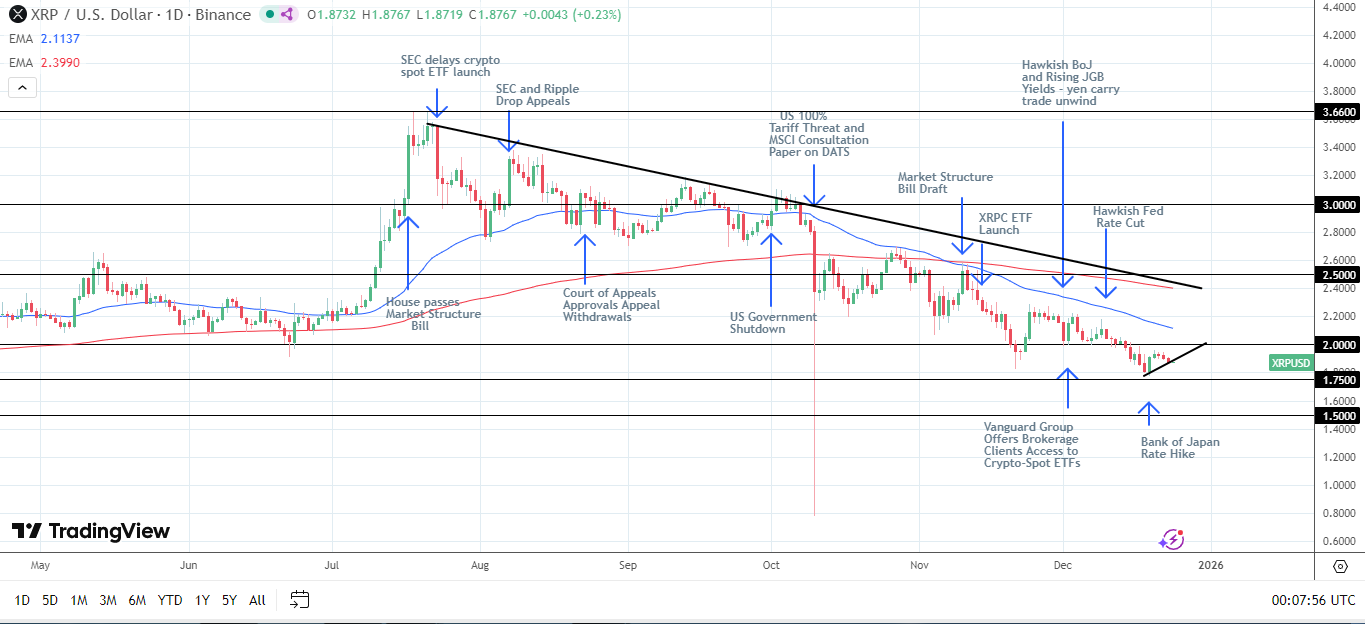
Tuesday’s pullback left XRP well below the 50-day and 200-day Exponential Moving Averages (EMAs), indicating a bearish bias. While technicals remain bearish, fundamentals are increasingly outweighing the technical structure.
Key technical levels to watch include:
- Support levels: $1.75, and then $1.50.
- 50-day EMA resistance: $2.1137.
- 200-day EMA resistance: $2.3990.
- Resistance levels: $2, $2.5, $3.0, and $3.66.
Looking at the daily chart, a break above the $2 psychological level would pave the way to the 50-day EMA. A sustained move through the 50-day EMA would signal a near-term bullish trend reversal, opening the door to retesting the 200-day EMA and the $2.5 resistance level.
A breakout above the EMAs would reinforce the constructive medium-term outlook and the longer-term (8-12 weeks) $3.0 price target.
Fundamental Indicators: BoJ, Fed, and ETF Demand
Near-term price drivers include:
- XRP-spot ETF flow trends.
- US economic indicators and March Fed rate cut bets.
- US crypto-related regulatory news.
- The BoJ’s neutral interest rate.
Bullish Structure Formation: What Happens if XRP Reclaims $2.0?
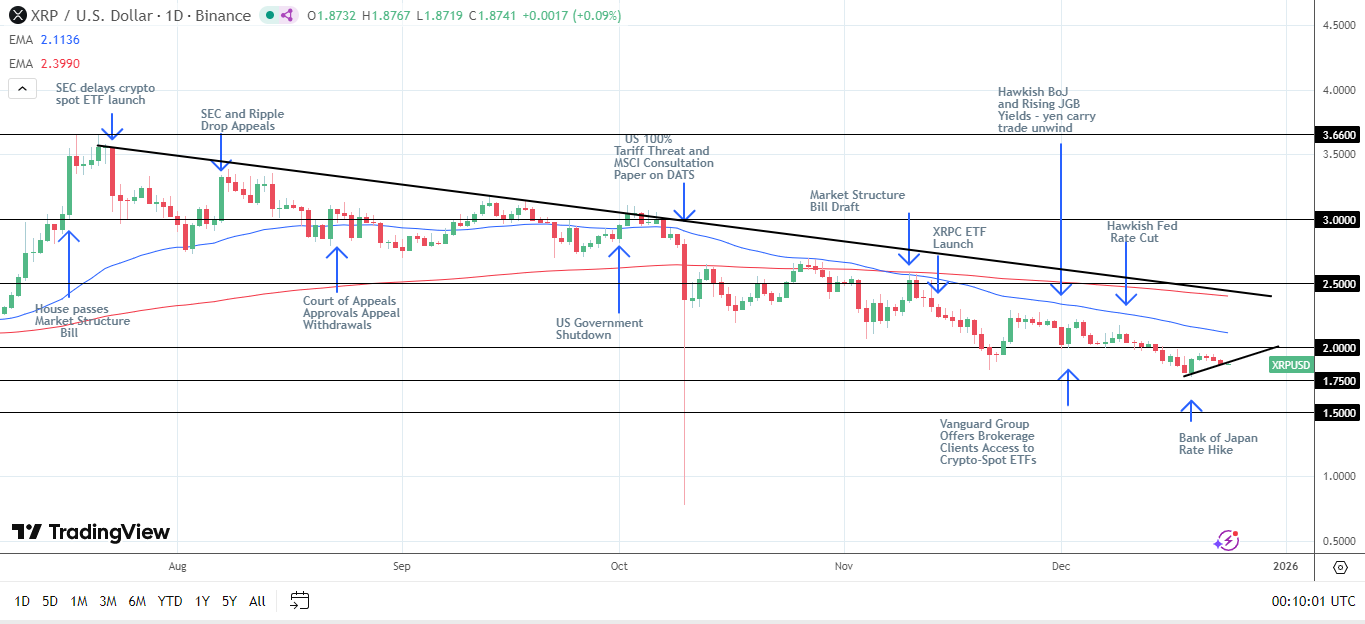
Despite Tuesday’s decline, the bullish structure remained intact, supporting the positive short- to medium-term outlook.
Reclaiming $2.0 would enable the bulls to target the upper trendline and the $2.5 resistance level. A sustained move through the upper trendline would indicate a bullish trend reversal, affirming the price targets.
- Medium-Term (4-8 weeks): $2.5.
- Longer-term (8–12 weeks): target of $3.0.
However, rejection at the $2.0 psychological level and a sustained drop below the lower trendline would invalidate the bullish short- to medium-term outlook, and indicate a bearish trend reversal.
Outlook: $2.0 Remains the Pivot Level
Looking ahead, central bank forward guidance, US economic data, XRP-spot ETF flow trends, and legislative developments will influence near-term sentiment.
Renewed bets on a March Fed rate cut and a cautious Bank of Japan policy stance would boost demand for XRP. Strong inflows into spot ETFs will also deliver price support.
In summary, robust institutional demand for XRP-spot ETFs and legislative developments support a medium-term (4–8 weeks) move to $2.5. A March Fed rate cut and the Senate passing the Market Structure Bill would support the longer-term (8–12 weeks) price target of $3.0.
Meanwhile, a breakout above the all-time high $3.66 is likely if the bullish scenarios unfold over the 6-12 month time horizon.