
XRP extends its losing streak to three consecutive sessions as Bitcoin (BTC), Wall Street, and the Fed hit sentiment.
The Nasdaq Composite Index slid 2.03% on Thursday, February 12, as fading bets on an H1 2026 Fed rate cut weighed on sentiment. BTC dropped to the $65,000 handle, with heavy outflows from the BTC-spot ETF market reflecting institutional investor sentiment toward the Fed’s policy outlook.
Meanwhile, XRP-spot ETF flow trends contrasted sharply with the BTC-spot ETF market, limiting the downside.
XRP’s substantial February losses reaffirm a bearish short-term outlook, while the medium-term outlook remains bullish.
Below, I will explore the key drivers behind recent price trends, the medium-term (4-8 weeks) outlook, and the technical levels traders should watch.

US Jobless Claims Fail to Lift Sentiment
On February 12, US labor market data drew significant interest following Wednesday’s hotter-than-expected US jobs report. Initial jobless claims dropped from 232k (week ending January 31) to 227k (week ending February 7), above a consensus of 222k. Nevertheless, 227k is historically low.
Notably, XRP briefly climbed to a high of $1.4025 before sliding to a session low of $1.3463 in reaction to the numbers. Despite falling less than expected, the drop in claims suggested a resilient labor market, challenging bets on an H1 2026 Fed rate cut.
According to the CME FedWatch Tool, the chances of a March Fed rate cut rose from 6.4% on February 11 to 7.8% on February 12. Meanwhile, the probability of a June cut increased from 57.6% to 63.9%. While higher on the day, the chances of a June cut have declined from 75% on February 5, signaling a shift in market sentiment toward a more hawkish Fed policy outlook.
Delays to Fed rate cuts would maintain tighter credit conditions, curbing speculative and leveraged positioning in XRP and the broader crypto market.
Bitcoin Price Forecast
Every new Bitcoin analysis as it publishes, today's technical signal and key levels, live price — on one page.
See all Bitcoin forecasts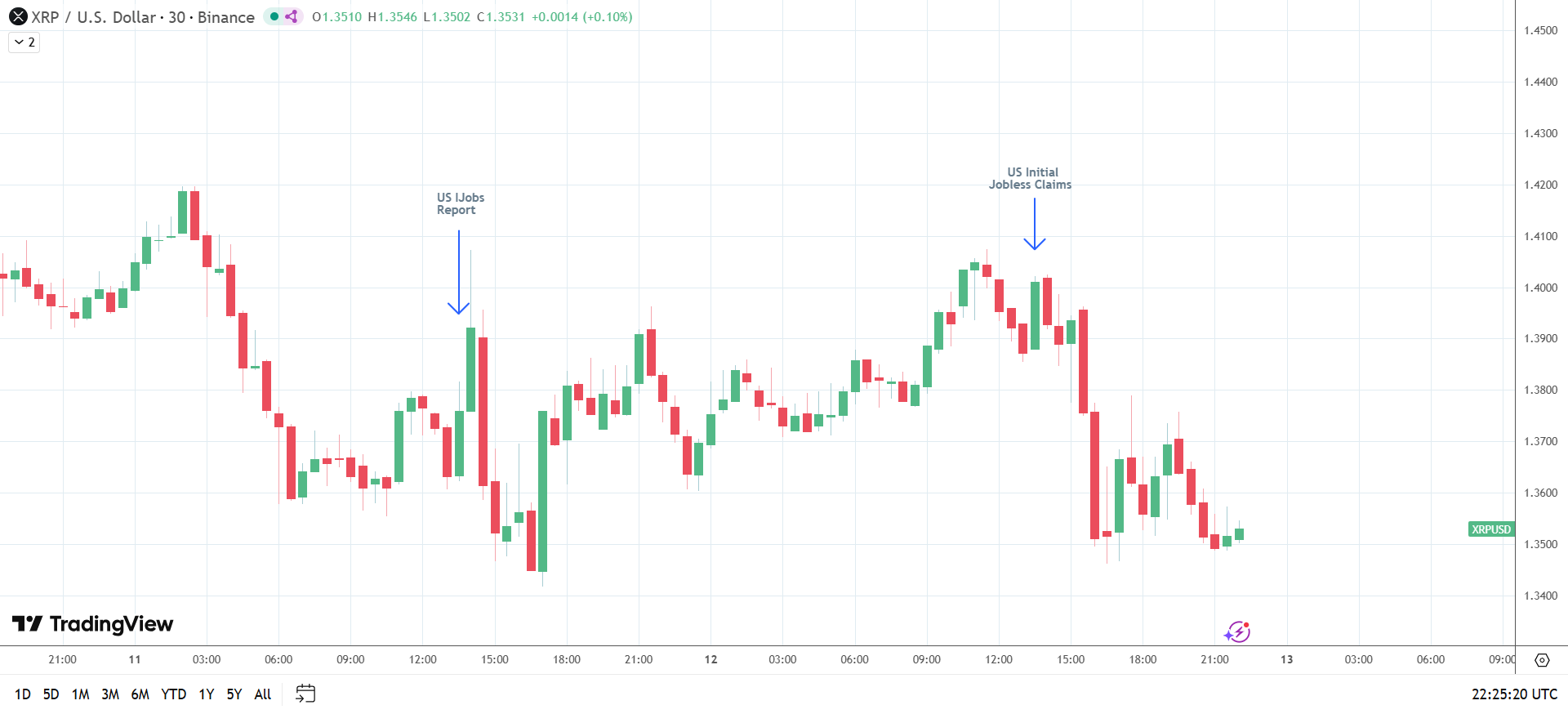
XRP-Spot ETF Market Avoids Investor Exodus
While fading Fed rate cut bets weighed on retail investor sentiment, US XRP-spot ETF market flow trends suggested resilient institutional investor demand.
The US XRP-spot ETF market saw zero net flows on February 12, crucially avoiding net outflows for an eighth consecutive session. In contrast, the US BTC-spot ETF market had net outflows of $276.3 million.
Importantly, the US XRP-spot ETF market has outperformed the US BTC-spot ETF market since trading began in November. While XRP-spot ETF issuers reported net inflows of $1.23 billion, US BTC-spot ETF issuers saw $4.6 billion in net outflows over the same period.
Given BTC’s status as the crypto market barometer, the heavy outflows have weighed on buying interest in digital assets. While the BTC-spot ETF market is significantly larger than the XRP-spot ETF market, flow trends reflect institutional investor sentiment.
Flow data for Thursday, February 12, will be out later today.
XRP Price Forecast: Short-, Medium-, and Long-Term Targets
XRP has tumbled 17% in February, reaffirming the negative short-term outlook (1-4 weeks), with a target price of $1.0.
Nevertheless, resilient buying interest in spot ETFs, expectations that the Senate will pass the Market Structure Bill, and increased XRP utility reinforce the bullish medium- to long-term price projections:
- Medium-term (4-8 weeks): $2.5.
- Longer-term (8-12 weeks): $3.0.
Key Downside Risks to the Bullish Medium-Term Outlook
Several factors could unravel the constructive medium-term bias. These include:
- A hawkish Bank of Japan, with a higher neutral interest rate (potentially 1.5%-2.5%). Aggressive BoJ rate hikes could narrow US-Japan rate differentials in favor of the yen. Narrowing rate differentials may trigger a yen carry trade unwind, as seen in mid-2024, drying up liquidity. A yen carry trade unwind would validate the bearish trend reversal.
- Waning expectations of an H1 2026 Fed rate cut.
- Delays and/or partisan opposition to the Market Structure Bill.
- Extended periods of XRP-spot ETF net outflows.
These events would weigh on XRP, sending the token toward $1.0, reinforcing the bearish short-term outlook.
Technical Analysis: Levels to Watch
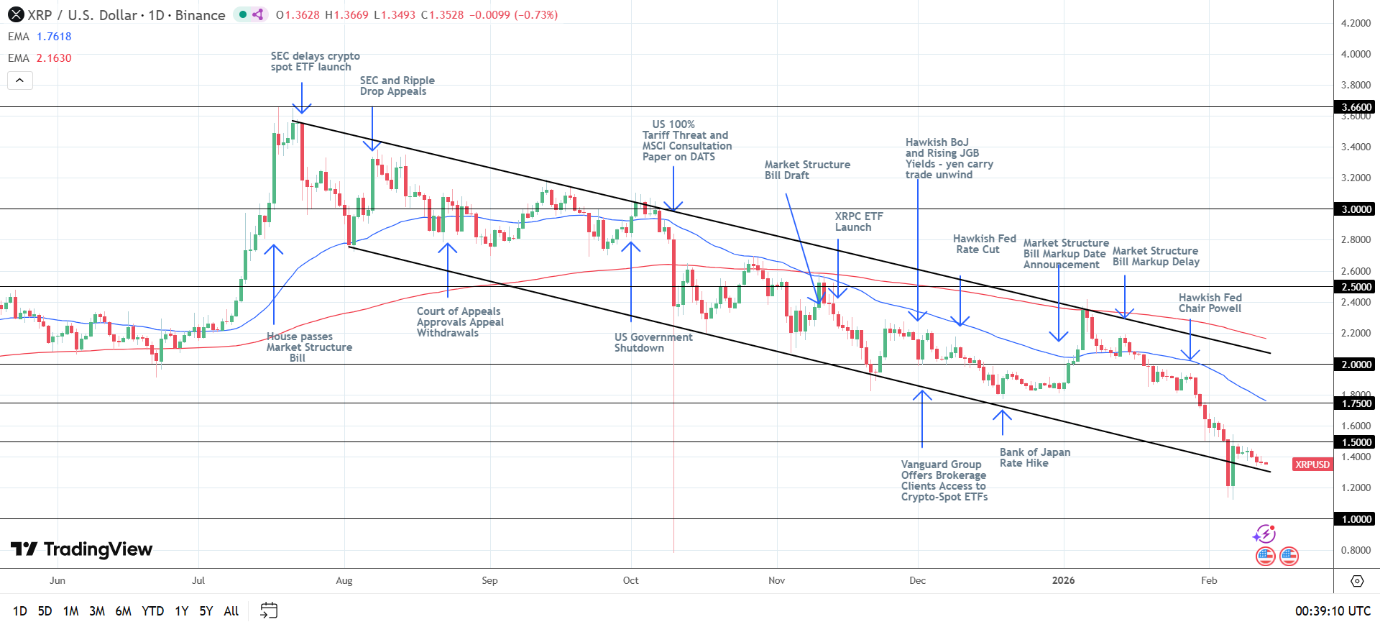
XRP fell 0.52% on February 12, following the previous day’s 2.14% loss to close at $1.3627. The token tracked the broader crypto market cap, which declined by 0.61%.
The three-day losing streak left XRP well below its 50-day and 200-day EMAs, indicating bearish momentum. However, several favorable fundamentals continue to offset bearish technicals, supporting a bullish medium-term outlook.
Key technical levels to watch include:
- Support levels: $1.0 and then $0.7773.
- 50-day EMA resistance: $1.7618.
- 200-day EMA resistance: $2.1630.
- Resistance levels: $1.50, $2.0, $2.5, and $3.0.
On the daily chart, a break above $1.50 would enable the bulls to target the 50-day EMA. A sustained move through the 50-day EMA would indicate a near-term bullish trend reversal. A bullish trend reversal would bring the 200-day EMA into play.
A sustained breakout above the EMAs would affirm a bullish trend reversal.
Fundamental Events Driving Near-Term Price Action
Near-term price drivers include:
- XRP-spot ETF flow trends.
- US economic indicators and the Fed’s policy stance. Friday’s US CPI report will be the next key catalyst.
- Crypto-related regulatory developments.
- The Bank of Japan’s neutral rate and policy stance.
- Increased geopolitical tensions.
Bearish Structure Intact: $1.0 Remains Critical Support
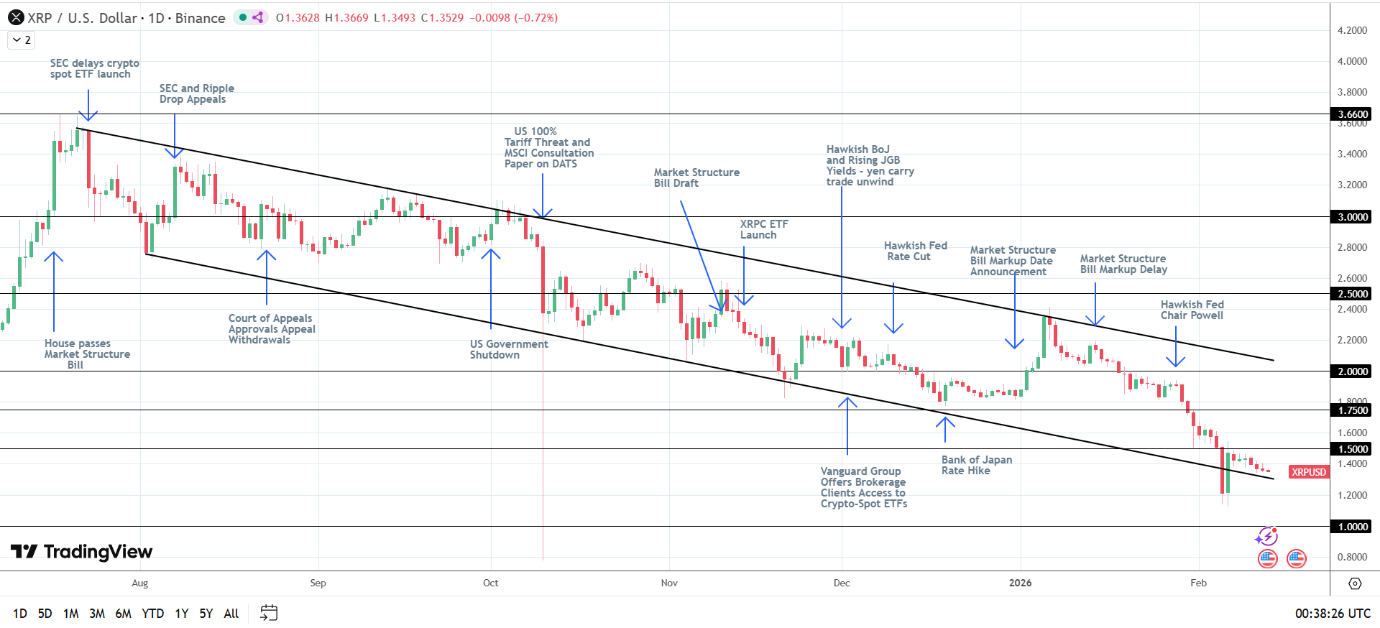
XRP’s extended reversal affirmed the existing bearish trend. A break below the lower trendline would bring the February 6 low of $1.1227 into play. If breached, $1.0 would be the next key support level. A fall through $1.0 would reinforce the bearish short-term outlook and further validate the bearish structure.
Conversely, a break above $1.5 would pave the way toward $2.0 and the upper trendline. A sustained move through the upper trendline would invalidate the bearish structure and indicate a bullish trend reversal, reaffirming the constructive medium-term bias.
- Short-term (1-4 weeks): $1.0.
- Medium-term (4-8 weeks): $2.5.
- Longer-term (8–12 weeks): target of $3.0.
XRP Outlook: Crypto Legislation, US CPI Report, and ETF Flows Remain Key Drivers
Looking ahead, crypto-related legislative developments on Capitol Hill are key to XRP’s price outlook. An agreement on stablecoin yields would lift expectations that the Senate will pass the Market Structure Bill, fueling XRP demand.
Meanwhile, US economic indicators, central bank rhetoric, and XRP-spot ETF flows will also influence demand for XRP.
A more dovish Fed policy stance and a lower BoJ neutral rate (potentially 1%-1.25%) would boost sentiment. Robust demand for US XRP-spot ETFs and the progress of the Market Structure Bill would reinforce the positive medium-term outlook.
In summary, these scenarios suggest a medium-term (4–8 weeks) move to $2.5. The US Senate passing the Market Structure Bill would reaffirm the longer-term (8–12 weeks) price target of $3.0.
Beyond 12 weeks, these scenarios are likely to send XRP to its all-time high of $3.66 (Binance). A break above $3.66 would affirm a 6- to 12-month price target of $5.