XRP gives up $1.4 as legislative developments on Capitol Hill and a hot US jobs report overshadowed Ripple news and robust demand for XRP-spot ETFs.
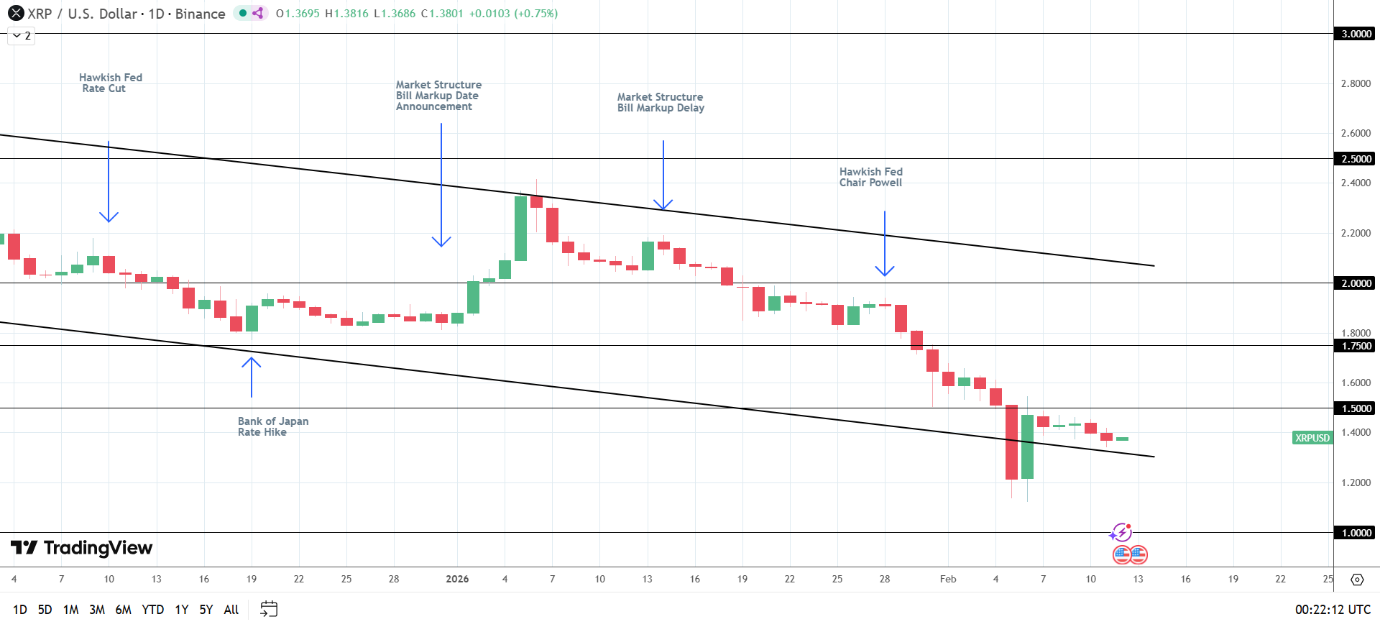
On Wednesday, February 11, markets continued to react to the TradFi-DeFi stalemate on stablecoin yields, a key price driver for XRP. US banks are pushing back on legislation that allows stablecoin rewards, delaying progress on the Market Structure Bill. XRP tumbled 49% to a February 6 low of $1.1227 in response to the Banking Committee postponing its markup vote.
Meanwhile, the US jobs report added to the selling pressure as an unexpected drop in unemployment cooled Fed rate cut bets.
XRP’s substantial February losses reaffirm a bearish short-term outlook, while the medium-term outlook remains bullish.
Below, I will explore the key drivers behind recent price trends, the medium-term (4-8 weeks) outlook, and the technical levels traders should watch.

US Jobs Report Hits Hopes for an H1 2026 Fed Rate Cut
On February 11, the US jobs report signaled a resilient labor market, weighing on demand for risk assets, such as Bitcoin (BTC) and XRP.
Nonfarm payrolls increased from 48k in December to 130k in January. Meanwhile, unemployment dropped from 4.4% to 4.3% despite the participation rate rising from 62.4% to 62.5%. Crucially, average hourly earnings increased by 3.7% year-over-year in January, mirroring December’s trend.
Tighter labor market conditions may boost wages and consumer confidence. A pickup in wages could fuel consumer spending and demand-driven inflation. Rising inflation would force the Fed to delay rate cuts, leaving borrowing costs elevated.
According to the CME FedWatch Tool, the chances of a March Fed rate cut fell from 20.1% on February 10 to 5.4% on February 11. Furthermore, the probability of a June cut dropped from 75.2% to 57.6%. Notably, XRP initially climbed on easing fears of a US recession before sliding to a session low of $1.3418 on fading bets on an H1 2026 Fed rate cut.
Bitcoin Price Forecast
Every new Bitcoin analysis as it publishes, today's technical signal and key levels, live price — on one page.
See all Bitcoin forecasts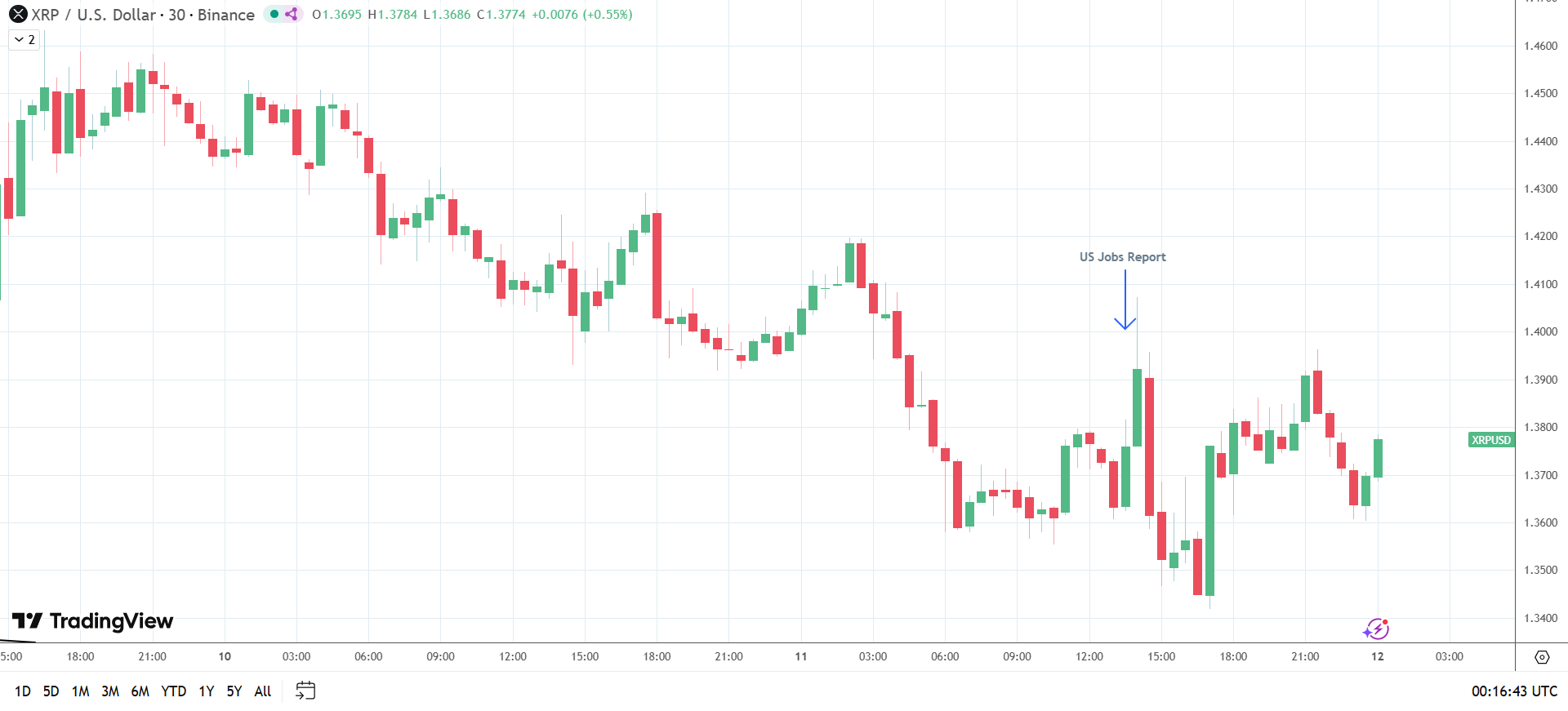
XRP-Spot ETF Inflows Signal Strong Institutional Interest
While a more hawkish Fed rate path and delays to crypto legislation weighed on sentiment, demand for XRP-spot ETFs cushioned the downside.
The US XRP-spot ETF market extended its inflow streak to five sessions on Tuesday, February 10. XRP-spot ETF issuers have seen total net inflows of $1.23 billion since launch, reflecting strong institutional investor interest. In contrast, the US BTC-spot ETF market has reported net outflows of $4.3 billion over the same period, impacting sentiment.
For context, BTC has fallen 46% from its October all-time high of $125,761 (Binance), as the US BTC-spot ETF market kick-started an extended outflow streak from October 10. XRP and the broader market remain under the shadow of BTC despite the US XRP-spot ETF market suggesting a decoupling.
Ripple’s advancements on Main Street are driving XRP utility, bolstering institutional demand for XRP-spot ETFs.
On February 11, Reece Merrick, Senior Executive Officer/Managing Director, Middle East & Africa at Ripple, shared another Ripple milestone, stating:
“We’re thrilled to announce that Ripple is partnering with Aviva Investors to bring traditional fund structures to the XRP Ledger. This marks our first collaboration with a European investment management firm to tokenize real-world assets (RWAs) at scale.”
Such developments are likely to continue driving demand for XRP-spot ETFs, key to XRP’s price trajectory.
XRP Price Forecast: Short-, Medium-, and Long-Term Targets
XRP has plunged 16% in February, reaffirming the negative short-term outlook (1-4 weeks), with a target price of $1.0.
However, robust demand for spot ETFs, hopes that the Senate will pass the Market Structure Bill, and increased XRP utility reinforce the bullish medium- to long-term price projections:
- Medium-term (4-8 weeks): $2.5.
- Longer-term (8-12 weeks): $3.0.
Key Downside Risks to the Bullish Medium-Term Outlook
Several scenarios could derail the constructive medium-term bias. These include:
- A hawkish Bank of Japan, with a higher neutral interest rate (potentially 1.5%-2.5%). Aggressive BoJ rate hikes could narrow US-Japan rate differentials in favor of the yen. Narrowing rate differentials may trigger a yen carry trade unwind, drying up crypto market liquidity, as seen in mid-2024. A yen carry trade unwind would validate the bearish trend reversal.
- Fading bets on an H1 2026 Fed rate cut.
- Delays and/or partisan opposition to the Market Structure Bill.
- Extended periods of XRP-spot ETF net outflows.
These factors would weigh on XRP, pushing the token toward $1.0, reaffirming the bearish short-term outlook.
Technical Analysis: Levels to Watch
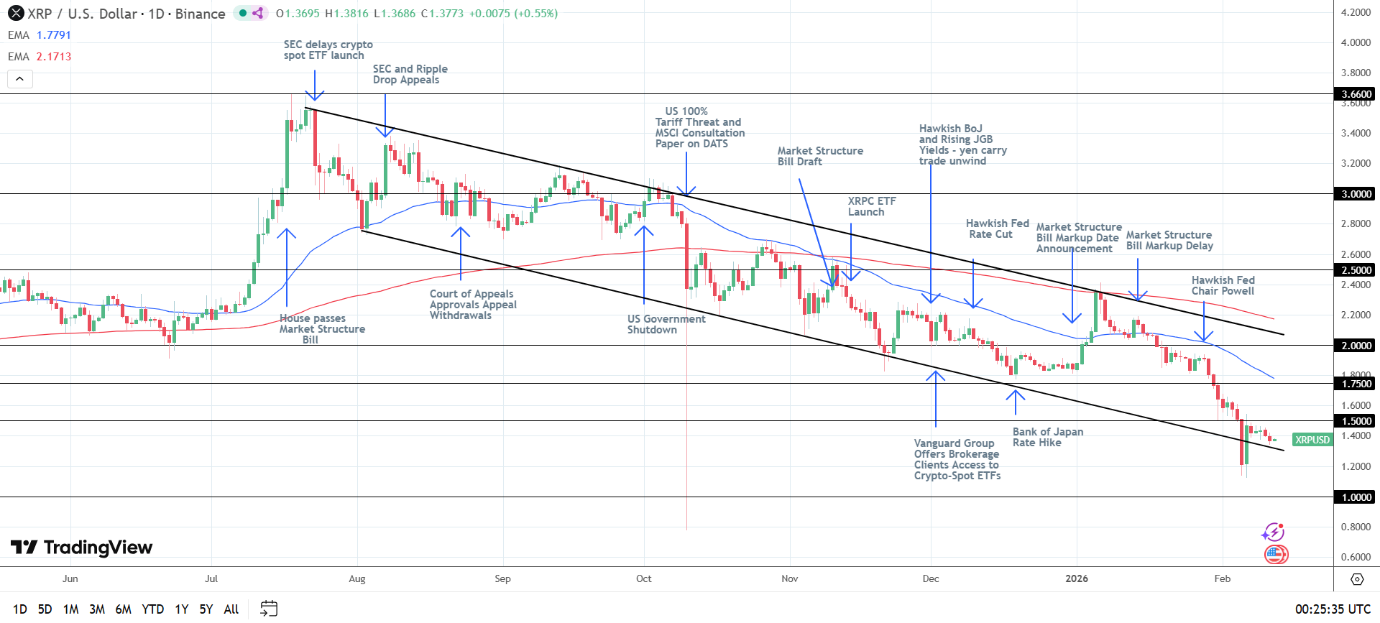
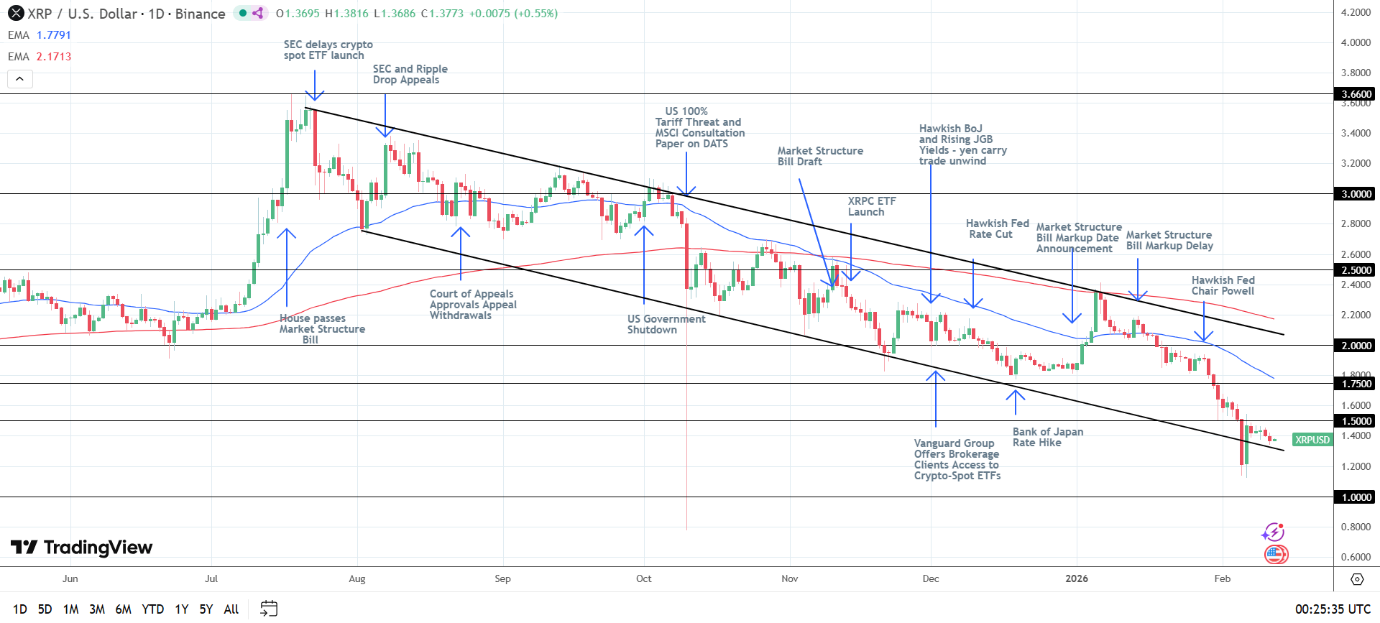
XRP fell 2.14% on February 11, following the previous day’s 2.58% loss to close at $1.3698. The token tracked the broader crypto market cap, which declined by 2.30%.
Wednesday’s drop left XRP well below its 50-day and 200-day EMAs, signaling bearish momentum. However, several positive fundamentals continue to counter bearish technicals, supporting a bullish medium-term outlook.
Key technical levels to watch include:
- Support levels: $1.0 and then $0.7773.
- 50-day EMA resistance: $1.7791.
- 200-day EMA resistance: $2.1713.
- Resistance levels: $1.50, $2.0, $2.5, and $3.0.
On the daily chart, a breakout above $1.50 would bring the 50-day EMA into play. A sustained move through the 50-day EMA would signal a near-term bullish trend reversal. A bullish trend reversal would pave the way toward the 200-day EMA.
A sustained break above the EMAs would affirm a bullish trend reversal.
Fundamental Events Driving Near-Term Price Action
Near-term price drivers include:
- XRP-spot ETF flows.
- US economic data and the Fed’s policy stance. Friday’s US CPI report will be the next key catalyst.
- Crypto-related legislative headlines.
- The Bank of Japan’s neutral rate and rate path.
- Increased geopolitical risks.
Bearish Structure Intact: $1.0 Remains Key Support
XRP’s extended sell-off reaffirmed the existing bearish trend. A drop below the lower trendline would expose the February 6 low of $1.1227. If breached, $1.0 would be the next key support level. A break below $1.0 would reaffirm the bearish short-term outlook and further validate the bearish structure.
Conversely, a breakout above $1.5 would bring $2.0 and the upper trendline into play. A sustained move through the upper trendline would invalidate the bearish structure and signal a bullish trend reversal, reinforcing the constructive medium-term bias.
- Short-term (1-4 weeks): $1.0.
- Medium-term (4-8 weeks): $2.5.
- Longer-term (8–12 weeks): target of $3.0.
XRP Outlook: Crypto Legislation, US Data, and ETF Flows Remain Key Drivers
Looking ahead, crypto-related regulatory developments are pivotal for XRP’s price outlook. A TradFi-DeFi agreement on stablecoin yields would fuel hopes of the Senate passing the Market Structure Bill, boosting XRP demand.
However, US economic data, central bank chatter, and XRP-spot ETF flows will also influence buying interest in XRP.
A more dovish Fed rate path and a lower BoJ neutral rate (potentially 1%-1.25%) would lift sentiment. Extended inflows into US XRP-spot ETFs and the progress of the Market Structure Bill would reaffirm the positive medium-term outlook.
In summary, these events indicate a medium-term (4–8 weeks) move to $2.5. The US Senate’s passing the Market Structure Bill would reinforce the longer-term (8–12 weeks) price target of $3.0.
Beyond the 12-week timeline, these events are likely to drive XRP to its all-time high of $3.66 (Binance). A break above $3.66 would affirm a 6- to 12-month price target of $5.