
Chinese equity markets enjoyed the spotlight as the MSCI boosted Global Standard Indexes’ exposure to Chinese stocks, underscoring improved sentiment toward the economy and AI advancements.
Meanwhile, improving US-China relations continue to bolster demand for Mainland-listed stocks ahead of the next Trump-Xi meeting.
Easing US-China trade tensions, continued fiscal and monetary policy support, and robust external demand for Chinese goods have contributed to year-to-date gains. However, softer consumer price inflation underpinned the challenges that Beijing faces in boosting domestic demand.
Despite the lackluster domestic demand, the prospect of further policy support and firm external demand reaffirms the bullish medium-term outlook for Mainland and Hong Kong-listed stocks.
Below, I will explore the key drivers behind recent gains, the medium-term (3-6 months) market outlook, and the key technical levels traders should watch.

MSCI Boosts Exposure to China
This week, the MSCI released changes to the constituents of the MSCI Global Standard Indexes, effective February 27. Crucially, the MSCI added 37 Chinese companies while removing 16, giving a net increase of 21 stocks, the largest in almost three years. In contrast, the MSCI added just 8 US stocks but removed 15, reducing exposure to US securities.
China’s tech sector was the main beneficiary of the latest changes, underscoring China’s advancements in AI. Meanwhile, the MSCI dropped consumer-related Chinese securities as Beijing faces waning domestic demand.
Passive ‘index-tracking’ funds must rebalance their portfolios, likely to lift demand for the newly included stocks. Active funds may also increase exposure to China, another boon for Mainland-listed stocks and indexes. For context, the MSCI added more Chinese stocks than it deleted in late 2025, the first net increase since early 2024.
This week’s announcement supports the bullish short- to medium-term outlook for Mainland China Indexes.
Hong Kong Hang Seng Price Forecast
Every new Hong Kong Hang Seng analysis as it publishes, today's technical signal and key levels, live price — on one page.
See all Hong Kong Hang Seng forecastsDomestic Demand Challenges Policymakers
While China’s tech sector grabbed the MSCI’s attention, Chinese inflation numbers signaled weakening demand, capping the upside for Mainland China indexes.
China’s annual inflation rate dropped from 0.8% in December to 0.2% in January. However, producer prices declined 1.4% year-on-year in January, after falling 1.9% in December, suggesting that demand conditions may be stabilizing.
A pickup in demand would ease competition for customers, allowing producers to pass higher prices on to consumers. Crucially, improving demand conditions could soften current margin squeezes. Higher profits may boost job creation and wages, key to domestic consumption.
The Kobeissi Letter recently commented on plunging consumer confidence, stating:
“China’s consumer confidence index is down ~90 points, near the lowest level on record. The index plunged ~40 points between 2021 and 2022 and has remained at extremely pessimistic levels over the last 4 years. Before that drop, the index never consistently fell below 100, even during the 2008 Financial Crisis. This comes as China has experienced one of the largest housing bubble bursts in modern history. As a result, home sales by floor area in China are now -50% below 2021 levels.”
Consumer confidence will need to improve markedly for Beijing’s policy measures to be effective. Effective measures would boost domestic consumption, syncing China’s dual economy (trade and domestic consumption). Importantly, external demand has remained strong despite US tariffs on China, China’s housing market crisis has impacted consumer spending. While Beijing targets consumers with new policies to boost consumption, stabilizing the housing market will likely be more critical.
For context, Chinese retail sales rose 0.9% year-on-year in December, down from 1.3% in November. Retail sales growth has trended lower since May’s 6.4% YoY surge.
Despite waning domestic demand, Beijing’s policy pledges remain key to the bullish outlook for Mainland indexes.
Key Downside Risks to the Bullish Outlook
Despite the positive sentiment, downside risks could challenge the positive outlook. These include:
- US-China trade tensions intensify.
- Global tariffs weigh on demand for Chinese goods.
- Beijing delays monetary and fiscal policy measures.
- External demand for Chinese goods weakens sharply.
- Domestic demand slumps.
- Chinese housing market deteriorates.
These scenarios would likely send the Hang Seng Index and the CSI 300 below their 50-day EMAs, indicating bearish trend reversals.
However, China’s AI advancements, improving chip manufacturing capabilities, and robust external demand reaffirm a constructive short- to medium-term bias for Mainland China indexes.
Furthermore, economists are optimistic that Beijing can boost domestic consumption through subsidies and lower borrowing rates, while stabilizing the housing market.
CSI 300 Technical Outlook: Resistance Levels in Focus
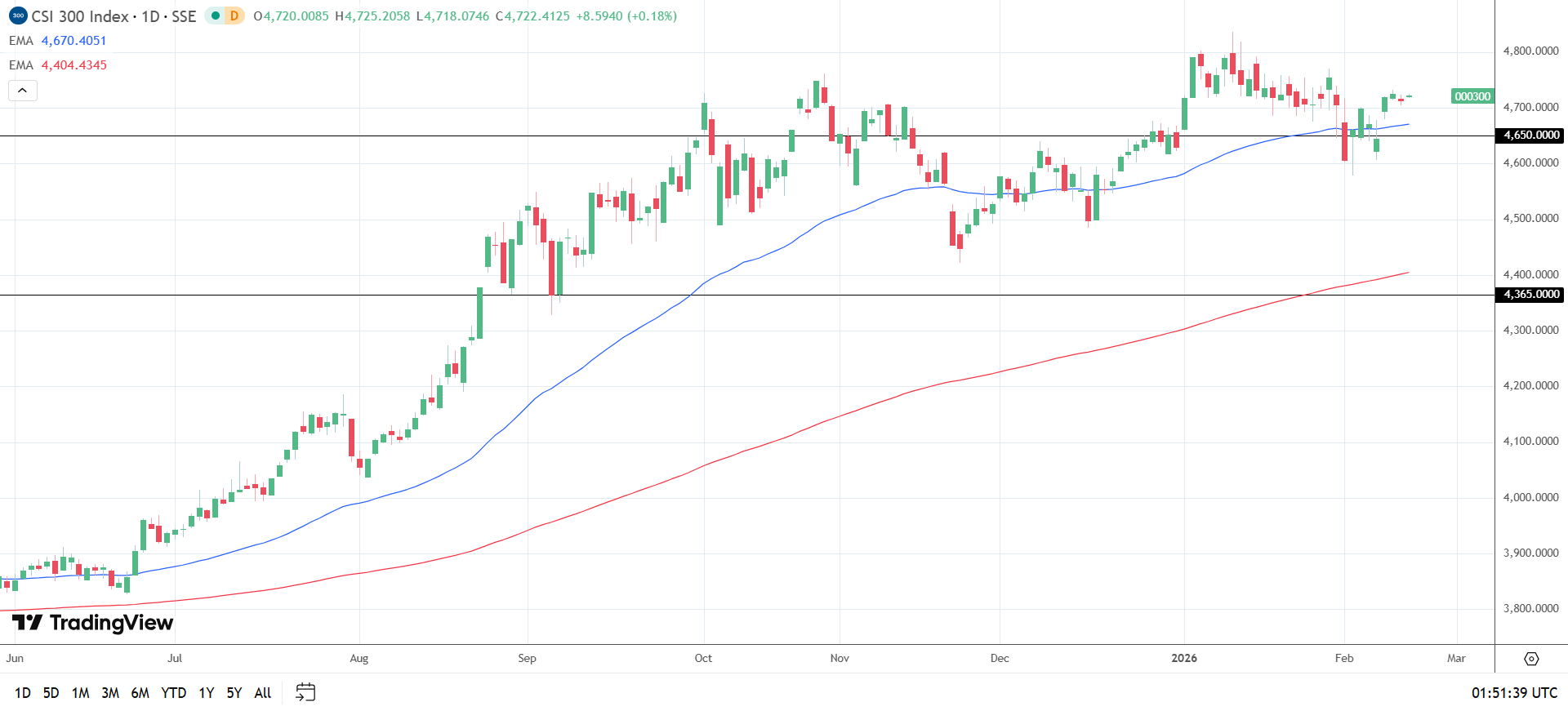
Chart technicals and fundamentals remained aligned in trading on Thursday, February 12. Looking at the daily chart, the CSI 300 remains above its 50-day and 200-day EMAs. The EMA positions signal a bullish bias.
A break above the 4,750 resistance level would enable the bulls to target the January 13 high of 4,837. A sustained move through 4,837 would bring 5,000 into play. Crucially, trading above the 50-day EMA reaffirms the bullish trend.
Hang Seng Index: Bullish Outlook Intact
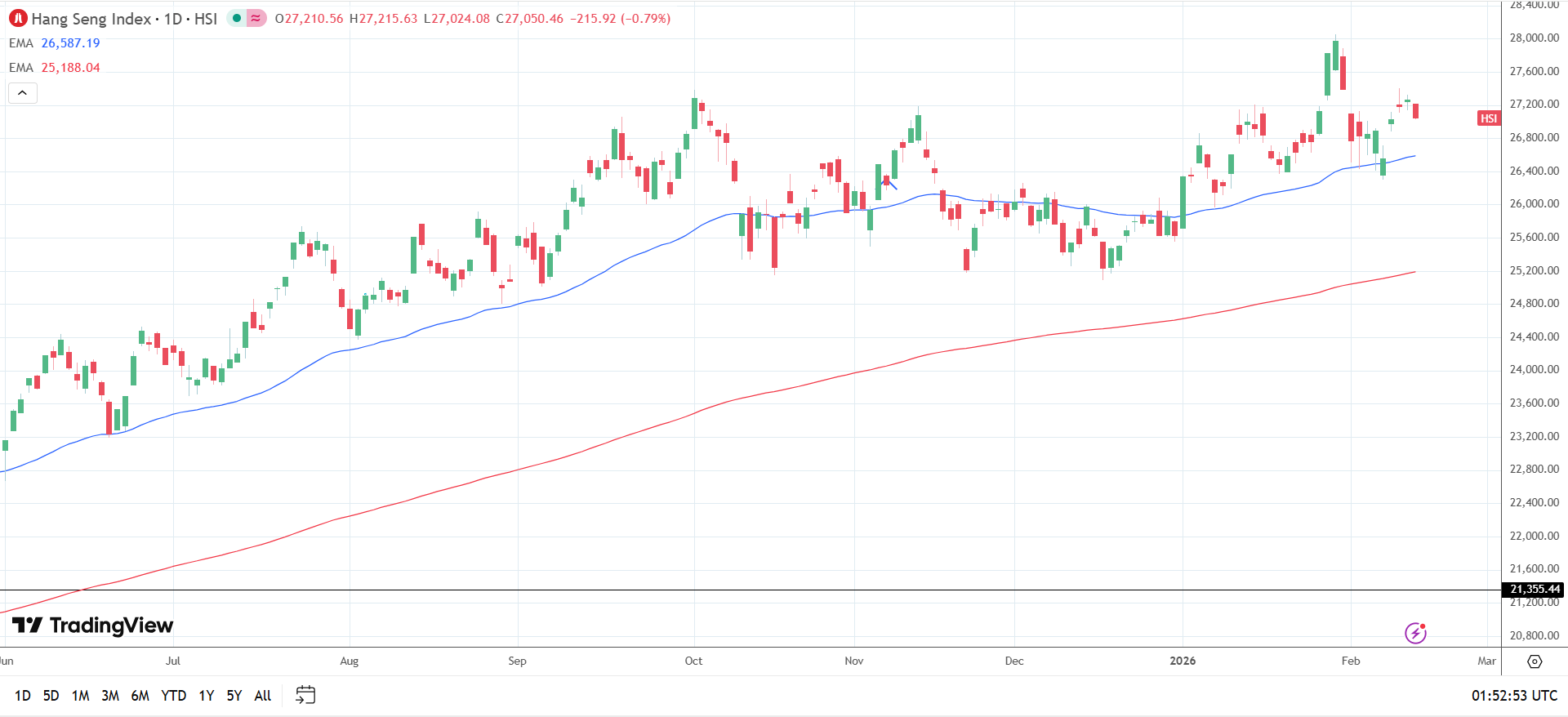
The Hang Seng Index’s trajectory aligns with the CSI 300, with the Index remaining above its 50-day and 200-day EMAs. The EMA positions signal bullish momentum, coupled with favorable fundamentals.
A break above 27,500 would enable the bulls to target the January high of 28,056. A sustained move through 28,056 would bring 30,000 into play for the first time since 2021.
Conclusion:
To summarize, the short- and medium-term outlook remains constructive. Beijing’s ongoing policy pledges, rising bets on the People’s Bank of China cutting rates, China’s AI developments, and robust external demand remain tailwinds for Mainland China and Hong Kong-listed stocks.
However, global trade headlines, China’s real estate market, and consumer price trends are likely pivotal for domestic consumption. Effective policy measures boosting domestic consumption would likely drive the CSI 300 to its 2021 all-time high of 5,931.
Discover strategies to navigate this week’s market trends here.