
Chinese economic indicators highlight Beijing’s challenge in boosting domestic demand and easing reliance on trade.
Beijing achieved its 5% GDP growth target for 2025, according to official data released on Monday, January 19. However, a continued slump in retail sales, a sharp drop in fixed asset investments, and an acceleration in falling house prices raised concerns about the economic outlook for 2026.
Mainland China equity markets advanced despite mixed economic data. Market trends underscored optimism that Beijing will introduce fresh stimulus to bolster the housing market and boost domestic consumption. The prospect of fresh fiscal stimulus and monetary policy easing supports the bullish medium-term outlook for Mainland China indices.
Below, I will explore the key drivers behind recent gains, the medium-term (3-6 months) market outlook, and the key technical levels traders should watch.

China’s Economy Loses Momentum in Q4 as Domestic Consumption Wanes
The Chinese economy expanded by 4.5% year-on-year in Q4, slowing from 4.8% growth in Q3. Year-on-year growth was the weakest since Q4 2022, despite the economy picking up pace from the previous quarter. Quarter-on-quarter, the economy grew 1.2%, up from 1.1% in Q3.
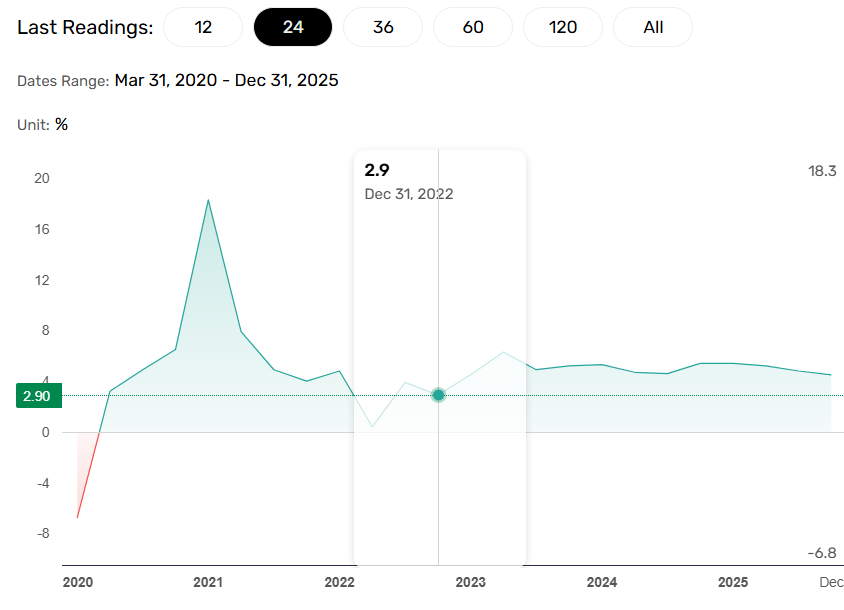
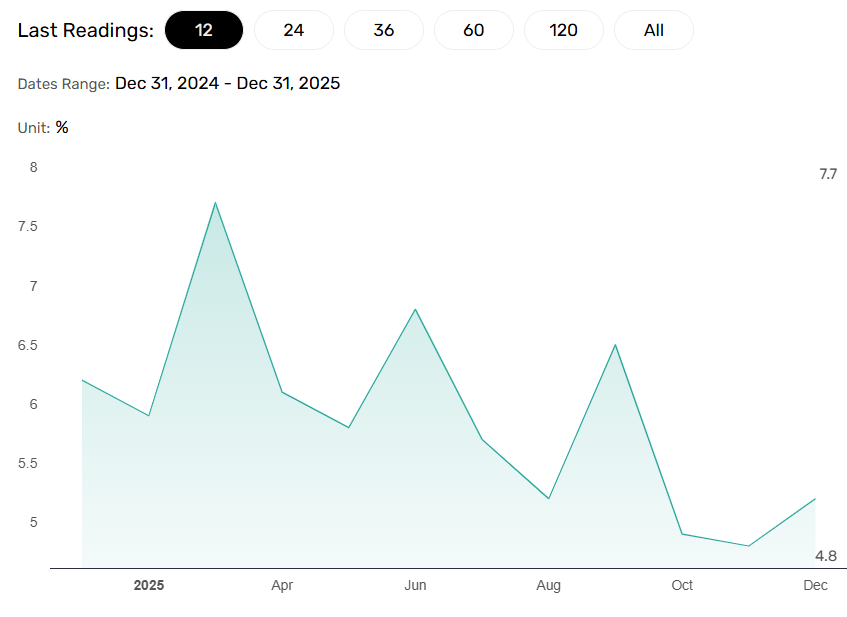
A pickup in industrial production and a sharp rise in exports bolstered the economy through the fourth quarter. Industrial production increased 5.2% year-on-year in December, up from 4.8% in November. Despite the uptick, industrial production remained below historical trends, suggesting a loss of economic momentum. For context, industrial production peaked at 7.7% in March 2025 ahead of US tariffs, before trending lower.
Meanwhile, Chinese exports soared 6.6% year-on-year (YoY) in December, up from 5.9% in November. These trends aligned with the rise in industrial production, crucial for Beijing’s GDP growth target for 2025.
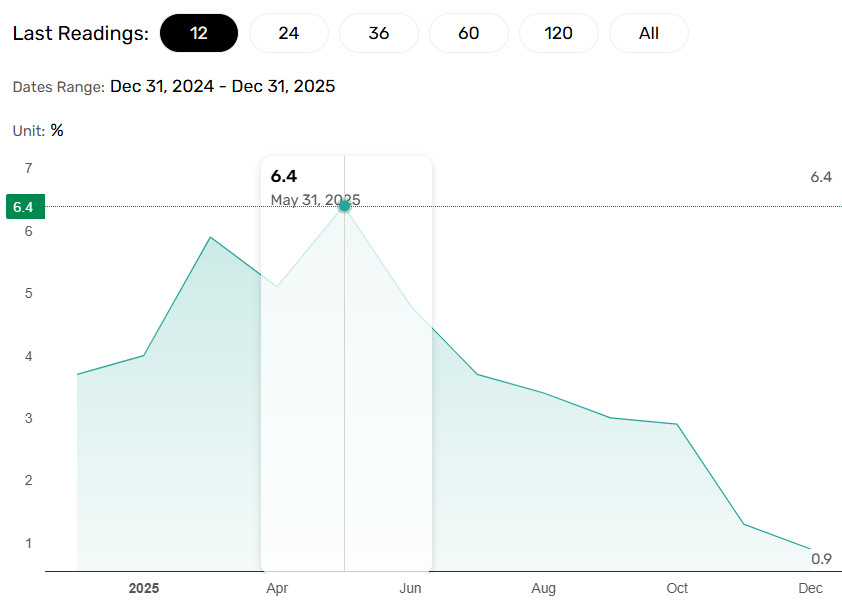
However, a slump in fixed asset investments suggests a potential decline in production, coinciding with weakening domestic consumption and a more marked drop in house prices. Retail sales rose 0.9% YoY in December, down from 1.3% in November. Importantly, retail sales growth has slowed sharply since a 6.4% surge in May, underscoring China’s dual economy.
The slowdown in retail sales growth coincided with China’s House Price Index, which signaled a deteriorating real estate market. The House Price Index fell 2.7% YoY in December after a 2.4% decline in November.
Despite the Index recovering from an October 2024 low, the continued decline in house prices impacted consumer sentiment and domestic consumption. Policy measures targeting the housing sector and private consumption are likely to be key for Mainland China equity markets in the year ahead.
Hong Kong Hang Seng Price Forecast
Every new Hong Kong Hang Seng analysis as it publishes, today's technical signal and key levels, live price — on one page.
See all Hong Kong Hang Seng forecastsEconomists Highlight the Need for Fresh Stimulus
Natixis Asia Chief Economist Alicia Garcia Herrero commented on the Chinese economic data, stating:
“China’s 5% GDP growth target for 2025 hits the government’s target, but it reveals cracks. Q4 year-over-year growth slowed to 4.5. With the 5% target secured, the government chose to “save its bullets” for the coming year. This is why we saw retail sales and fixed asset investment slow to 0.9% YoY and -3.8% YoY, respectively. Therefore, I would not interpret these numbers as overly negative, as they largely reflect a deliberate government maneuver to manage the economy.”
On the need for more stimulus, Garcia Herrero added:
“What is most concerning is that China’s domestic growth momentum is becoming increasingly autonomous and unsustainable. Household income grew really little in 2025 (4.4% from 5.1% in 2024), causing household spending to decelerate from 5.4% YoY to 4.4% YoY. Furthermore, the deflationary environment, especially for corporates, is entrenched. More stimulus will be needed in 2026, especially if the government keeps the 5% target, as it is being rumored.”
PBoC Keeps Loan Prime Rates Steady
Waning consumer spending and falling house prices failed to trigger a monetary policy response. The People’s Bank of China kept one-year and five-year loan prime rates at 3% and 3.5%, respectively, on Tuesday, January 20. Notably, the PBoC maintained its monetary policy stance despite demand for credit plunging in December.
CN Wire reported on December’s new loan figures, stating:
“Chinese banks issued the smallest amount of new loans since 2018, reflecting weak borrower demand and slowing growth. In December, new CNY loans totaled 908 billion ($130 billion), above expectations of 800 billion. For 2025, new loans reached 16.27 trillion yuan, with aggregate financing rising 2.2 trillion. Persistent weak consumer spending and business investment have fueled a deflationary environment, dampening corporate profits, wages, and borrowing appetite.”
The PBoC’s decision weighed on sentiment, with the CSI 300 and the Shanghai Composite Index posting losses in early trading on January 20. However, Mainland China indices remain close to January highs amid market bets on fresh stimulus and monetary policy easing to bolster the economy. Further policy support would affirm the bullish outlook over the short to medium term.
Key Downside Risks to the Bullish Outlook
However, downside risks could challenge the positive outlook. These include:
- A breach of the fragile trade war truce.
- Global tariffs on Chinese goods.
- Beijing delays monetary policy easing and fresh fiscal stimulus.
- Weaker demand for Chinese goods.
- Chinese housing market crisis intensifies.
These factors could push the Hang Seng Index and CSI 300 below their 50-day EMAs, indicating near-term bearish trend reversals.
Medium-Term Outlook: Remains Bullish
Fiscal stimulus targeting the housing sector, the labor market, and domestic consumption would support the economy in the year ahead.
The outlook for Mainland China’s indices remains bullish, given strong external demand for Chinese goods, Beijing’s policies goals, and China’s advancements in AI.
CSI 300 Technical Outlook: Resistance Levels in Focus
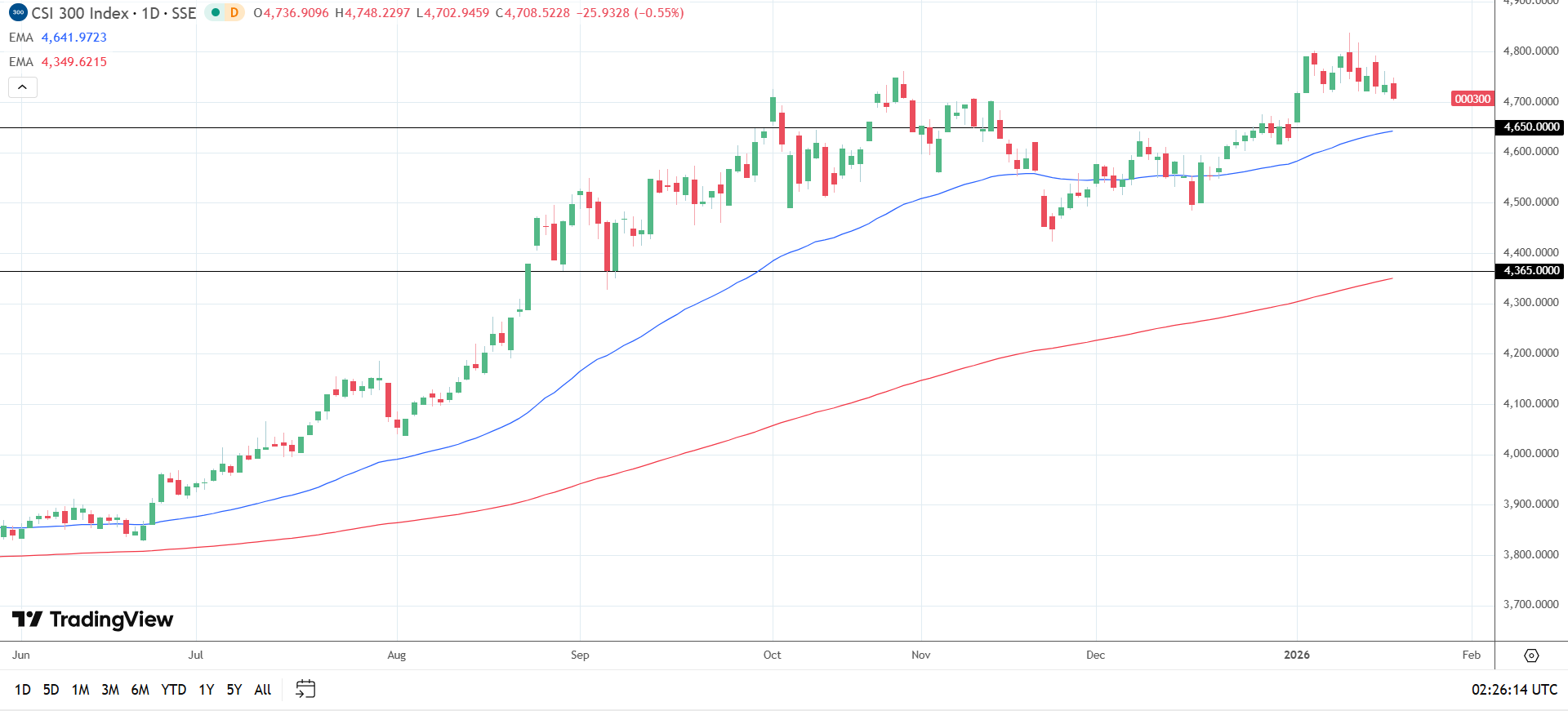
Technicals and fundamentals are aligned in early trading on Tuesday, January 20. Viewing the daily chart, the CSI 300 trades above its 50-day and 200-day EMAs, signaling bullish momentum.
A break above the January 13 high of 4,817 would pave the way toward 5,000. A sustained move through 5,000 would enable the bulls to target the 2021 all-time high of 5,931. Avoiding a sustained fall through the 50-day EMA remains crucial for the bullish outlook.
Hang Seng Index: Bullish Outlook Intact
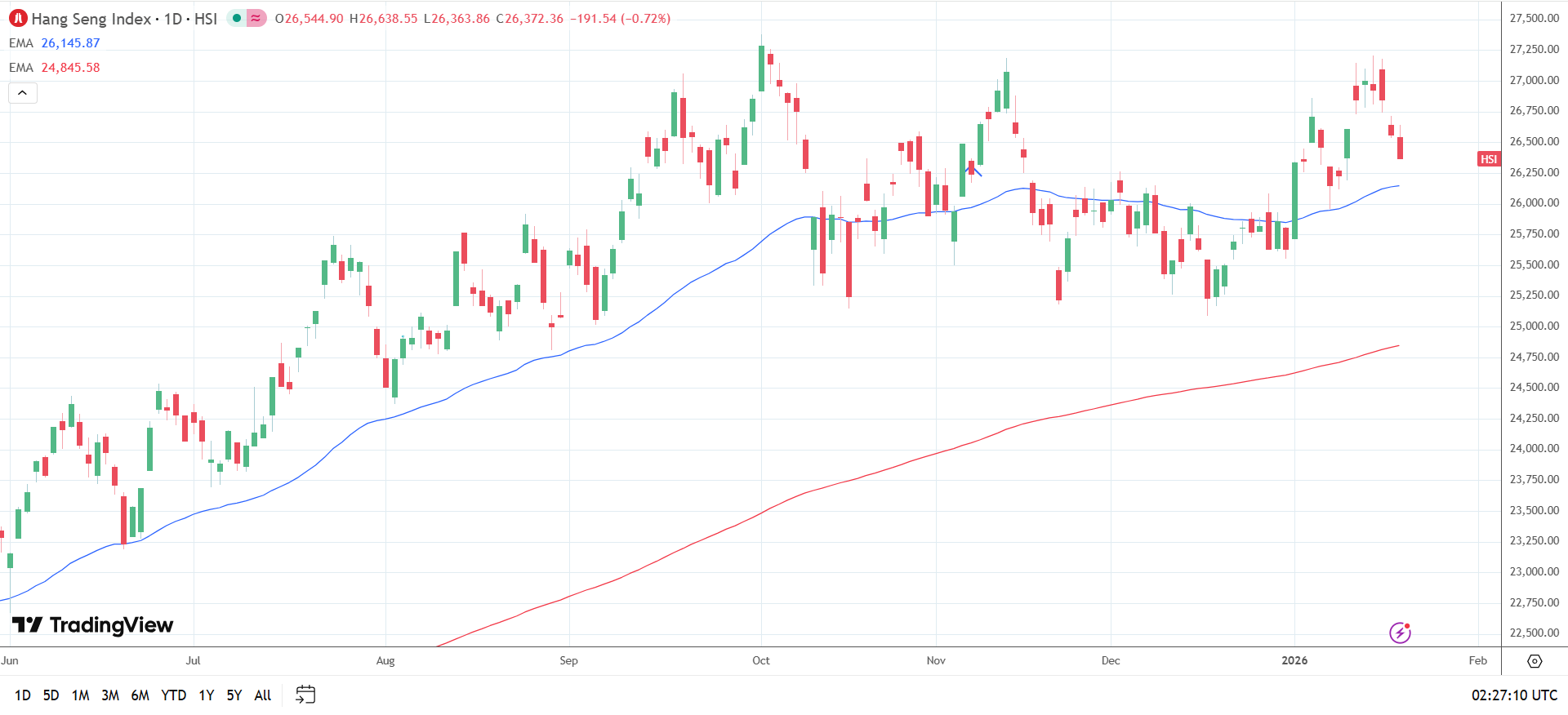
The Hang Seng Index’s projection matches the CSI 300’s, with the index trading above its 50-day and 200-day EMAs. These EMAs indicate bullish momentum, complementing favorable fundamentals.
A break above the January 15 high of 27,207 would bring the October 2025 high of 27,382 into play. A move through 27,382 would open the door to testing 28,000. A breakout above 28,000 would open the door to testing 30,000 for the first time since 2021.
Conclusion:
In summary, the short- and medium-term outlook remains constructive. Beijing’s policy goals, China’s advancement in the AI space, and strong external demand for Chinese goods are likely to raise buyer demand for Mainland China and Hong Kong-listed stocks.
However, housing sector developments, global trade headlines, and company margin trends remain factors for consumers and private consumption. Effective policy measures would likely drive the CSI 300 to its 2021 all-time high of 5,931.
Discover strategies to navigate this week’s market trends here.