If last week left traders feeling a little tossed around, it’s understandable. The S&P 500 slipped under its 50-day moving average on Wednesday, December 17, closing near 6,720 and losing a support level that had been reliable for months. Tech didn’t help the mood — the Nasdaq cracked as investors questioned whether the AI buildout was starting to look overextended and whether companies would ever see the payoff on their massive infrastructure spending.
But sentiment flipped almost overnight. Thursday brought a clean upside reversal, the S&P 500 tacking on 0.8% while the Nasdaq charged more than 1% higher. By Friday afternoon, buyers were pressing again: the S&P 500 added another 0.8%, the Nasdaq climbed 1%, and the Dow’s 290-point gain confirmed that this wasn’t just a tech bounce. After four straight down sessions, the market clawed back to essentially flat on the week — and set the stage for a legitimate run into year-end.
Richmond Lee, CFA and Senior Market Analyst at PU Prime commented:
As the year winds down, markets often exhibit a seasonal pattern known as the Santa Claus Rally. This phenomenon typically occurs during the last five trading days of December and the first two of January, when equities tend to post above-average returns. While most pronounced in U.S. stock markets, the effects can ripple across other asset classes, including FX, influencing USD positioning and risk sentiment.
Several factors contribute to this pattern. Holiday optimism generally boosts investor confidence, encouraging risk-on positioning. Fund managers often rebalance portfolios before the year-end, creating additional demand for equities and other risk assets. Low liquidity during this period can amplify price swings, while tax-loss selling generally concludes earlier in December, removing downward pressure. Collectively, these elements can generate temporary upside momentum in markets.
For forex traders, understanding the Santa Claus Rally is critical. Improved year-end risk sentiment often leads to a softer USD, while so-called risk currencies like AUD and NZD may gain. Conversely, traditional safe havens such as JPY and CHF can underperform. Traders should also note that thinner liquidity during this period can make movements more pronounced, emphasizing the importance of careful position sizing and risk management.
Historical data shows that this seven-day window has, on average, delivered stronger equity returns. However, it is not guaranteed. Macroeconomic shocks, geopolitical events, or unexpected central bank actions can easily override seasonal tendencies. In some cases, a failed Santa Claus Rally has been interpreted as a warning signal for the year ahead.
In summary, the Santa Claus Rally provides a lens through which traders can understand year-end market dynamics, liquidity conditions, and positioning trends. While not a trading strategy on its own, awareness of this seasonal pattern equips investors with context for making informed decisions during a period often marked by heightened volatility.
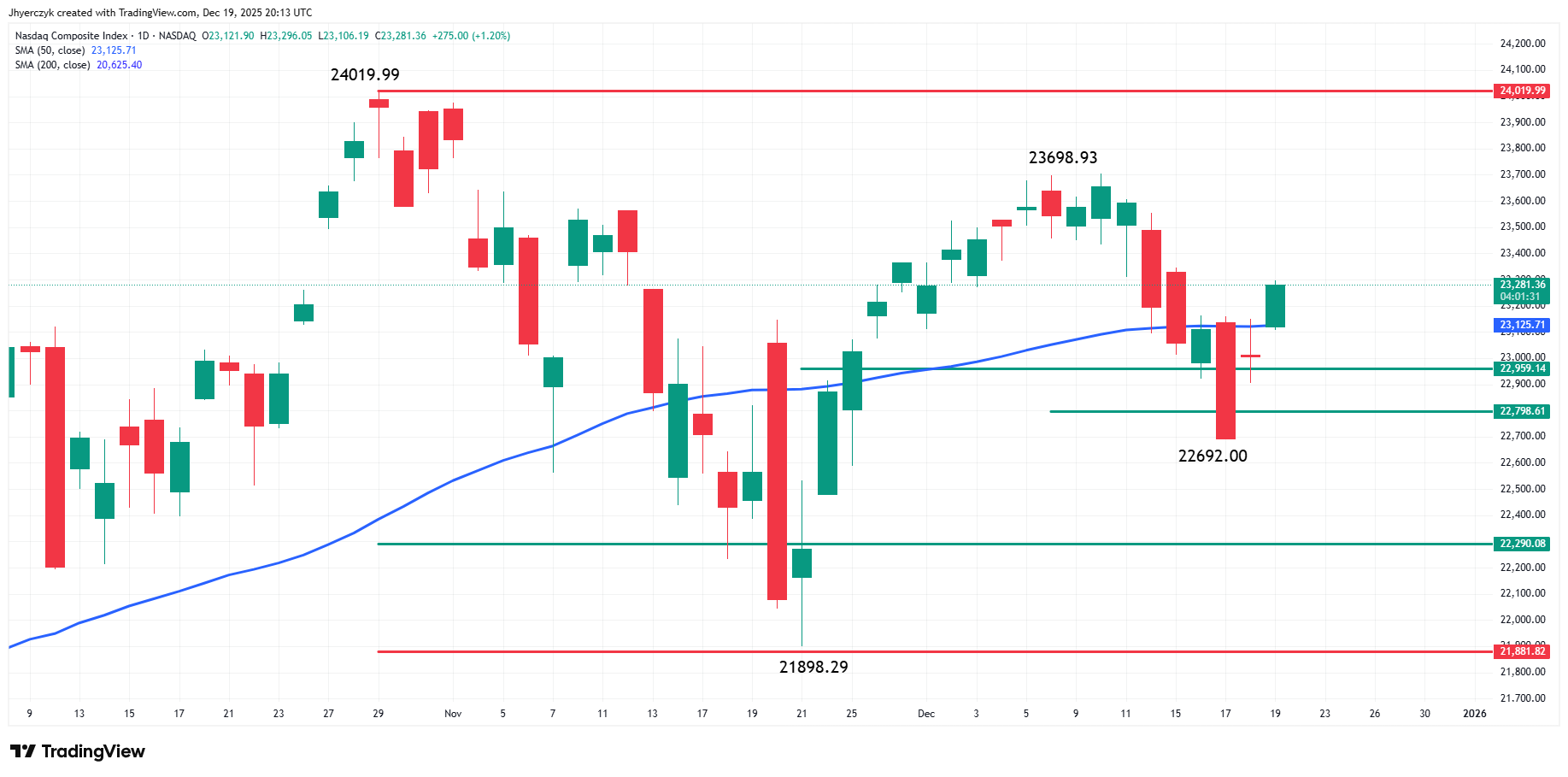
Nasdaq Composite daily chart. Source: TradingView

What Turned the Mood So Quickly?
Three catalysts did the heavy lifting, and together they reshaped the narrative that had been sliding away from the bulls. The first was the November CPI. Traders were waiting on this report, and it delivered. Headline inflation landed at 2.7% versus expectations for 3.1%, with core at 2.6% — the lowest in more than three years.
Skeptics immediately pointed to data limitations tied to the government shutdown, noting that October’s results were incomplete and that month-over-month moves couldn’t be calculated. That mattered to economists, but not to traders. Markets heard something much simpler: inflation is cooling faster than forecast, and the Fed suddenly looks more comfortable cutting rates again in early 2026.
The Fed’s 25-basis-point cut on December 10 came with a cautious tone, but a print like this pulls forward easing expectations whether policymakers want it to or not. Lower rates improve equity appeal — and traders responded accordingly.
Did Micron’s Blowout Quarter Change the AI Conversation?
Absolutely. The second catalyst was Micron’s earnings on Wednesday evening. The company didn’t just beat; it cleared the bar by several layers. Revenue for the fiscal first quarter hit $13.64 billion against expectations for $12.84 billion, but the shock came from the guidance: Micron projected $18.70 billion for the current quarter, versus a consensus near $14.20 billion.
More important was management’s language. They said high-bandwidth memory for AI servers is “more than sold out,” with demand “substantially higher than supply” through the foreseeable future. When a company with Micron’s visibility says it can’t keep up with orders, traders pay attention. The stock’s 10% surge Thursday — followed by another 7% gain Friday — wasn’t just about Micron. It reset sentiment for the entire sector.
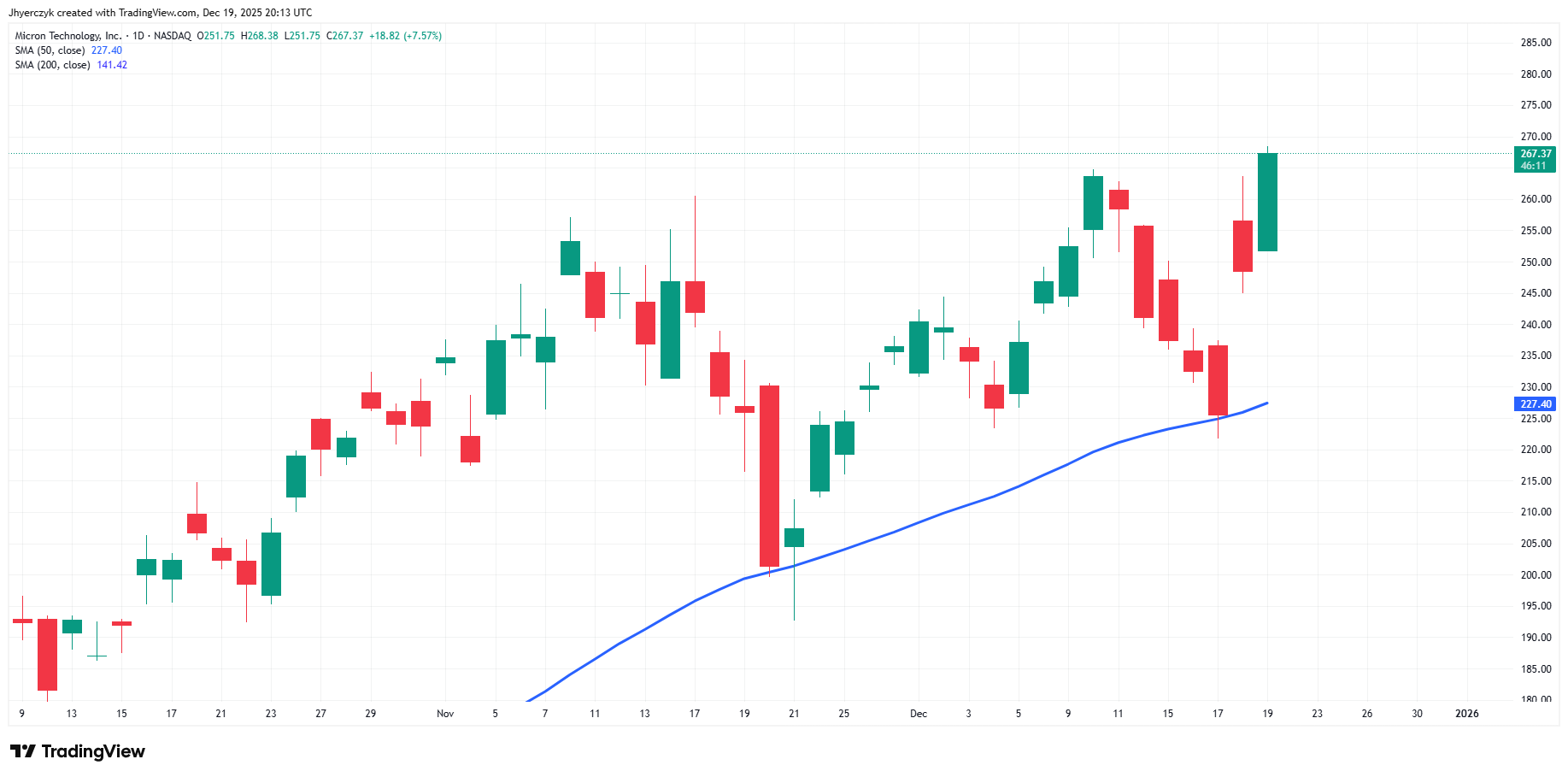
Micron (MU) daily chart. Source: TradingView
The question weighing on the market was simple: is AI spending ahead of itself? Micron’s numbers didn’t solve every concern, but they answered the biggest one — demand is real. And big players are willing to put fresh capital behind that confidence. Micron lifting capex from $18 billion to $20 billion reinforced that belief.
Does Oracle’s Surprise Rebound Signal Fresh Life for AI Infrastructure?
It sure helps. The third catalyst was Friday’s headline that TikTok agreed to sell its U.S. operations to a group that includes Oracle and Silver Lake. Oracle had been beaten up earlier in the week on concerns tied to a data-center project losing support. That dip dragged the broader AI infrastructure group lower — names like Broadcom and AMD felt it too.
But Friday’s news flipped that narrative. Oracle jumping more than 7% wasn’t just about TikTok; it was proof that large-scale AI-related deals are still moving. That reduced fears that the funding pipeline was tightening. For a sector that thrives on long-term investment commitments, seeing money continue to flow was a confidence booster.
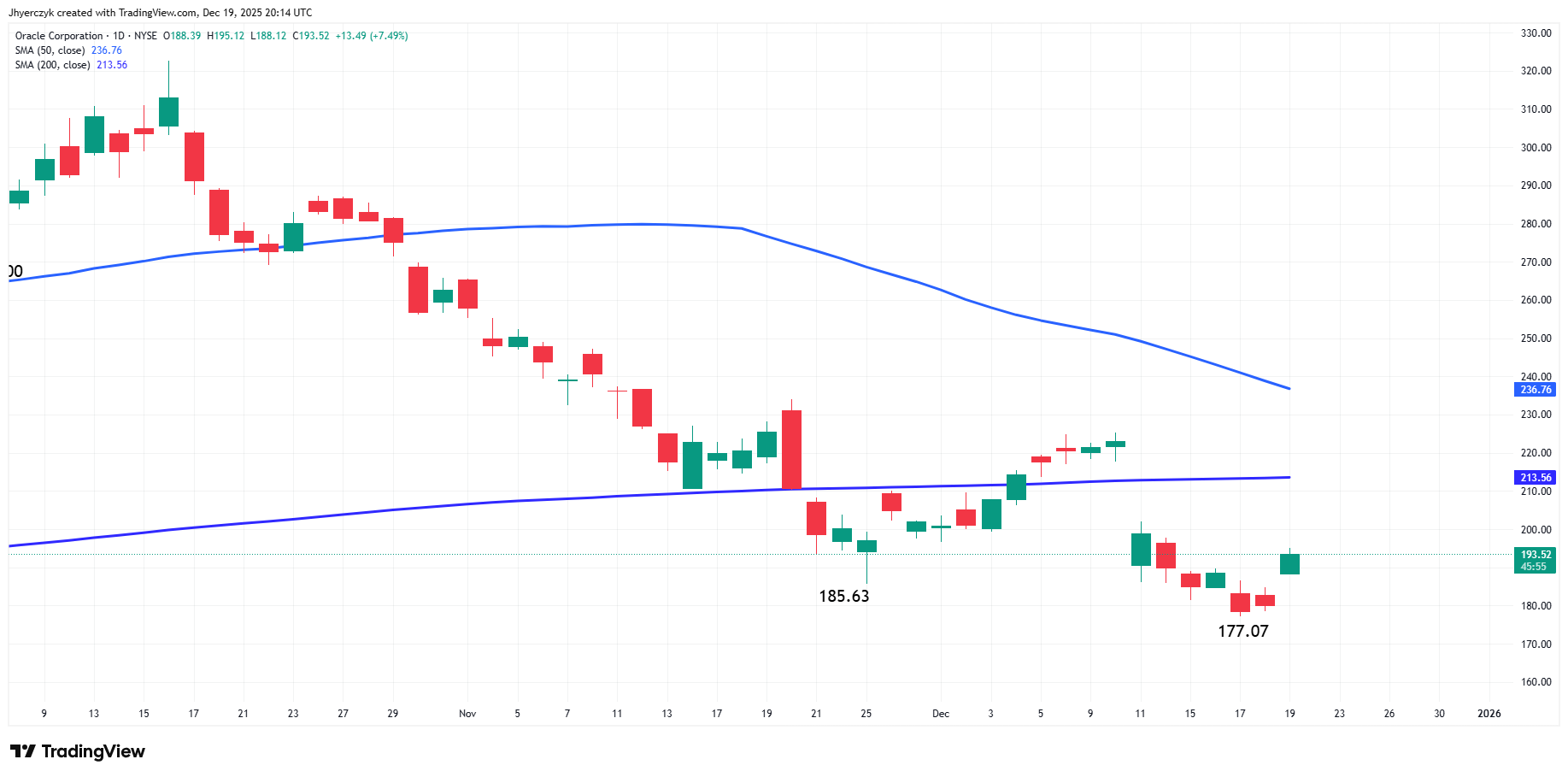
Oracle (ORCL) daily chart. Source: TradingView
Is the AI Trade Really Cooling Off — or Just Catching Its Breath?
What looked like the start of an AI unwind last week turned out to be a reset. Traders had legitimate worries: corporate budgets, timelines for returns, and whether spending would plateau if results didn’t materialize. But Micron’s quarter offered the kind of clarity that cuts through noise. If anything, the company’s comments suggested supply constraints — not demand concerns — are the bigger story heading into 2026.
Additional headlines supported that view. Nvidia gained more than 3% on reporting that the administration is reviewing whether the company may sell certain advanced AI chips to approved buyers in China. That potential market reopening is huge. China remains a deep pool of pent-up demand that hasn’t been fully accessible.
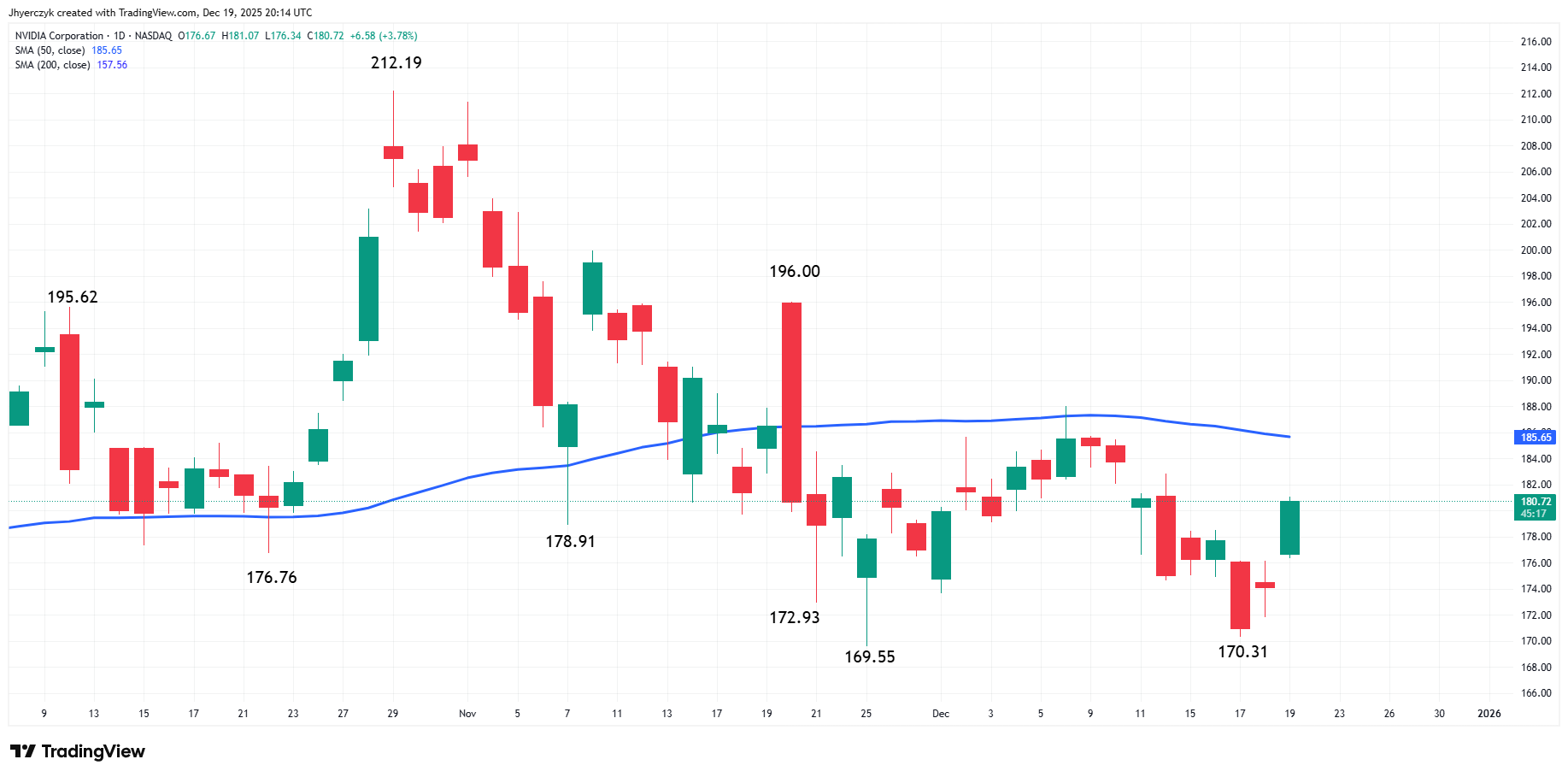
Nvidia (NVDA) daily chart. Source: TradingView
Even so, semis are still about 4% below their recent highs. That’s not a negative; it’s healthy consolidation. The sector needed to digest the run, shake loose some weak hands, and reset expectations. That process now looks largely complete.
Did Last Week’s Pullback Actually Strengthen the Broader Market?
From a technical standpoint, yes. The S&P 500 tested its 50-day moving average on Wednesday and attracted buyers quickly. Two straight up days that pulled the index back toward the 6,765–6,775 region — the zone many traders are watching as the current band of support — showed that buyers still care about defending trend levels.
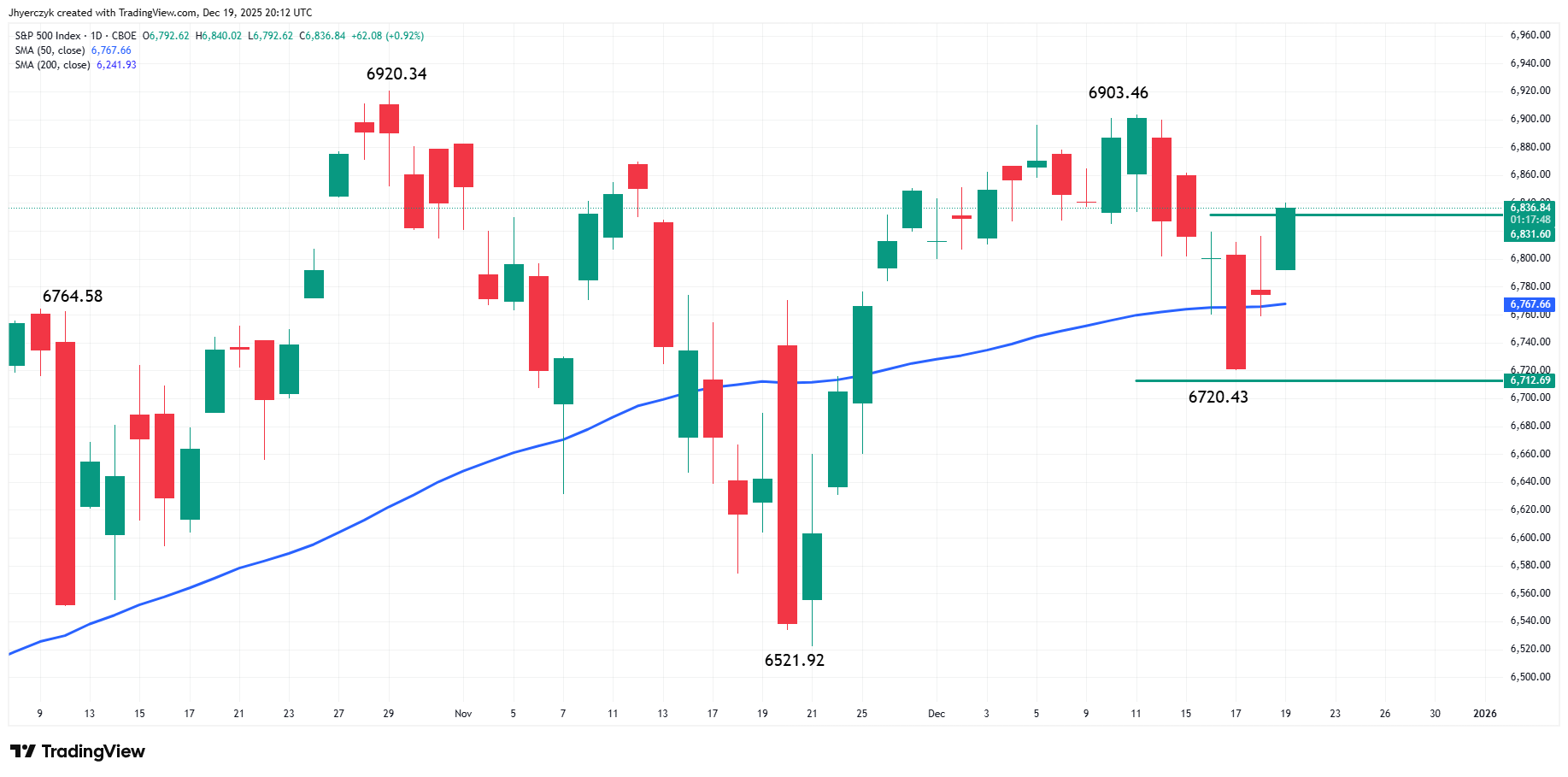
S&P 500 (SPX) daily chart. Source: TradingView
And this all happened during the biggest options expiration in history, with more than $7.1 trillion in notional set to roll off. Days like that usually bring sloppy action. Instead, the market climbed. That’s the kind of behavior that suggests real demand rather than short-term squeezing.
Breadth improved too. Tech led, but industrials and financials showed legitimate participation. Rotation into transports, small-caps, and financials has been building through December, and last week strengthened that pattern. When more groups are working, rallies tend to last longer.
Nike’s 9% drop on weak China sales could’ve sparked broader selling, but it didn’t. Traders treated it as a company-specific issue — a sign the market is differentiating rather than panicking.
Are We Set Up for a Strong Santa Claus Period?
The conditions look favorable. The Santa Claus window — the last five trading days of December and first two of January — begun Monday, December 23. Historically it has produced about a 1.3% gain for the S&P 500. Seasonality alone isn’t a trading plan, but the context matters. Tax-loss selling is wrapping up. Fund managers with strong years aren’t inclined to make big shifts. Sentiment typically gets a holiday boost. And thin holiday volume often provides an easier path higher when buyers lean in.
What makes this year interesting is that seasonal strength isn’t doing all the work. Inflation is easing. AI demand has been validated. Corporate deal flow hasn’t dried up. And the technical backdrop stabilized quickly after last week’s scare.
What Should Traders Watch Heading Into Next Week?
Volume will matter. It should thin out as the holidays approach, and lighter volume can exaggerate moves in both directions. But historically, buyers tend to take advantage when sellers step back.
AI bellwethers remain central to the story. If Micron, Nvidia, Oracle, AMD, and Broadcom keep attracting flows, the major indices will feel that tailwind.
Rotation matters too. Strength in cyclicals, financials, and small-caps alongside tech would indicate a broad rally rather than a narrow one. That’s what bulls want to see.
And yes — keep one eye on the S&P 500’s 50-day moving average around 6,765–6,775. The index reclaimed that zone last week. A clean extension above it on solid volume would reinforce the case for continued strength into year-end.
Bottom Line
Last week’s downturn now looks more like a shakeout than a warning. Inflation cooled more than expected. AI demand proved sturdier than the bears suggested. Corporate investment is still flowing. And buyers stepped in exactly where they needed to.
With the Santa Claus period starting next week, the market has the wind at its back. Pullbacks will come — they always do — but the evidence points to a bullish finish rather than a stumble. Traders who were waiting to see whether buyers still had conviction got their answer: they do.
And if last week’s action is any guide, the bulls aren’t just back. They’re pressing their advantage into the final days of the year.