


Here's an insight into how we make money. While we strive to be comprehensive, the compensation we receive can influence the products, companies, or services we showcase and review. Not all available options may be featured on this page.
Pepperstone vs FP Markets Comparison – 2026


Comparison Table
Pepperstone | FP Markets | |
|---|---|---|
Overall Rating | 4.7 | 4.6 |
Trust | 4.5 | 4.2 |
Fees | 4.4 | 4.1 |
Platforms and Tools | 4.8 | 4.6 |
Tradable Instruments | 5.0 | 4.6 |
Customer Support | 4.9 | 4.9 |
Research | 4.4 | 4.3 |
Deposit and Withdrawal | 5.0 | 4.9 |
Account Types and Terms | 4.9 | 4.9 |
Education | 4.2 | 5.0 |
Regulators & Max Leverage | 1:30 (FCA), 1:200 (SCB), 1:30 (BaFin), 1:30 (ASIC), 1:30 (DFSA), 1:400 (CMA), 1:30 (CySEC), 1:30 (CMA UAE), 1:30 (CMA UAE) | 1:500 (FSA), 1:500 (FSCM), 1:500 (Unregulated), 1:400 (FSCA), 1:30 (ASIC), 1:500 (CMA) |
Foundation Year | 2010 | 2005 |
Fees Test | Low | Medium |
Tradable Instruments | 1,494 | 10,180 |
Trading Platforms | MT5, cTrader, MT4, TradingView, Pepperstone WebTrader, Pepperstone Mobile App | MT5, cTrader, IRESS, MT4, Mottai, TradingView |
Minimum Deposit | $0 | $100 |
Read Reviews |
Both Pepperstone and FP Markets are well known in the CFD world. However, not every trader will be equally well served by them. By testing these brokers, I looked for the strengths and weaknesses of both firms.
I used the Standard accounts with MetaTrader 5 for this test with both brokers. I also looked at the performance of the mobile versions of this platform, checking speed and execution.
I then searched for both strengths and weaknesses with both Pepperstone and FP Markets. This was done to determine which traders would benefit from each of these brokers, with the following being some of the biggest things that I discovered:
Top Reasons to Choose Pepperstone or FP Markets
Pepperstone has many benefits for traders to consider. It is known for low fees and a variety of assets available. The spreads in the markets were consistently lower than the industry average, whether in forex, metals, stocks, indices, and crypto. Pepperstone offers around 1,400 assets for trading on each of its platforms. This is true in MetaTrader 4, MetaTrader 5, TradingView, cTrader, or the proprietary Pepperstone platform.
FP Markets has been a strong contender for traders to choose over the years, and the number of offerings is quite impressive. Its lineup of more than 10,000 assets, including forex, shares, indices, commodities, bonds, ETFs, and crypto, allows traders to take advantage of the global markets. And you can use MetaTrader 4, MetaTrader 5, cTrader, and TradingView, plus Iress and Mottai, though the last two are available only to Australian traders.
| Pepperstone Better Fees |
FP Markets Better Instrument Selection |
| Low spreads in most asset classes | 10,000+ global stocks |
| No minimum deposit | 970+ CFD assets |
| Average commissions | Competitive spreads |
| MT4, MT5, cTrader, TradingView, Pepperstone WebTrader & App | MT4, MT5, cTrader, TradingView, Iress & Mottai |
| Commission-free accounts available | Traders Toolbox plugin, Autochartist content |
| 1,380+ markets, 90+ currency pairs | DMA trading |
Pepperstone: Snapshot
Pepperstone opened in 2010. With time, this Australian broker has expanded its operations and is now licensed by multiple Tier-1 regulators, including FCA, CySEC, ASIC, and BaFin. One of the big advantages of trading at Pepperstone is its low trading costs. The spreads in Major forex pairs can be as low as 1.0 pip using the Standard account, with its commission-free trading. Spreads in most markets were essentially near industry standards, but the variable spread accounts truly are some of the lowest that I have seen in the 20-plus years I have been trading.
Pepperstone: Who is it For?
Pepperstone is excellent for short-term trading. The commission-free Standard account has thin and steady spreads. That being said, there are some markets that aren’t as competitive, such as oil markets. Swing trading is also well served here, as the swaps are average, despite the discount on trading costs.
What Makes Pepperstone Stand Out?
The biggest advantage of trading at Pepperstone is the low spreads. This is especially obvious on share CFDs, which are sometimes wider at other brokers. The AAPL spread was 3 cents during the New York sessions, while TSLA was just 6 cents, which is 8 times better than the industry average of 50 cents. This can save the trader significant money in fees, especially when they are active day traders.
| Recommended in 4 best broker guides: |
| Forex Brokers | CFD Brokers | Zero Spread Brokers | Brokers with Low Minimum Deposit |
FP Markets: Snapshot
FP Markets is a bit older than Pepperstone, opening in 2005. Founded in Sydney, FP Markets has since expanded globally. It holds licenses from ASIC, the FSCA, and other major regulators. FP Markets offers over 10,000 instruments across seven asset classes, giving a huge number of possibilities to traders. FP Markets also has tight spreads and low fees that can facilitate different trading styles.
FP Markets: Who is it For?
FP Markets is a broker that suits a lot of different styles of trading. The overall number of assets available here means that a lot of globally aware traders will be attracted to this broker. It’s best suited for an overall portfolio, as the ability to trade so many different markets means that you can hedge risks in ways that most brokers cannot touch. As for the timeframe, the broker is equally strong whether you prefer to trade intraday or long term.
What Makes FP Markets Stand Out?
The huge number of tradable markets is a major factor in making FP Markets stand out. The low fees in major markets and the leverage offered, up to 1:500, are a benefit for traders as well. The ability to trade variable spreads and having several platforms offered all make FP Markets a standout for professional traders looking to trade assets as diverse as aluminum, Ripple, exotic currency pairs, and more. The professional trader will be attracted to the ability to find numerous opportunities around the world.
| Recommended in 8 best broker guides: |
| Forex Brokers | CFD Brokers | Zero Spreads| Regulated Brokers | MT4 | Social Trading | Scalping | Commodities |
Trust
Pepperstone vs FP Markets Trust and Regulation Comparison
Trust Rank | 4.5 | 4.2 |
Regulators & Max Leverage | 1:30 (FCA), 1:200 (SCB), 1:30 (BaFin), 1:30 (ASIC), 1:30 (DFSA), 1:400 (CMA), 1:30 (CySEC), 1:30 (CMA UAE), 1:30 (CMA UAE) | 1:500 (FSA), 1:500 (FSCM), 1:500 (Unregulated), 1:400 (FSCA), 1:30 (ASIC), 1:500 (CMA) |
Foundation Year | 2010 | 2005 |
Publicly Traded |

Pepperstone is heavily regulated in multiple jurisdictions. It is authorized by CySEC, BaFin, FCA, ASIC, DFSA, CMA, and the SCB. This shows heavy regulation from some of the most well-regarded governing bodies in the world. Its legal documents spell out the client’s protections. Pepperstone segregates client funds and provides negative balance protection. The broker has a large workforce as well, with over 900 associated members on LinkedIn.
FP Markets is also heavily regulated in multiple jurisdictions. This includes the FSA, ASIC, FSCA, and CMA. FP Markets is also heavily regulated by some of the top regulators in the world, offering strong client protection. Looking at the legal documents, FP Markets will also segregate client funds and provide negative balance protection. FP Markets has 380 associated members on LinkedIn, which shows a sizable company as well. While FP has been around a bit longer than Pepperstone, both have extensive protections for traders.
If you want to learn more about how forex brokers are regulated, we have a dedicated article on it here.
Fees
Pepperstone vs FP Markets Spreads, Fees and Commissions Comparison
Fees Rank | 4.4 | 4.1 |
Inactivity Fee |
With the Pepperstone Standard CFD account, the spread on the EUR/USD pair averages 1.0 pip during the US session. This is just under the industry average of 1.08 pips. Most of the stock CFDs have a spread of 3-6 cents, with the GBP/JPY pair around 2.0 pips on average. The overall spread on the Standard account is generally lower than the industry average. The Razor account is also very competitive, as its commissions are average, but spreads are extremely low. Pepperstone has no inactivity fees, allowing longer-term traders to feel at home.
| Account Type | Standard Account | Razor Account | ||||
| Instrument | Live Spread AM | Live Spread PM | Industry Average* | Live Spread AM | Live Spread PM | Industry Average* |
| EUR/USD | 1.1 Pips | 1 Pip | 1.2 Pips | 0.0 Pips | 0.0 Pips | 0.06 Pips |
| GBP/JPY | 2.4 Pips | 1.6 Pips | 2.9 Pips | 1.4 Pips | 0.5 Pips | 1.02 Pips |
| Gold | 18 Cents | 14 Cents | 36 Cents | 16 Cents | 14 Cents | 11 Cents |
| WTI Oil | 7 Cents | 5 Cents | 4 Cents | 4 Cents | 3.6 Cents | 2.7 Cents |
| Apple | N/A | 3 Cents | 33 Cents | N/A | 5 Cents | 24 Cents |
| Tesla | N/A | 6 Cents | 51 Cents | N/A | 7 Cents | 41 Cents |
| DAX 40 | 0.9 Pips | 0.9 Pips | 2.7 Pips | 0.09 | 0.09 | 1.5 Pips |
| Dow Jones 30 | 2 Pips | 2 Pips | 3.7 Pips | 2 Pips | 2 Pips | 2.2 Pips |
| Bitcoin | $15 | $15 | $51.45 | $15 | $19.49 | $23.69 |
Razor accounts allow raw spreads as low as 0.0 pips, and a $6 round-trip commission on forex and share CFDs, using cTrader. MetaTrader 4, MetaTrader 5, WebTrader, and TradingView all have slightly higher commission rates.
FP Markets is also a very competitive broker when it comes to fees. Like Pepperstone, it offers a commission-free Standard account, where I saw a 1.1-pip spread on EUR/USD. This is essentially the same as the overall industry average. FP Markets also doesn’t charge inactivity fees, allowing both longer-term and swing traders to feel comfortable here.
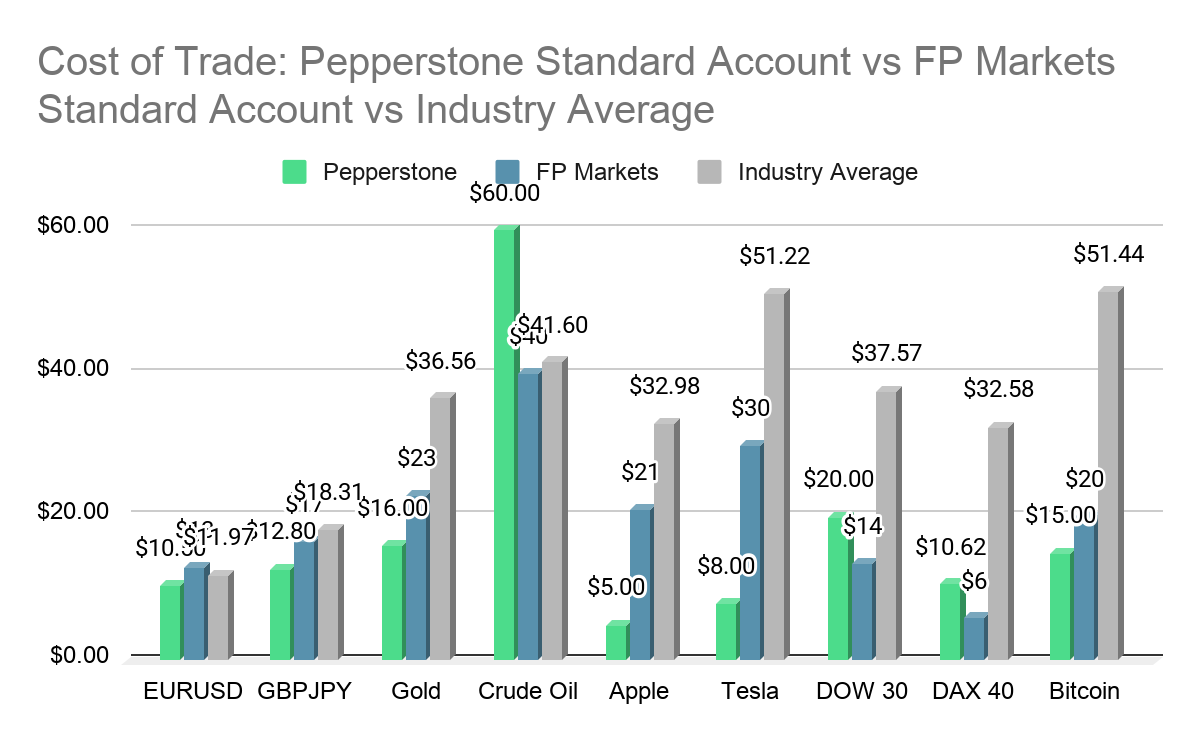
Please note that, in addition to Pepperstone’s stock spreads, I also took into account a $2 commission per full contract.
The differences between the two brokers are slight. I found Pepperstone to be the better option for trading forex pairs, metals, stocks, and cryptocurrencies. However, FP Markets offers more competitive conditions for trading energies and indices.
New to how spreads and commissions work? Our guide Forex Pricing Explained: How Brokers Set Prices has you covered.
Platforms and Tools
Pepperstone vs FP Markets Trading Platforms Comparison
Platform Rank | 4.8 | 4.6 |
Trading Platforms | MT5, cTrader, MT4, TradingView, Pepperstone WebTrader, Pepperstone Mobile App | MT5, cTrader, IRESS, MT4, Mottai, TradingView |
Mobile Apps | Android, iOS | Android, iOS |
Pepperstone has a diverse lineup of trading platforms, including a proprietary WebTrader platform, MetaTrader 4, MetaTrader 5, cTrader, and TradingView. The proprietary platform is a nice choice, as it has advanced charting capabilities and a large number of technical indicators.
cTrader and MetaTrader allow for algorithmic trading. For MetaTrader, this is via Expert Advisors. The broker also offers Virtual Private Servers (VPS) for low-latency automated trading, as well as FIX API integration.


FP Markets doesn’t lag behind when it comes to the choice of trading platforms for both beginner and advanced traders. The broker offers MetaTrader 4, MetaTrader 5, cTrader, TradingView, Iress, and Mottai. Both Iress and Mottai offer direct market access to CFDs from exchanges. The TradingView platform is, of course, a popular choice for traders in general, as it is beginner-friendly, highly customizable, and offers access to a vast social network of traders.
Tradable Instruments
Pepperstone vs FP Markets Instruments Selection Comparison
Tradable Instruments Rank | 5.0 | 4.6 |
# Tradable Instruments | 1,494 | 10,180 |
# Currency Pairs | 90 | 72 |
# Commodities | 40 | 29 |
# Crypto | 51 | 12 |
# Stocks | 1,200 | 10,000 |
# Indices | 23 | 19 |
Pepperstone offers a good selection of tradable instruments. There are more than 1,380 assets across currency pairs, commodities, stocks, indices, cryptos, and ETFs. The bulk of the offering is share CFDs, including 1,100+ stocks of US, UK, Hong Kong, Australian, and EU companies. The 90+ FX pairs and 51 crypto assets are further highlights.
Another unique aspect of the offering is the inclusion of 116 24-hour stocks, which give traders access to the market even on weekends.
FP Markets truly shines in this category. It offers 970+ CFD contracts across FX pairs, commodities, stocks, indices, cryptos, bonds, and ETFs. This stack far exceeds the industry average of 350-500. But the real standout part of the offering is access to more than 10,000 global stocks. That selection of tradable instruments puts FP Markets in the top 10% of the forex brokers we’ve tested at FXEmpire.
Customer Support
Pepperstone vs FP Markets Customer Support Comparison
Customer Support Rank | 4.9 | 4.9 |
Availability | Available 24/7 | Available 24/5 |
Live Chat |

Pepperstone has support available 24/7 via live chat, email, or phone. Help at Pepperstone is available in 9 languages, which include English, Spanish, Chinese, and Arabic. The first thing you see is an AI chatbot, but I also tested the customer support by asking questions about the trading account particulars, minimum deposit requirements, and trading tools. I found that the agents knew the answers to the questions I was asking and were generally nice and helpful.
FP Markets can also be reached 24/7. Like Pepperstone, FP Markets offers live chat, email, and phone. Help is available in more than 40 languages from around the world. The first stop will be the AI chatbot, which I found very good at pointing out the information I was looking for. The live agent I spoke to was also knowledgeable, making the support strong.
You can check our customer support test in more detail here.
Research
Pepperstone vs FP Markets Research Tools Comparison
Research Rank | 4.4 | 4.3 |
News (Top-Tier Sources) | ||
Economic calendar | ||
Videos/Webinars | ||
Trading Central (Recognia) | ||
Autochartist |
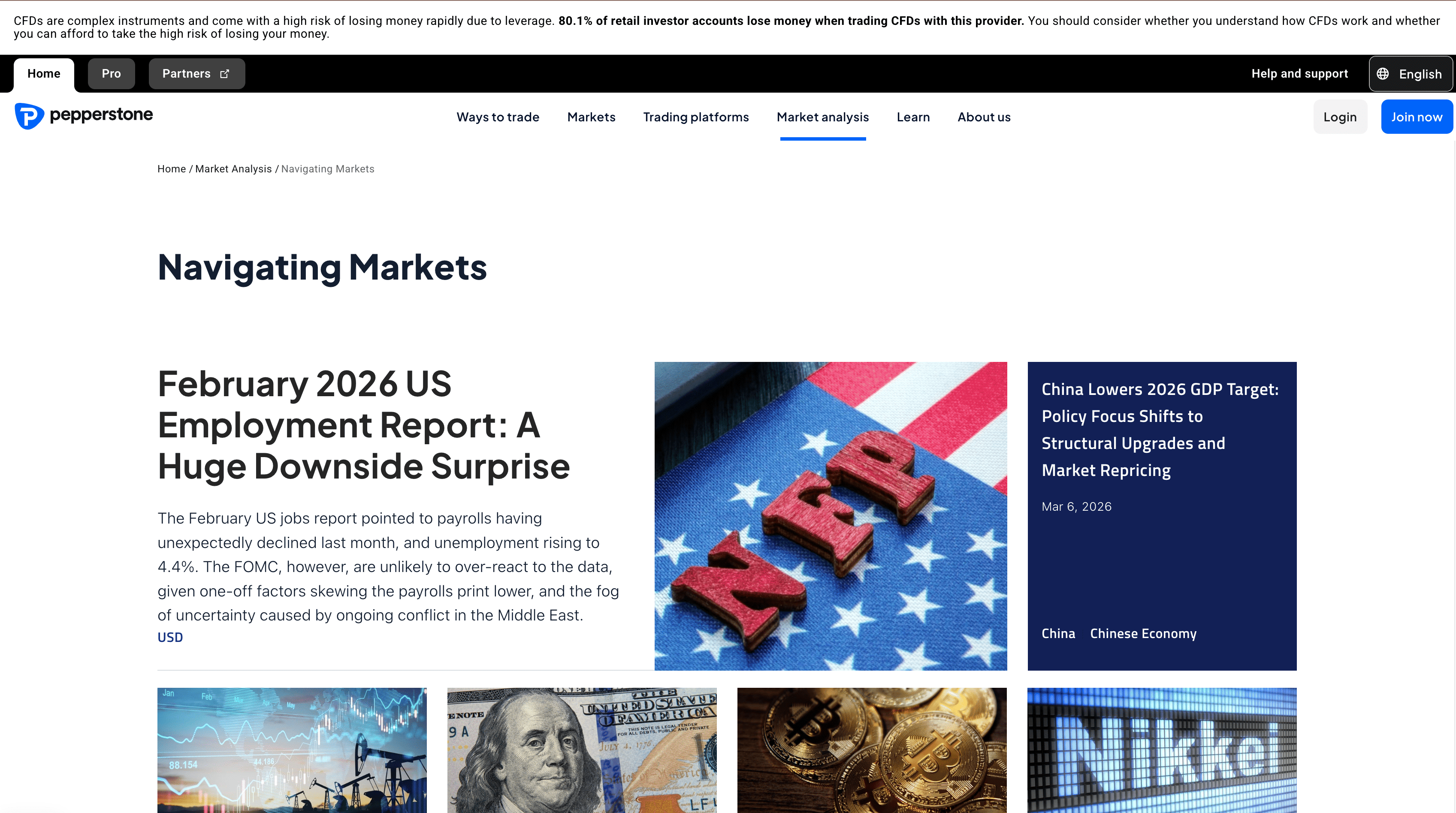
Pepperstone offers strong market research developed in-house. The live podcast episodes and webinars are also available, which can help you track trends in the markets and break down many important concepts or setups. The content is useful for both long-term and short-term traders. Some highlights include the “Navigating Markets” analysis hub, which features market commentary and analysis from Pepperstone’s global analysts, focusing on global macro themes, economic data, and major events that can move markets. Even though there’s no third-party content, the scope and breadth of what you can get here are impressive.
FP Markets does incorporate third-party research from Trading Central and Autochartist. It also offers AI-powered add-ons for platforms, webinars, podcasts, and several trading courses. The education and news sections were both strong points here as well, though the market insights seem to have slowed down over the last few months.
That being said, the frequency of webinars seems to be picking back up. This should mean more timely information for those learning to trade or getting to grips with the global markets.
Deposits & Withdrawals
Pepperstone vs FP Markets Deposit and Withdrawal Methods Comparison
Deposit and Withdrawal Rank | 5.0 | 4.9 |
Deposit Options | Cryptocurrencies, PayPal, Wire Transfer, Skrill, Neteller, Union Pay, ZotaPay, Visa, Mastercard, Apple Pay, Google Pay | PayPal, Wire Transfer, Skrill, Neteller, Credit Card, Bpay, Broker to Broker, Debit Card, PayID |
Withdrawal Options | Wire Transfer, Visa, Mastercard, PayPal, Apple Pay, Google Pay, Neteller, Skrill, Union Pay, Cryptocurrencies, ZotaPay | Wire Transfer, Neteller, Skrill, PayPal, Paytrust, Online Pay, Debit Card |
Withdrawal Fee |
Pepperstone allows deposits and withdrawals using bank wire, credit and debit cards, several e-wallets, and cryptocurrencies. This means there are plenty of options to choose from. All transactions are within the standard times seen throughout the industry, and Pepperstone itself doesn’t charge fees for either. However, there are sometimes fees attached to the method outside of Pepperstone, such as bank wire fees.
FP Markets is very similar to Pepperstone, as it allows similar methods: bank wires, credit and debit cards, cryptocurrencies, and several e-wallets. FP Markets doesn’t charge processing fees either.
Account Types and Terms
Pepperstone vs FP Markets Account Types Comparison
Account Types and Terms | 4.9 | 4.9 |
# Base Currencies | 90 | 72 |
Islamic Account | ||
Demo Account | ||
Minimum Deposit | $0 | $100 |
Pepperstone has no minimum deposit requirements to get started. This is true with both Standard and Razor accounts. The Standard account allows commission-free trading and floating spreads that start at just 1.0 pip. The Razor account offers raw spreads that can be 0.0 pips, with a $6-7 round-trip commission, depending on the platform that you’re trading on. Swap-free accounts are available at Pepperstone as well. You can use 10 base currencies, including USD, JPY, EUR, GBP, and more.
FP Markets has a minimum of AUD 100 to open an account. This is true with both Standard and Raw accounts. The Standard account offers spreads from just 1.0 pip without commissions, while the Raw account offers spreads from 0.0 pips, with a commission of $6 per round trip. This is right in line with Pepperstone, making both similar in this regard.
Education
Pepperstone vs FP Markets Educational Content Comparison
Education Rank | 4.2 | 5.0 |
Videos | ||
Webinars |
Pepperstone has performed well in the education area. The broker offers plenty of articles and videos for beginners, as well as intermediate traders. I found the content to be helpful and practical. Most of the focus in these educational pieces is on technical analysis, such as candlestick patterns and reading price action. Beyond technical analysis, the educational area has some content on risk management, as well as a podcast series called “Deciphering the Market Rhythm.”
FP Markets has a huge educational area on its website, suitable for beginner, intermediate, and advanced traders. It features several trading courses, grouped by the experience level of the trader. FP Markets also produces live webinars, podcasts, events, eBooks, trading guides, platform tutorials, and a trading glossary. Very few brokers offer the amount of education that FP Markets does, making it a great pick for those looking to learn more about the art of trading.

Our Methodology
Since 2011, FX Empire has developed a detailed methodology for evaluating CFD brokers, involving over 250 variables across nine crucial categories. Our team of experts, with deep industry knowledge, conducts live testing and research by interacting with the brokers directly. We check regulations, open accounts, test spreads, account costs, platform functionality, instrument variety, customer support reliability, and the quality of research and educational content. This granular analysis helps us identify each broker’s strengths and weaknesses, keeping our comparisons current with market trends and ensuring our guides meet traders’ needs.
We strive to evaluate each broker objectively, considering how their offerings align with the diverse trading goals and preferences of our readers. Our focus is on providing a balanced overview of each broker’s strengths and weaknesses. This method ensures that our readers receive clear, insightful comparisons to aid in making well-informed trading decisions.
We employ a comprehensive rating system across nine key categories:
- Trust
- Fees
- Platforms and Tools
- Tradable Instruments
- Customer Support
- Research
- Deposits and Withdrawals
- Account Types and Terms
- Education
In each category, we conduct an in-depth analysis for both brokers, outlining features, advantages, and disadvantages and determining their suitability for different trader profiles. By blending insights from our extensive reviews with first-hand experiences and observations, we ensure each comparison is balanced, informative, and tailored to the trader’s unique needs. You can read more about our review process here.
Related Comparison Articles
About the Author
Christopher Lewis is an experienced trader and technical analyst specializing on currencies, indices, and commodities. He also has been working as a proprietary trader for institutional accounts. Chris has been an FXEmpire analyst since the site's early days and shares his trading insights on his own blog, The Trader Guy. His sharp, practical understanding of the trading industry means he knows forex and CFD brokers inside-out, so you can trust his guidance on how they work and which one to choose.
Why you can trust FXEmpire
At FXEmpire, we strive to provide unbiased, thorough and accurate broker reviews by industry experts to help our users make smarter financial decisions.