The market is still pricing the artificial intelligence revolution as if it lives only inside software, semiconductors and cloud platforms. That may prove to be one of the most expensive misreading of this entire cycle.
Because the real AI boom is not weightless. It is not virtual. And it is not confined to code.
It is being built in Copper. Natural Gas. Power grids. Transformers. Turbines. Cooling systems. Transmission lines. Data centres. And the uninterrupted electricity required to keep the most energy-hungry technology revolution in history online.
This is the hidden trade beneath the AI boom and most traders are still looking in the wrong direction.
While the world chases the next AI stock, the physical infrastructure behind the revolution is entering a demand shock few portfolios are prepared for. Global data centre electricity consumption is projected by the International Energy Agency to surge from around 485 terawatt hours in 2025 to roughly 950 terawatt hours by 2030, with AI-focused data centres expanding even faster.
Natural Gas is expected to meet more than 40% of additional data centre electricity demand through 2030, turning energy reliability into one of the defining bottlenecks of the AI era.
That bottleneck is where the real scarcity premium may now be forming.
Lars Hansen, Head of Research at The Gold & Silver Club, says markets are still dangerously under-pricing the physical trade beneath the digital boom: “AI is not a weightless revolution. It is one of the most power-hungry, metal-intensive industrial build-outs in modern history. Traders who only own the software layer may be missing the real scarcity trade underneath it.”
Copper: The Metal Wiring of the AI Age
Copper is becoming the electrical backbone of artificial intelligence. Every hyperscale data centre requires high-density cabling, transformers, substations, cooling equipment, backup systems and grid interconnections. None of that happens without Copper.
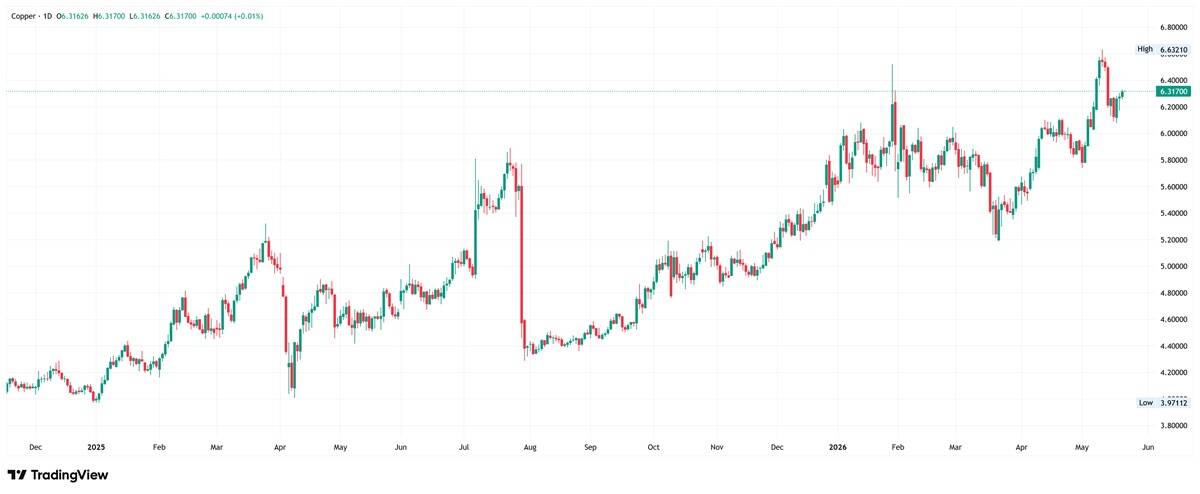
The problem is supply. Mine grades are declining, new projects take years to permit, resource nationalism is rising and geopolitical disruption is tightening the availability of critical processing inputs.
Goldman Sachs has now raised its copper price forecast, lifting its long-term target to $15,000 per tonne, while Citi expects prices to climb to $14,000 within the next three months.
That is not a marginal upgrade. It is a major institutional signal that Wall Street is beginning to price in a structural copper squeeze – driven by electrification, grid expansion, AI data centres, infrastructure demand and years of underinvestment in new mine supply.
“This is the moment Copper stops trading like a cyclical metal and starts trading like strategic infrastructure,” says Hansen. “If AI is the brain of the new economy, Copper is the nervous system. Without it, the entire machine slows down.”
Brent Oil Price Forecast
Every new Brent Oil analysis as it publishes, today's technical signal and key levels, live price — on one page.
See all Brent Oil forecastsIran, Hormuz, and the New Scarcity Premium
The Iran war has changed the Commodity equation. This is no longer just a demand story. It is now a demand shock colliding with a supply-chain crisis.
The Strait of Hormuz remains one of the world’s most important energy chokepoints. The IEA notes that more than 110 billion cubic metres of Liquefied Natural Gas (LNG) passed through the Strait in 2025, including about 93% of Qatar’s LNG exports and 96% of the UAE’s LNG exports. That represented almost one-fifth of global LNG trade, with no easy alternative routes for those volumes.
That matters because AI needs power and power needs fuel. If LNG flows are disrupted, energy markets tighten. If energy markets tighten, electricity costs rise. If electricity costs rise, the cost of running AI infrastructure rises. And if the world is forced to compete for the same shrinking supply of reliable energy, Natural Gas prices could reprice violently higher.
“The market is beginning to realise that energy security is no longer optional,” Hansen says. “When war risk enters the same market already being tightened by AI demand, LNG growth and underinvestment, the upside in Natural Gas can become explosive.”
The Oil-To-Gas Ratio Is Flashing a Major Upside Signal
The valuation signal is extraordinary. With WTI Crude Oil currently trading near $98 per barrel and U.S Natural Gas close to $3 per MMBtu, the Oil-To-Natural-Gas ratio sits around 32.7.
On an energy-equivalent basis, one barrel of Oil contains roughly 5.8 MMBtu. A ratio above 30 suggests Natural Gas is trading at a deep discount to Oil. If the ratio compresses toward 20, Natural Gas would imply roughly $4.90. At 15, it implies more than $6.50. At 10, it implies almost $10 – before factoring in AI power demand, LNG disruption, weather shocks or supply-chain stress.
Hansen calls it “one of the cleanest relative-value signals in global Commodities today.”
The Hard Asset Trade May Define This Cycle
As scarcity tightens across the world, the Hard Asset trade may become one of the most powerful wealth creation opportunities of our lifetime.
Copper wires the AI economy. Natural Gas powers it. War, chokepoints, underinvestment and supply-chain disruption are now adding a scarcity premium to both.
The call to action is clear: do not wait for consensus.
By the time mainstream traders fully understand that AI, Iran, Energy Security and Commodity Scarcity are part of the same trade, the early positioning window may already be gone.
The smart money is already moving before the headlines catch up. The opportunity now is to position ahead of the repricing before Copper and Natural Gas become the trades everyone wishes they had bought sooner.