



The Ethereum Foundation is facing renewed scrutiny after a fresh wave of high-profile researcher resignations, intensifying debates about the project’s direction, leadership, and the long-term value of its native token, Ether (ETH).
Beek, with approximately seven years at the Foundation and a key role in the Beacon Chain launch, set his final working date for May 29. Ma, a cryptoeconomics and mechanism design researcher, had been with the EF for about four years.
Their exits follow a broader reshuffle that has already seen several recognizable Ethereum contributors leave or step back in 2026, including Barnabé Monnot, Tim Beiko, Trent Van Epps, Alex Stokes, Josh Stark, and former co-executive director Tomasz Stańczak.
🚨 THIS IS CONCERNING:
8 ETHEREUM FOUNDATION LEADERS AND RESEARCHERS HAVE RESIGNED IN 2026.
5 of them in May alone.
The full list will shock you:
1. Tomasz Stanczak – co-executive director
2. Josh Stark – long-time operations and writing lead
3. Trent Van Epps – architect… pic.twitter.com/9jVWpeMdB6
— CryptoGoos (@cryptogoos) May 22, 2026
The departures have raised questions inside the Ethereum community about why so many researchers, coordinators, and ecosystem leaders have left the foundation in recent months.
Ethereum Price Forecast
Every new Ethereum analysis as it publishes, today's technical signal and key levels, live price — on one page.
See all Ethereum forecasts“It’s not personal. As an engineer, you can tell within 1 hour of trying to build anything that Solana and SUI are just better software.”
Ethereum Chooses Idealism Over Capitalism
The Ethereum Foundation has also been trying to redefine its role after publishing a new mandate earlier this year, stressing that it is not Ethereum’s “owner” or central authority.
The Mandate explicitly calls for reducing the foundation’s influence over time, allowing Ethereum to evolve as a more decentralized ecosystem with multiple stewards. Many departures appear aligned with this vision.

Critics argue that the Ethereum Foundation’s idealistic approach is becoming harder to defend in a more competitive crypto market.
Crypto journalist Laura Shin said Ethereum’s mistake after Dencun was failing to weigh its roadmap decisions against ETH tokenomics, especially as the layer-2 strategy weakened the “ultrasound money” thesis.
I think Ethereum’s original sin was not considering tokenomics with every move it made from Dencun on.
The ultrasound money thesis was a good one and with Dencun (or the L2 roadmap generally) they should have stopped to say that this was going to hurt the ultrasound money thesis…
— Laura Shin (@laurashin) May 21, 2026
In her view, the foundation has leaned too heavily on values and not enough on price, value accrual, business development, and market share.
Shin argued that Ethereum’s principles and tokenomics do not have to conflict. Instead, stronger attention to ETH’s monetary premium and ecosystem growth could help those principles spread to more users.
Realistic Scenarios For ETH Price
The Ethereum Foundation exodus points to governance and execution frustrations, but it does not mean the network itself is failing.
Ethereum still anchors some of crypto’s most important markets. For instance, it remains the dominant stablecoin settlement layer, hosting more than 50% of total stablecoin capitalization, according to RWA.XYZ data.
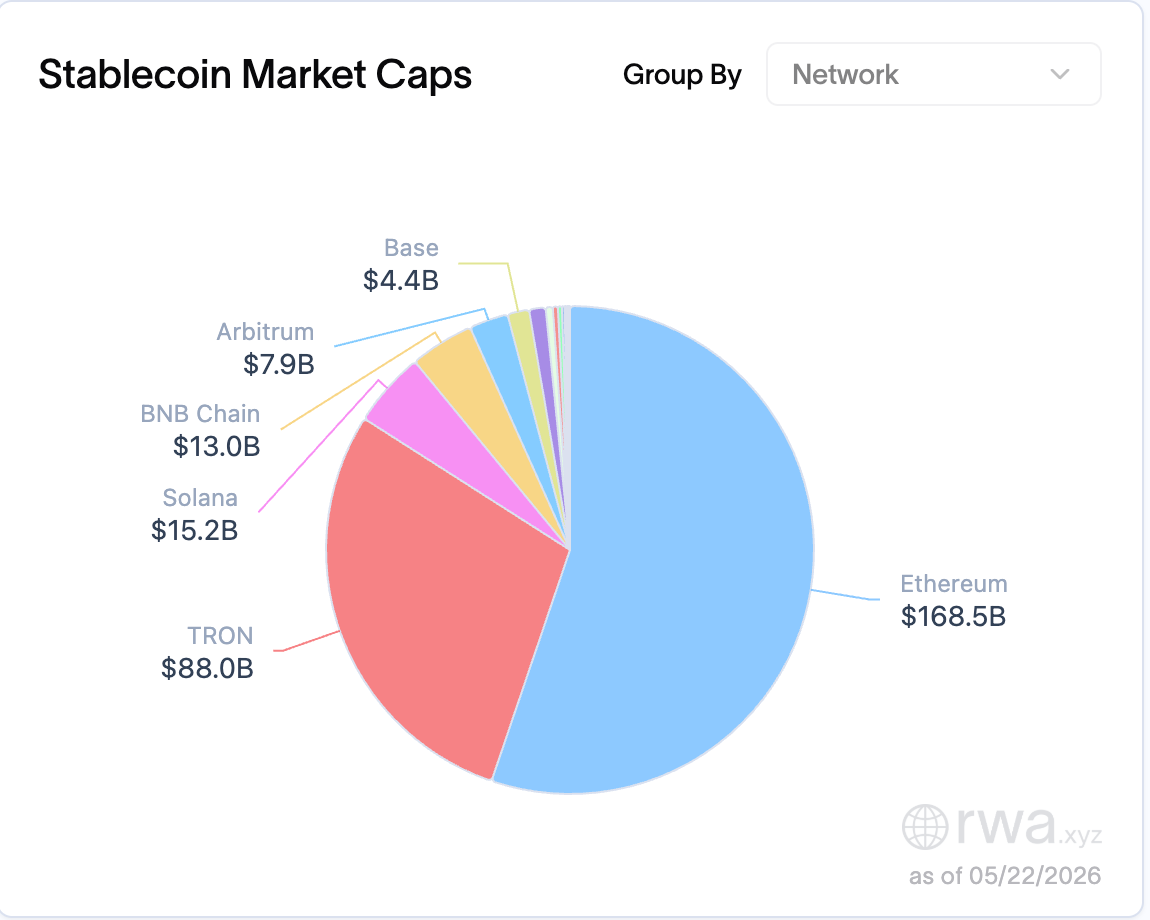

In other words, Ethereum is fundamentally strong, which hints at a persistent organic demand for its underlying asset, ETH.
Here are some realistic scenarios under the current fundamental and technical conditions:
Ethereum Four-Hour Chart: ETH Bear Flag Hints At Decline Toward $2,000
A bear flag forming on Ethereum’s four-hour chart indicates bearish continuation in the coming days.
Bear Flags form when the price consolidates higher inside a parallel channel immediately after undergoing a strong downtrend. In technical analysis, it resolves when the price breaks below the lower trendline while accompanying higher volumes, and falls by as much as the previous decline’s length.
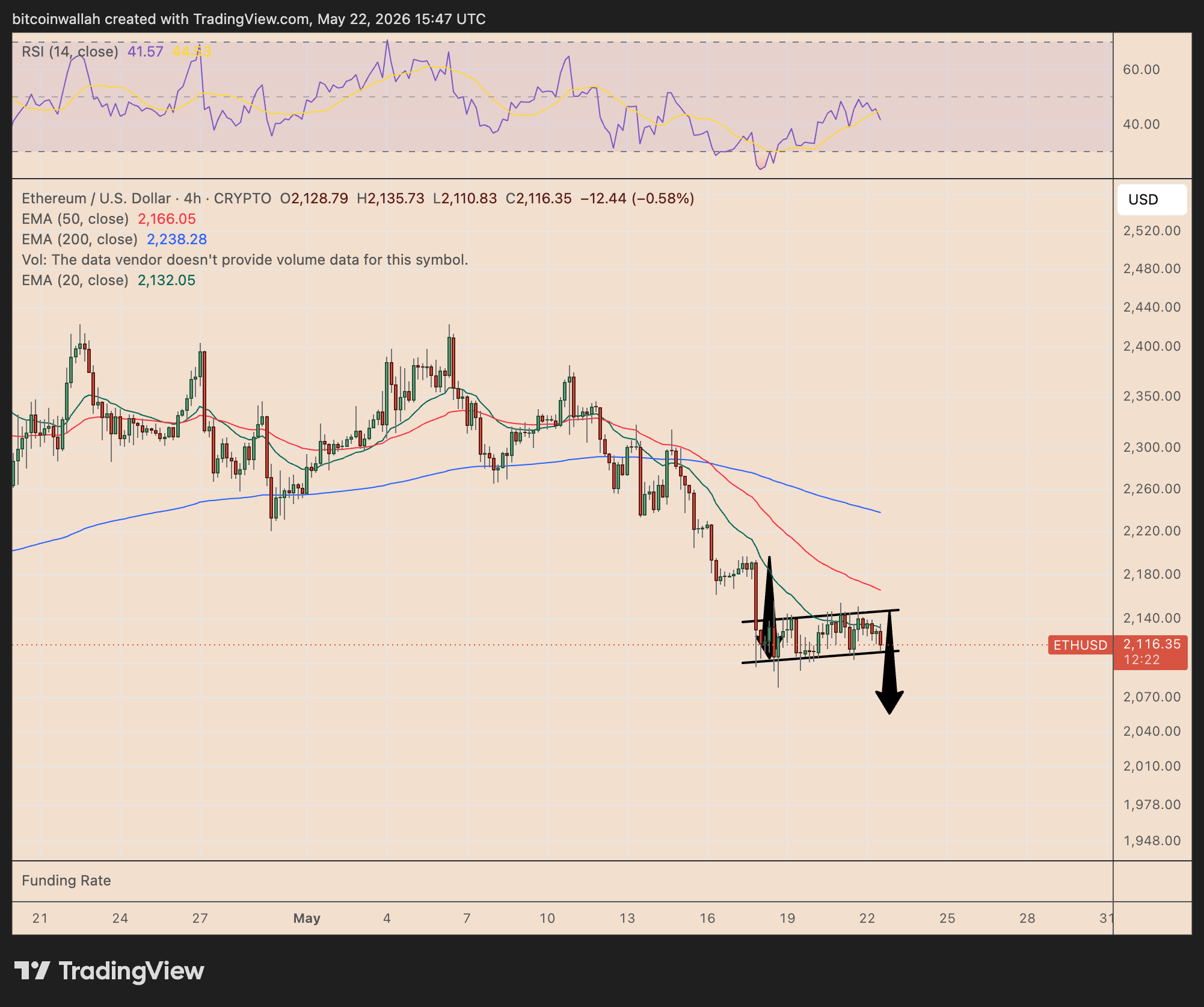
Applying this technical rule to the ETH/USD chart brings its downside target to around $2,000. Negative sentiments led by the Ethereum Foundation may support this downside scenario.
Ethereum Three-Day Price Chart: Rising Wedge Hints At 22% ETH Decline
ETH’s three-day chart shows a rising wedge breakdown in progress after price slipped below the pattern’s lower trendline near $2,200.
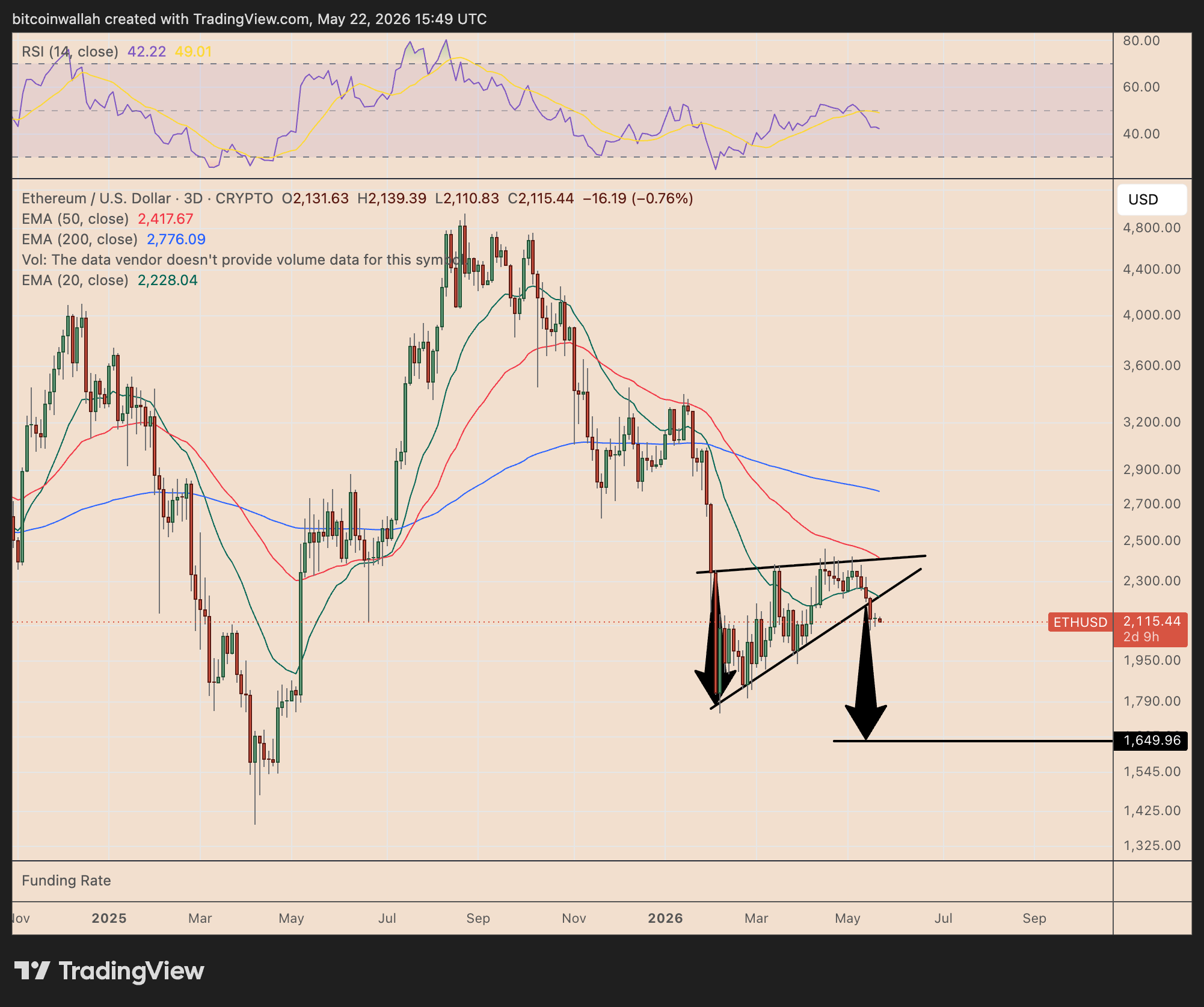
A rising wedge means the price was climbing, but each bounce was getting weaker. Once support breaks, traders often measure the wedge’s height to estimate downside.
That puts ETH’s next bearish target near $1,650, down about 22% from current levels.
Ethereum Weekly Price Chart: Bottom-Forming Trendline is Near
The $1,650-$2,000 target range discussed in the above charts comes closer to ETH’s multi-year ascending trendline support. This baseline has formed near cycle bottoms in the past.
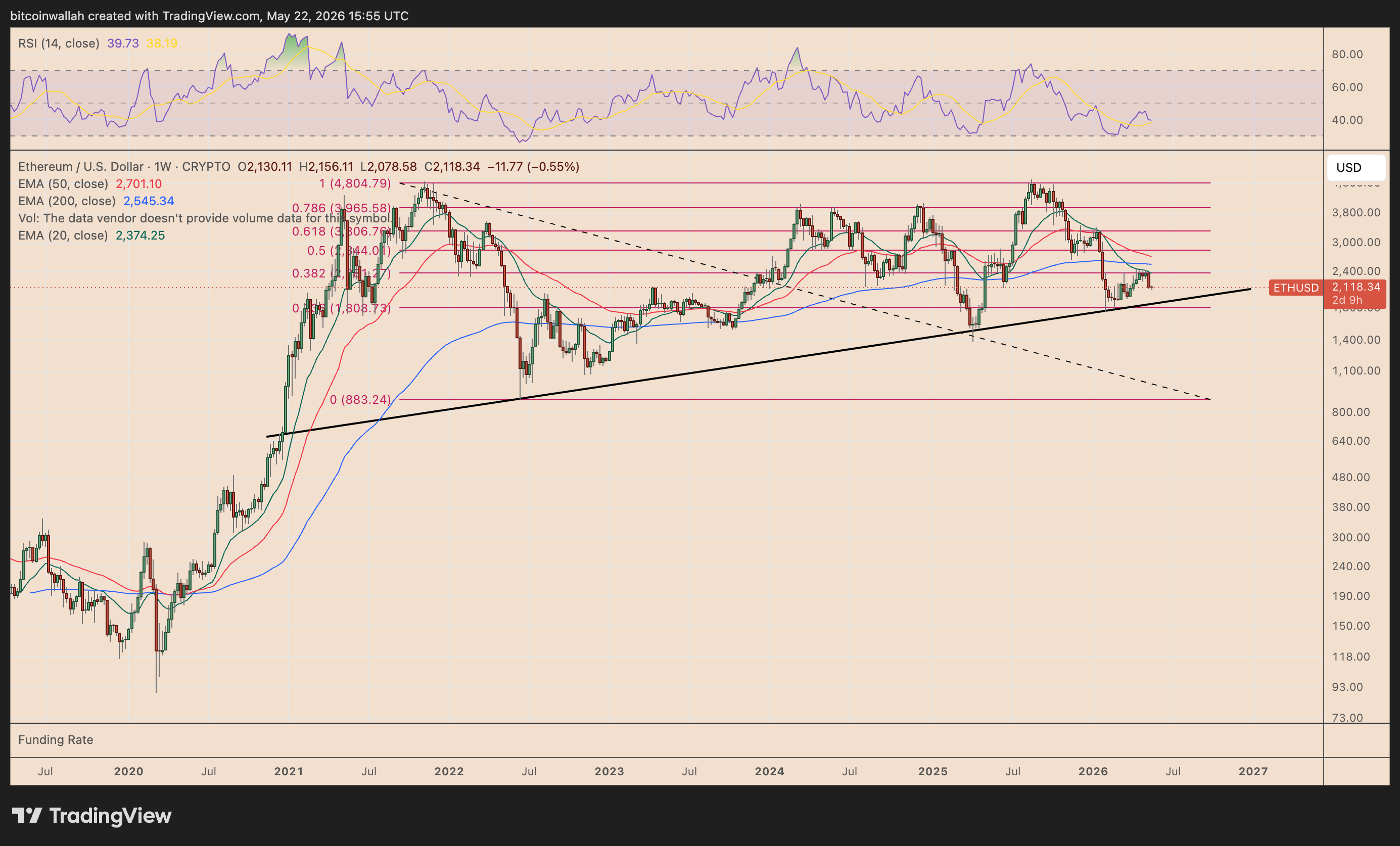
A strong bounce from the trendline could put ETH’s 200-week exponential moving average (200-week EMA, the blue wave) near $2,545 back in focus as the first upside target.
A decisive close above that level may open the door toward the 50-week EMA near $2,700, followed by the 0.618 Fib retracement near $3,305.