



Ethereum has spent years building crypto’s largest smart-contract economy. Its token, Ether (ETH), has not kept up.
A five-year comparison shows Ether down about 40.6%, while its top-ranking rival Bitcoin (BTC) is up 122.4%. Other competitors, such as Solana (SOL), BNB (BNB) and XRP (XRP), have surged 140%, 146.2%, and 82.8%, respectively, in the same period.
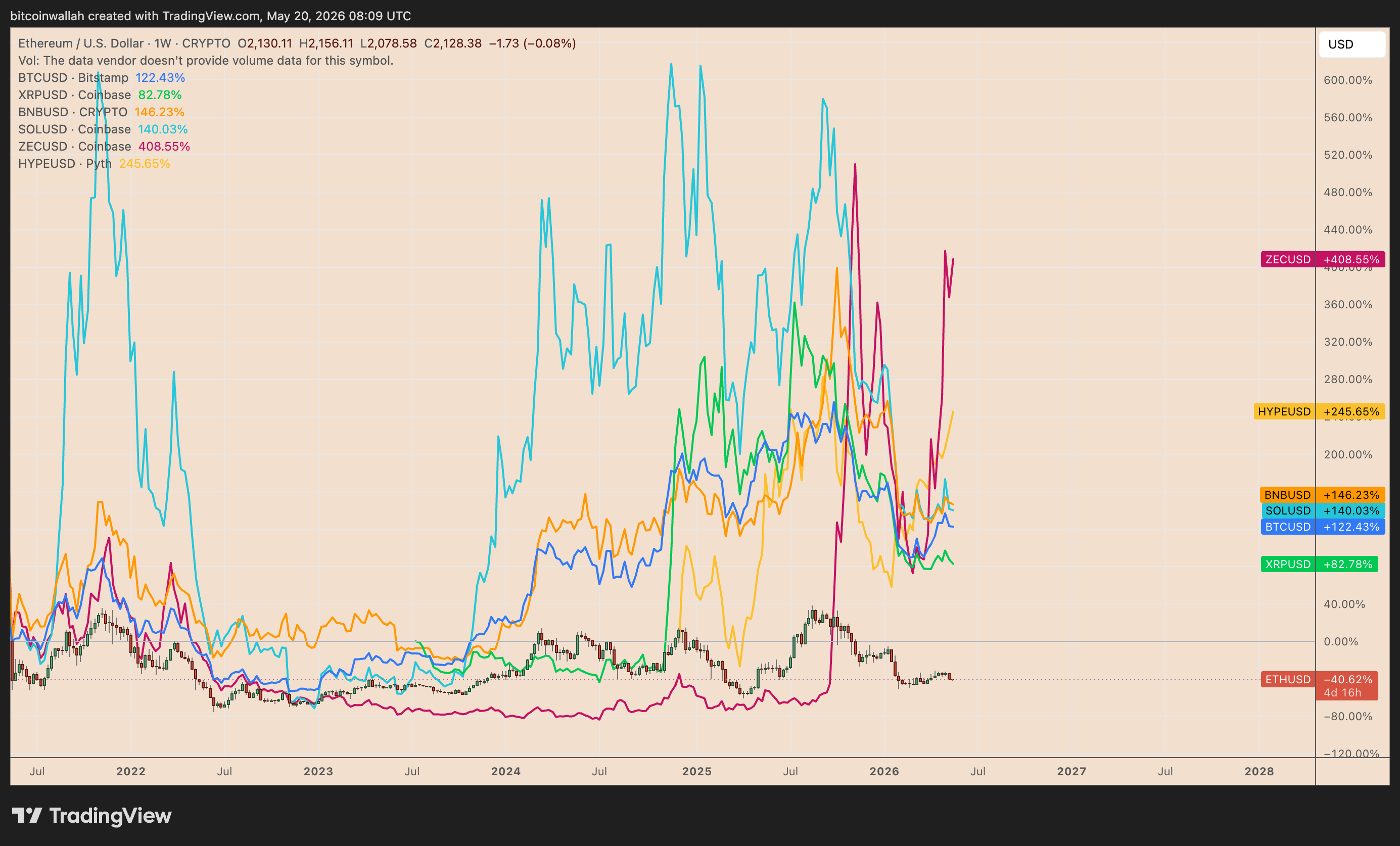
Privacy coin Zcash (ZEC) broke its downtrend cycle last year and is now up 408.6% on a five-year rolling basis. Hyperliquid’s HYPE, a much newer token, is up 245.7% since launch on the same chart.
That divergence raises a blunt question for traders: Is Ethereum still crypto’s most important application layer, or has ETH become a structurally weaker trade?
Ethereum Leads Other Blockchains in Network Statistics
Ether’s underperformance looks severe because it is not just losing to Bitcoin.
Bitcoin’s five-year outperformance makes sense on one level. BTC won the institutional adoption narrative. Spot ETFs, treasury accumulation, the 21 million supply cap, and its simple “digital gold” story made Bitcoin easier for large investors to understand.
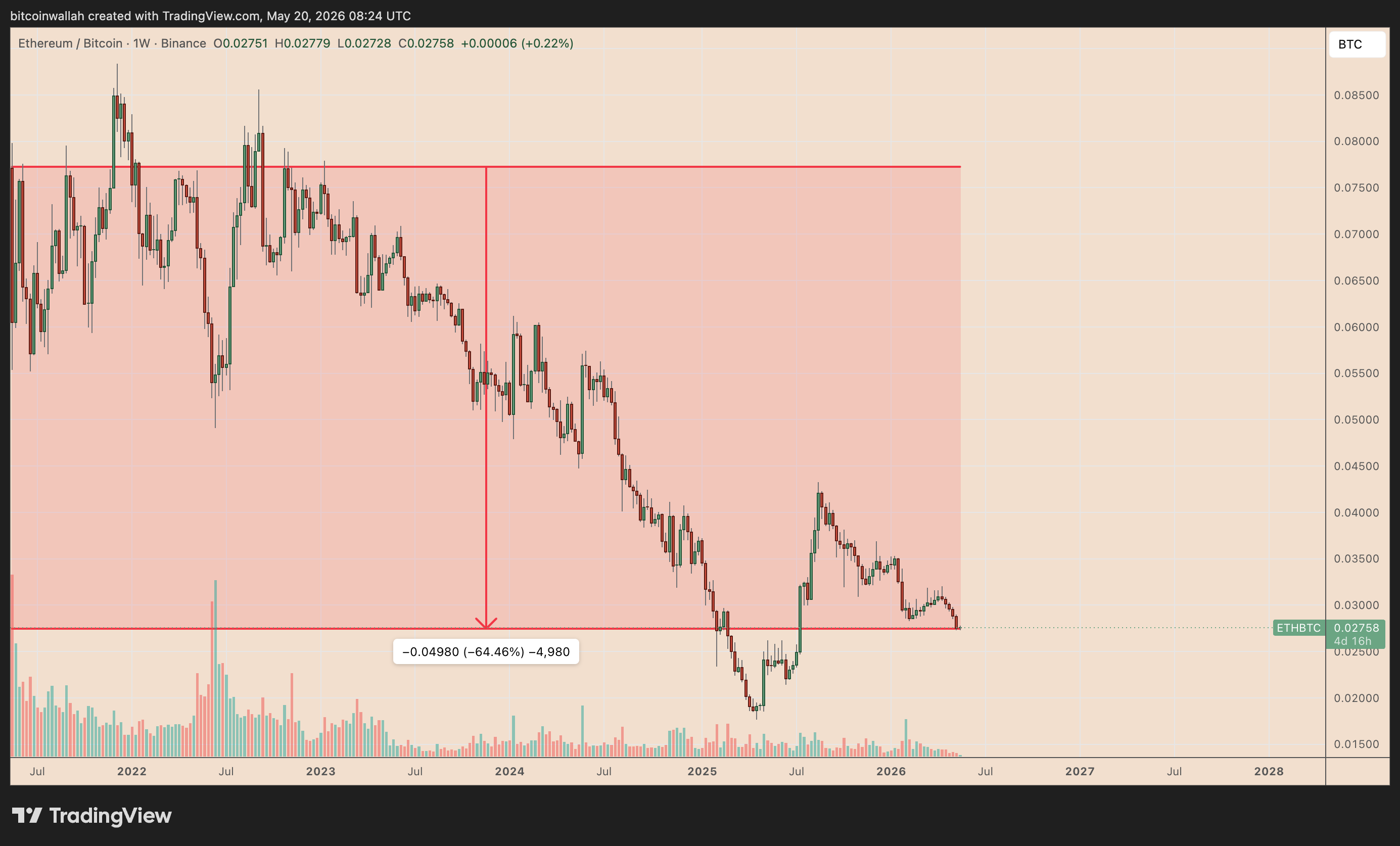
But Ethereum also lagged behind assets with much messier histories.
Zcash, which spent years in a brutal downtrend, staged a sharp recovery. Solana and BNB outperformed ETH despite repeated concerns over centralization, outages, regulatory pressure, and ecosystem concentration.
Still, Ethereum remains the dominant venue for high-value DeFi, stablecoins, tokenization, and institutional settlement.
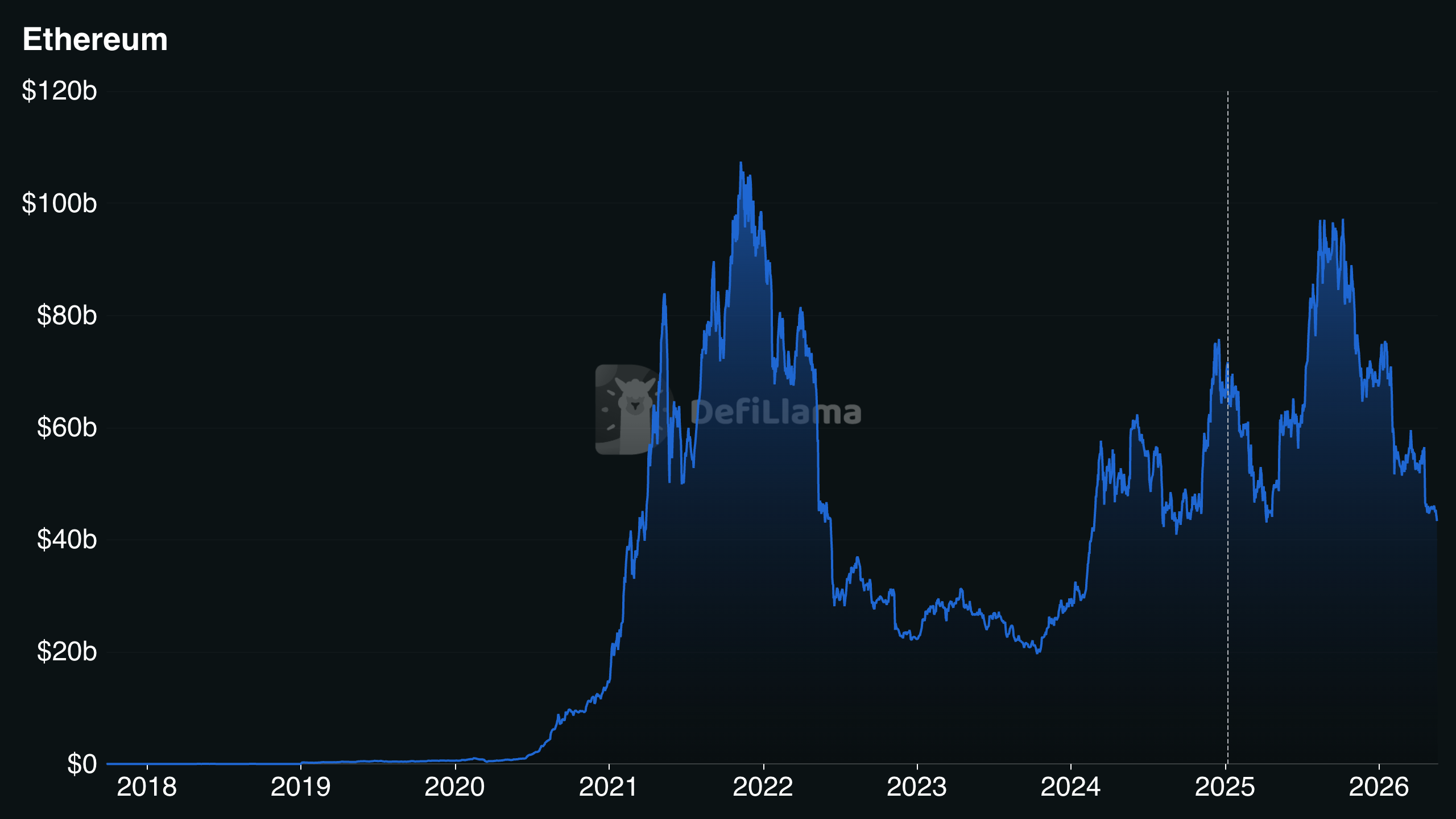
As of May 20, the network was holding about $164.8 billion in stablecoins on-chain, with more than 541,000 active addresses over the past 24 hours and $8.35 billion in seven-day DEX volume, according to data resource DeFi Llama.
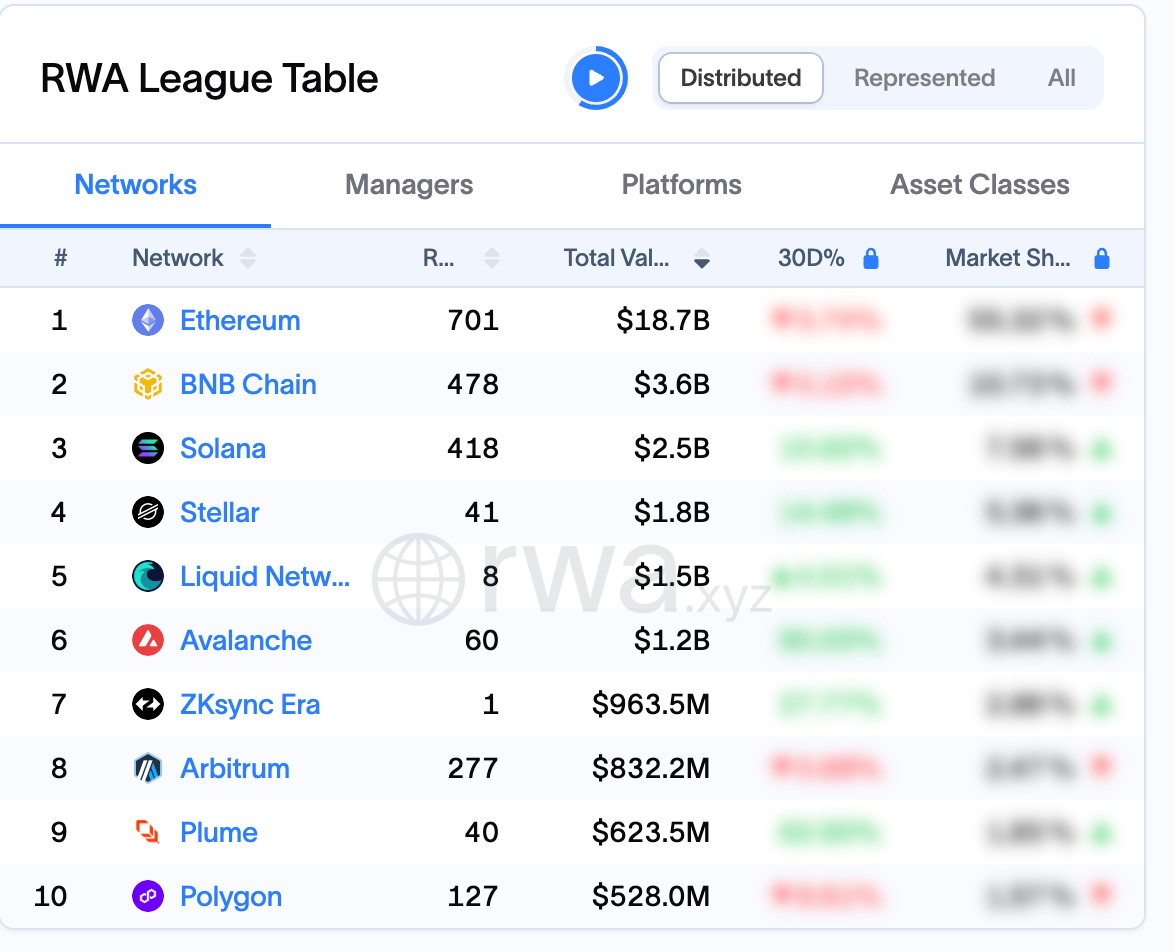
Ethereum also leads the tokenized real-world asset market.
RWA.XYZ data shows that Ethereum hosts $15.5 billion in tokenised RWAs across 625 assets, controlling about 58% of the market. BNB Chain ranks second with $3.4 billion, while Solana holds about $1.7 billion.
That is why some analysts still argue ETH looks undervalued.
In its February report, Bitwise Europe said Ethereum has been underperforming Bitcoin since Q4 2022. However, its ETH/BTC fundamental indicator suggests ETH is “fundamentally mispriced” relative to on-chain activity and adoption metrics.
Citi has also noted that ETH remains highly sensitive to user activity, but stablecoin and tokenization trends could increase Ethereum usage over time.
Ethereum Price Forecast
Every new Ethereum analysis as it publishes, today's technical signal and key levels, live price — on one page.
See all Ethereum forecastsEthereum’s Big Scaling Fix Is Hurting ETH Demand
Ethereum scaled by moving much of its activity to Layer 2 networks like Arbitrum, Optimism and Base. These networks sit on top of Ethereum and process transactions more cheaply and quickly.
That is good for users. But it creates a problem for ETH.
When more activity happens on Layer 2s, fewer users pay high fees directly on Ethereum’s main network. That matters because part of every Ethereum fee gets “burned,” meaning the ETH is permanently removed from supply. Fewer fees mean fewer burns.
Growthpie data shows Ethereum now has 99 live Layer 2s, which handle 98.18% of the ecosystem’s daily transaction activity. In simple terms, Ethereum is growing, but most of that growth is happening outside the main chain.
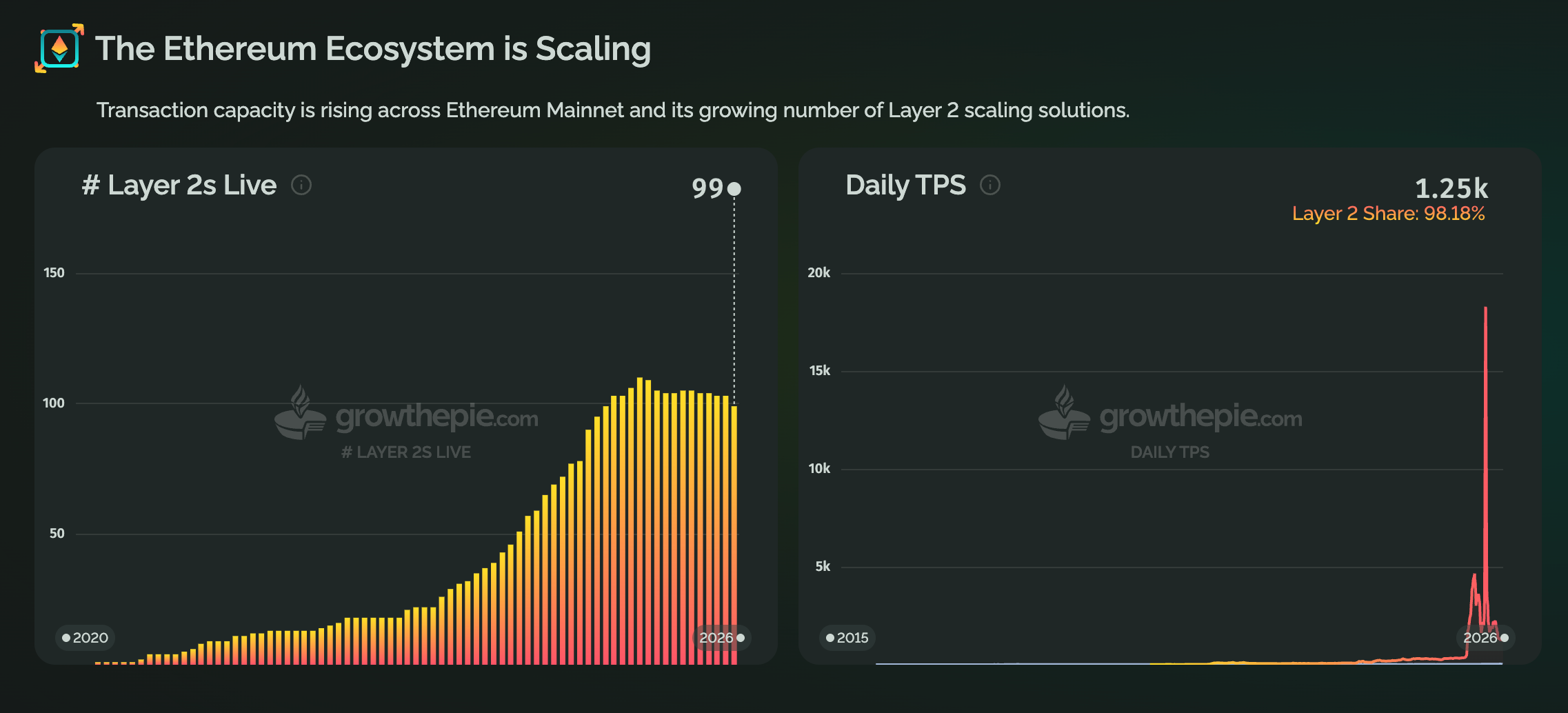
Dencun made this trade-off bigger. The upgrade made Layer 2 transactions even cheaper by reducing the cost of storing their data on Ethereum. Again, that helped users. But it also meant Ethereum collected fewer fees from that activity.
The supply numbers show the issue. Since the Merge, Ethereum has burned about 547,000 ETH per year, but it has issued around 870,000 ETH per year to validators.
That leaves ETH supply growing by about 0.27% per year, according to data resource Ultrasound Money.
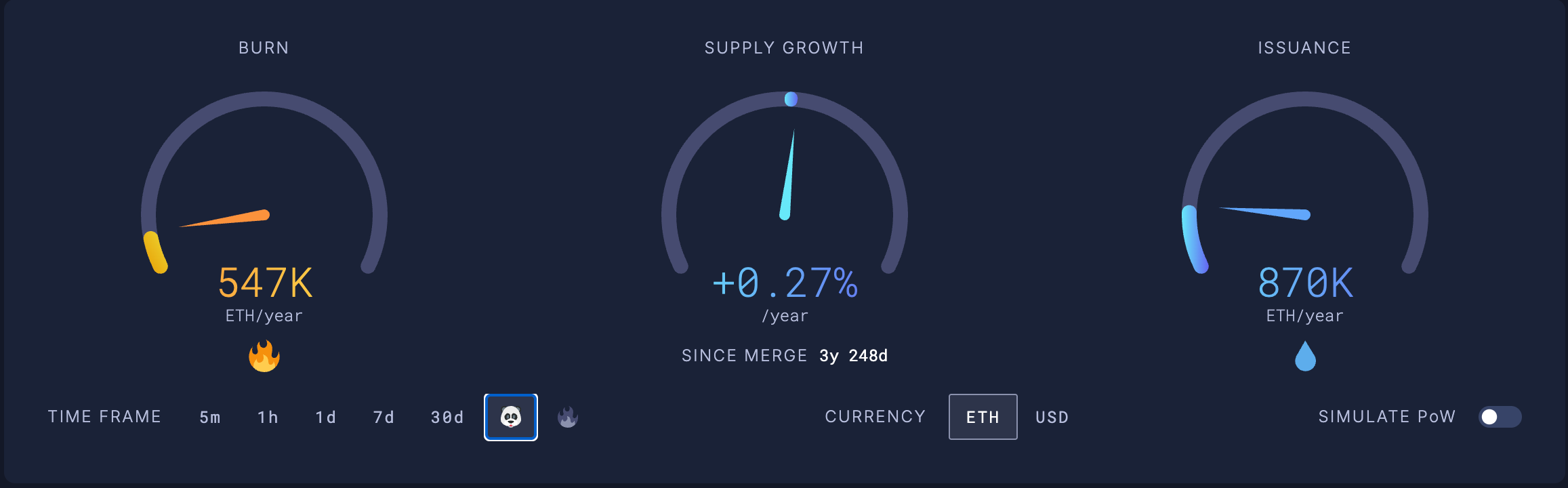
That is still low. But it weakens the old “ultrasound money” idea, which said ETH could become scarcer over time because burns would offset new issuance.
So Ethereum became cheaper and more scalable, but ETH lost some of the fee pressure and scarcity story that once supported its price.
Ethereum’s Base Layer is Significantly Slower Than Solana and Sui
Ethereum’s Layer 1 remains notably slower than Solana and Sui across key performance metrics.
As of 2026, the data is as follows:
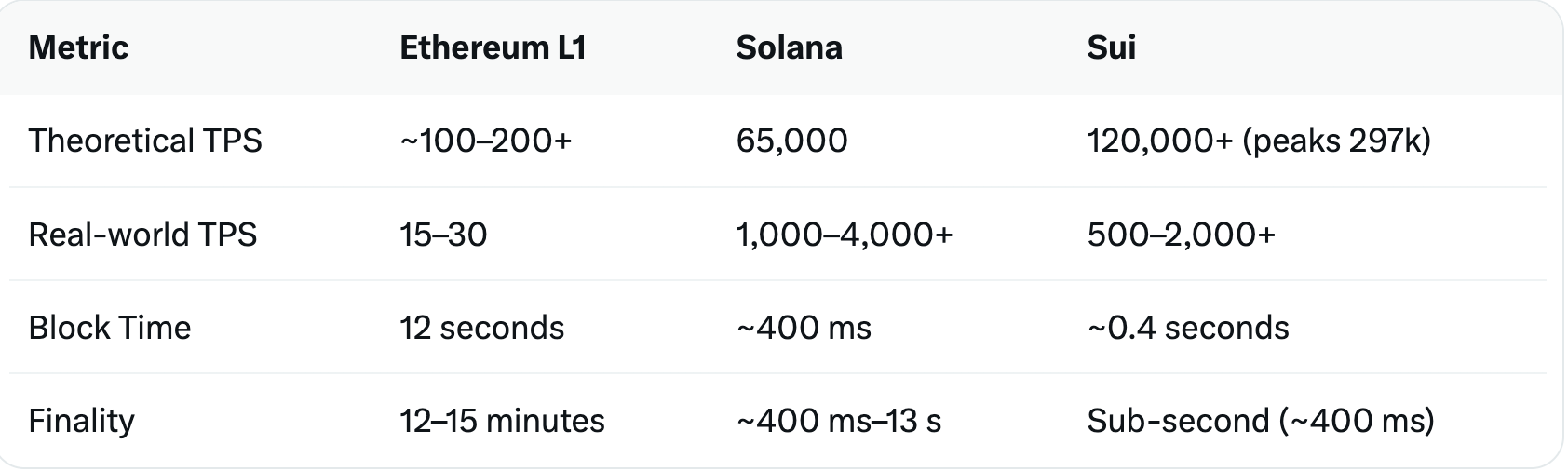
Ethereum is slower on purpose.
Its main chain focuses on security and decentralization, meaning it wants many people to run nodes and verify the network. That keeps Ethereum safer, but limits how many transactions it can process directly.
Layer-1 rivals Solana and Sui take a different approach. They process many transactions at the same time, which makes them much faster and cheaper for users.
Ethereum’s answer is Layer 2s like Arbitrum, Base and Optimism. These networks handle transactions faster and then send the final results back to Ethereum.
That helps Ethereum scale, but it also creates a messy user experience. Money and apps get spread across many L2s, and users often need bridges to move between them.
So Ethereum still leads in security, capital and developer depth. But on raw speed and ease of use, Solana and Sui have looked better to many users and developers. That also explains why ETH has been lagging SOL and SUI price performances in recent years.
ETH Rising Wedge Hints At Another 20% Dip
ETH’s weekly chart shows a rising wedge, a bearish reversal setup where price climbs between two narrowing upward trendlines.
For noobs: it means ETH has been bouncing, but each bounce is getting weaker. Buyers are still pushing the price up, but they are running out of room. That often ends with a breakdown below the lower trendline.
ETH is already showing weakness after failing near the wedge’s upper boundary around the $2,350–$2,400 area. The token also remains below its 50-week EMA near $2,700 and 200-week EMA near $2,547, keeping the broader trend under pressure.
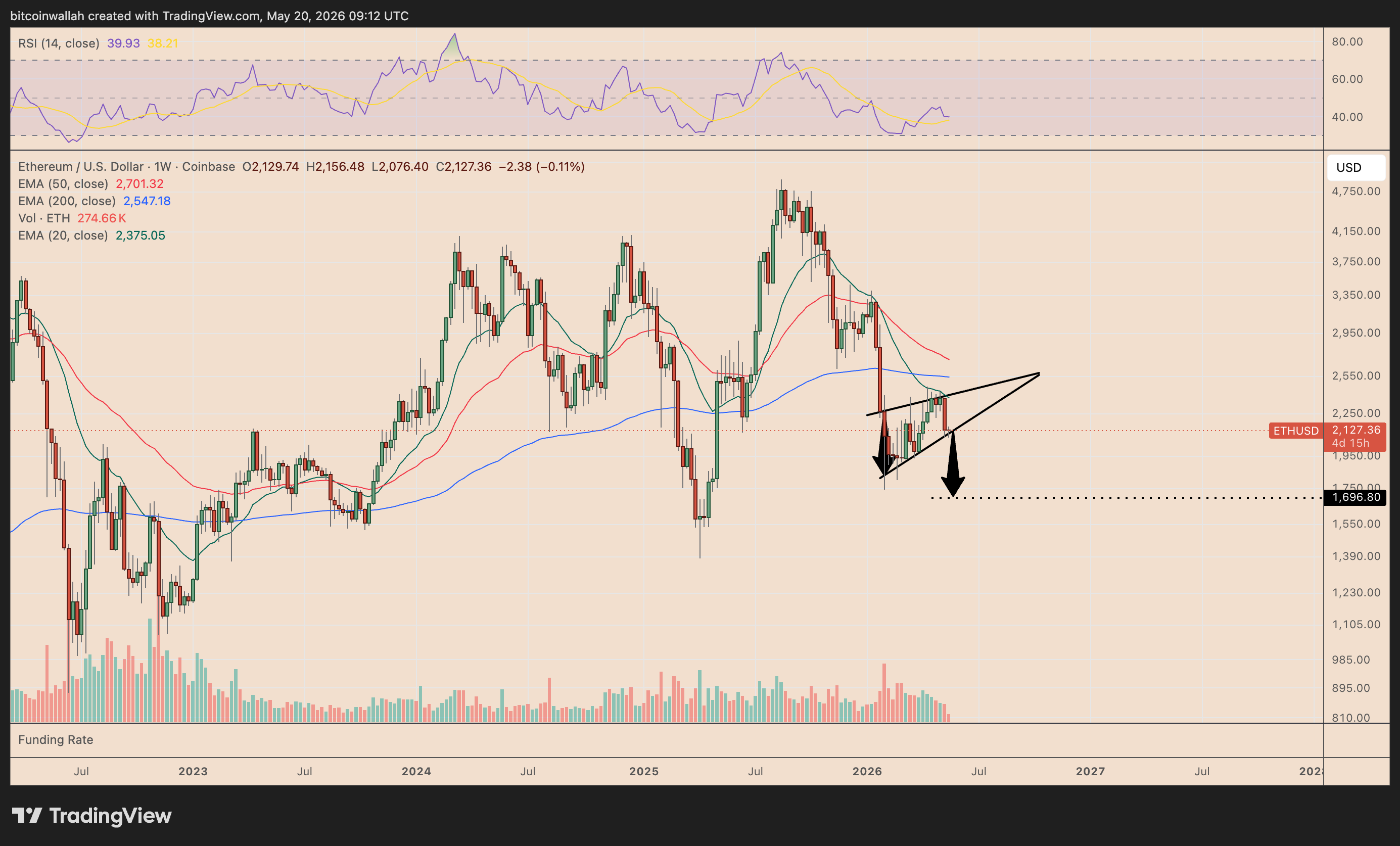
A clear weekly close below the wedge support near $2,050–$2,100 could confirm the breakdown.
The measured downside target sits near $1,700, down 20% from current prices, based on the wedge’s height subtracted from the breakdown point.
The RSI near 40 also supports the bearish view. It is not oversold yet, meaning ETH still has room to fall before sellers look exhausted.