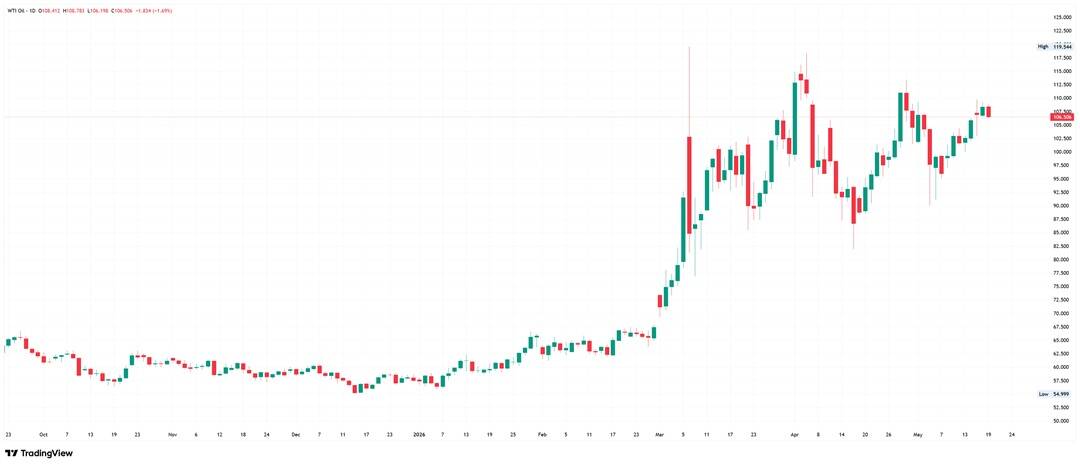
Evidently, the US-Iran war’s inflationary impact is showing up in the fixed-income space, with a number of desks indicating that global bond yields are headed higher. Yesterday saw US Treasury yields bear-flattened; the 30-year yield clocked its highest level since 2007 after engulfing the 5.178% high (set on 23 October 2023) and is now within striking distance of 5.2%.
In the equities space, investors continue to take profit, with major US equity benchmarks down for a third straight session. S&P 500 market breadth showed 185 names ending Tuesday in positive territory, while 317 stocks nudged lower, with energy (XLE) unsurprisingly outperforming. The combination of rising yields and stubbornly elevated oil prices continues to weigh on investor sentiment.
Canada’s CPI Miss Fails to Pull the CAD Materially Lower
Canada’s April CPI inflation report came in broadly lower than expected. The YY headline reported at 2.8%, versus the 3.1% forecast, albeit up from March’s reading of 2.4%. The BoC’s core measures – CPI median and trim – also came in lower than expected, at 2.1% (versus 2.2%) and 2.0% (versus 2.1%), respectively.
You may recall that I felt the better trade was for a broad miss across these measures, given that I believe BoC rate pricing is a little overstretched to the upside, along with the CAD’s stretched bullish positioning. This proved a solid event to scalp long out of on EUR/CAD, either immediately after the print was released or by trading a break/retest of short-term levels. However, the energy behind the immediate push was lacklustre – trades go that way sometimes, which is why you should always ensure solid trade management.
UK CPI Numbers Undershoot – but the Relief Could Be Short-lived
In the UK, following a disappointing Jan-Mar 2026 jobs report – where unemployment ticked up to 5% from 4.9% in February, private-sector wage growth cooled to 3.0% from 3.2%, and HMRC payrolls fell by 100,000 (April) – this morning’s April CPI inflation report revealed a more benign picture for inflation. However, while this is largely down to Ofgem’s energy price cap introduced on 1 April, both jobs and inflation data still currently cast a shadow over current BoE rate pricing (+54 bps of tightening by year-end).
Headline YY CPI inflation came in at 2.8%, below the 3% median estimate, while the YY core measure was also lower at 2.5%, against an expected 2.6%. Additionally, the YY services print decelerated to 3.2%, defying forecasts of 3.5%.
Brent Oil Price Forecast
Every new Brent Oil analysis as it publishes, today's technical signal and key levels, live price — on one page.
See all Brent Oil forecastsHowever, enjoy it while it lasts. Inflation is expected to accelerate, particularly when the Ofgem energy price cap resets again in July. While the BoE is expected to remain on hold at the June and July meetings, markets are fully pricing in a rate hike for September.
Fed Minutes: 8-4 Vote Split and New Chair in the Wings
Later today, we also have the minutes of the April Fed meeting at 6:00 pm GMT. You will recall that this was Jerome Powell’s final meeting as Chair – with Kevin Warsh taking the reins at the next meeting in June – and the central bank kept the target rate on hold at 3.50-3.75%. While the hold decision raised few eyebrows, the 8-4 vote split caught the markets off guard. Governor Stephen Miran unsurprisingly broke ranks, opting to lower the rate by 25 bps, and three Presidents – Hammack, Kashkari, and Logan – supported maintaining the target but dissented from the easing-bias language in the statement. This was the highest level of dissent since the early 1990s.
The minutes could prove interesting. The Fed is caught between a rock and a hard place, attempting to balance persistent inflationary pressures with a gradually softening jobs market – at a time when Warsh steps into the fray, and Trump wants lower rates. Undoubtedly, Warsh has a difficult task ahead of him. Interestingly, from markets pricing in nearly three Fed rate cuts at the beginning of the year to no cuts, we now see investors almost fully discounting a rate increase (+23 bps) by year-end.
Nvidia Earnings: 80% Revenue Growth Expected
Following the Fed minutes, after the US cash equity market closes, equity investors will be eagerly awaiting Nvidia’s (NVDA) earnings for the fiscal quarter ending April 2026.
Analysts expect revenue of roughly US$78.8 billion – slightly above Nvidia’s guidance of US$78 billion – and adjusted earnings of approximately US$1.77 per share. That would represent nearly 80% YY revenue growth for a company now valued at around US$5.4 trillion.
The market will be closely watching the guidance regarding Nvidia’s Blackwell and next-generation Rubin GPU lines, where demand has reportedly outstripped supply, as well as any commentary on the CPU opportunity. CEO Jensen Huang’s recent trip to China alongside Trump has also sharpened the focus on potential upside in Chinese revenue. Nvidia estimates that unlocking sales in China could generate an additional US$15 billion in revenue, though Chinese companies have increasingly turned to domestic alternatives following years of US export restrictions.
Options markets are pricing in a post-earnings move of around 6.5% in either direction, which represents approximately double the NVDA stock’s average swing over the past four quarters.
Written by FP Markets Chief Market Analyst, Aaron Hill