



Markets have had a lot thrown at them this week — these last couple of months, rather. Tensions flaring in the Strait of Hormuz have pushed crude oil up roughly 7% in a matter of days, again. Yet the ASX 200 somehow managed to hold the current trend. Australian equity investors, it seems, are not easily spooked.
That resilience is worth pausing on. When oil prices whipsaw and naval blockades start making headlines, the instinct is usually to sell first and ask questions later. The fact that buyers stepped in and held the line says something about the underlying conviction in this market right now.
What’s driving that conviction? A slow but steady rotation. Money has been quietly moving out of energy names and war-premium trades, finding a new home in domestically focused stocks like ZIP Co and James Hardie — businesses that have little exposure to what happens in the Gulf of Oman.
That said, the picture is far from clean. But the trend is your friend — only at the end, where it bends.

NAB’s AUD 2 Billion Warning Shot: What It Means for Australian Bank Stocks
While geopolitics grabbed the headlines, the more consequential story for Australian investors may have been National Australia Bank’s AUD 2.05 billion in one-off charges. Shares fell 3.55% on the news — a notable drag on the financial sector just as the broader index was trying to find its feet.
The charges themselves are a mix of software accounting adjustments and a sharp rise in credit impairment provisions. That second part is the one to watch. When a major bank starts setting aside significantly more capital against potential bad debts, it typically signals that management sees rougher conditions ahead — conditions the market may not yet have fully priced in.
NAB also announced a discounted Dividend Reinvestment Plan, which functions in practice as a quiet capital raise. That’s a meaningful shift from the era of share buybacks that rewarded investors over recent years. For shareholders, it’s dilution. For the broader read on the economy, it suggests at least one of Australia’s big four is quietly bracing for a harder landing.
By contrast, CBA and Westpac managed modest gains, which highlights just how much of that financial sector weakness was NAB-specific rather than systemic.
ASX 200 Technical Analysis: Pressing Against Weekly Resistance
Step back to the weekly chart and the picture remains more constructive than destructive. The index is testing long-term Supertrend resistance as it tries to undo the correction from March 2026. Overall, the weekly move is a consolidation within a longer uptrend — and for patient investors, those two things are very different.
ASX 200 Weekly: Pressing Resistance Within the Broader Uptrend
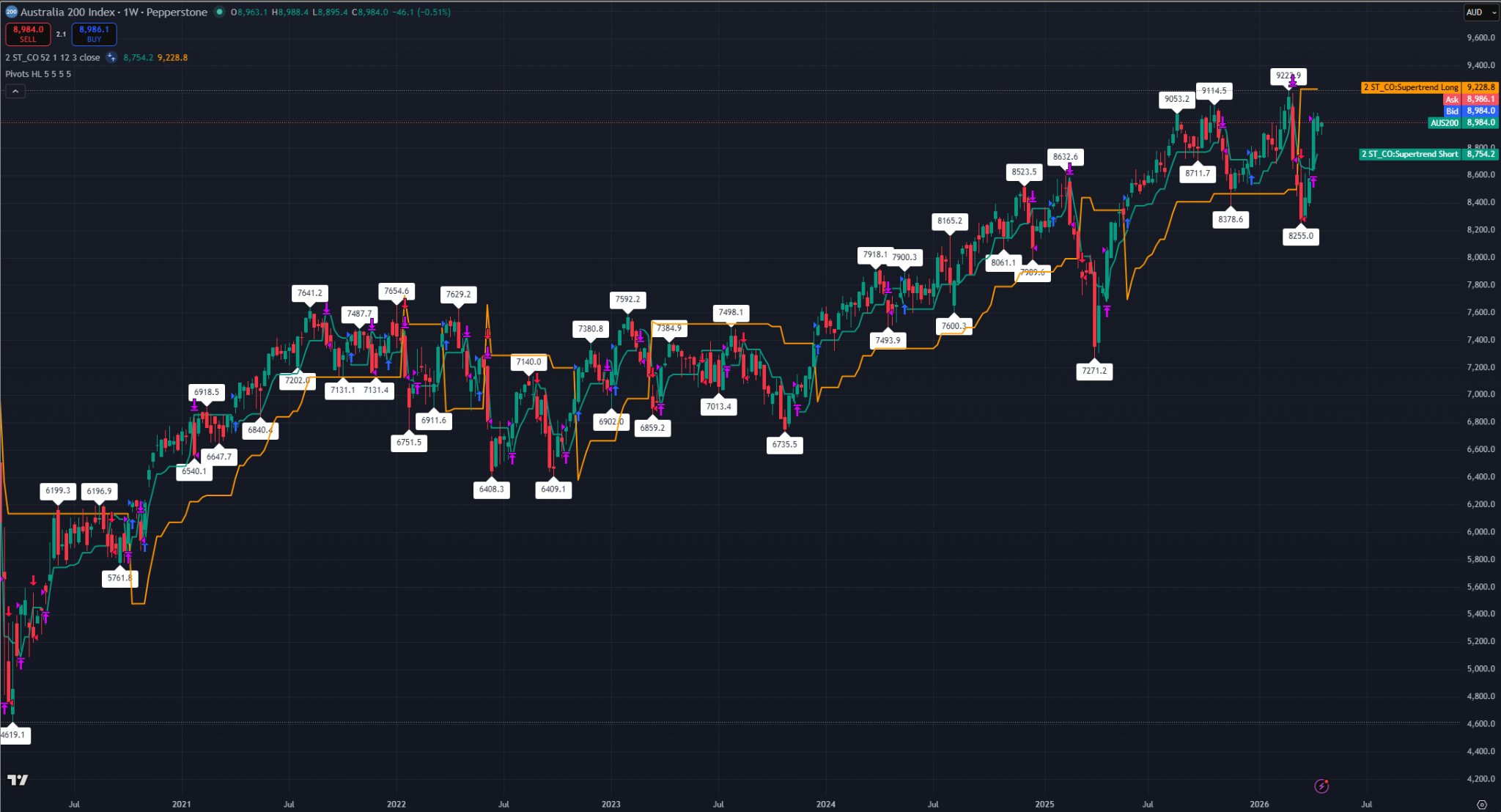
Weekly ASX 200 — testing Supertrend resistance | Source: TradingView
The Daily Consolidation Above the 21-EMA
The daily chart tells a more granular story. After the sharp sell-off in March, price action has stabilised — and critically, the index has been consistently above the rising 21-EMA. That flip matters. For months, this moving average acted as overhead resistance, capping every recovery attempt. Now it has become a dynamic support level, with buyers defending it on each intraday dip. The RSI sits close to 60, which leaves meaningful room to the upside.
The market is consolidating around the 9,000 psychological level. Whether or not it can break through that ceiling will likely depend less on the charts and more on whether diplomatic progress emerges from the current geopolitical impasse.
Why the Daily Consolidation Matters
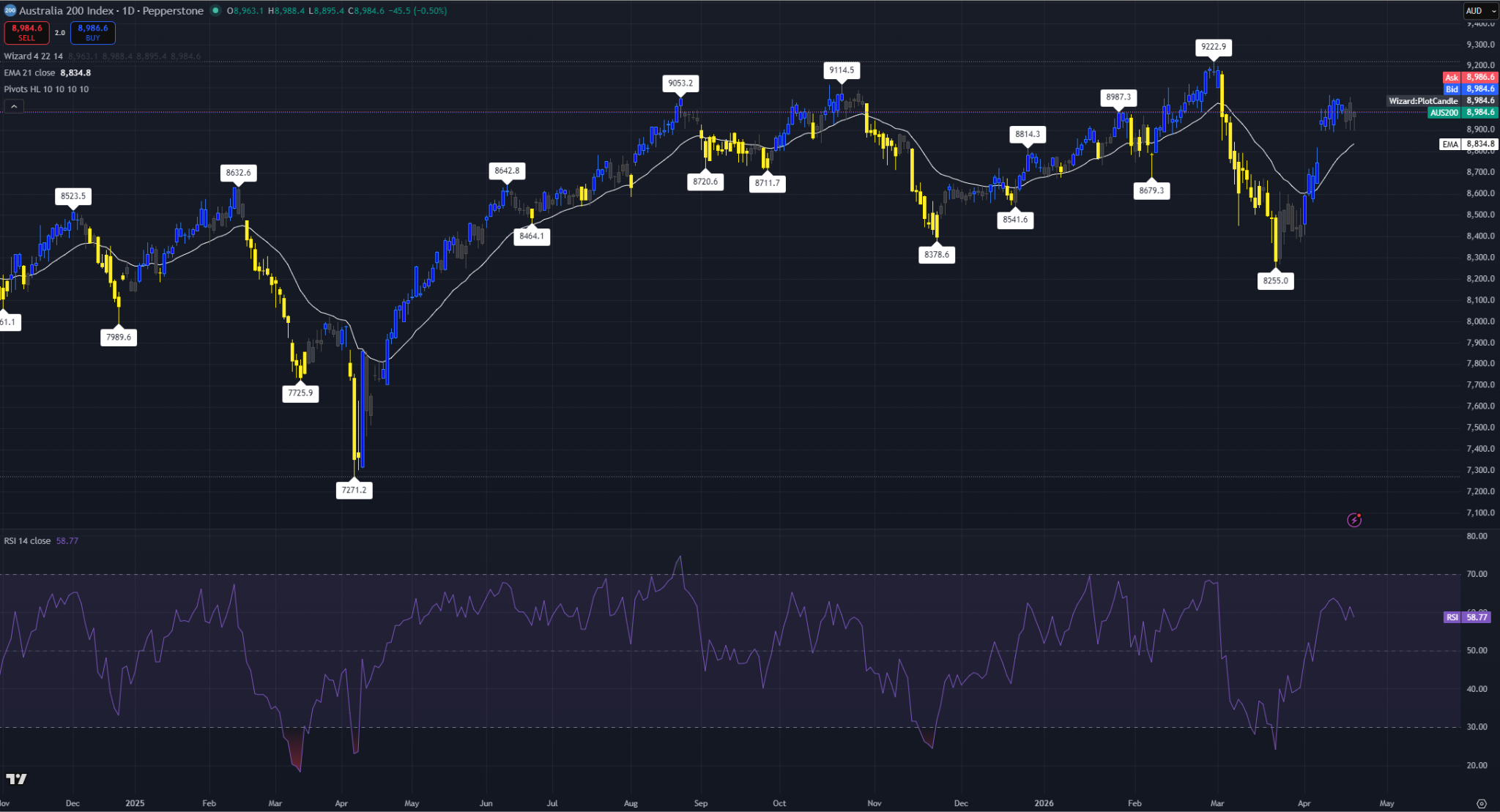
Daily ASX 200 — 21-EMA flipped to dynamic support | Source: TradingView
Renko View: Buyers Defend the 8,900 Dip
For those who follow Renko charting, the 11-brick traditional view adds useful context. For short-term traders, 8,900 is the level to watch as immediate support. The pace of recovery is a grind rather than a sharp impulsive move, but the directional bias is clear. As long as price stays above that reclaimed 500-SMA, the path of least resistance points upward.
Renko Holds Above 8,900 and the 500-SMA
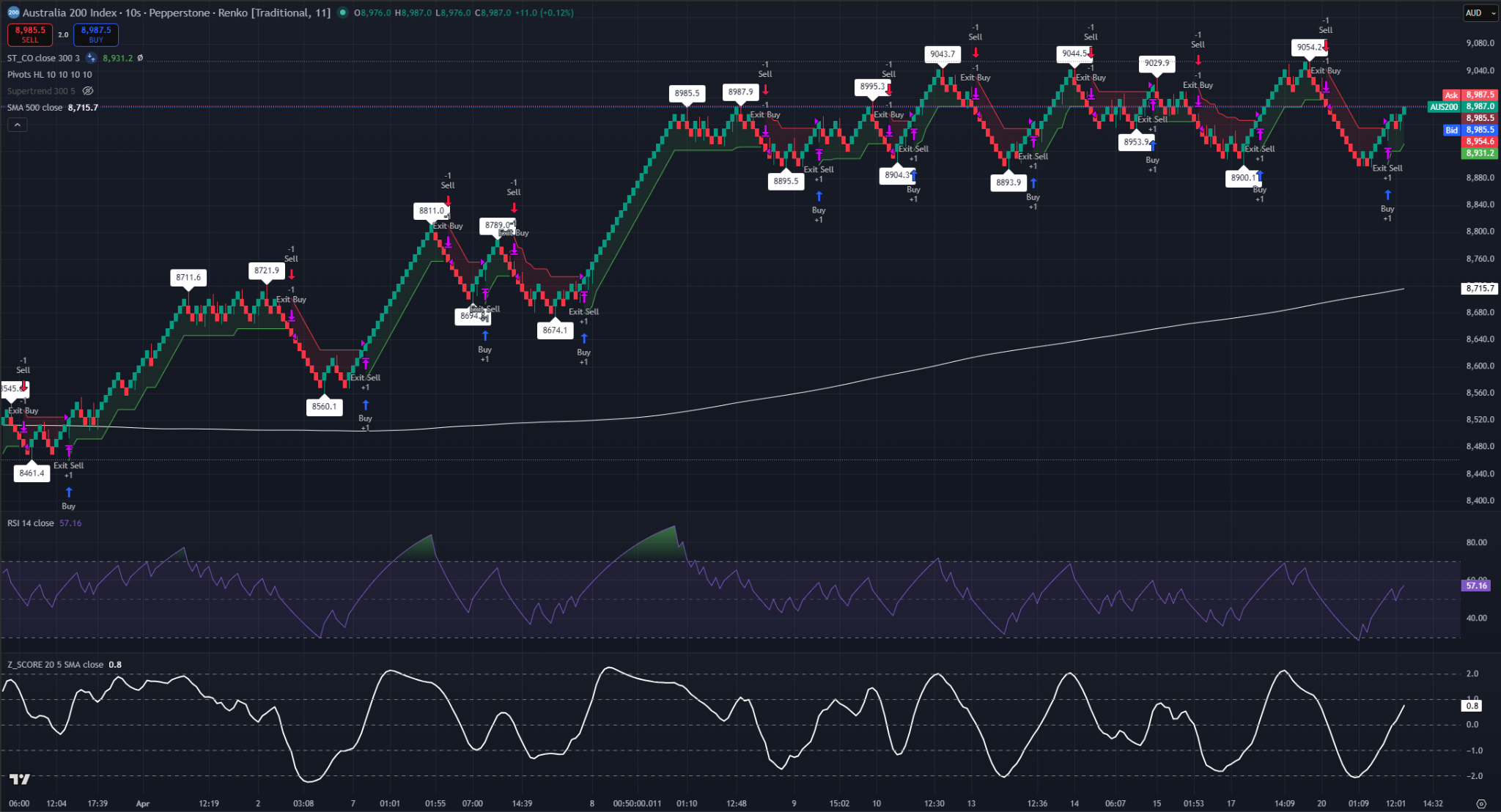
ASX 200 Renko (11-brick) — above the 500-SMA | Source: TradingView
ASX 200 Key Levels and Outlook
Current Trend Direction: Neutral
Bias: Positive
Support Levels: 8,255, 8,755, 8,900
Resistance Levels: 9,000 (psychological), 9,230
Medium-Term Path: The near-term expectation is for the index to stay range-bound while it digests the NAB shock and waits on ceasefire developments. The 9,000 level is a genuine psychological barrier, and breaking it convincingly will require either a meaningful de-escalation in the Strait of Hormuz or a string of cleaner domestic earnings results. The structural case for Australian equities remains intact, but in the short run, diplomacy may matter more than technicals. Keep a close eye on any headlines out of Islamabad — they have the power to either unlock the next leg higher or drag the index back toward that 8,755 support floor.


