
The Australian dollar is currently facing a high-stakes “geopolitical stress test”. As it stands on Friday, March 6, 2026, the AUD/USD is trading close to 0.7036 – consolidating after a rather turbulent week where it dipped as low as 0.6974 before slowly clawing its way back up.
Despite the “War Premium” in the U.S. Dollar continuing to weigh on the Aussie, three rather bullish domestic factors – a stronger-than-expected GDP, a hawkish RBA, and the price of commodities surging higher – are acting as a bit of a safety net for the Aussie.

The Fundamental Drivers: GDP Beats, Bullock Warns
To everyone’s surprise, the Australian economy is proving to be a whole lot more resilient than people were expecting which is making it harder for the Reserve Bank of Australia (RBA) to know which way to go.
GDP Smashes Expectations: Official numbers just released show the Australian economy grew by 0.8% in Q4 2025 – easily beating market forecasts of 0.6%. Annual growth is now up to 2.6%, the best pace in almost three years thanks to a massive growth in inventories and a healthy increase in government spending.
Bullock Warnings the Rate Hike Meeting is Live: RBA Governor Michele Bullock gave a rather hawkish turn at the AFR Business Summit, saying that the RBA’s next meeting is very much still on the cards. The markets are at the moment putting a 22% chance on a rate hike to 4.10% this month, with an all-out hike now becoming much more likely by May.
A Commodity Hedge: As an energy supplier, Australia is somewhat shielded from the oil price shock. With WTI Crude prices breaking through a barrier its seen around 30 months ago, the big surge in LNG and coal prices is acting as sort of a natural protection for the AUD, which is countering the broader ‘risk-off’ sentiment.
AUD/USD Price Forecast
Every new AUD/USD analysis as it publishes, today's technical signal and key levels, live price — on one page.
See all AUD/USD forecastsThe Geopolitical Headwinds: Operation Epic Fury in Full Swing
Despite the Aussie’s domestic successes, it’s unfortunately still pretty much at the mercy of the escalating US-Israel-Iran conflict (Operation Epic Fury).
Safe Haven Squeezing the AUD: The U.S. Dollar Index (DXY) has had a lift from safe-haven demand following the all-out strikes on Iranian leadership.
The Hormuz Strait Risk: The effective closure of the Strait of Hormuz has sent oil prices up by nearly 20% this week, and the resulting fears of stagflation have seen the USD strengthen against risk-sensitive currencies like the Aussie.
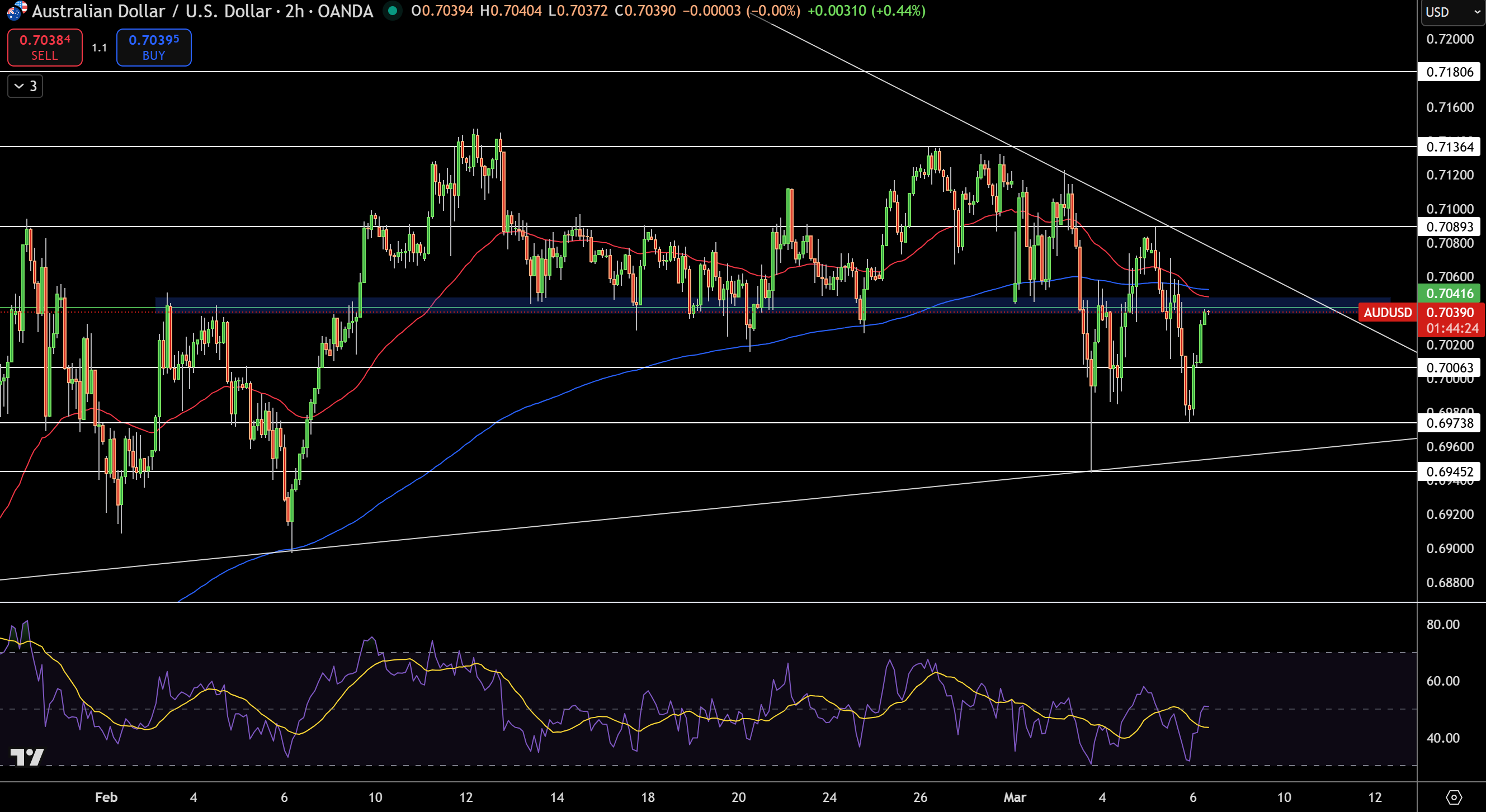
AUD/USD Price Outlook: Compression at 0.7040, Breakout or Rejection Ahead?
AUD/USD is currently heading straight for a descending trendline on the 2 hour chart while sitting inside a key supply zone around 0.7035-0.7060. This is a key spot. Price has rebounded from the 0.6975-0.7000 support zone, but now its momentum is running into some structural resistance.
The 200 EMA is hovering near 0.7040, which is adding to the resistance cluster. The 50 EMA has flattened out and is actually below price, suggesting short-term recovery – but not yet a clear bullish turn. Until the pair can clear both the trendline and 0.7060 on a strong close, then the upside will remain corrective.
Looking structurally, the market has been forming lower highs since the 0.7136 peak. The current bounce is testing that bearish structure. A clean break above 0.7060 would open the way to 0.7090 and 0.7136. Beyond that, 0.7180 is the next big target.
But if the pair fails at this trendline then pressure will remain intact. A rejection here could reverse price back to 0.7006, then 0.6973. A break below 0.6945 would confirm that the downtrend is in full flight.
Key levels to watch:
- Resistance: 0.7060, 0.7090, 0.7136
- Support: 0.7006, 0.6973, 0.6945
A decisive breakout or a sharp rejection from 0.7040-0.7060 will set the course for the next move up or down.
The Analyst’s Verdict: Watch the NFP Open
As a professional analyst, my advice to clients at the moment is to stay nimble ahead of the US NFP release tonight. While the RBA is hawkish and the Australian economy is booming, a strong US jobs number could supercharge the USD and force a break down to 0.6900.
Trade Idea: Look for long positions only after a confirmed break above 0.7060 – that’s your buy signal, target 0.7090. On the other hand, if price breaks below 0.7033 and stays there, you’ll want to sell, targeting 0.6973 or lower.