
Bitcoin (BTC) reversed its 2025 gains this week, eying a fourth consecutive weekly loss. Crucially, BTC has fallen 32% from its October all-time high of $125,761, entering a bear market (-20% drop from latest peak).
BTC-spot ETFs extended their weekly outflow streak to four weeks in the reporting week ending November 21, tilting the supply-demand side against BTC. Several factors have influenced sentiment in the fourth quarter, triggering a sharp sell-off and leaving BTC down 9% year-to-date.
Crucially, BTC has been under pressure since the US government shutdown, President Trump’s tariff threats against China, and fading bets on a December Fed rate cut.
However, reports of an MSCI consultation paper, potentially leading to the reclassification of digital asset treasury companies (DATs) to funds, also spooked investors.

US BTC-Spot ETFs Bleed for a Fourth Week
Headwinds have collided in the fourth quarter, triggering BTC’s largest monthly drawdown since June 2022’s 37% loss. BTC has fallen 22.4% in November, leaving the token at risk of its first calendar year loss since 2022.
The US government shutdown kick-started the October reversal. The shutdown delayed key US economic reports, fueling uncertainty about inflation and the labor market. Fed speakers raised concerns about inflation, while downplaying the cooling labor market, which lowered bets on a December Fed rate cut.
According to the CME FedWatch Tool, the probability of a December Fed rate cut fell from 95.5% on October 22 to 44.4% on November 14. However, NY Fed President John Williams revived hopes for a December rate cut on Friday, November 21, signaling a potential cut. The chances of a December cut jumped to 71.0% on November 21.
Meanwhile, President Trump threatened to hike tariffs on Chinese shipments by 100% on October 10, adding to the negative sentiment.
BTC-spot ETF issuers faced heavy outflows as markets lowered bets on a December Fed rate cut and rising stagflation risks. According to Farside Investors, the US BTC-spot ETF market saw total net outflows of $1.22 billion in the reporting week ending Friday, November 21, after $1.11 billion in outflows the previous week. Outflows for November surged to $3.54 billion. Key flows for the reporting week ending November 21 included:
- BlackRock’s (BLK) iShares Bitcoin Trust (IBIT) saw net outflows of $1.09 billion.
- Grayscale Bitcoin Trust (GBTC) had net outflows of $172.4 million.
- Meanwhile, Grayscale Bitcoin Mini Trust (BTC) saw net inflows of $274.1 million.
- In total, six of the eleven ETF issuers registered net outflows in the week.
Demand for BTC-spot ETFs remains key for BTC’s supply-demand balance and price trajectory.
Bitcoin Price Forecast
Every new Bitcoin analysis as it publishes, today's technical signal and key levels, live price — on one page.
See all Bitcoin forecasts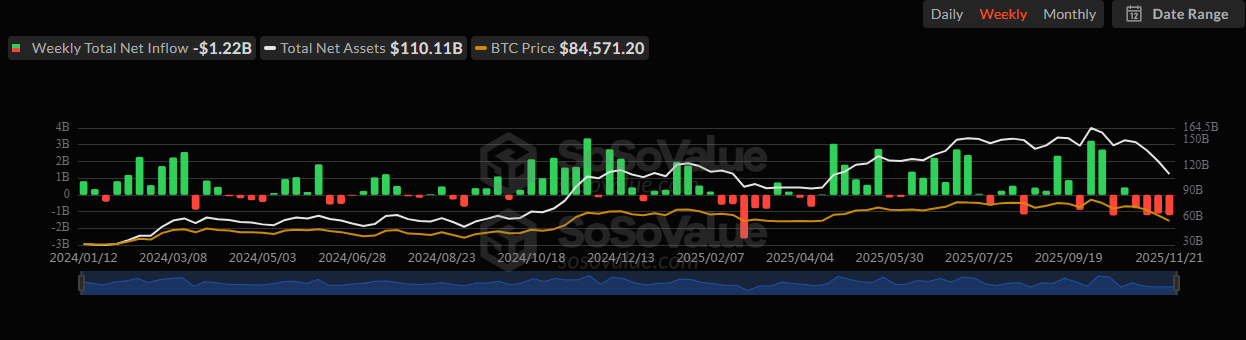
Key Week Ahead: US Inflation, Jobs Data, and the Fed in Focus
The week ahead could be crucial for BTC, given Friday’s jump in chances of a December Fed rate cut. Key US economic indicators, including retail sales, inflation, and jobs data, will likely influence the Fed rate path.
A softer Core PCE Price Index, rising jobless claims, and a slump in retail sales could boost bets on a December cut, lifting sentiment. However, sticky inflation, combined with rising jobless claims and falling retail sales, may raise stagflation risks, weighing on BTC and the broader market.
Traders should also monitor FOMC members’ speeches, which may raise bets on a December Fed rate cut, demand for BTC-spot ETFs, and BTC’s near-term outlook.
Crucially, Bitcoin remains the crypto market barometer, influencing investor appetite for Ethereum (ETH).
Ethereum ETF Outflows Send ETH to Four-Month Low
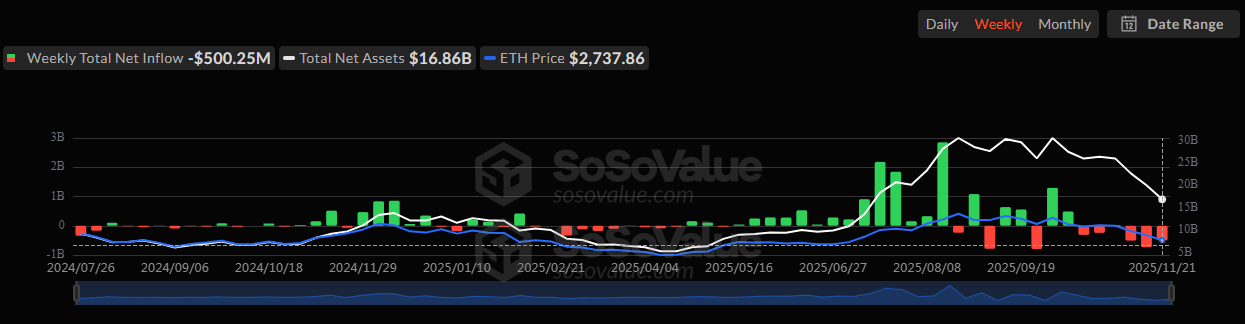
ETH-spot ETF issuers faced similar pressures as their BTC-spot ETF peers, with net outflows of $500.2 million in the reporting week ending November 21. A third consecutive week of net outflows left ETH-spot ETF issuers with $1.74 billion in outflows for November. November’s outflows led ETH down 28% in the current month and 16% year-to-date.
Explore our ETF flow deep dive to see which tokens are winning the most capital.
Key Drivers for BTC Price Outlook
Looking ahead, several key events will influence BTC’s near-term outlook:
- US economic data.
- FOMC members’ speeches.
- Legislative developments, including the progress of the Market Structure Bill on Capitol Hill.
- US BTC-spot ETF flow trends.
BTC Price Scenarios:
- Bullish Scenario: Bipartisan support for the Market Structure Bill, dovish Fed comments, softer US inflation data, and ETF inflows. These factors could drive BTC toward $100,000.
- Bearish Scenario: higher inflation, softer jobs data, legislative roadblocks, hawkish Fed rhetoric, or ETF outflows. These factors could drag BTC toward $80,000.
Technical Analysis
Bitcoin Analysis
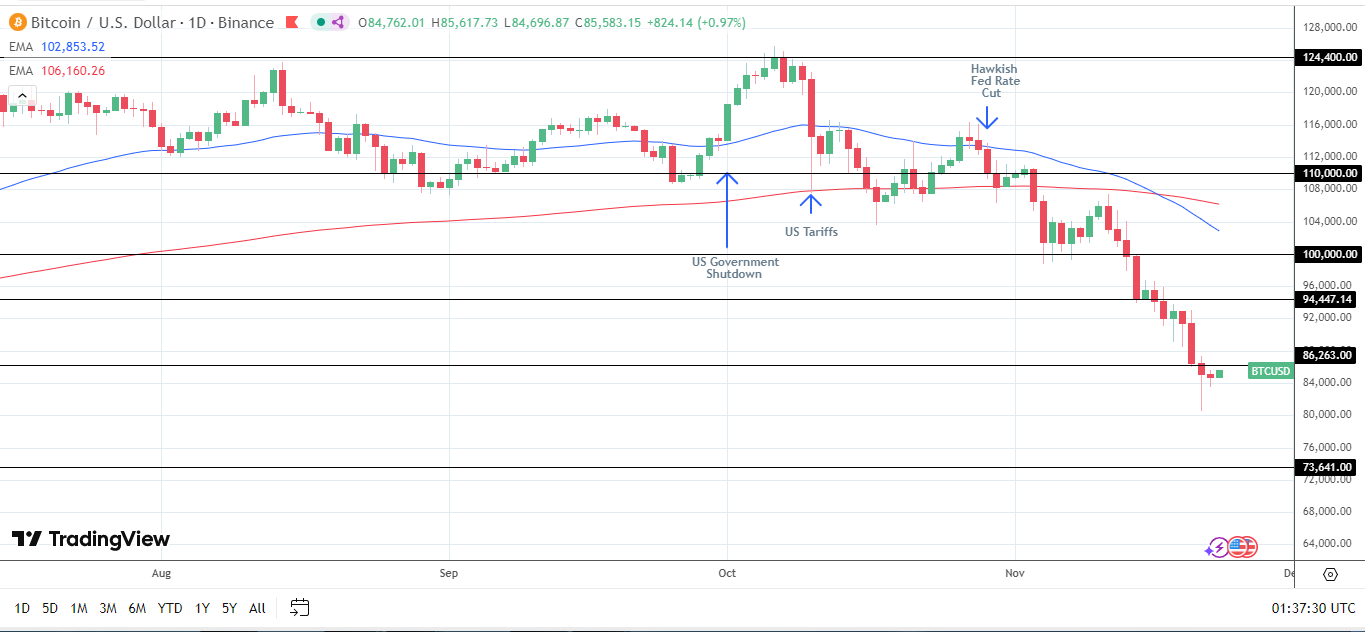
BTC trades well below the 50-day and 200-day Exponential Moving Averages (EMAs), affirming bearish momentum after last week’s bearish cross.
- Upside Target: A break above the $86,263 resistance level could support a move toward $90,000. A sustained move through $90,000 may pave the way toward the $94,447 resistance level, with $100,000 the next key level.
- On the downside, a drop below the November 21 low of $80,523 could bring $75,000 into play. If breached, $73,641 would be the next key support level.
Track BTC and ETH market trends with our real-time data and insights here.
Ethereum ETF Flows and Key Support and Resistance Levels
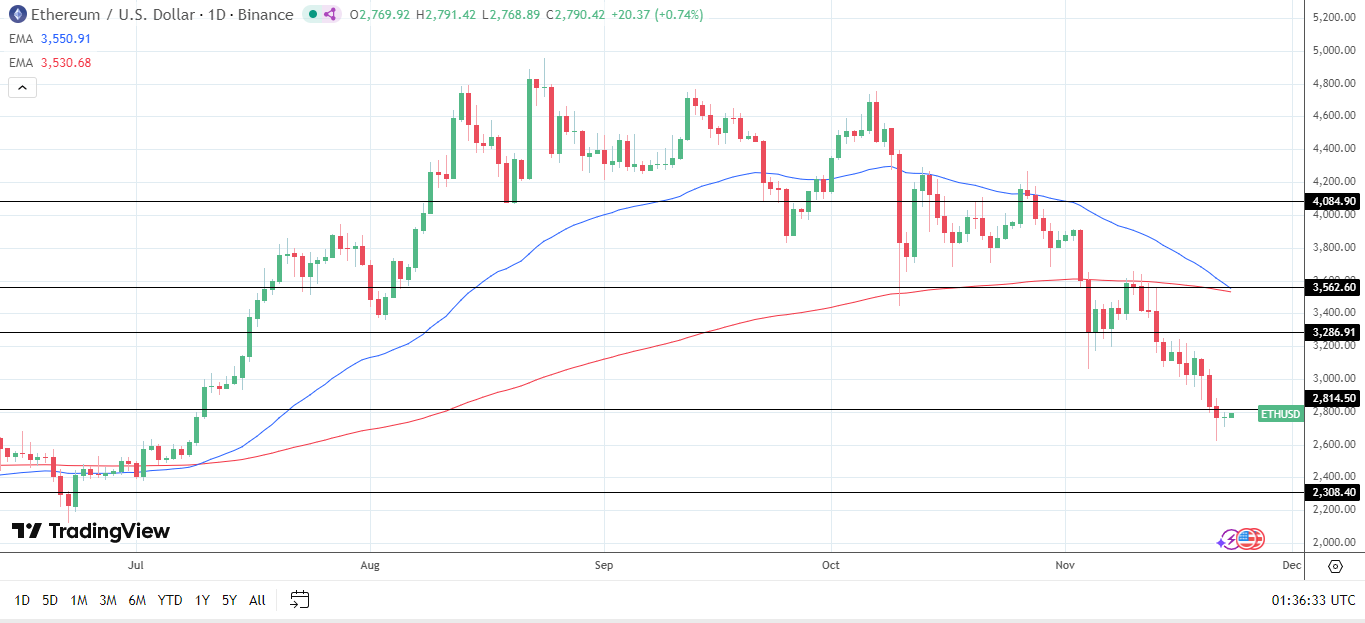
Turning to Ethereum, ETH continued to trade below the 50-day and 200-day EMAs, affirming a bearish bias. Notably, the 50-day EMA converged on the 200-day EMA, signaling a potential bearish cross.
- Upside Target: A break above the $2,815 resistance level could open the door to testing the $3,000 resistance level. A sustained move through $3,000 may bring the $3,287 resistance level into play.
- On the downside, a drop below the November 21 low of $2,620 could bring the $2,308 support level into play. If breached, $2,000 would be the next key support level.
Stay informed on BTC and ETH trends by monitoring macroeconomic developments, ETF flows, and technical indicators here.