
Bitcoin is doing what it does best when nobody knows what to do — nothing. The range between $70,000 and $64,000 has been the market’s waiting room for weeks, and this week it finally showed signs of life, pushing to $73,900 before pulling back to consolidate around $71,000. Both levels carry serious weight. $74,000 is now the immediate line in the sand — a high volume break above it opens $80,000 directly. $64,000 remains the structural floor that the entire bullish narrative depends on.
The world isn’t making it easier. Recession talk is getting louder, geopolitical escalation shows no sign of cooling, and macro uncertainty has pushed investors toward the one thing nobody ever got fired for holding — cash. Ironically, even Gold is seeing selling pressure right now, which tells you everything you need to know about current market sentiment. This isn’t rotation. This is people waiting to see how bad it gets before they make a move. When Gold gets sold alongside risk assets, that’s not a sector rotation signal — that’s fear of a deeper crisis, and it’s a dynamic worth watching very closely.

The Adoption Story Is Real — And It’s Accelerating
Before getting into the charts, the fundamental shift happening beneath the surface deserves attention because it rarely gets enough of it.
US-based exchanges are aggressively expanding into global markets, displacing established local players from major sponsorship deals and brand positioning — a land grab that signals long-term institutional confidence in crypto as an asset class regardless of short-term price action. Bitcoin mining is entering daily consumer products. Superheat’s water heater — which generates heat while simultaneously mining Bitcoin and depositing Satoshis directly to a user’s wallet — sounds like a gimmick until you realize it represents exactly the kind of frictionless adoption that historically precedes mass market penetration.
More structurally significant: ICE has opened access to tokenized equities and major cryptocurrencies outside standard US stock exchange operating hours. The broader movement toward 24/7 equity trading — essentially borrowing the operational model of crypto exchanges — is already underway across global exchanges. Tokenization of exchange-traded assets is the first step, and the first pilots are closer than most people think. When that infrastructure matures, Bitcoin’s position as the global central reserve of the entire digital asset ecosystem becomes considerably harder to argue against.
None of these moves prices this week. But it’s the foundation everything else is being built on.
Bitcoin Price Forecast
Every new Bitcoin analysis as it publishes, today's technical signal and key levels, live price — on one page.
See all Bitcoin forecastsTechnical Analysis: Elliott Wave, MACD, and the Line in the Sand
Price landed precisely where the prior analysis projected — the $64,100 area has been marked, tested, and is now being respected. That kind of precision in a forward projection isn’t noise. It validates the wave structure.
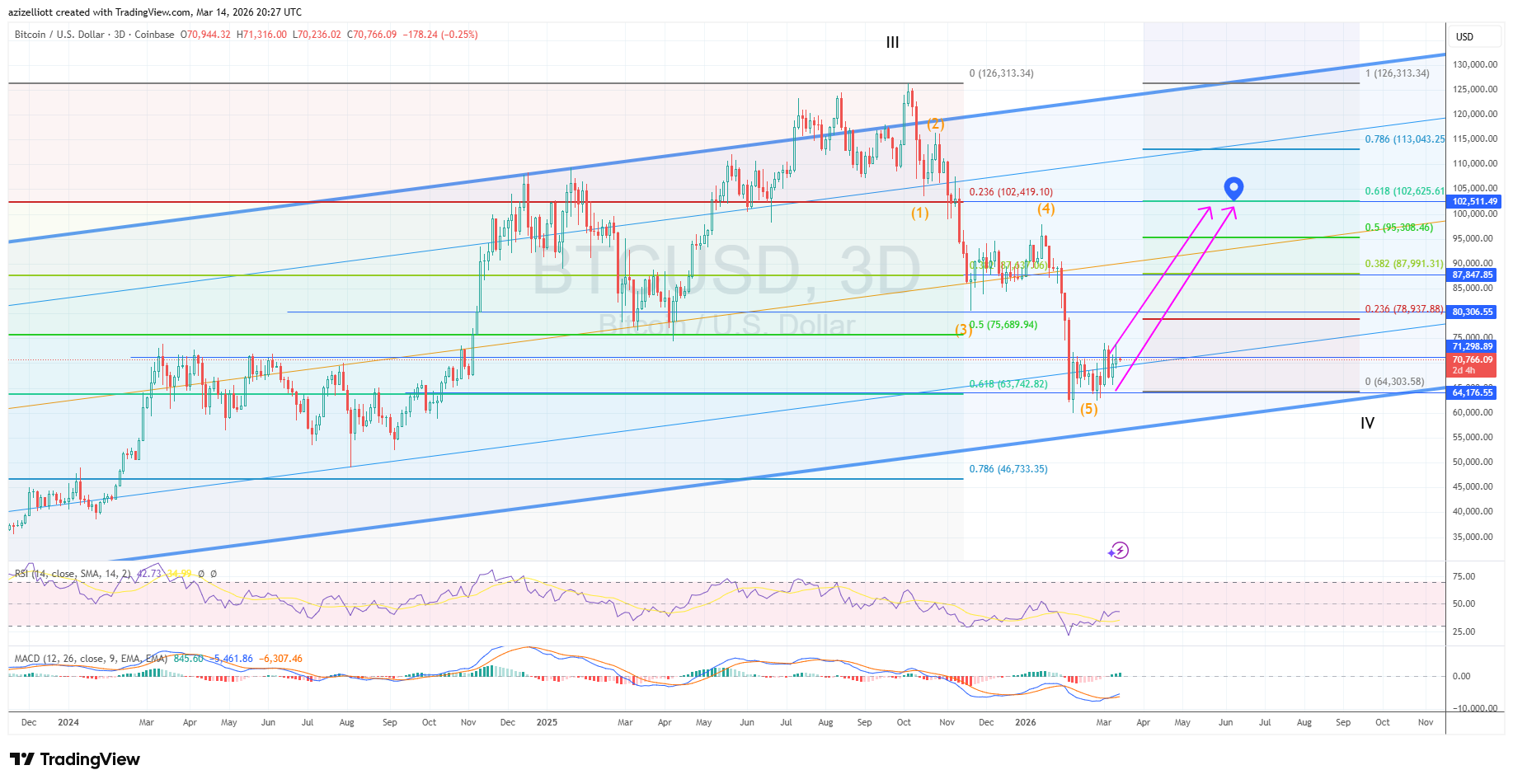
The push to $73,900 this week is consistent with what Elliott Wave principles pointed toward — a bounce toward the Fibonacci 0.5 and 0.618 retracement zones. That move is now underway, and how price behaves at these retracement levels will be the diagnostic. Whether Bitcoin finds resistance here and rolls over or absorbs supply and pushes decisively through $74,000 will determine whether we are entering a fresh bull cycle or completing the final leg of a corrective structure. That answer isn’t fully available yet, and anyone telling you it is with certainty isn’t reading the same charts.
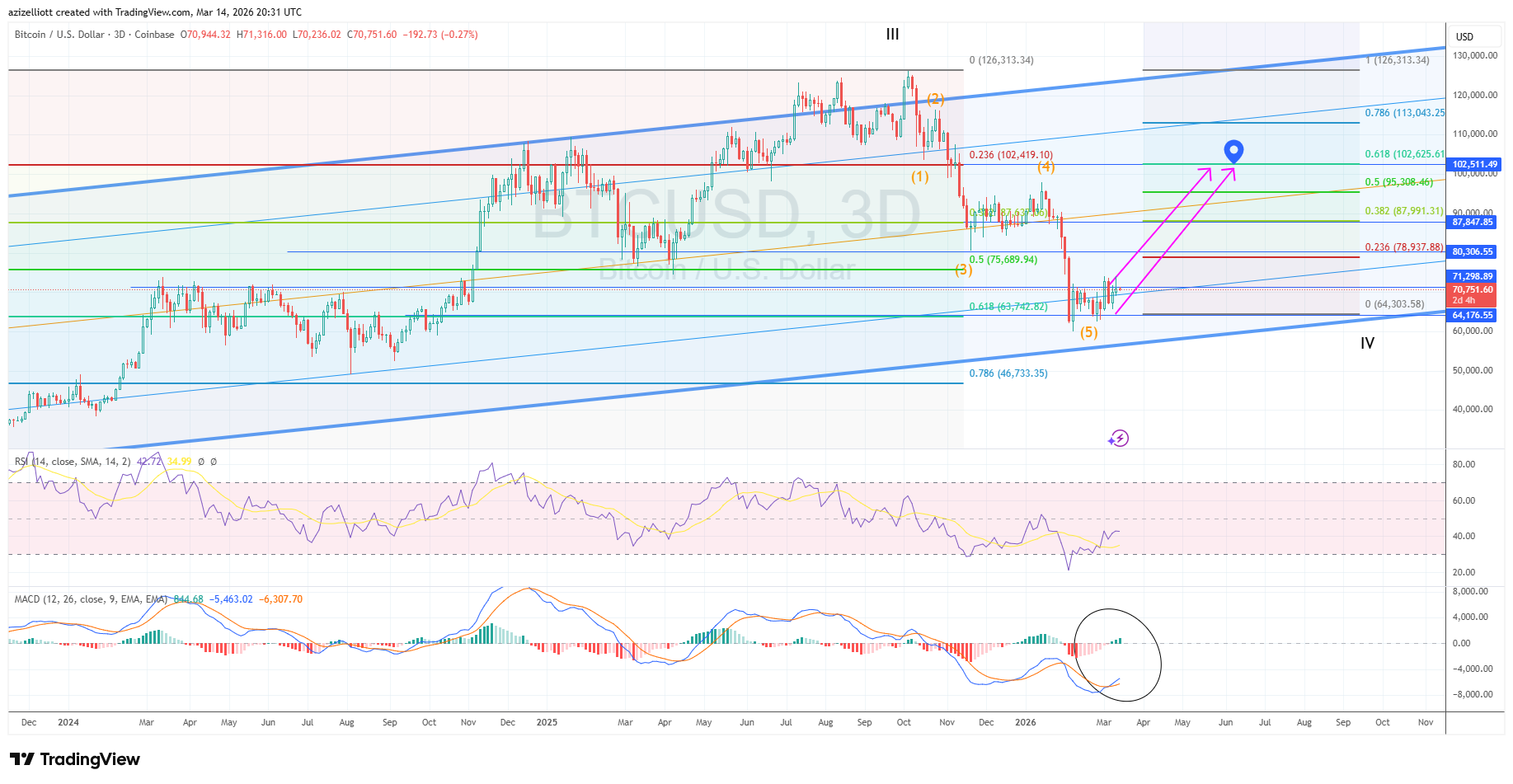
The MACD structure on the current timeframe is genuinely interesting. The configuration is signaling a short-term bullish cycle, and the setup is clean enough to take seriously. Short-term bullish pressure building from this level is consistent with an Elliott Wave bounce from a wave 4 terminus — which is exactly what the broader count implies.
Adding further weight to the bullish case — perpetual funding rates have been negative for 14 consecutive days, the longest such streak since December 2022, which historically has coincided with local price bottoms rather than trend reversals. And US spot Bitcoin ETFs have recorded $1.3 billion in net inflows in March alone, shaping up to be the first positive monthly flow reading since October. Institutional money is returning — quietly, but measurably.
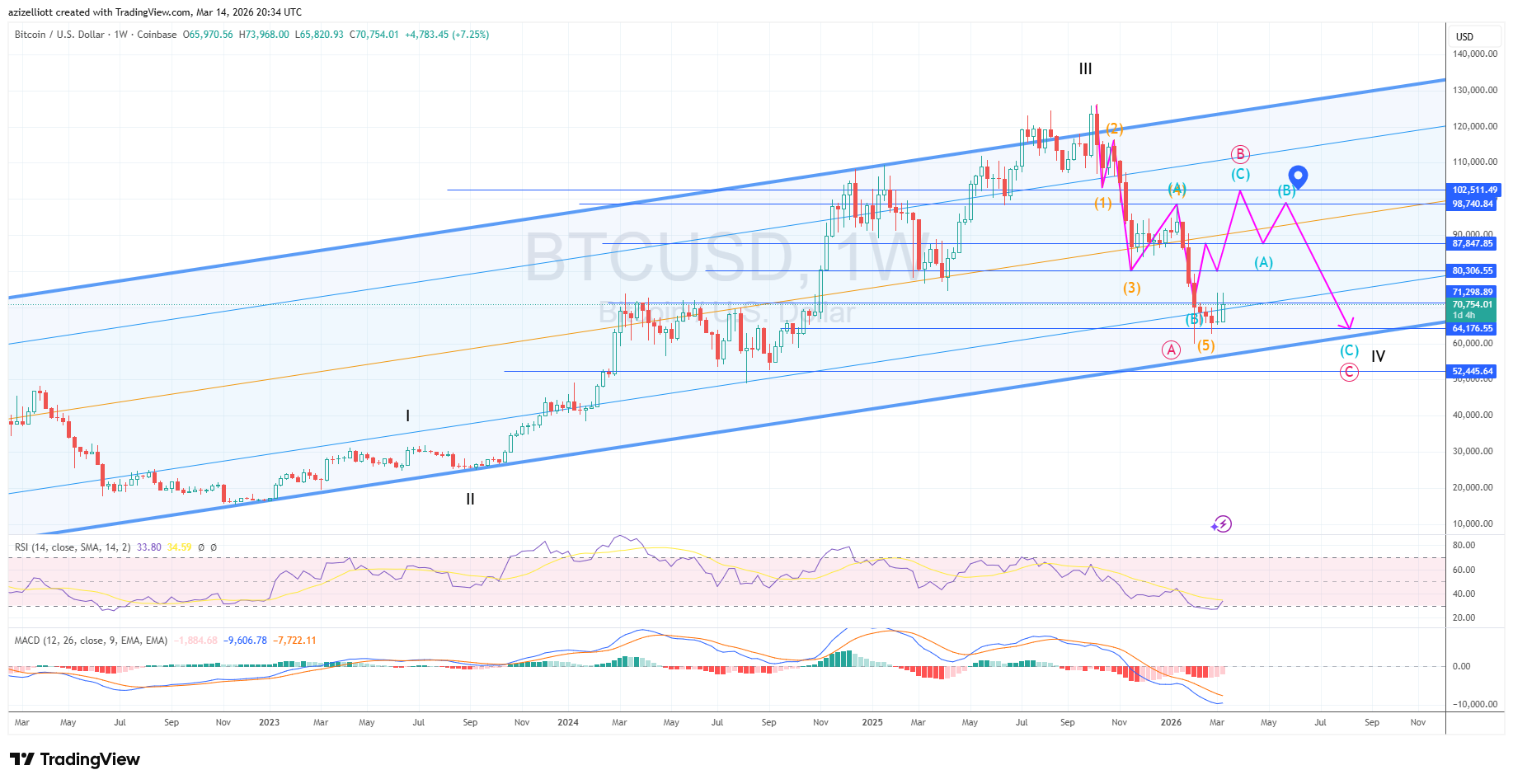
The line in the sand is simple: $64,000 must hold. A breakdown below that level invalidates the primary wave structure. The secondary scenario — a Diagonal formation — would technically permit wave 4 to extend beyond wave 1, which is the only Elliott Wave formation where that is permissible. But let’s be direct — if $64,000 breaks, the path to $60,000 opens immediately, and below that, $40,000 comes back into the conversation. That’s not a prediction. It’s the structural consequence of breaking the support.
Order Book Data: The Green Walls Are There, But They Need to Be Triggered
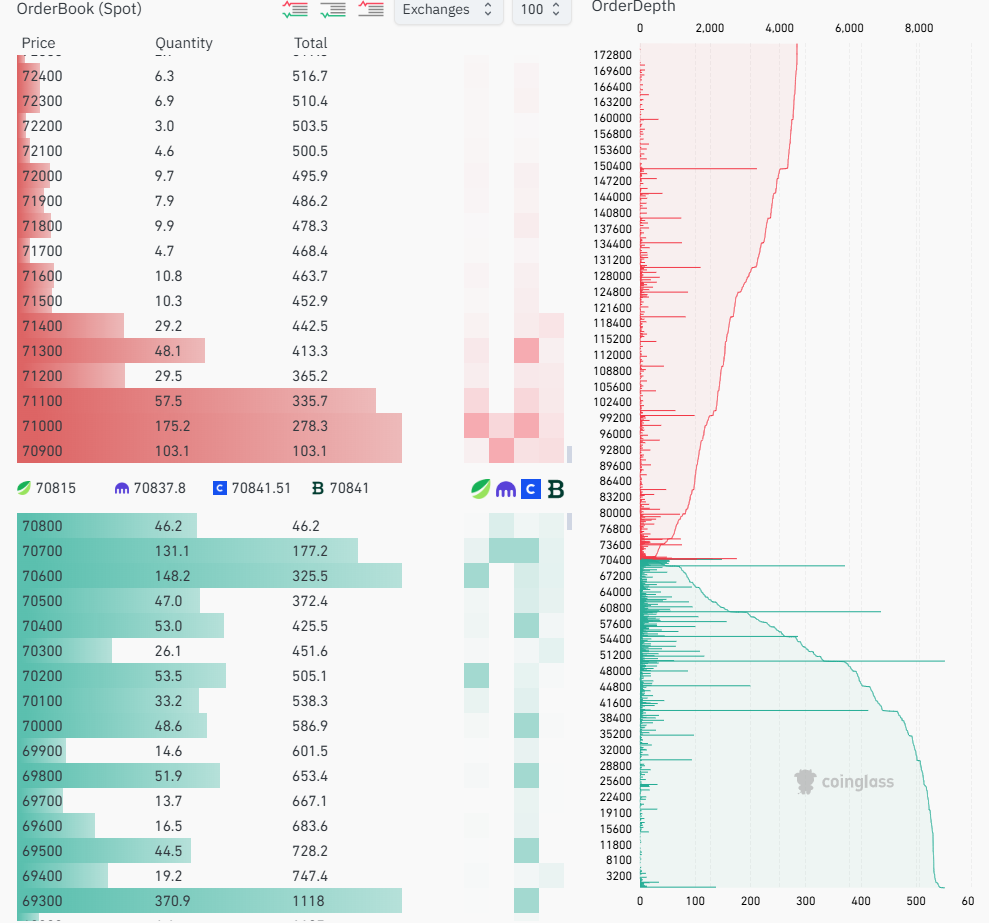
Coinglass order book data shows meaningful buy-side depth at key levels. The first significant green wall sits at $69,600, the next at $60,300, and the largest concentration of support is parked at $50,000. The orders exist. The problem is that passive order book depth only matters when price reaches it — and the current bounce toward $73,900 suggests that the $69,600 wall has already been absorbed on the way up, which is a constructive sign for near-term momentum.
A drop to $50,000 would trigger a fast recovery back toward $70,000. The buy pressure at that level is substantial enough to produce a sharp snap-back. However, the path from $70,000 to $150,000 would become materially more difficult from that starting point — the expected rapid advance toward the $150,000 target would be delayed, and the market would need to rebuild structural momentum from scratch.
The $102,000 Retest — Still the Key Sequence to Watch
The broader macro setup hasn’t changed. The working thesis remains: a retest of $102,000 followed by yet another pullback to $64,000 — or as deep as $52,000 — before the next sustained leg higher. Price needs to complete that sequence cleanly before the $150,000 target becomes a realistic near-term discussion. Rushing that conclusion has been the mistake of every premature bull call in this cycle.
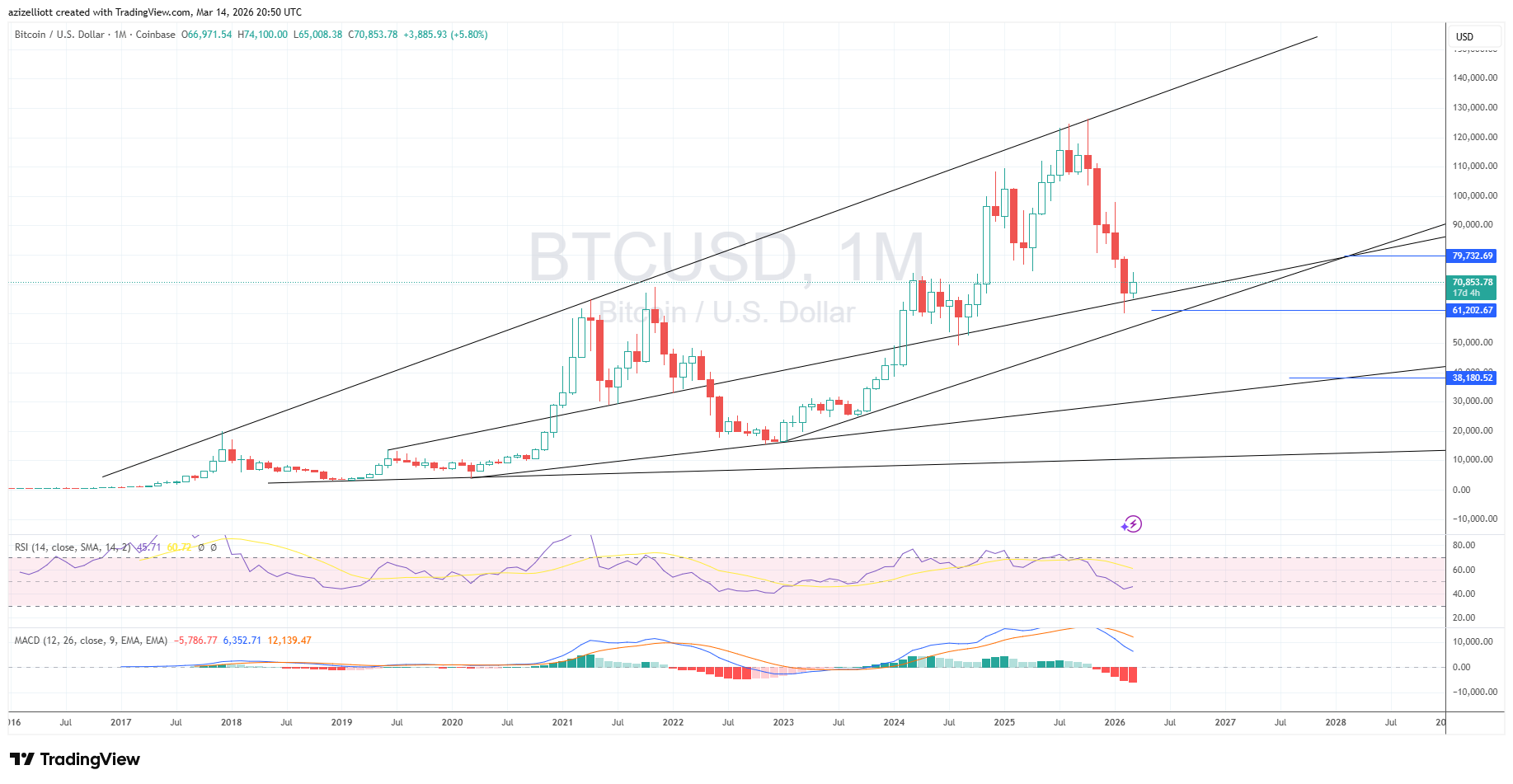
This analysis will be updated weekly as the structure develops.
Final Thought
The COVID-19 pandemic produced one of Bitcoin’s most explosive adoption waves — not because of the technology, but because the macro environment forced people to rethink what a store of value actually means. The current global setup — war escalation, recession risk, stock market stress, and a potential energy crisis of historic proportions — carries the structural ingredients for a similar behavioral shift. Bitcoin is already up 13% since the Middle East conflict escalated, outperforming tech stocks, gold, and US equities. Capital is beginning to treat it as a legitimate crisis hedge alongside traditional safe havens — quietly, but the data is there.
The difference is that Bitcoin’s adoption infrastructure in 2026 is incomparably more mature than it was in 2020. The price is moving again. $64,000 held. $74,000 is next. Everything else follows from there.