
Bitcoin (BTC) is showing signs of another macro-driven breakdown as the yen carry trade risk that rattled global markets in August 2024 returns to focus.

Bitcoin Drops as Yen Carry Trade Fears Return
Bitcoin fell near $62,800 on Tuesday, down approximayely 7% from its June highs as traders reacted to weakness across Asian markets and renewed concerns over the Japanese yen carry trade.
The pressure comes as USD/JPY trades near 161–162, close to levels that previously triggered heavy concern from Japanese authorities. Japan’s previous intervention, worth about 11.7 trillion yen, or roughly $72–73 billion, has largely failed to keep the yen stronger.
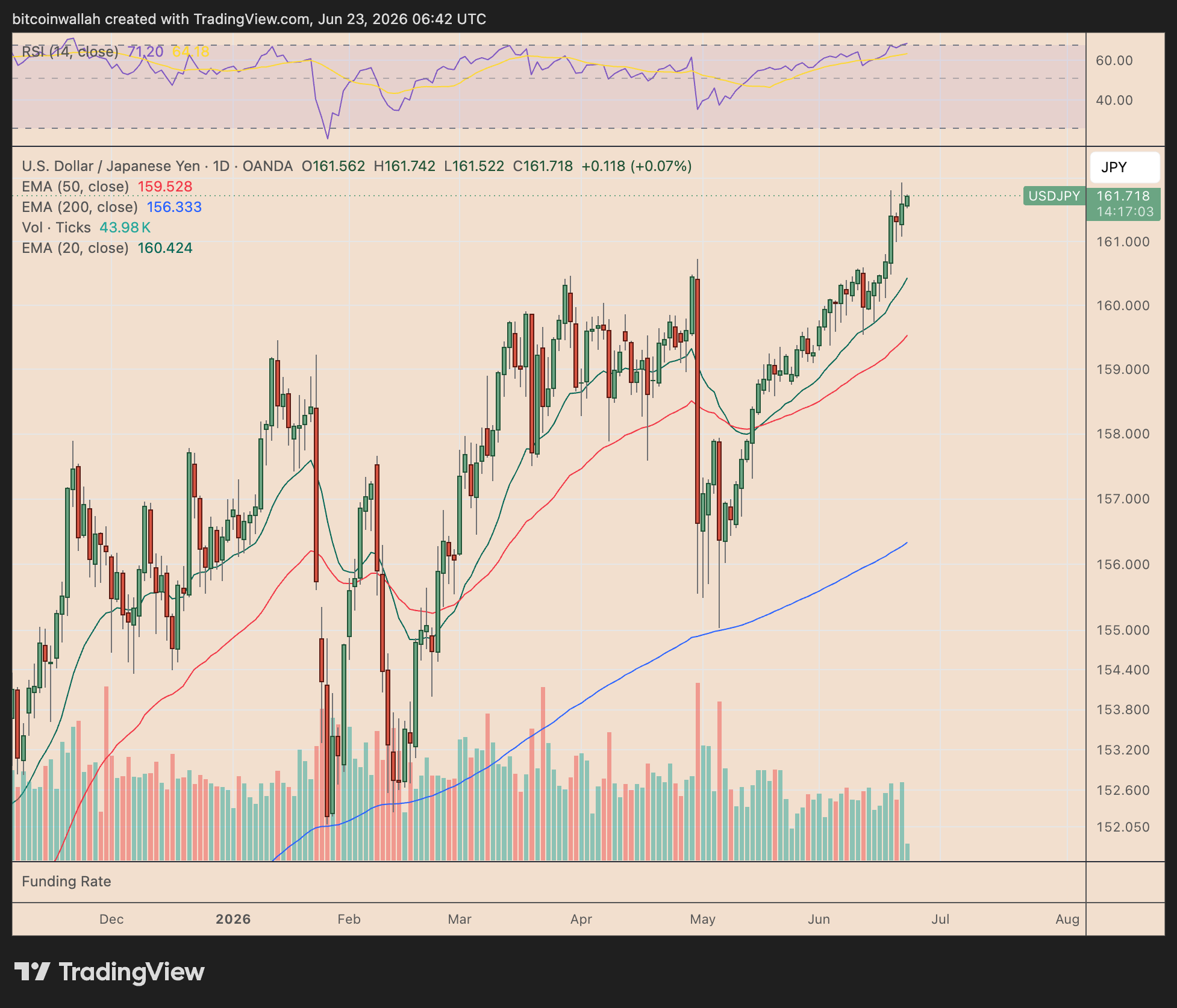
A sudden yen rebound can force investors to unwind yen-funded trades.
In simple terms, investors borrow cheap yen, sell it for dollars and buy higher-yielding assets, including equities, credit and other risk-sensitive assets. When the yen rises quickly, those trades become expensive to maintain, forcing traders to sell assets to raise cash and repay yen liabilities.
Bitcoin suffered from that same deleveraging pressure in August 2024.
At the time, Japan’s Nikkei had tumbled nearly 20%, the S&P 500 had fallen more than 5%, and Bitcoin had slid around 15% as the unwind of crowded trades hit global markets. Nikkei also suffered a brutal 12% one-day crash, its worst session since 1987.
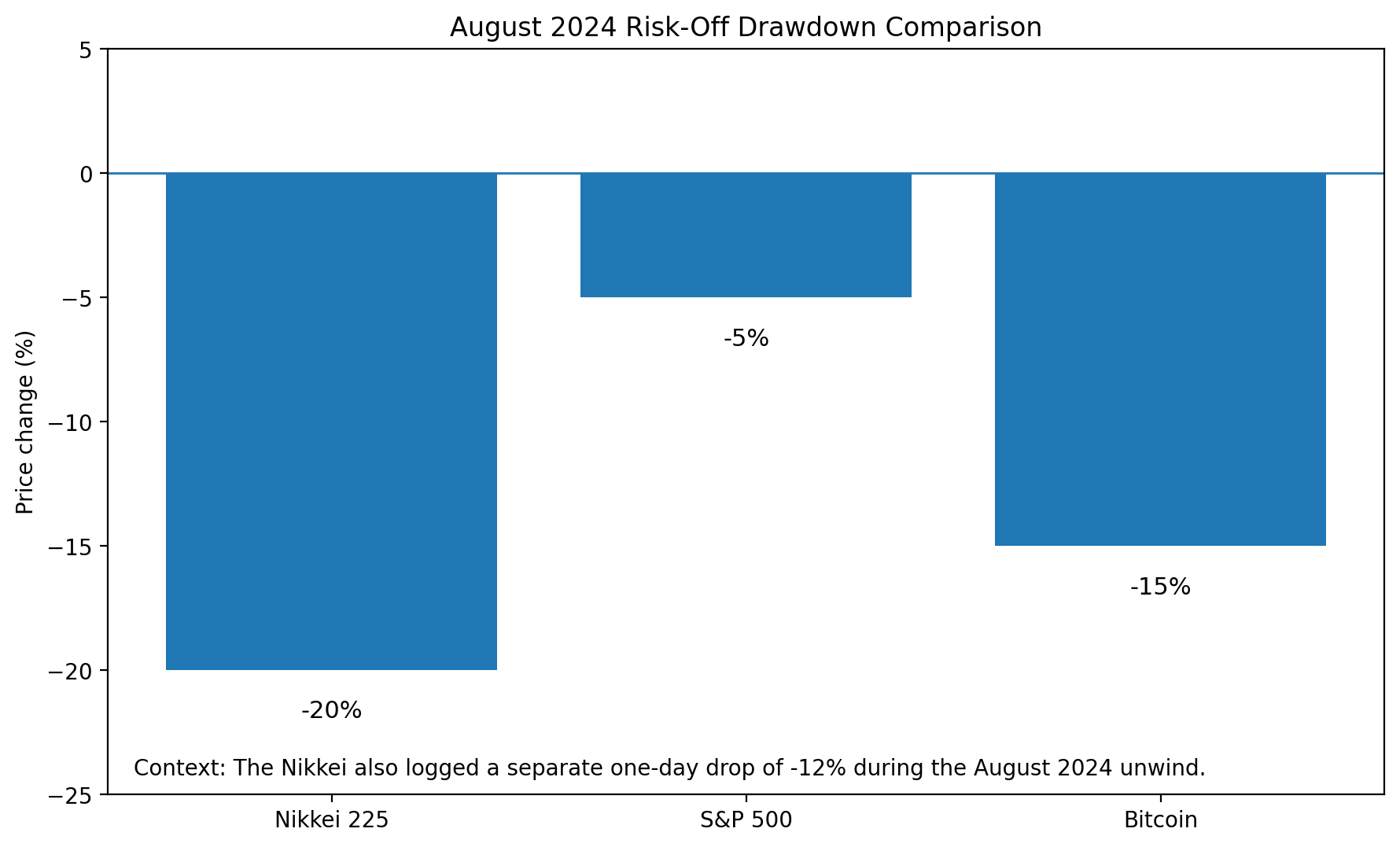
The Bank for International Settlements later said the August 2024 episode was amplified by the unwinding of leveraged equity and currency trades, including carry trades worth an estimated ¥40 trillion, or about $250 billion, though the true size was difficult to measure.
As of June 23, 2026, USD/JPY was treading near the same danger zone while Asian equities flashed stress. For instance, South Korea’s KOSPI dropped more than 6%, MSCI Asia-Pacific (excluding Japan) fell 1.5%, and Nikkei retreated 1.2% after an eight-day rally.
WealthManager, an X-based independent market analyst, also echoed similar views, noting that BTC may drop “below $6,000 very soon” if the yen-carry trade risks return.
Bitcoin Price Forecast
Every new Bitcoin analysis as it publishes, today's technical signal and key levels, live price — on one page.
See all Bitcoin forecastsBitcoin Bear Flag Keeps $55K BTC Target in Play
Bitcoin’s daily chart is flashing downside risk as BTC breaks below a rising parallel channel, forming a bear flag after its sharp early-June selloff.
The pattern developed as Bitcoin rebounded weakly from around $59,000 to $66,000 before losing momentum near the channel’s lower trendline. A decisive breakdown below the flag support near $63,000 puts the measured downside target near $55,000–$55,300.
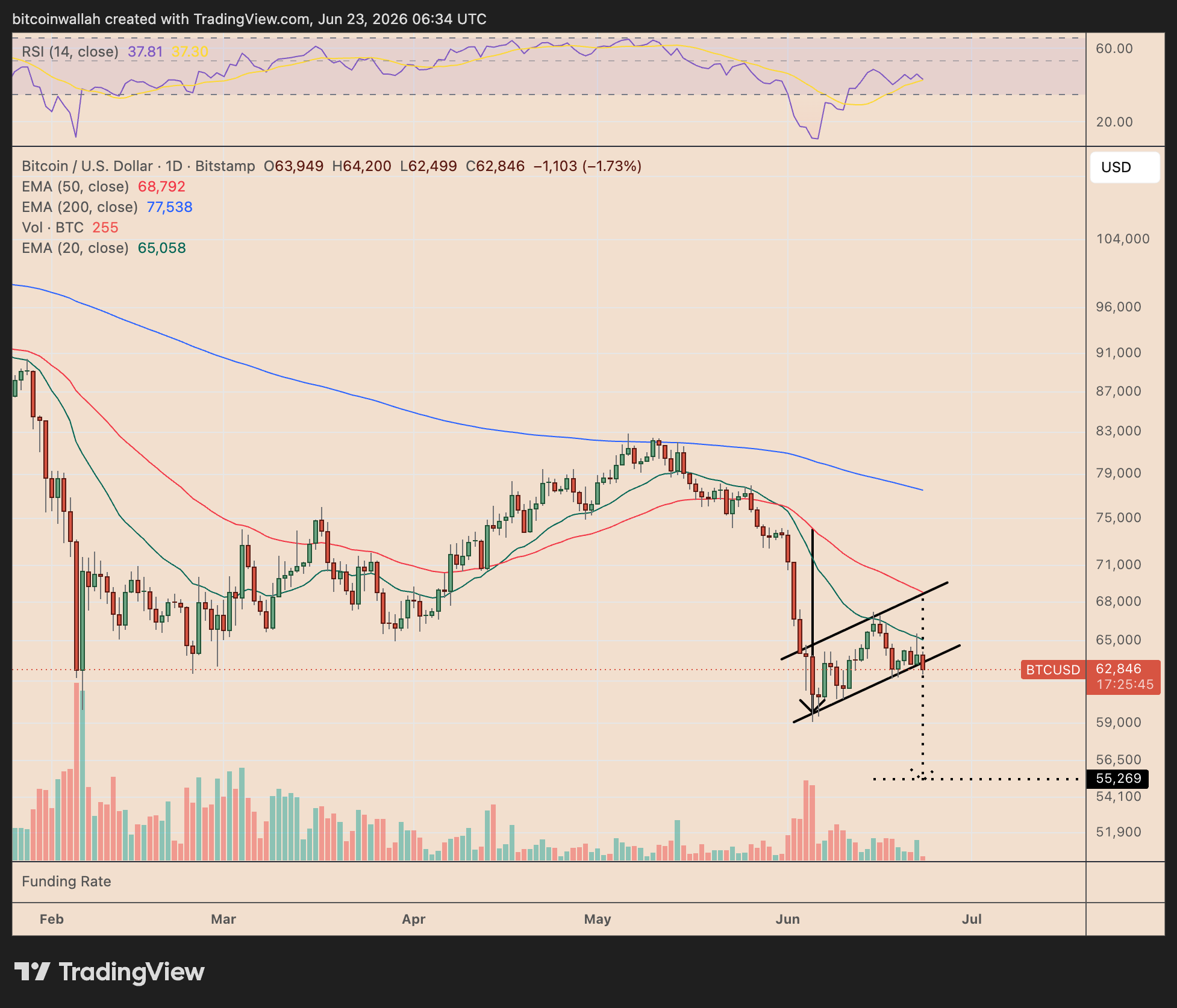
The bearish setup is reinforced by BTC trading below its 20-day EMA (green) near $65,058, 50-day EMA (red) near $68,792, and 200-day EMA (blue) near $77,538. Meanwhile, the daily RSI near 38 shows weak momentum but is not yet deeply oversold, leaving room for further downside.
The first key support zone sits around $60,000–$59,000. A daily close below that range could accelerate the move toward the bear-flag target near $55,000.
The bearish view would weaken if Bitcoin quickly reclaims the flag support and closes back above the 20-day EMA. A stronger invalidation signal would be a move above the 50-day EMA near $68,800, suggesting the breakdown has failed.