
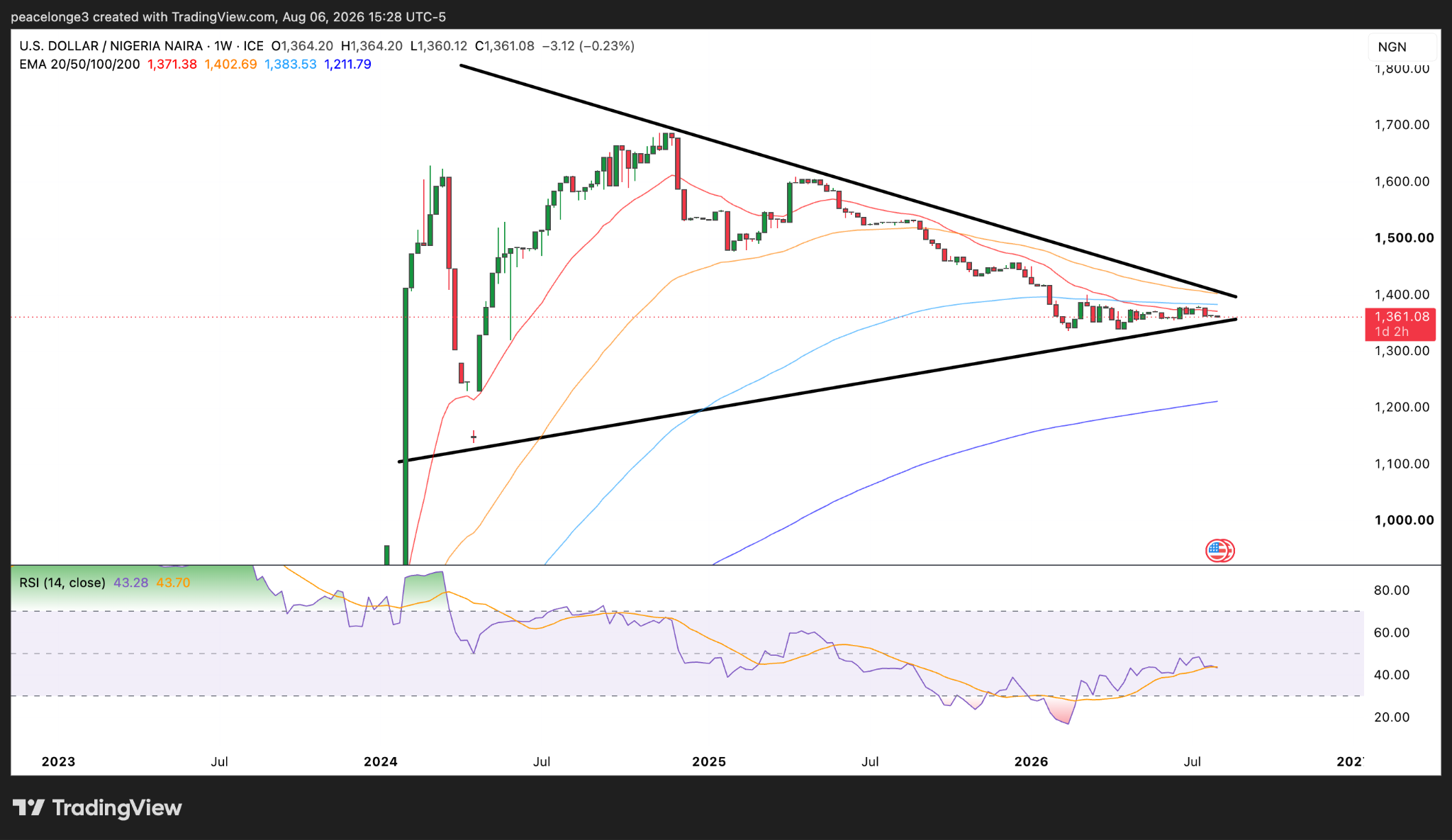
Things have only gotten worse ever since, with the naira reaching a record high of about ₦1,687 against the dollar in November, 2024. The naira now sits near ₦1,360 at the time of writing, pressed inside a symmetrical triangle pattern on the weekly timeframe.
Volume on the pair has dropped significantly, with price consolidating linearly for almost 26 weeks now, and a breakout will dictate which direction price trends in for the next few weeks.

Rising Reserves and FX Inflows Support the Naira
A closer look at the fundamental analysis of the naira reveals why the currency’s aggressive depreciation has slowed down significantly. The Central Bank of Nigeria (CBN) reported that its external reserves had climbed above $52.5 billion as of July 17, 2026, making it the reserves’ highest level in the last 17 years and well above the CBN’s yearly target.
The bank’s foreign reserves serve as a powerful tool for stabilizing exchange rates and curbing the naira’s selloff by creating artificial demand through the purchase of naira with dollars from the reserve.
In addition to this, the inflow of foreign money into the Nigerian economy is playing a big role in strengthening the naira. According to the CBN’s 2025 Annual Report, foreign exchange inflows increased by 13.8% to a record high of $109.86 billion in 2025. These increased inflows were a result of more non-oil commodities being exported out of the country, foreign investors pumping money into the economy, and over-the-counter purchases. These inflows have ultimately strengthened the naira by boosting dollar supply.
₦1,211 Support Comes Into Focus
The USD/NGN weekly chart shows three out of four EMA lines lying close together and compressing in a manner that indicates the market is coiled for a near-term breakout. The fourth EMA line, which is the 200 EMA, lies far below the others at around ₦1,211. If price breaches the symmetrical triangle downwards, and closes a weekly candle in the ₦1,300 region, we can expect a test of that 200 EMA as a support at ₦1,211.
The weekly RSI reads 43.28 at the time of writing, which is slightly below the average mark and leaves enough room for price to run before hitting either extremity of the full RSI range.
The immediate risk for naira bulls is a drop in oil revenue, as the country’s economy relies heavily on foreign currency inflows through the export of its crude oil. Weak oil sales means weaker foreign reserves, as most of the Central Bank’s forex savings are built from the proceeds of crude exports. The country’s heavy dependence on imported goods doesn’t help, and the more goods need to be imported, the more naira is sold to buy dollars so that traders can pay for the foreign goods.
Key Breakout Levels at ₦1,359 and ₦1,376
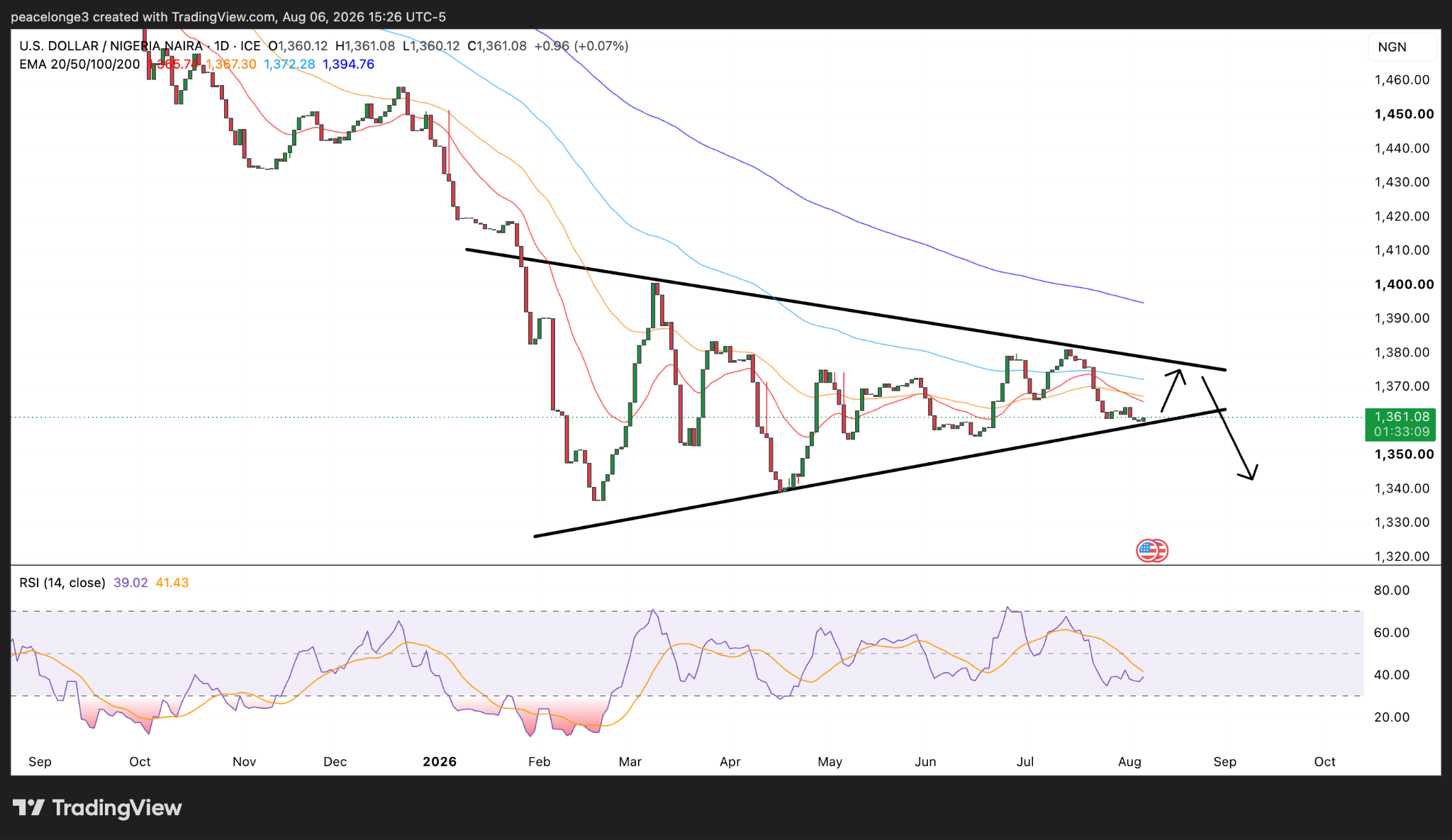
Zooming closer into the USD/NGN chart reveals a smaller symmetrical triangle on the daily timeframe. The triangle is mostly filled, with very little space left to hold the tightly compressed candles. The upper trendline of the triangle creates an immediate resistance at around ₦1,376, while the lower trendline creates a near support at around ₦1,359. Price currently sits at that support level, and if it holds, price could go up to test the ₦1,376 resistance.
A break above the tightly pressed 20, 50, and 100 EMA, alongside a daily close above ₦1,376, exposes a clear upward path to ₦1,390 and the ₦1,400 psychological level.
The RSI on the daily timeframe is at 39.02, which is significantly below average and leans more in favor of bearish momentum. If fundamental signals like foreign inflows and exchange reserves strengthen, they could edge the market in favor of the bears and send USD/NGN to lower levels.
What CBN Data Means for USD/NGN
A key catalyst worth watching in naira’s story is CBN’s inflation report. According to the bank, headline inflation dropped by 0.02%, from 15.93% in May to 15.92% in June. Official exchange rates also moved closer to bureau de change rates, reducing the spread between both rates to a below 2% figure. The tighter the spread, the healthier the naira FX market.
In the grand scheme of things, inflation is still high, as it sits close to 16%, and this favors the depreciation thesis until a significant reversal happens.
In the meantime, price remains compressed inside the ₦1,359 – ₦1,376 range. Until there’s a clean breakout in either direction, traders stay put with their eyes on inflation rates. According to Premium Times Nigeria, the Central Bank of Nigeria remains confident that it can bring inflation down to single digits by early 2027.
If that happens, we can see the USD/NGN trade swing strongly in favor of the naira bulls.