British Pound / US Dollar Analysis (GBP/USD)
To begin with, let’s take a look at where this pair sets towards the end of the year as it hangs around this 1.34 region. It is sitting below the highs of the year, which is significant because, as this video is recorded, the reality is there are a lot of questions being asked about the Federal Reserve and, of course, the currency markets in general, specifically the British pound. But to understand how we got here, we need to first step back and take a look at the year to begin with 2025.

The British Pound’s 2025 Performance
You can see that almost immediately in 2025, the British pound bottomed and started to go higher. In fact, that wasn’t much of a surprise in the sense that if the dollar was going to lose strength during the year, the British pound would be expected to do fairly well. It had actually outperformed a lot of its contemporaries on the way down, meaning that when the US dollar was strengthening so much, the British pound just lost less. It looked a little bit more resilient.
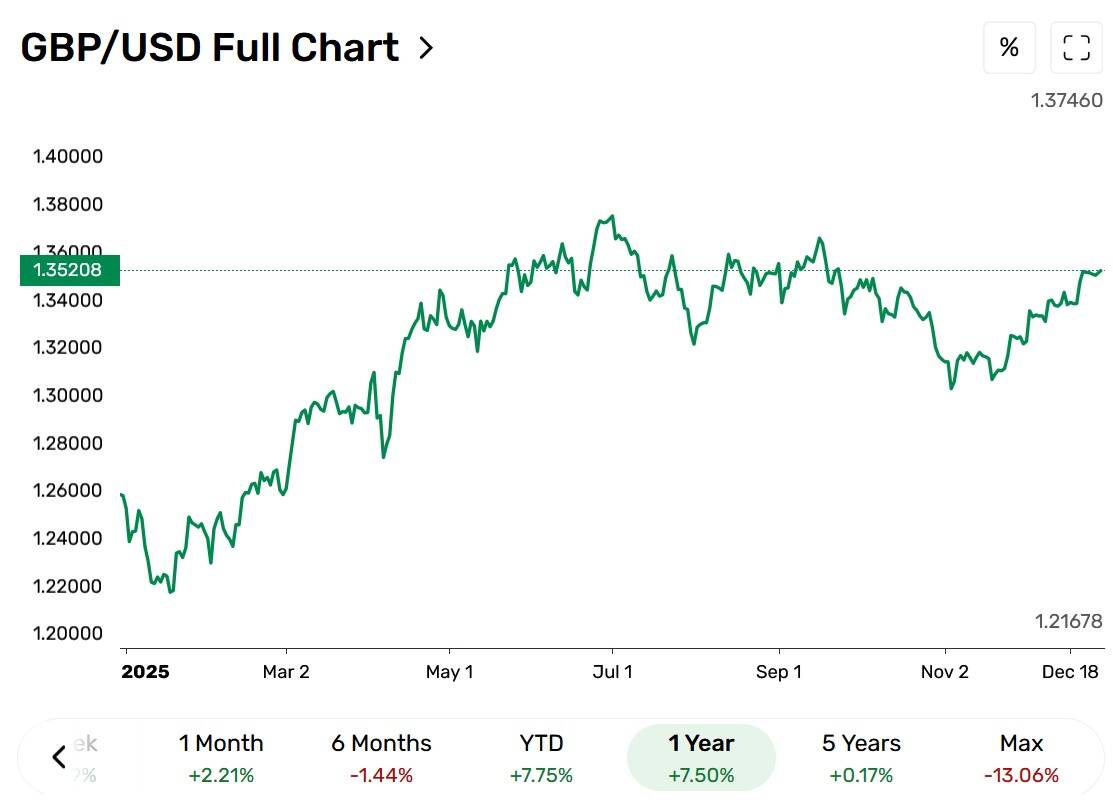
So, with all of that being said, it’s probably not surprising that it was one of the better performers on the way back up. The Federal Reserve transitioned from a tightening monetary policy to a patient, data-dependent stance. That was the first sign that maybe things were changing just a bit. They went from being overly hawkish to somewhat ambivalent and cautious. That being said, the markets multiple times during the year mispriced the dollar, not just against the British pound, expecting massive interest rate cuts and a return to super-easy money.
You also have to keep in mind that the Bank of England maintained a relatively hawkish stance early in the year, driven by sticky inflation, especially in the services sector of the United Kingdom. It did eventually soften a bit as growth concerns and sensitivity in the housing market became apparent. That is basically what started to happen right around the beginning of July, when the British pound started to show cracks in its strength.
Growth Divergence and Rate Differentials
The rate differential is pretty narrow, but it overall supports the US dollar. It just kind of depends on what the bond markets are doing at any given moment. The economic performance in the United States has been better than expected. While much of the year was spent plotting the death of the US economy, it turns out people in America still spend. It looks like a boom town in many places, with consumers continuing to buy. Whether that is on credit or cash is a different story, but it does provide growth.
GBP/USD Price Forecast
Every new GBP/USD analysis as it publishes, today's technical signal and key levels, live price — on one page.
See all GBP/USD forecastsThe labor market in the United States is still really strong. It is not hard to find a job at all, and in fact, there is a shortage of workers, which is a good problem to have. The United Kingdom avoided a significant recession, but it did remain somewhat fragile. That fragility helped drive the pound lower. Mortgage resets weighed on consumption in the UK, unlike the United States, where fixed-rate mortgages insulate households from rate changes.
The British pound traded with more volatility than the euro and initially benefited from the hawkishness of the Bank of England. That being said, rallies often stalled during the year due to growth uncertainty and UK fiscal credibility concerns. Global sentiment was in flux at times, which often favored the US dollar regardless of UK-specific factors.
The British released a budget that was received positively, helping form a double bottom around the 1.30 level. That provided some support later in the year. However, the current technical structure shows a lot of uncertainty. The long-term trend going into 2026 appears sideways but mildly bearish. Momentum swings are short but violent, and despite the bullish start to 2025, the market spent a lot of time moving sideways.
GBP/USD Forecast for 2026
Looking ahead to 2026, the Federal Reserve is likely to ease gradually, with gradual being the keyword. The Bank of England is likely to be forced to ease, and markets already expect rate cuts. Interest rate differentials are slightly dollar positive. UK growth is expected to be weak but stable and vulnerable to shocks, while US growth continues to outperform. That US outperformance may catch many people off guard.
Bullish Scenario
The bullish case would require UK inflation to remain sticky, delaying rate cuts, while the Fed eases faster than anticipated. Improving global risk appetite could also help, with scenarios such as peace in Ukraine potentially weakening the US dollar through capital flows into higher beta currencies. Even then, any upside would likely be fragile and uneven.
Bearish Scenario
The bearish outlook carries roughly a 60% to 65% probability. UK growth could deteriorate faster than expected, forcing the Bank of England to cut earlier and more aggressively. US growth and yields remaining attractive would support the dollar. Any risk-off environment would also be very dollar positive. This would likely be a fade-the-rally market, grinding back toward 1.30 and potentially 1.2750 by year-end.
The base case for 2026 is choppy, headline-driven price action. Sterling is likely to remain one of the more volatile major pairs, favoring selling into strength. There is no clear trend unless growth differentials widen sharply, and if they do, it is likely in favor of the United States. Watch the 1.36 level for signs of dollar weakness and 1.32 as a gateway to lower pricing. A break below 1.30 could accelerate selling pressure. The most likely scenario is that rallies lasting a few days present opportunities to sell.
For a look at all of today’s economic events, check out our economic calendar.