



China Mainland equity markets and the Hang Seng Index have outperformed the Nasdaq Composite Index and S&P 500 year-to-date in 2026. With Mainland China’s Shanghai Stock Exchange (SSE) closed for trading from February 16 through February 23 for the Lunar New Year, traders have a week to reflect on key developments and potential speed bumps.
Non-US external demand remains strong despite a stronger Chinese Yuan (CNY). Pre-Lunar New Year holiday USD-RMB flows suggesting continued diversification from the US dollar.
Meanwhile, deflation and the housing market remain hurdles for Beijing to address if stimulus measures targeting domestic consumption are to be effective.
Despite weak domestic consumption and the ongoing housing crisis, expectations of further policy support and robust external demand affirm the bullish medium-term outlook for Mainland and Hong Kong-listed stocks.
Below, I will explore the key drivers behind recent gains, the medium-term (3-6 months) market outlook, and the key technical levels traders should watch.
USD/CNY Drops below 7 as China Offloads US Treasuries
USD/CNY trends have received plenty of attention since President Trump triggered the US-China trade war in early 2025. Typically, a weaker Chinese Yuan against the US dollar would offset the effect of tariffs on Chinese goods bound for the US, supporting demand.
However, USD/CNY plunged 4.2% to 6.9926 in 2025 and has fallen 1.22% to 6.9075 in early 2026. For context, USD/CNY climbed to a 2025 high of 7.3504, its highest level since the Global Financial Crisis, before the reversal. Notably, China’s US Treasury holdings have followed a similar pattern, falling to their lowest level since 2008 in November and dropping further in 2026.
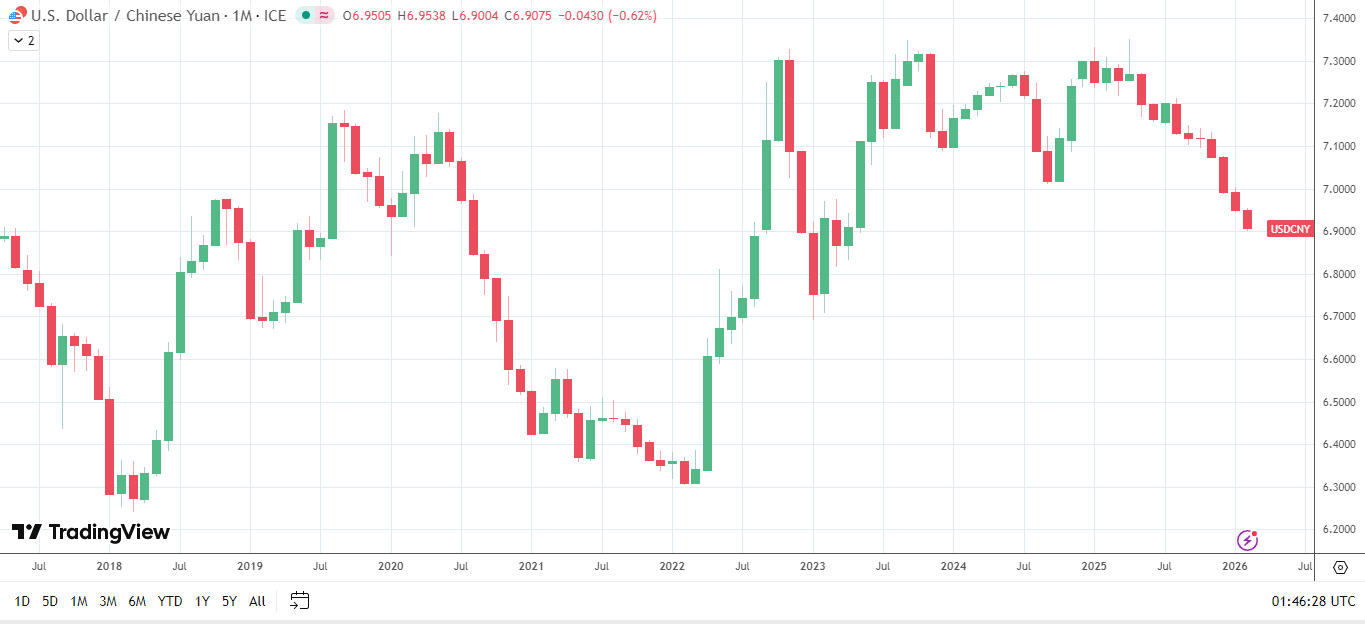
These price trends may further erode US demand for Chinese-manufactured goods, underscoring Beijing’s push to forge stronger trade relations with Africa, Canada, Europe, India, Latin America, and the UK.
Hong Kong Hang Seng Price Forecast
Every new Hong Kong Hang Seng analysis as it publishes, today's technical signal and key levels, live price — on one page.
See all Hong Kong Hang Seng forecastsChina Sees Africa and Latin America as Key Trading Partners
Beijing’s efforts to mute the effect of US tariffs on external demand appear to have paid off. Chinese exports jumped 6.6% year-on-year in December 2025, up from 5.9% in November. Notably, exports to Africa rose 25.8%, while exports to the US were down 20%.
Beijing has responded to the increased demand from Africa, reportedly preparing to cut tariffs on African nations to boost trade ties. Caixin Global reported:
“China says it will drop tariffs for 53 African nations starting May. The move comes after annual trade surged past $300 billion, cementing Beijing’s role as the continent’s top partner amid rising U.S. trade barriers.”
Meanwhile, Latin America has been another key target for Beijing, looking to reduce reliance on the US. China reportedly accounted for 20.9% of Latin American and Caribbean exports (excluding Mexico), exceeding the EU (12.4%) and the US (16.4%). According to The Kobeissi Letter,
“In absolute terms, China imports $180 billion from the region annually, compared to $142 billion for the US and $107 billion for the EU. This comes as Latin America has become the key supplier of commodities, including oil, soybeans, copper, iron ore, and various meats to China. China’s global economic influence is growing.”
China’s push for stronger trade ties comes ahead of April’s highly anticipated meeting between President Trump and President Xi Jinping. Economists expect the meeting to yield an extension to the trade war truce.
China-Iran, Crude Oil, and US-China Tensions in Focus
US-China tensions could intensify ahead of the April meeting, as China’s close ties with Iran come under scrutiny.
The US administration is pushing for oil importers to cut supply from Iran. China is Iran’s key export market for oil, reportedly accounting for the majority of Iran’s 1.5 million barrels per day. With Iran-US talks resuming this week, the US administration will want greater leverage. Pressuring China to cut oil imports from Iran would be another economic blow to the Iranian government. China’s stance could set the tone for April’s Trump-Xi meeting and the potential for an extended trade war truce.
Tensions are already rising, given reports of the US Pentagon plan to add Alibaba, Baidu, BYD, COSCO, Huawei, and Nio Inc. to its list of Chinese companies aiding the military.
While some posturing may test buying interest in Mainland China-listed equity markets, the medium-term outlook remains bullish. Robust external demand, China’s advancements in the AI space, and expectations of further fiscal and monetary policy support from Beijing remain key to the outlook.
Key Downside Risks to the Bullish Outlook
Despite the upbeat sentiment, downside risks could derail the positive outlook. These include:
- US-China trade tensions intensify.
- Global governments impose tariffs on Chinese goods.
- Beijing delays monetary and fiscal policy measures.
- Weakening external demand for Chinese goods.
- Domestic demand slumps further.
- Chinese housing market deteriorates.
These events would likely send the Hang Seng Index and the SSE Composite Index below their 50-day EMAs. Breaching the 50-day EMAs would signal bearish near-term trend reversals.
However, China’s AI developments, improving chip manufacturing capacities, and strong external demand reaffirm a cautiously bullish short-term outlook and a constructive medium-term bias for Mainland China indexes and the Hang Seng Index.
Additionally, economists expect that Beijing can revive domestic demand through subsidies and lower borrowing rates, while stabilizing the housing market.
SSE Composite Index and Hang Seng Index – Technical Outlook: Resistance Levels in Focus
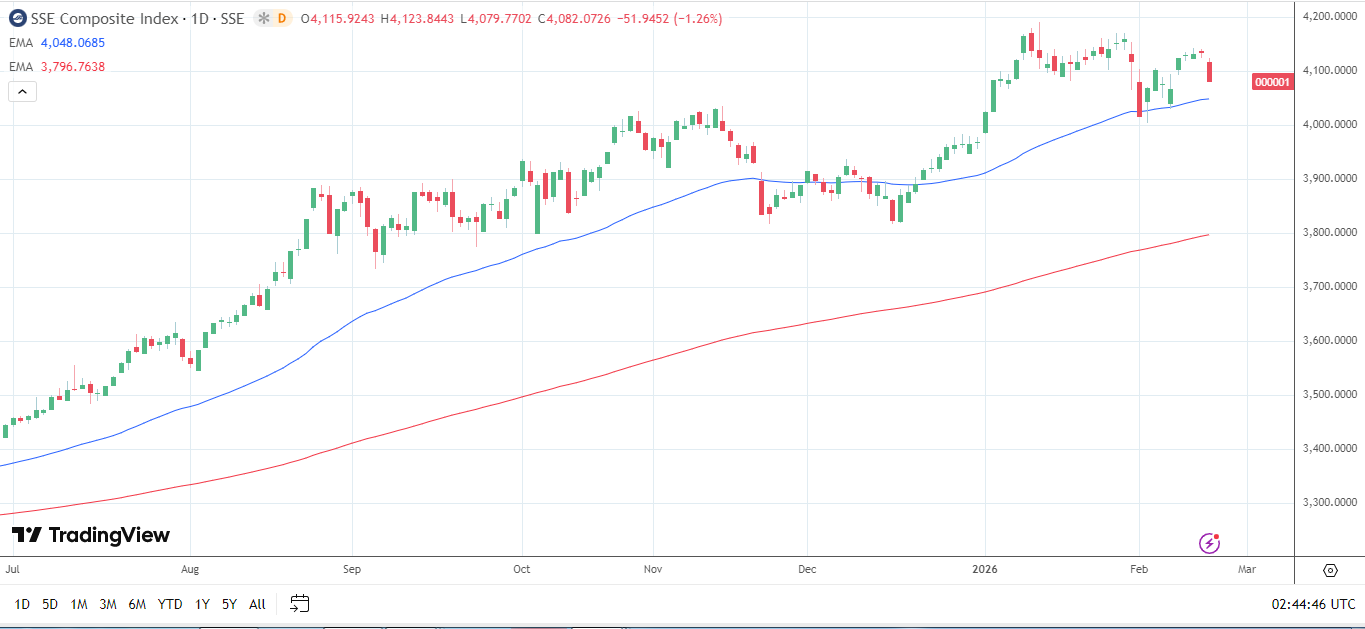
Chart technicals and fundamentals remain aligned in trading on Tuesday, February 17. Looking at the daily chart, the SSE Composite Index trades above its 50-day and 200-day EMAs. The EMA positions indicate a bullish bias.
A break above last week’s high of 4,143 would bring the January high of 4,191 into play. A sustained move through 4,191 would pave the way toward the July 2015 high of 4,317. Significantly, holding above the 50-day EMA reaffirms the bullish trend.
Hang Seng Index: Bullish Outlook Intact
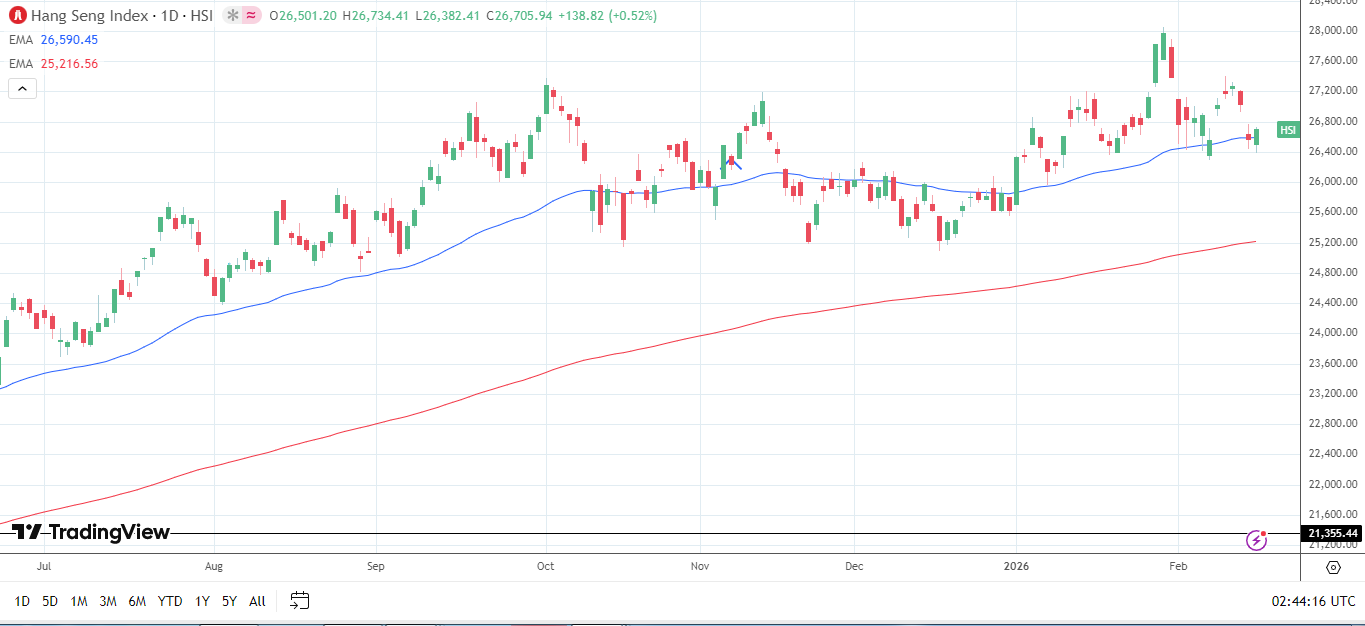
The Hang Seng Index’s outlook aligns with the CSI 300, with the Index trading above its 50-day and 200-day EMAs. The EMA positions indicate bullish momentum, bolstered by favorable fundamentals.
A break above last week’s high of 27,398 would pave the way toward the January high of 28,056. A sustained move through 28,056 would enable the bulls to target 30,000 for the first time since 2021.
Conclusion:
To summarize, the short- and medium-term outlook remains bullish. Beijing’s ongoing policy pledges, rising bets on the People’s Bank of China lowering rates, China’s AI advancements, and strong external demand are tailwinds for Mainland China and Hong Kong-listed stocks.
However, global trade developments, China’s housing market, and consumer price trends remain key for domestic demand. Effective policy measures driving domestic consumption would likely send the SSE Composite Index to its 2015 all-time high of 5,178.
Discover strategies to navigate this week’s market trends here.