Breakout Confirms Strength Near Key Resistance
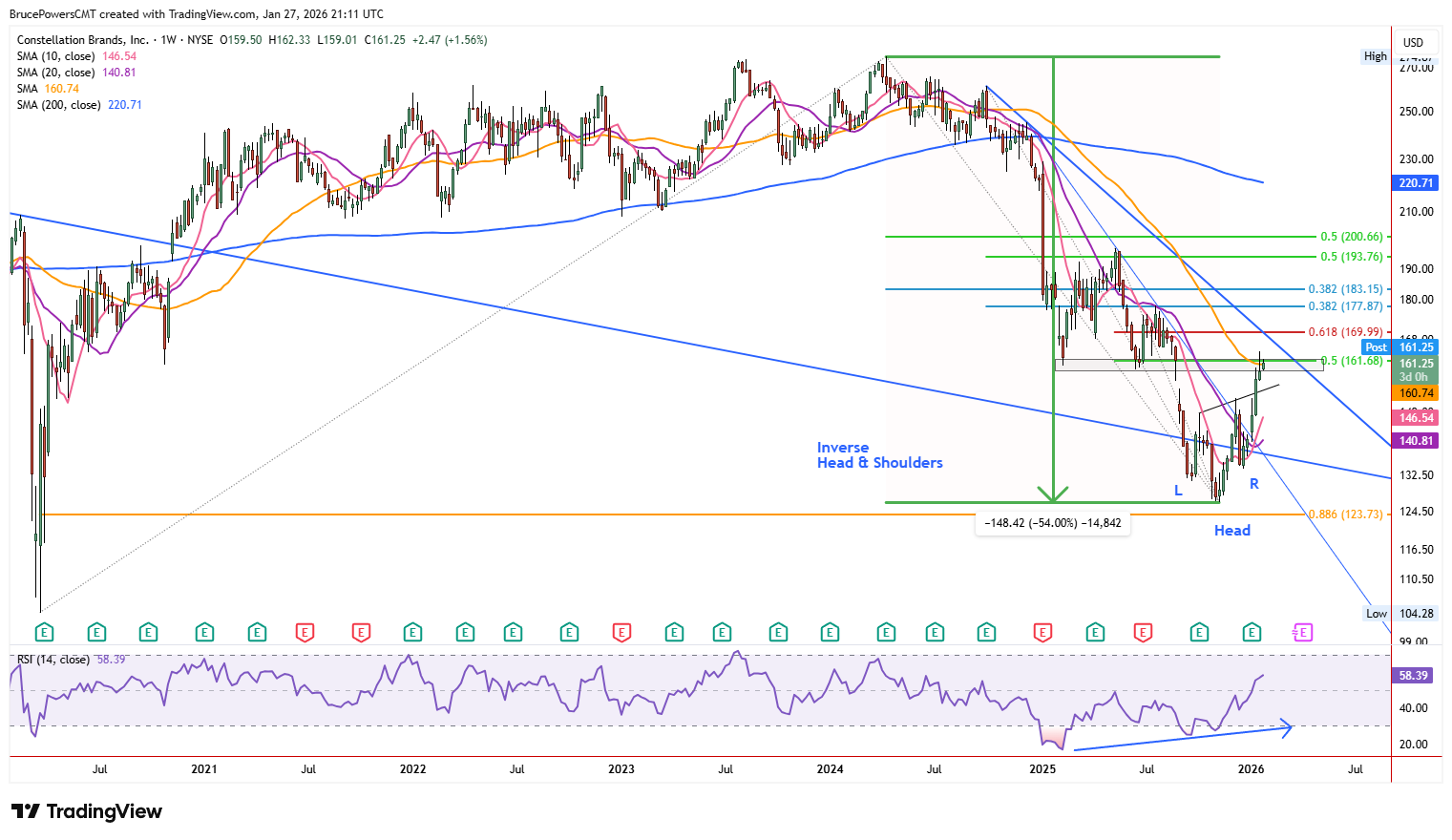
Shares of Constellation Brands, Inc. (STZ) broke out of an inverse head and shoulders reversal pattern early in January and continued to strengthen. The stock subsequently advanced to a high of$164.49, reaching a 50% retracement level at $161.68 and testing resistance at the 50-week moving average, now at $160.72. STZ confirmed strength by reclaiming the 200-day average a week ago, with trading remaining above that average for the six days since and a low of $157.87 for the range.

Holding Above 200-Day Average Signals Bullish Momentum
Holding above the 200-day average confirms underlying strength. The 10-day average crossed above the 200-day, further confirming short-term bullish sentiment. Note that resistance for the advance was also seen near a previous support shelf from the first half of 2025.
Deep Retracement and RSI Divergence Mark Trend Reversal
Prior to the breakout, STZ stock reached an extended bearish retracement of $126.45. That was the lowest price for the stock in almost six years, and it was a little shy of a full 88.6% retracement of the prior advance at $123.73. As the bottom reversal pattern formed, a bullish divergence showed on the relative strength index (RSI), reflecting a slowdown in bearish momentum. That provided added evidence that an upside breakout could be the beginning of an uptrend.
Support Levels Define Pullback Risk
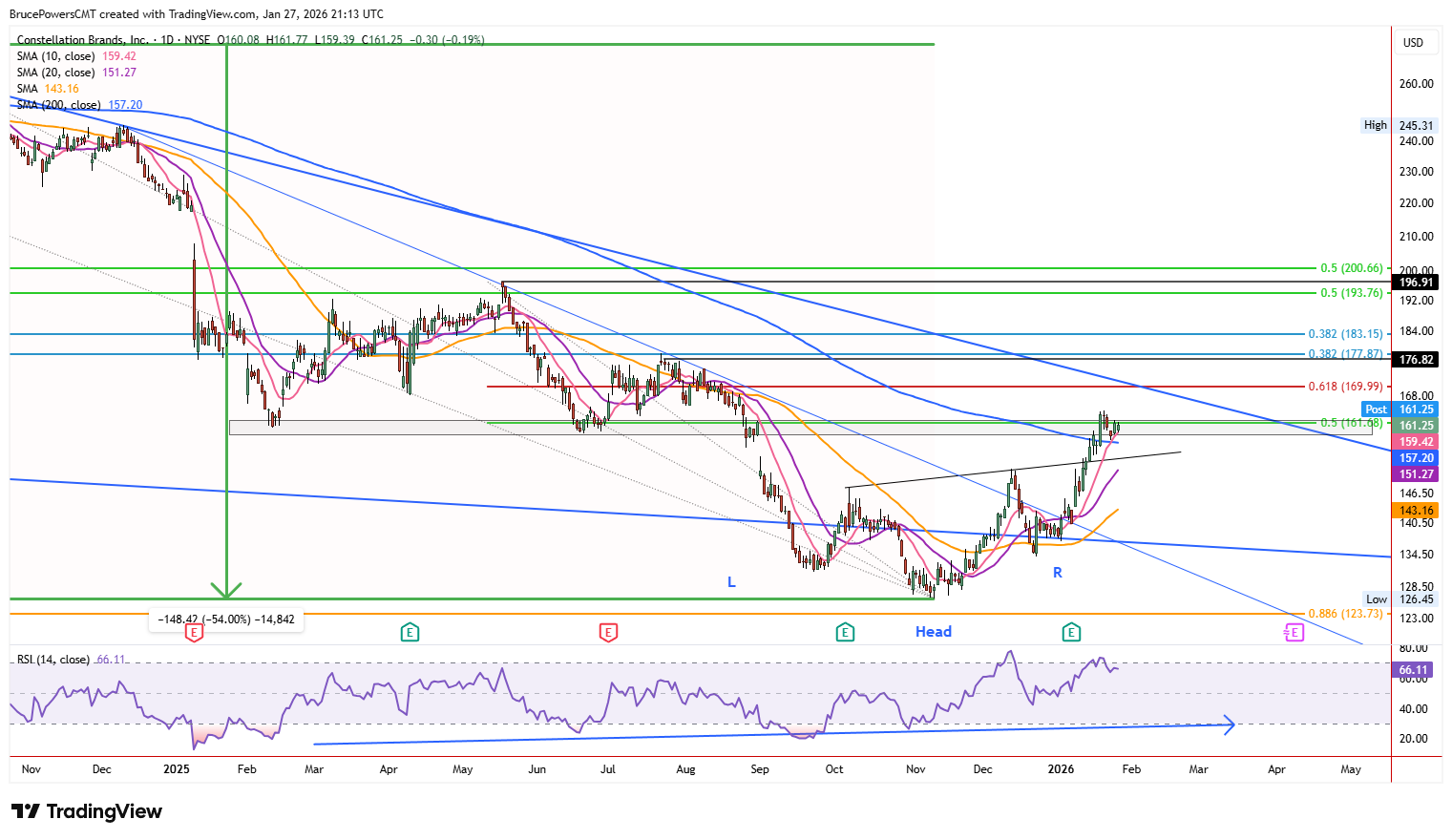
Given resistance near the 50-week average, and a shooting star candle pattern that formed last week, there is a chance that STZ falls to test prior resistance as support before attempting to extend the trend. Weakness triggers below last week’s low of $156.27. The two pivots that form the neckline of the bottoming pattern, at $151.51 and $147.60, provide key potential support levels on a pullback. Those levels should be watched along with the 10-week average at $146.53 and rising. Since the 10-week average has crossed above the 20-week average, it takes on added significance as possible support. In addition, it was successfully tested once on the first pullback following a reclaim of the line in early-December.
Upside Targets Aligned with Fibonacci Resistance
Nonetheless, the reclaim of the 200-day average suggests an eventual continuation of the advance, first towards a downtrend line and then lower swing highs at $178.14 and $196.91. A 61.8% Fibonacci retracement at $170 acts like a proxy for the downtrend line. If the $164.49 high is exceeded, the $178.14 level becomes a target. That price zone is confirmed by a 38.6% Fibonacci retracement of an internal downswing. The higher target is also marked by a 50% retracement of the same measure at $193.76.
If you’d like to know more about chart patterns and how to trade them, please visit our educational area.