
US stock futures slide in early trading on Monday, January 19, extending their previous session’s losses.
US President Trump announced a 10% tariff on eight European countries on Saturday, January 17, impacting risk appetite. 10% tariffs were aimed at pressuring European leaders to agree to the US purchasing Greenland. The threat of a full-blown US-EU trade war triggered a flight-to-safety, with the Nikkei 225, the Hang Seng Index, and ASX 200 joining US equity futures in the red.
Despite rising geopolitical tensions, market optimism about AI-linked earnings, hopes for multiple Fed rate cuts, and robust US economic indicators support a bullish medium-term outlook for US stock futures.
Below, I’ll outline the key market drivers, the medium-term outlook, and the key technical levels traders should watch.

US President Trump Hits European Countries with Tariffs
On Saturday, January 17, President Trump announced 10% tariffs on Denmark, Finland, Norway, Sweden, France, Germany, the Netherlands, and the UK. The tariffs will come into effect on February 1, with tariffs rising to 25% on June 1.
Trump announced the tariffs after European leaders pushed back on his attempts to acquire Greenland in the interest of national security, stating:
“We have subsidized Denmark, and all of the Countries of the European Union, and others, for many years by not charging them Tariffs, or any other forms of remuneration. Now, after Centuries, it is time for Denmark to give back — World Peace is at stake! China and Russia want Greenland, and there is not a thing that Denmark can do about it.”
Outlining the potential timeframe for tariffs, Trump added:
“This Tariff will be due and payable until such time as a Deal is reached for the Complete and Total purchase of Greenland.”
European leaders are reportedly preparing a retaliatory response to Trump’s tariffs. The Kobeissi Letter stated:
“The next 48 hours are critical: With the EU’s emergency meeting scheduled for tomorrow we are no on step #4 of our tariff playbook. We expect the EU to take an aggressive, but open approach. They will threaten to cancel the EU-US trade deal, while encouraging President Trump to negotiate. This is exactly the position President Trump aims to achieve.”
The Kobeissi Letter elaborated on the road ahead, adding:
“Ultimately, the road to a trade deal on the Greenland situation will be longer than the recent US-China bout. Why? Because an acquisition of Greenland can’t happen overnight and the EU remains highly opposed to even the idea of such a transaction.”
Crucially, tariff developments will be key for the cautiously bullish short-term and positive medium-term outlook for US stock futures.
Dow Jones Price Forecast
Every new Dow Jones analysis as it publishes, today's technical signal and key levels, live price — on one page.
See all Dow Jones forecastsChinese Economic Data Send Mixed Signals
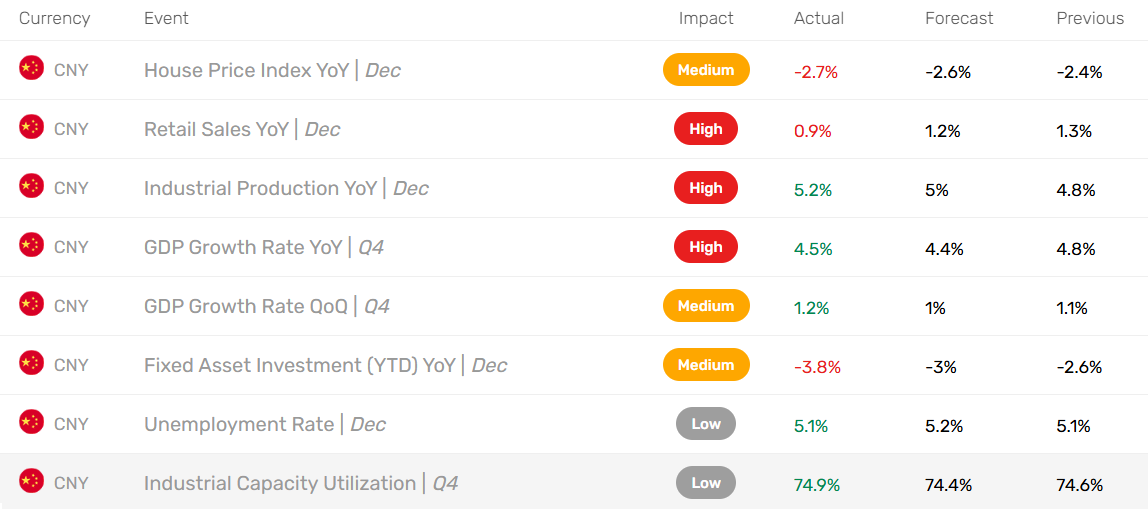
While risk assets faced a tariff shock, Chinese economic indicators also weighed on sentiment. A sharper fall in house prices, waning retail sales, and a marked drop in fixed asset investments suggested a loss of economic momentum going into 2026. Crucially, the housing market crisis and waning private consumption could derail Beijing’s push to boost domestic demand.
Meanwhile, industrial production rose amid growing external demand, countering weaker domestic consumption. China’s economy expanded 1.2% quarter-on-quarter in Q4, up from 1.1% in the previous quarter. Despite the quarterly uptick, the economy grew 4.5% year-on-year in Q4, down from 4.8% in the third quarter. The mixed numbers left US equity futures under pressure in morning trading.
Alicia Garcia Herrero, Natixis Asia Chief Economist, recently commented on China’s domestic woes amid weakening credit demand, stating:
“China’s dual economy continues: December export data shows that China will continue to grow out of external demand, as much or even more than in 2025. Today’s loan data is the worst on record. The Chinese economy has no demand for credit (this is even worse if you focus on private credit). Imagine how weak domestic demand must be. I just returned from Shanghai, and this lack of demand is apparent everywhere.”
Key Technical Levels for Dow Jones, Nasdaq 100, and S&P 500
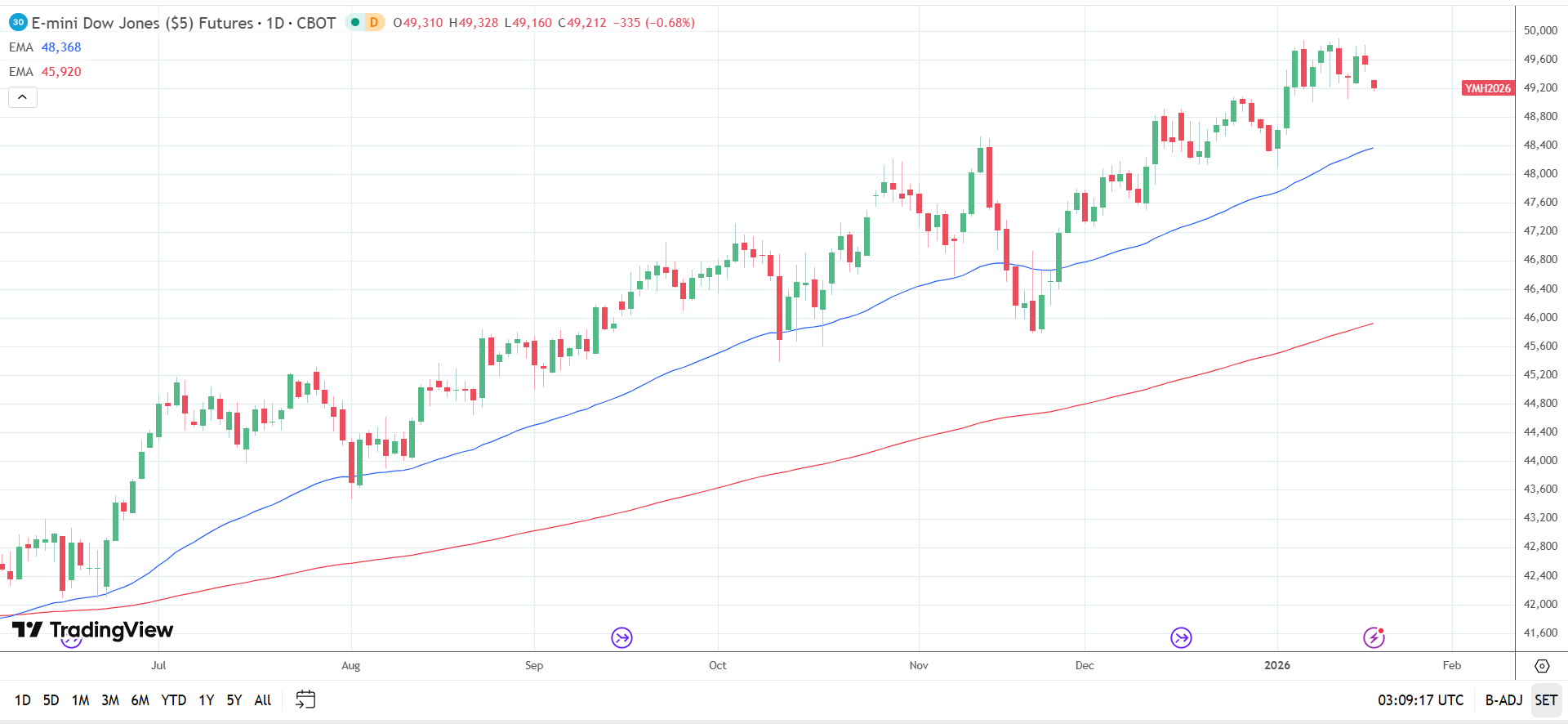
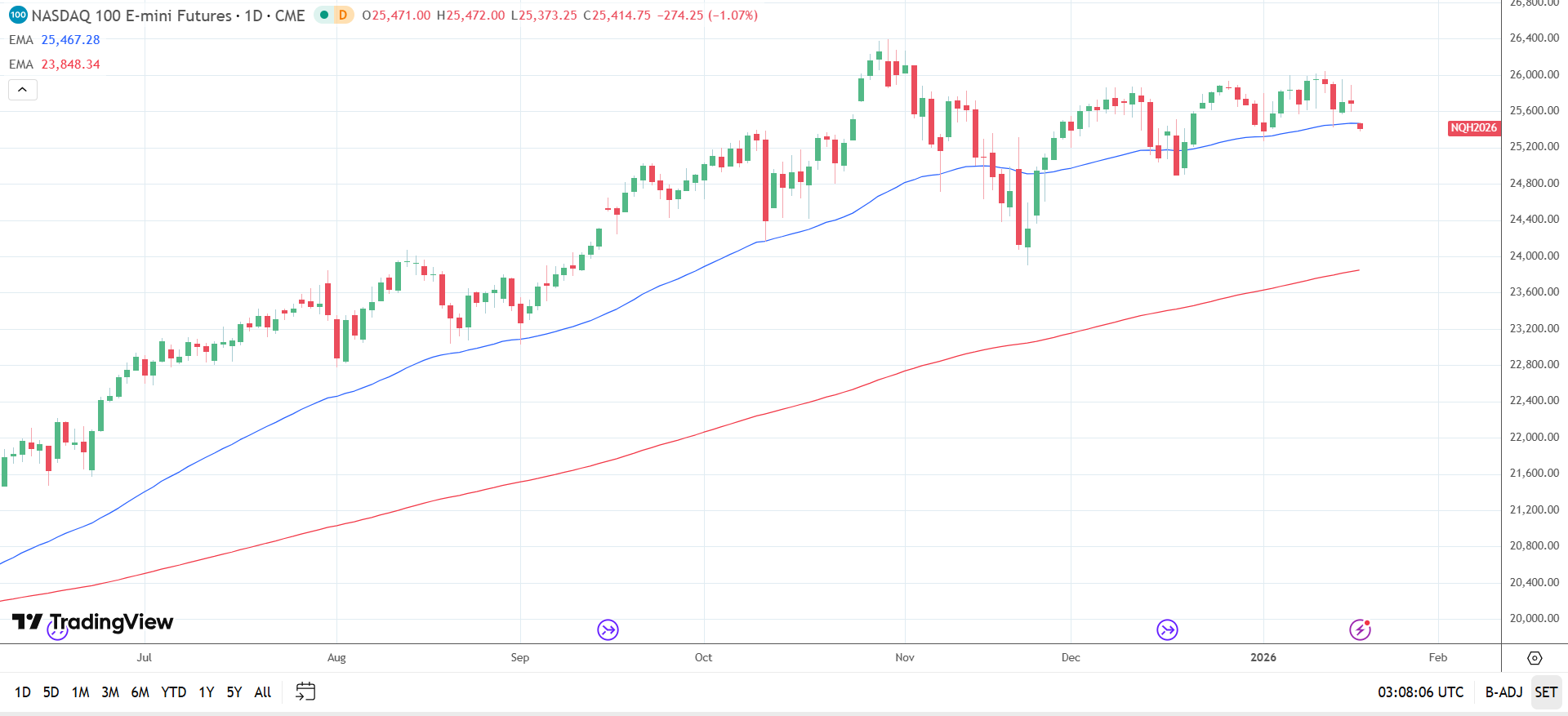
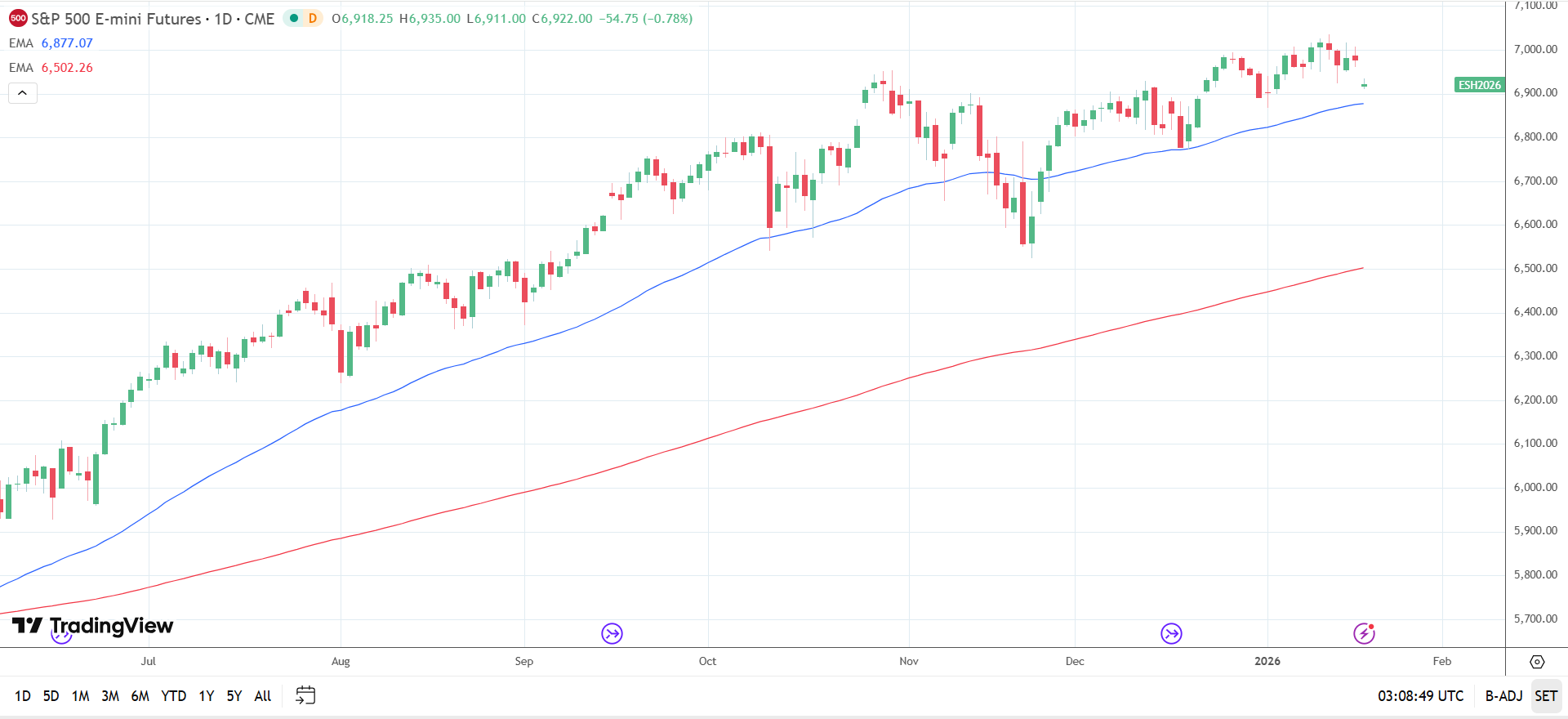
Following the morning losses, the Dow Jones E-mini and the S&P 500 E-mini traded above their 50-day and 200-day EMAs. The EMAs signaled bullish momentum, aligning with positive fundamentals. However, the Nasdaq 100 E-mini fell below its 50-day EMA, indicating a bearish near-term bias.
Near-term trends will hinge on trade developments, corporate earnings, US economic indicators, and the Fed’s rate path. Key levels to monitor include:
Dow Jones
- Resistance: the January 13 record high of 49,901, and then 50,000.
- Support: 49,000 followed by the 50-day EMA (48,368).
Nasdaq 100
- Resistance: the 50-day EMA (25,467), 26,000, followed by the October 30 record high of 26,399.
- Support: 25,000 and then 24,500.
S&P 500
- Resistance: the January 13 high of 7,036, followed by 7,500.
- Support: the 50-day EMA (6,877) and then 6,500.
US Stock Futures Outlook: Fed Rate Cut Hopes and Earnings Keep Bullish Bias
In my opinion, the short-term price outlook remains cautiously bullish. Market optimism about upcoming earnings and bets on an H1 2026 Fed rate cut affirm the positive outlook. These fundamentals align with constructive technicals for the Dow and S&P 500, while countering the bearish near-term technicals for the Nasdaq.
However, several scenarios would derail the bullish medium-term outlook, including:
- An escalation in EU-US tensions, leading to the end of the 2025 trade deal and retaliatory measures.
- The Bank of Japan declares a hawkish neutral interest rate (potentially 1.5%-2.5%). A narrower US-Japan rate differential may trigger a yen carry trade unwind, mirroring events in mid-2024, derailing the short-term outlook.
- Strong US economic data and hawkish Fed chatter would dampen expectations of multiple Fed rate cuts.
- Corporate earnings and outlooks disappoint.
- If the US Supreme Court rules tariffs illegal, it will likely raise concerns over US policy and debt.
Conclusion: Cautiously Bullish Bias
In summary, a strong US economy, a dovish Fed policy stance, earnings optimism, and a less hawkish BoJ support a cautiously positive short-term and a bullish medium-term outlook for US stock futures.
Nevertheless, traders should monitor trade developments. Retaliatory measures from the EU and a counter-response from the US would fuel risk aversion.
However, hopes of the EU and the US reaching a compromise on Greenland will likely limit the downside. US stock futures are likely to retarget new highs if trade tensions ease, with earnings and the Fed the key drivers.
Follow our live coverage and consult the economic calendar for real-time market updates.