
Ethereum (ETH) has gone up by nearly 12% in the past 30 days, and seems to be playing catch-up with Bitcoin (BTC), as cryptos continue to recover.
The top altcoin once again hit $2,400 this week, as cryptos rallied following President Donald Trump’s series of threats against Iran.
Peace talks have been relatively stalled, but market participants don’t seem to be deterred by this situation, as interest in cryptos has been increasing.

Ethereum Transactions Hit New All-Time High
Looking at on-chain data, network usage levels hit a new all-time high last week, as the Ethereum blockchain processed 21.8 million transactions.
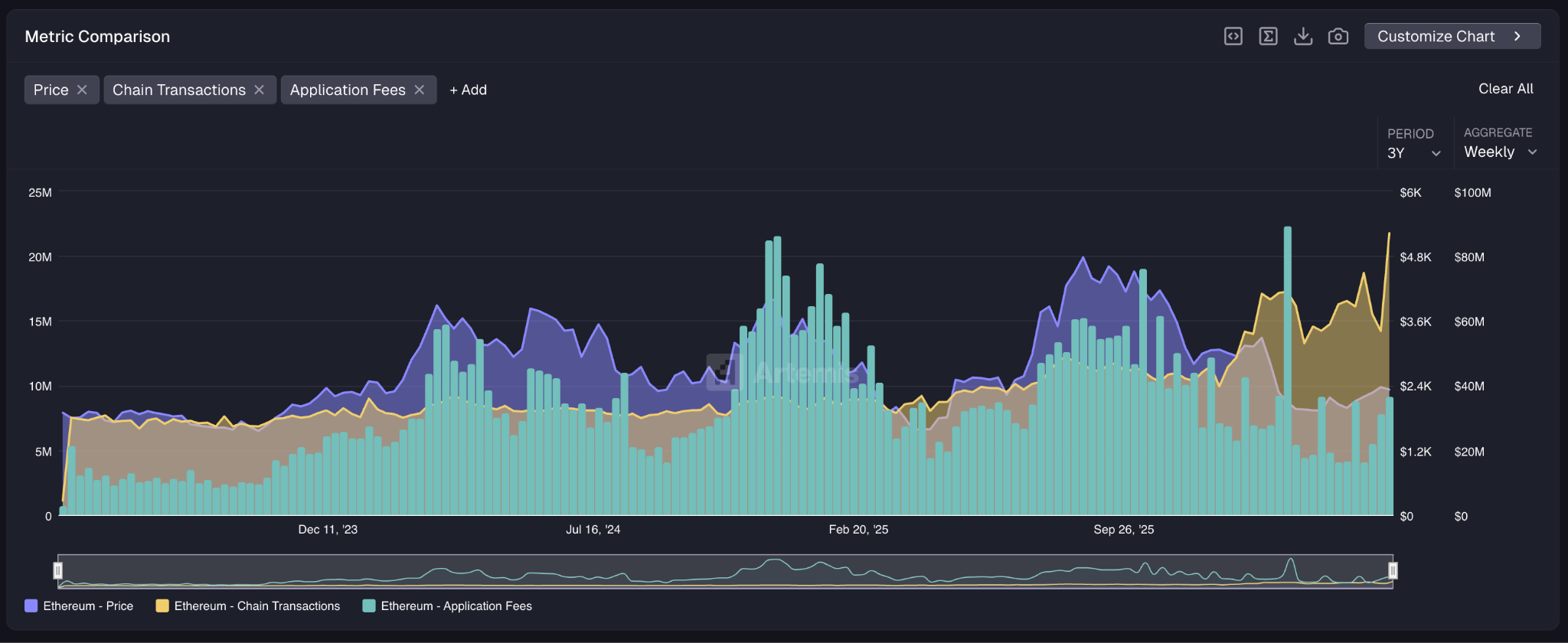
This meant a 54% increase compared to the previous week, and was accompanied by a steady increase in application fees.
Where these higher volumes are coming from is not entirely clear, as it is definitely not the result of a spike in transactions among decentralized exchanges (DEX). According to data from DeFi Llama, DEX volumes are actually dropping.
Last week, they finished at $8 billion. This was the lowest level on record since April 2025, back when Ethereum hit its cycle bottom of $1,400.
That said, application fees have increased, rising by 65% in the past three weeks to hit $37 million. It could be that investors are coming back to the DeFi segment and using platforms like Aave and Lido once again.
Ethereum Price Forecast
Every new Ethereum analysis as it publishes, today's technical signal and key levels, live price — on one page.
See all Ethereum forecasts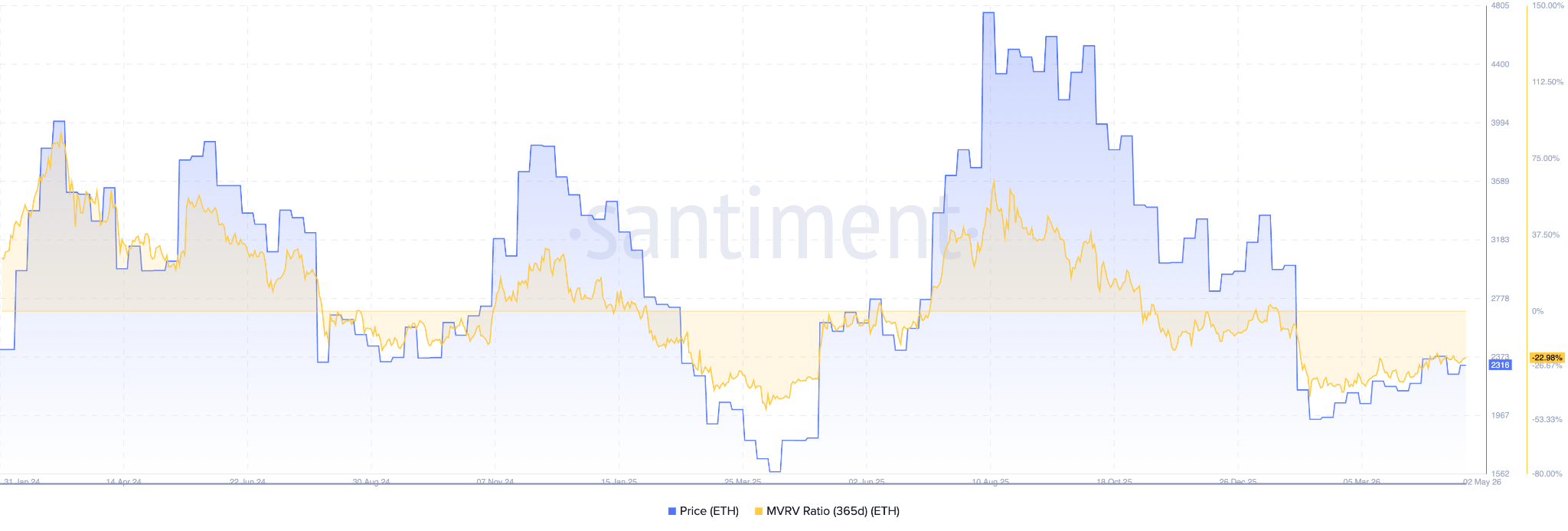
Meanwhile, market sentiment has remained in neutral territory. The Fear and Greed Index sits at 50, indicating persistent caution among investors. Some degree of skepticism still prevails despite the latest rally.
We have been tracking for weeks the evolution of a key on-chain metric called the MVRV Ratio (365 days) and have seen it evolve positively in the past few weeks. Although the improvement has been relatively mild, the metric’s steady increase could be an early signal of an imminent trend reversal.
The MVRV Ratio tracks the relationship between the market value and the realized value of all ETH tokens. The latter is the result of multiplying each ETH token in circulation by the price at which it was bought.
Historically, the MVRV Ratio has been a great tool to predict the end of bear markets. When the metric rises past the zero line, that tends to mark the beginning of ETH’s next leg up.
Right now, this metric rose from a cycle low of -42% to -23% at the time of writing. In previous cycles, we have seen that these strong upticks in the MVRV tend to confirm that the price has already hit bottom.
Weekly Chart Sends Buy Signal with 200% Upside Potential
In Ethereum’s case, that bottom could have been the $1,800 level. An improvement in market sentiment, paired with positive ETF inflows, and a break above a key level like the $2,150 resistance, provides further evidence that the price trend has changed direction.
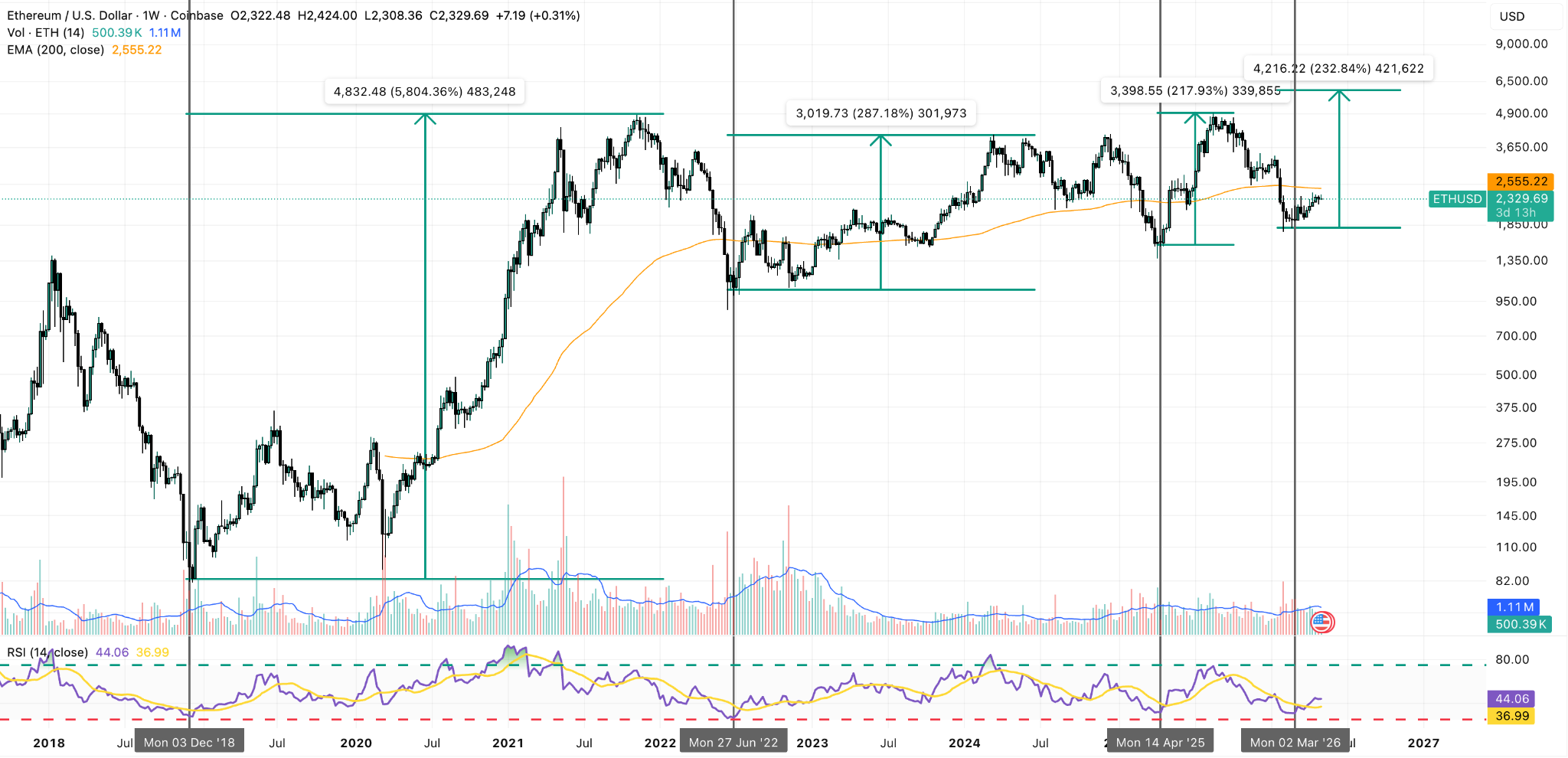
Same as BTC, Ethereum recently sent a buy signal in the weekly chart that has historically yielded some attractive returns.
Whenever the Relative Strength Index (RSI) has hit levels below 30 in the weekly chart, the price has started to recover, producing gains ranging from 218% to 5,800% in the last three cycles.
This momentum indicator sent a definite buy signal upon climbing above the 14-week moving average. Although the price has retested its previous lows in two out of the three past occasions, it has always bounced back to keep rallying.
Hence, late buyers may get another chance to buy ETH below $2,000 in the near term if this behavior repeats. We expect this buy signal to produce returns beyond 200%. That means we could see ETH rising past $5,000 during the next bull market.
ETH Needs to Break Past $2,600 to Reverse Its Downtrend
The daily chart shows that the $2,400 is currently the key level to overcome, as sellers continue to be in control of that area. Trading volumes have spiked whenever the price hits that mark, indicating strong selling pressure.
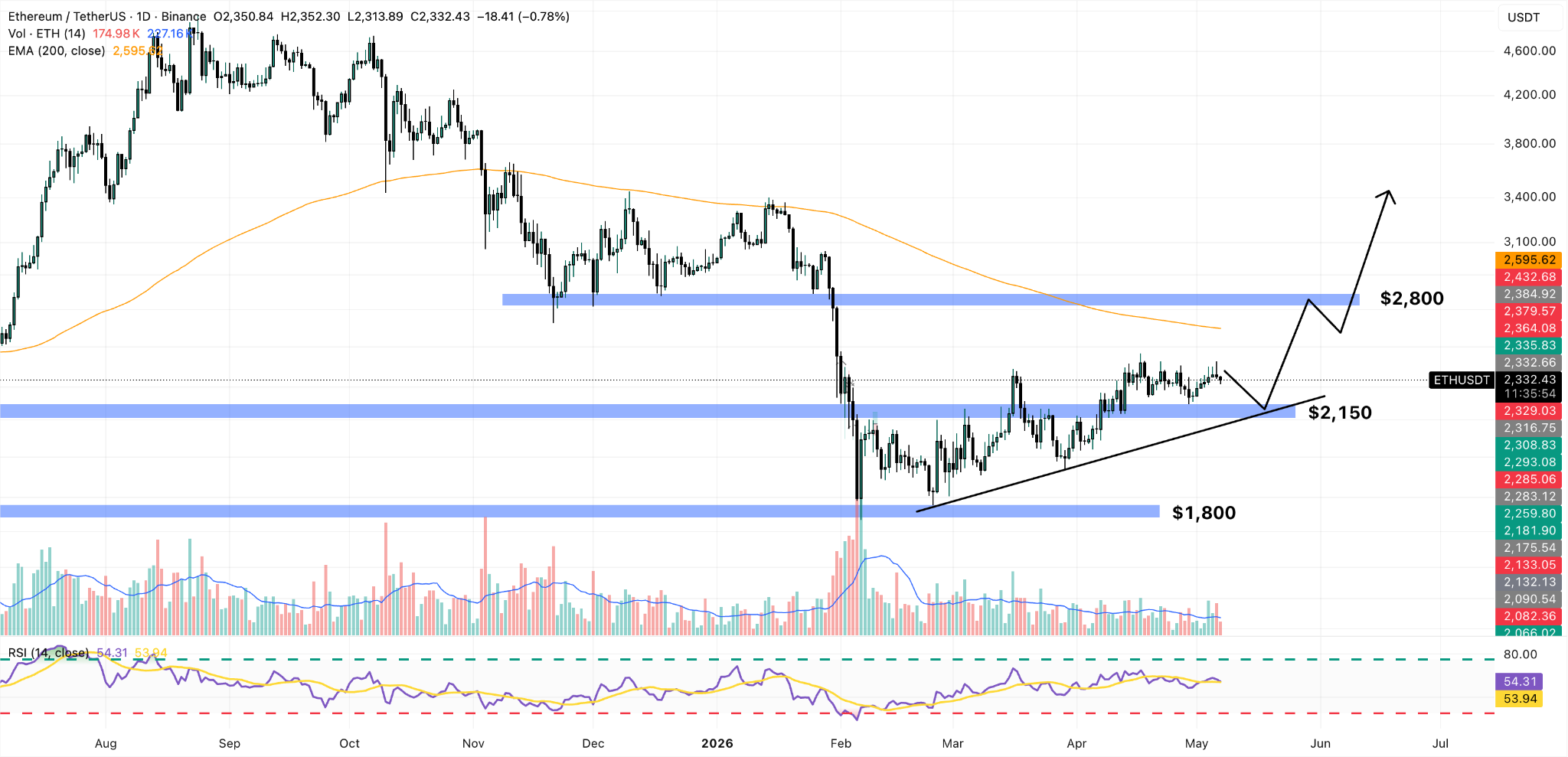
Hence, we need a clean breakout above this level in the next few days to put ETH on track to hit $2,800. The latter would be our first target for what could still qualify as a “bear market rally.”
Nonetheless, we are getting close to the 200-day exponential moving average (EMA). This is a key line that tends to be followed by market participants. When the price rises above this level, it usually means that the price trend has turned bullish.
For Ethereum, that line sits at $2,600 right now. Hence, a move above it, plus a breakout of the $2,800 resistance, could put ETH on track to retest other psychological thresholds like $3,000.
Interestingly, the $3K area has been a strong “decisional” level for the market in past instances. When the price breaks past that mark, it usually signals the beginning of a strong rally to new highs.
The opposite has also been true during downtrends, as trading volumes have spiked whenever ETH drops below $3K. Moreover, in this lower time frame, the RSI currently sits at 54. This means that momentum favors a bullish outlook. However, the oscillator needs to climb above 60 to confirm a buy signal.
Break Above $2,400 Could Unleash Explosive Rally for ETH
Heading down to the 4-hour chart, we can see the strength of the $2,400 sell wall. ETH has retreated five times now after hitting that mark. It is highly likely that a break above this level could set off a dramatic short squeeze that could propel ETH to $2,800 rapidly.
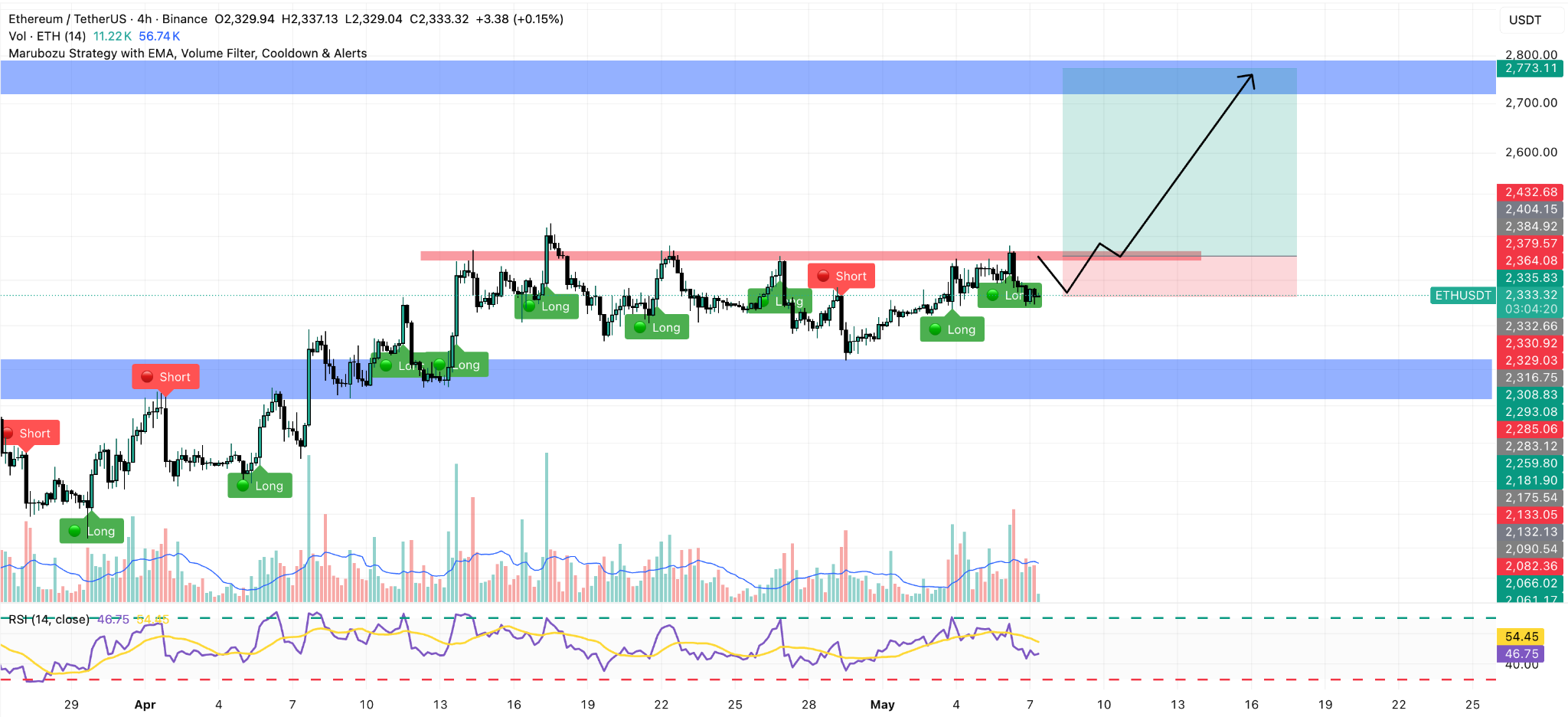
A total of 6 buy signals have popped up below $2,400. This is clear evidence of ongoing accumulation.
Our signals system picks up specific candle patterns that are accompanied by above-average trading volumes. Whales are clearly buying, institutions are accumulating, momentum has turned positive, and sentiment is improving. A breakout at this point seems imminent.
Hence, we see this is an interesting opportunity for a long position if that breakout occurs. The entry, in this case, should be right after the breakout, as an explosive rally seems highly likely if that break above $2,400 happens.
Such a position would offer a 5x risk-reward with a stop loss at around $2,330 and a target at $2,800.