
EUR/USD shows subdued price action in the early day on Monday which is attributed to the Easter Monday holiday. However, volatility has generally slowed and there is a reason to believe this trend may continue.
There was a sharp rise in volatility in late February as the Coronavirus threat started to accelerate. Average weekly price movements rose significantly from that point forward although last week was the first time since late February that the weekly price change was somewhat in line with the prior average.
Granted, the markets have become a bit more optimistic as central banks and governments around the world have stepped up to provide significant easing packages. The aim is to help offset the negative economic of the virus as much as they can. This optimism is best seen in the equity markets.
In the currency markets, that means there is no longer panicked buying of the dollar.
Since late February, there have been two predominant drivers for the EUR/USD exchange rate. The first was a short-covering of euros as the currency is often used to fund more risky trades. This lasted for about two weeks. From there, out of fear, investors started stockpiling the dollar, which drove the exchange rate towards three-year lows.
At this point, there is no longer a driver with the same sense of urgency, and this should translate into a further decline in volatility that favors a range over the foreseeable near-term.
Technical Analysis
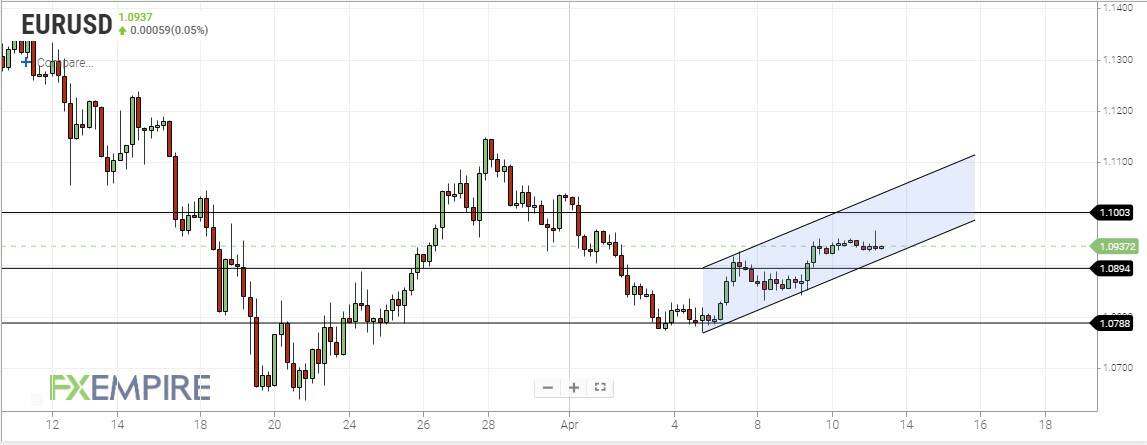
In line with the view of a range, EUR/USD stands to continue trading sideways in the session ahead. This holds especially true because of the Easter Monday holiday.
Near-term support is seen from the lower bound of a rising trend channel although stronger support comes from a horizontal level at 1.0894.
To the upside, resistance remains at 1.1000 which has generally been a respected level over several months now.
Bottom Line
- A range appears likely in the session ahead due to the Easter Monday holiday. Traders will likely look to fade any extreme moves.
- A further decline in volatility appears plausible as the initial shock the markets from the Coronvirus continues to fade.