Beijing: Pleasantries on the Surface, but Chips Are on the Table
Kicking this off in China, President Trump touched down in Beijing to a red-carpet welcome. Watching President Xi Jinping and Trump exchange opening pleasantries, I was struck by the warmth – genuine or performative – between two leaders who spent much of last year trying to strangle each other economically with tariffs.
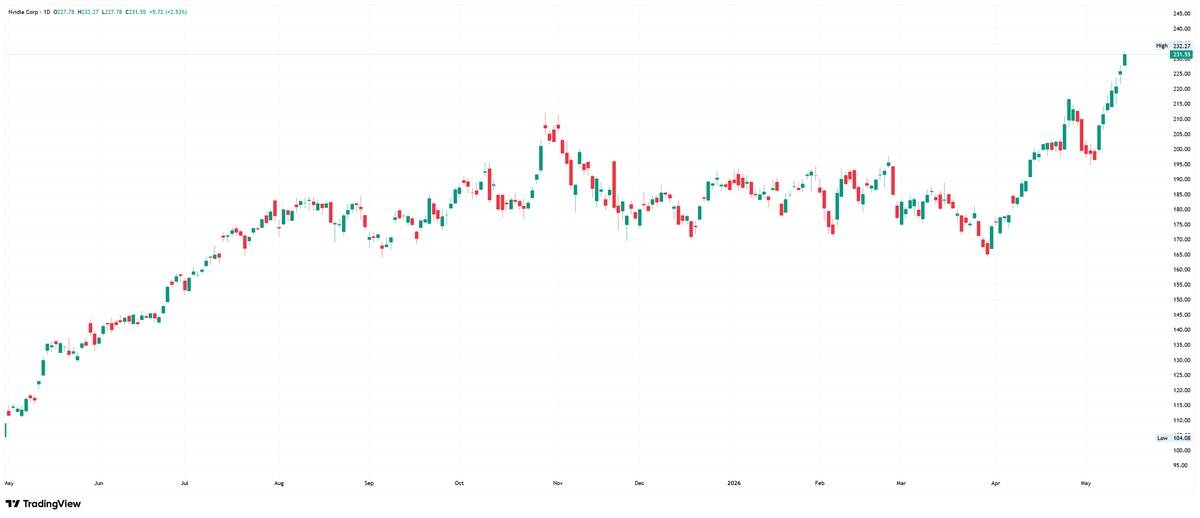
The offshore yuan (CNH) has strengthened considerably over the last week or so, Chinese tech is surging, and Alibaba is up sharply after signaling it expects its AI revenue to triple by year-end. It is hard to ignore that Nvidia‘s CEO, Jensen Huang, joining Trump on Air Force One sent the chip ecosystem into overdrive, with semiconductors and AI very much on the negotiating table. Whether Beijing ultimately allows those advanced chips through its own doors remains the defining question.
Warsh Confirmed, but the Real Test Awaits
Stateside, Kevin Warsh is now officially the Fed Chair; he was confirmed by the Senate in the narrowest margin in the institution’s history – 54 to 45. However, Trump wants immediate policy easing, but Warsh has explicitly pledged Fed independence. Time will tell, as I do not see how the two are compatible, and the fixed-income space is showing this.
US Treasury yields have largely been rising across the curve since March, but remain within well-established historical ranges. What we actually have is a market in a genuine wait-and-see posture – collectively watching Warsh, Beijing, and Iran – and investors refusing to commit directionally until they get more clarity.
PPI Inflation Hotter Than Expected
The inflation backdrop gives Warsh precious little room. Yesterday’s April US PPI data was HOT. Both the YY headline and core measures comfortably beat top estimates, rising by 6.0% and 5.2%, respectively. You must go back to late 2022 to find a larger headline increase. Unsurprisingly, more than 40% of the goods component was attributed to gasoline, while 60% of the rise was credited to a 1.2% increase in services. This well and truly cements the Fed’s wait-and-see stance – markets are now pricing in just 8 bps of tightening, down from 12 bps a day ago.
While this follows a relatively hot US CPI print – which also saw headline and core rise YY at 3.8% and 2.8%, respectively – the market’s response was lacklustre. Equities shrugged off the data and hit records; the S&P 500 rallied 0.6% to 7,444, and the Nasdaq 100 added 1.0% to 29,366, while the Dow slipped 0.1% to 49,693. While the rally in stocks is concentrated, equities are currently being bolstered by earnings and AI. In other markets, the stronger PPI reading drove yields higher yesterday, and the USD index saw a modest bid.
UK Politics: Leadership Challenge Nearing
Crossing the Atlantic, the UK offers its own spectacle this morning. While we did have UK GDP numbers land earlier this morning and – except for the Q1 26 print – came in stronger than expected across the board, this provided a momentary distraction from the political implosion unfolding inside Downing Street.
I am sure you have seen the news that Angela Rayner – the former deputy PM – has ‘conveniently’ been cleared by HMRC of deliberate wrongdoing in her tax affairs. This ‘conveniently’ allows her to challenge PM Keir Starmer for the party leadership. Health Secretary Wes Streeting is also reportedly days away from resigning to launch his own bid. I feel that markets view Streeting as the fiscally credible option, with Rayner, with her more leftward instincts, is seen as more uncertain and gilt-unfriendly. Much like Warsh, time will tell how this all plays out!
Written by FP Markets Chief Market Analyst, Aaron Hill