Oil prices turn positive on Thursday as the market waits for the Trump-Xi meeting in Beijing. Brent crude oil trades at around $107 while WTI oil trades at around $101. The small bounce was after both indexes lost ground on Wednesday amid concerns about the potential interest rate increases by the Federal Reserve. A hike in interest rates may dampen demand expectations due to the contraction of economic activity and appreciation of the U.S. dollar. The Iran war was helping to keep oil prices high due to supply concerns.
The main problem in the oil sector is the Strait of Hormuz. The delay in reopening the Strait could help to sustain the crude price rally and the fear of supply. If Trump does not secure China’s assistance to help defuse conflict with Iran, the US might have limited options. This may fuel the prospect of new war and a high geopolitical price for oil. Iran’s increased influence over the strait also bucks the pressure as the strait remains vital to international oil and LNG trade.
China’s role is important because it is the largest importer of Iranian oil despite U.S. sanctions. As per reports, over 80% of Iran’s exported oil in 2025 was shipped to China where independent Chinese refiners purchased discounted barrels. This will add some leverage for Beijing but also complicate the talks.
A success in the meeting between Trump and Xi could help to defuse risk premiums and calm down crude futures. But if the meeting fails to make any headway with Iran and the Strait of Hormuz, both Brent and WTI could remain at their current levels or climb ever higher as traders factor in additional supply disruption concerns.

Brent Technical Analysis: Double Bottom Breakout Points Higher Prices
The long-term outlook for Brent crude oil remains constructive as the price has formed a double bottom pattern using the lows of April 2025 and December 2025 at $58.69 and $58.98, respectively.
The breakout above $72 has initiated surge in crude oil prices towards the $120 area in March 2026. The strong monthly candle in March and the positive candle in April indicate that prices in May will likely remain higher and push towards the $127 to $135 level in the next few weeks.
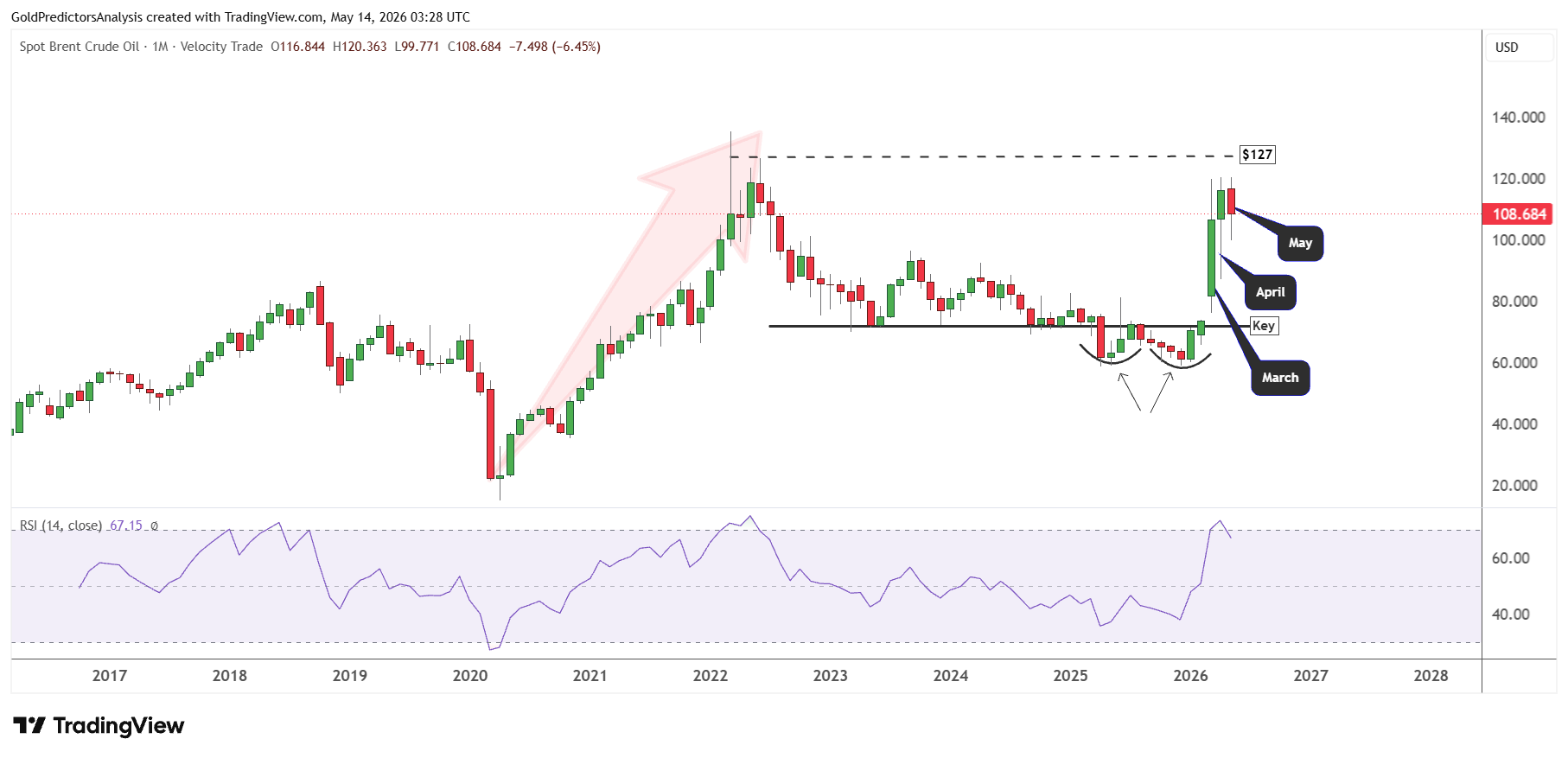
On the other hand, the formation of a shadow in April’s monthly candle also supports the bullish action in Brent crude oil.
The weekly chart for Brent crude oil also shows sharp shadows on the weekly candles. These shadows suggest a positive trend above $100. This positive momentum in Brent crude oil suggests a push towards the grey highlighted region.
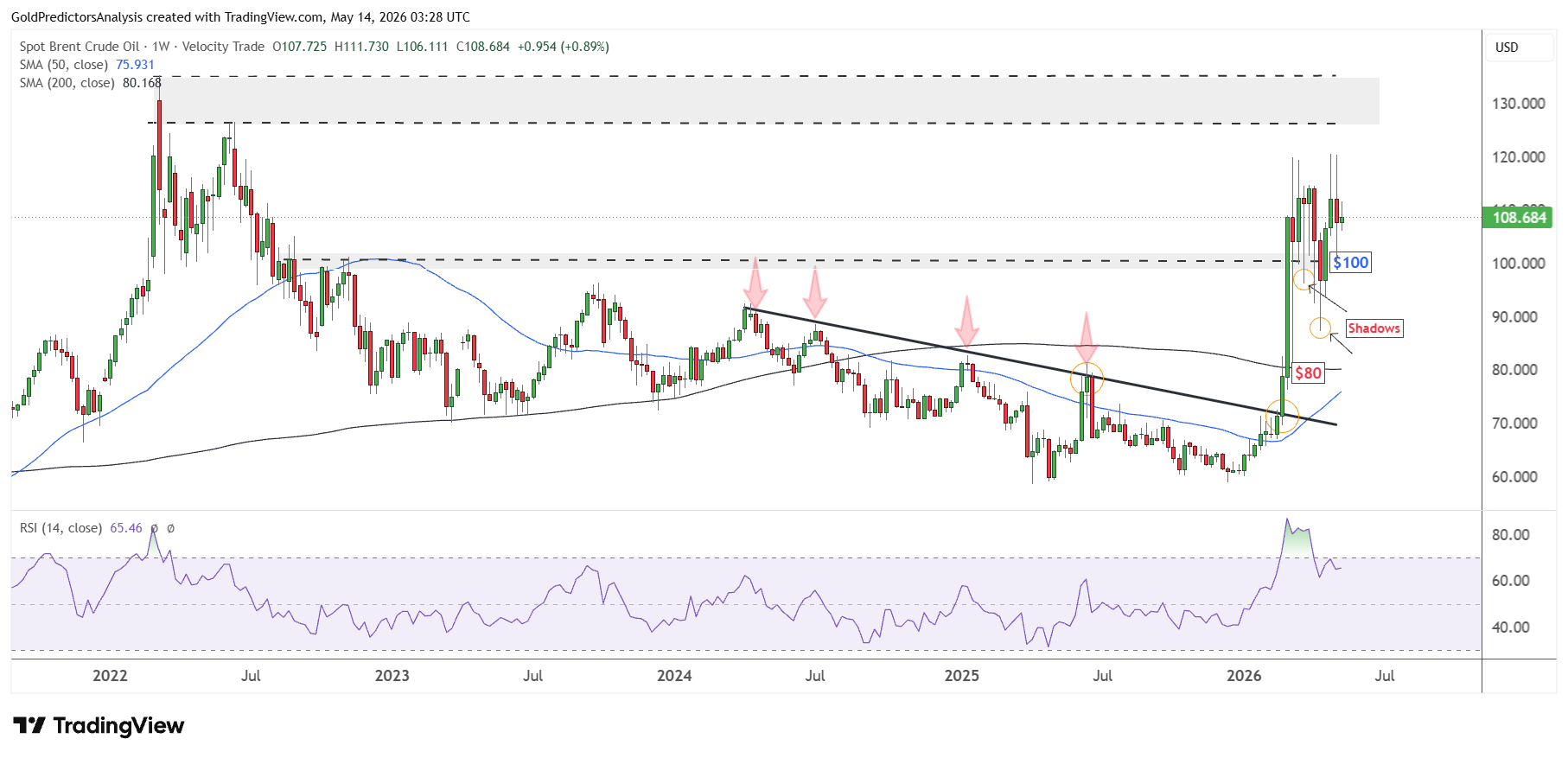
The strong volatility below $120 in Brent crude oil, despite the strong supply concerns, is due to the technical overbought conditions on the chart as seen by the RSI. However, prices are now stabilizing between $80 and $90 which indicates positive momentum.
Brent Oil Price Forecast
Every new Brent Oil analysis as it publishes, today's technical signal and key levels, live price — on one page.
See all Brent Oil forecastsWTI Technical Analysis: Triangle Breakout Could Target $120
The WTI crude oil market also shows strong bullish momentum by consolidating between $80 and $120. This consolidation within the broad range is also contracted within the triangle pattern from the high of April 7, 2026 towards the lows of April 17, 2026.
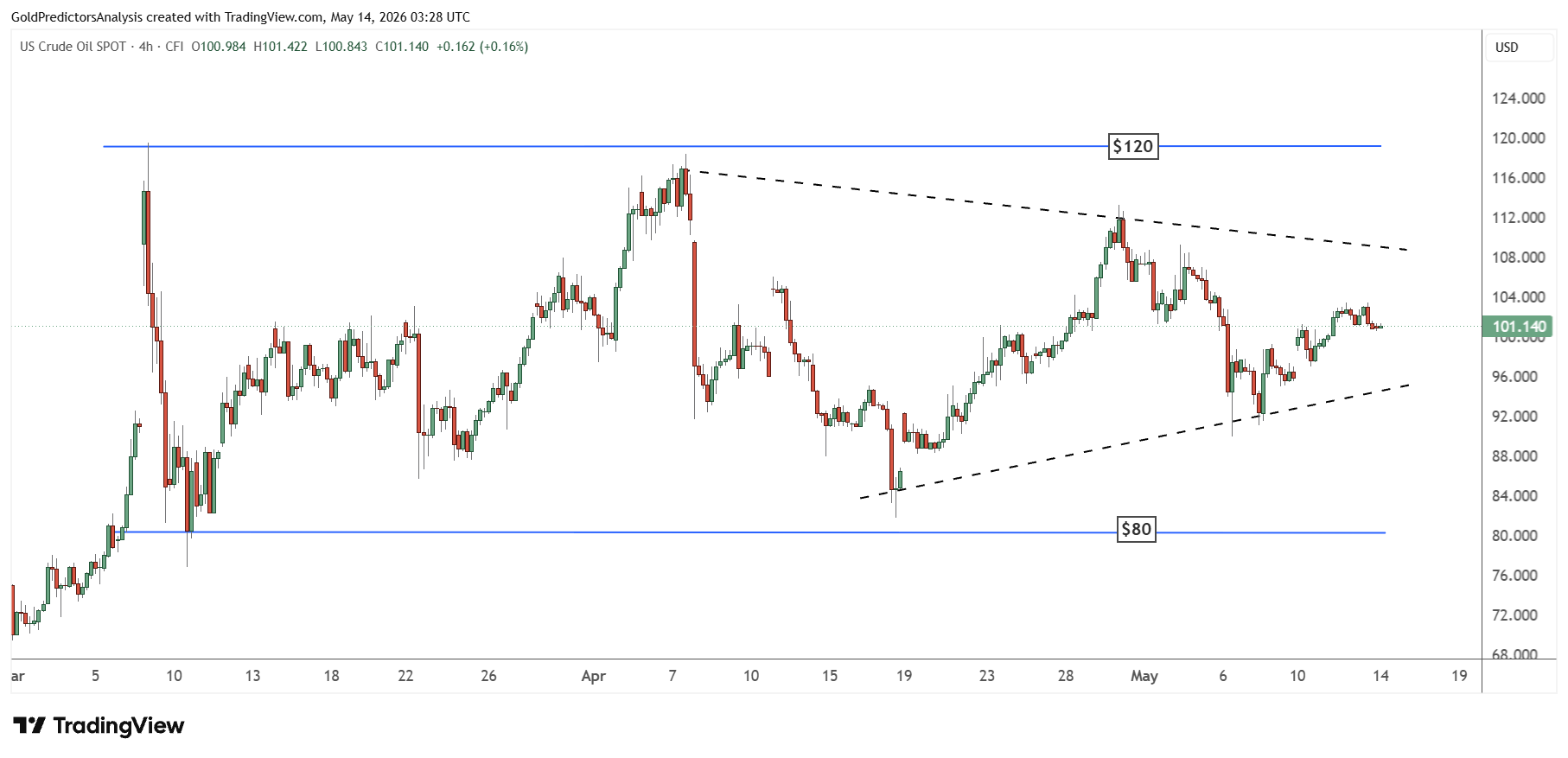
This means that if prices break above $110, they will break the triangle pattern and trigger a move towards $120. But a break above $120 will likely break the price compression zone and initiate a strong surge in the WTI market. However, a break below $95 will likely push WTI crude oil prices towards $80 in the short term.
As long as prices remain between $80 and $120, the next direction in WTI remains uncertain.
Bottom Line
Oil prices are benefiting from the Iran war, the Strait of Hormuz risk and the uncertainty about the Trump-Xi meeting. A positive outcome of the talks would help to ease the geopolitical premium and ease the prices of both Brent and WTI. But if the Strait of Hormuz remains closed, crude prices could continue to rise and keep supply worries high.
From a technical perspective, Brent is still in positive territory above $100 and looks for further rally to $127–$135 if the geopolitical tensions worsen. On the other hand, the WTI is stuck between $80 and $120. But a break above $110 in WTI will initiate a move towards $120. Any price break below $95 in WTI could turn the short-term picture negative and could set the stage for a return to the $80s.
If you’d like to know more about how to trade crude oil, please visit our educational area.