Undoubtedly, headline risk remains elevated, and yesterday was a prime example.
Don’t Believe Everything You Read
You will likely recall that, via a post on X, US Energy Secretary Chris Wright stated that an oil tanker had been safely escorted through the Strait of Hormuz by the US Navy. Evidently, this is positive news, and markets reacted to the headline. One might reasonably expect that Wright would have verified the claim before posting it – but here we are.
The post was subsequently deleted, and in a media briefing, White House press secretary Caroline Levit denied the claim, triggering an unwind of the initial move.
Market Scoreboard
Oil prices have continued to oscillate between gains and losses, though both WTI and Brent are down more than 3% this morning. I think this latest price drop is on the back of WSJ news reporting that the IEA – International Energy Agency – has suggested its largest-ever release of oil reserves.
For key US Stock benchmarks, Tuesday’s session wrapped up largely off best levels; the S&P 500 eased lower by 14 points (0.2%) to 6,781, the Nasdaq 100 shed 10 points (0.04%) to 24,956, and the Dow Jones dipped 34 points (0.1%) to 47,706.
356 Stocks lost ground in the S&P 500 versus 147 to the upside, while GICS sector performance shows only 2 in positive territory and 9 in the red, with energy taking the biggest hit.
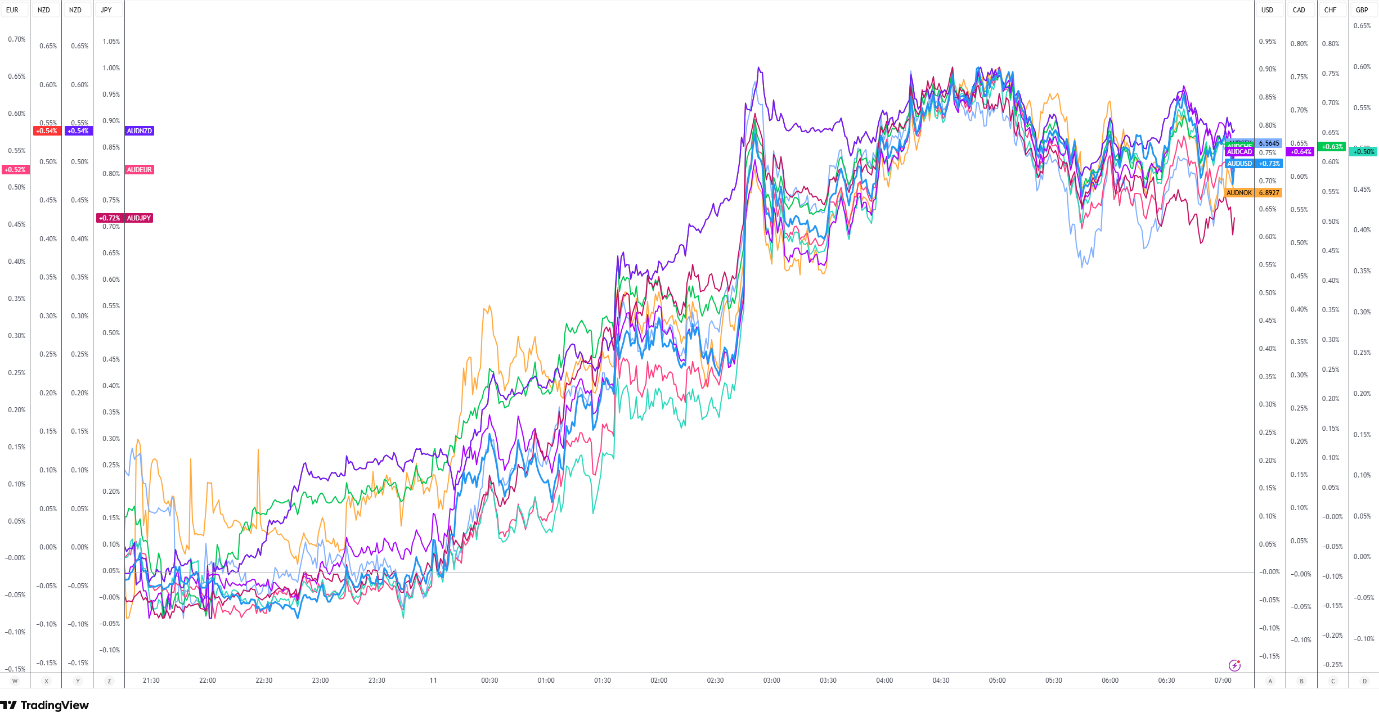
Across FX, although giving up some of its gains, the USD’s strength remains bolstered by a combination of haven demand, the rise in Oil prices, and the dialling back of Fed rate-cut expectations. The AUD also caught a healthy bid in recent trading and remains higher versus G10 peers as of writing (see performance chart below). This strength came on the back of comments from RBA Deputy Governor Andrew Hauser, who noted that rising energy prices pose an upside risk to price pressures and that the economy is strong in many respects. As you would expect, this has prompted a hawkish repricing in money markets, with investors now assigning around a 70% chance of an RBA rate hike next week, up from 62% the previous day and a whopping 35% probability a week ago.
In the fixed-income space, Bonds have also been caught in the crossfire this week. Monday saw US Treasury yields fall across the curve, amid US President Donald Trump’s comments that the war with Iran is nearing its end – a development that would naturally reduce upside inflation risk and bring Fed rate cuts back into view. However, on Tuesday, Bonds sold off and yields rose sharply, driven by an intelligence report suggesting the Strait of Hormuz may have been mined.
US Inflation Data Incoming
The dominant macro driver on deck today will be the US February CPI inflation report at 12:30 pm GMT, which will provide a picture of inflation prior to the start of the US-Iran conflict. Personally, with both YY headline and core inflation prints expected to remain steady at 2.4% and 2.5%, respectively, I am not envisaging much in the way of fireworks from this release, and it already feels outdated amid the surge in energy prices over the last week or so. Consequently, the March numbers could attract more eyes, which will be published in April.
Although the Fed remains in blackout, the vibe from officials has been one of division, with patience the word of the day and the bar to lowering rates high at this point. However, as I communicated in my week-ahead post, I think it is safe to say that Governors Christopher Waller and Stephen Miran will vote to cut rates this month following disappointing jobs growth in February.
Checking the forecast distributions on LSEG for today’s CPI data, anything above 2.6% for the headline or 2.7% on core would be considered a strong beat, whilst below 2.3% (headline) and 2.4% (core) may be viewed as a miss. Ultimately, stronger inflation underpins the Fed’s wait-and-see stance and may prompt further hawkish repricing in rates markets – currently pricing in 40 bps of easing by year-end. This would bolster US Treasury yields and the USD, weighing on Stocks via higher rates and on Gold through the increased opportunity cost of holding a non-yielding asset. I would expect a mirror reaction in these markets on a strong miss, though this may be more of a short-lived move due to overextended downside positioning in the buck.
Written by FP Markets Chief Market Analyst Aaron Hill