Oil Shrugs Off IEA Reserve Release
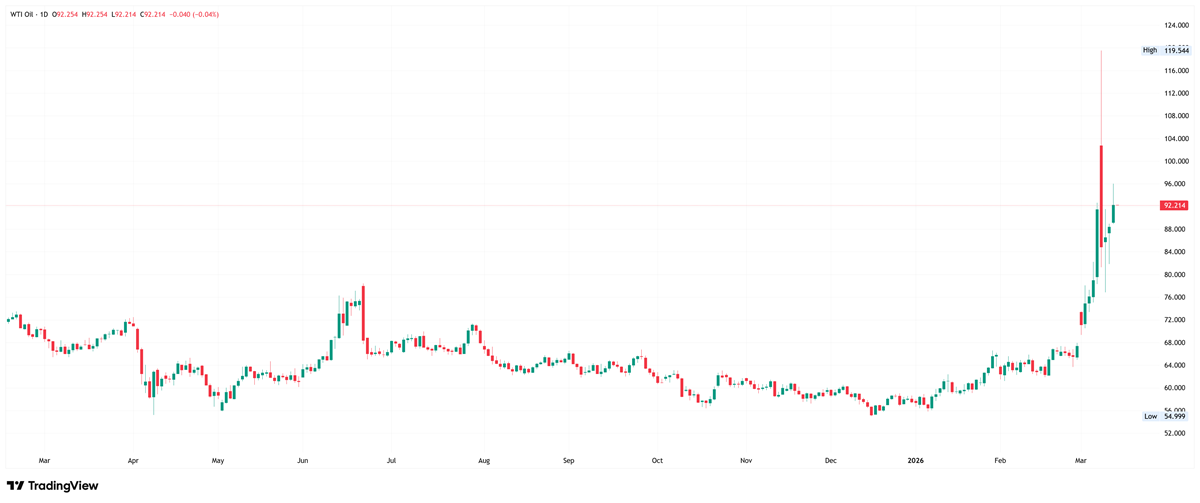
Threats to the energy structure in the Middle East have kept Oil prices bid; Brent Crude has retested US$100, with WTI Oil touching highs of US$96. This is despite the IEA making headlines, underscoring a coordinated release of an eye-popping 400 million barrels from member-nation strategic reserves. However, considering that the Strait of Hormuz handles approximately 20% of global seaborne Oil flows – about 20 million barrels per day – this offers under three weeks’ worth of supply, assuming the Strait keeps its doors closed.
Iran Is Not Backing Down
While Trump has declared victory, Iran has demonstrated no signs of backing down. In Iraq, two foreign oil tankers were recently set ablaze, in Oman, an Iranian drone struck a fuel tank, and a fuel depot was attacked in Bahrain.
It is clear that Trump is in a bind and cannot afford a prolonged conflict, as a sustained disruption in oil flow would cause him too many problems on the political front. Let’s be honest, the ‘TACO’ option seems to have worked in Greenland, but I just do not see this working here. The only real win, from the market’s perspective, is the reopening of the Strait. But given the latest strikes, Iran is certainly not opening up any time soon.
Market Scoreboard
In the US, key benchmarks ended mixed at the close of Wednesday’s session. The S&P 500 dipped 5 points (-0.1%) to 6,775, and the Dow dropped 289 points (0.6%) to 47,417, while the Nasdaq 100 closed 8 points higher (0.03%) at 24,965. Most companies in the S&P 500 wrapped up the day lower, with around 330 names losing ground versus 170 that ended higher. In terms of GICS sector performance, energy outperformed, adding 2.5%, along with technology, adding 0.4%, while consumer staples shed around 1.3%.
Looking at the FX space, the USD continued higher and remains supported by haven demand, rising Oil prices, and easing Fed rate-cut expectations. US government Bonds also remained under pressure across the curve yesterday, lifting yields as investors price in higher inflation expectations amid rising energy prices.
Brent Oil Price Forecast
Every new Brent Oil analysis as it publishes, today's technical signal and key levels, live price — on one page.
See all Brent Oil forecastsUS Inflation – Nothing to See Here, YET
On the macro front, the BLS released the February US CPI inflation numbers yesterday, showing that both the headline and core prints remained steady at 2.4% and 2.5% on a YY basis, respectively. This was widely forecast and, frankly, triggered minimal market reaction. I feel the March report – released next month – will have a far greater impact, given these reports will factor in rising energy prices.
So, at the core of things, we have rising inflation expectations and February’s US employment report showing dismal job growth; there is no denying that the Fed remains between a rock and a hard place and is widely expected to hold the target rate at 3.50-3.75% next week.
Day Ahead: Data Continues to Take a Back Seat
Today’s economic calendar focusses on US data, specifically housing starts and building permits for January, and weekly jobless claims for the week ending 7 March.
However, I do not expect these data to move the market’s needle, as the main focus remains on geopolitical headlines. The key questions for markets right now are whether another TACO from Trump will occur and whether the Strait of Hormuz will open anytime soon.
Written by FP Markets Chief Market Analyst Aaron Hill