The Strait of Hormuz – the waterway that carries approximately a fifth of global seaborne oil and gas – remains boarded up, and diplomatic momentum has all but stalled. You will likely recall that Trump was recently asked by a reporter how long he was willing to wait for a unified response from Iran, and he responded, ‘don’t rush me’. I thought he had already declared victory?
That said, on a more positive note, there was some diplomatic progress as the US and Lebanon agreed to extend their ceasefire by three weeks. Trump announced he would also host Prime Minister Netanyahu and the Lebanese President, though markets largely overlooked the announcement.
Markets: Oil Elevated, Gold Slips, and the USD Firms
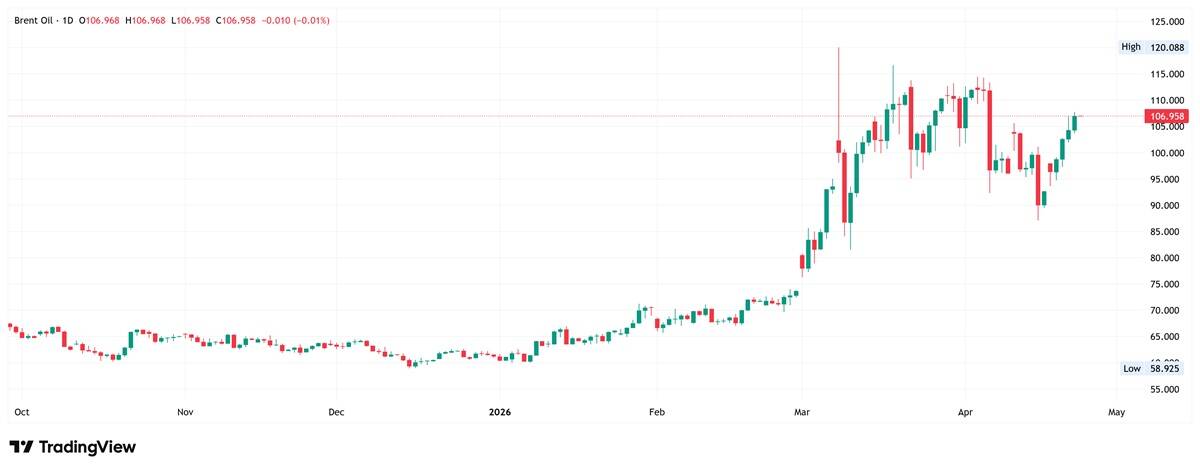
Oil benchmarks wrapped up Thursday, notching a 3rd consecutive day in the green, with WTI and Brent continuing to trade around the widely watched US$100/barrel mark. Meanwhile, spot gold finished the session down 1% to test US$4,694/ounce, as the yellow metal remains caught between energy-driven inflation (positive) and tighter policy conditions (negative).
The USD remained bid, up for a third straight session and finding acceptance north of the 200-day SMA at 98.53, per the USD index. It is also worth noting that the unit is currently testing the underside of the 50-day SMA at 98.87, with a break potentially supporting a bullish theme to resistance between 100.05 and 99.79.
US Treasury yields modestly bear steepened yesterday, sending the benchmark 10-year yield to 4.32% as bond investors are clearly operating in a wait-and-see mode for now.
Finally, major US stock benchmarks were down across the board. The S&P 500 closed 29 points lower (0.4%) to 7,108, the Nasdaq 100 was down 154 points (0.6%) to 26,782, and the Dow Jones shed 179 points (0.4%) to 49,310. Of note, Intel (INTC) beat earnings expectations in Q1 26. Revenue came in at US$13.6 billion against a US$12.4 billion estimate, adjusted EPS was reported at US$0.29 against a consensus of just US$0.01, and the operating margin was 12.3% versus an expected 3.0%. This sent shares up by nearly 20% in after-hours trading.
Brent Oil Price Forecast
Every new Brent Oil analysis as it publishes, today's technical signal and key levels, live price — on one page.
See all Brent Oil forecastsApril PMIs Paint an Uneven Picture
The April flash PMI readings offered a fragmented view of economic activity, with eurozone data showing expansion in manufacturing but deterioration in services. In the UK and the US, however, both manufacturing and services data beat expectations, indicating expansion.
Nevertheless, looking under the hood, input costs are rising for all three key economies. In the UK, it was also apparent that activity strength was due to businesses front-loading, as they attempted to secure purchases ahead of expected price rises and possible supply shortages. So, the one common thread here is that price pressures are placing central banks in a challenging position.
The ECB, the BoE, and the Fed are all widely expected to keep overnight policy rates unchanged next week, as I think central banks are looking through the energy price shock for now. What is telling is how markets are positioning beyond next week. Year-end pricing implies 62 bps of tightening for the ECB, 56 bps for the BoE, and a marginal -4 bps worth of cuts for the Fed – offering quite the divergence.
The UK March retail sales data landed earlier this morning, showing a 0.7% rise, but the number flattered to deceive. The gain was driven almost entirely by a sharp rise in fuel sales, as motorists stocked up in response to price increases driven by the Middle East. Strip that out, and volumes rose just 0.2% on the month. With BoE rate hike expectations now priced at 60 bps by year-end, today’s data does little to argue against tightening – the consumer, for now, is holding up.
In terms of today’s economic calendar, we have very little to get excited about. Attention will now shift to the raft of central bank announcements next week.
Written by FP Markets Chief Market Analyst Aaron Hill